
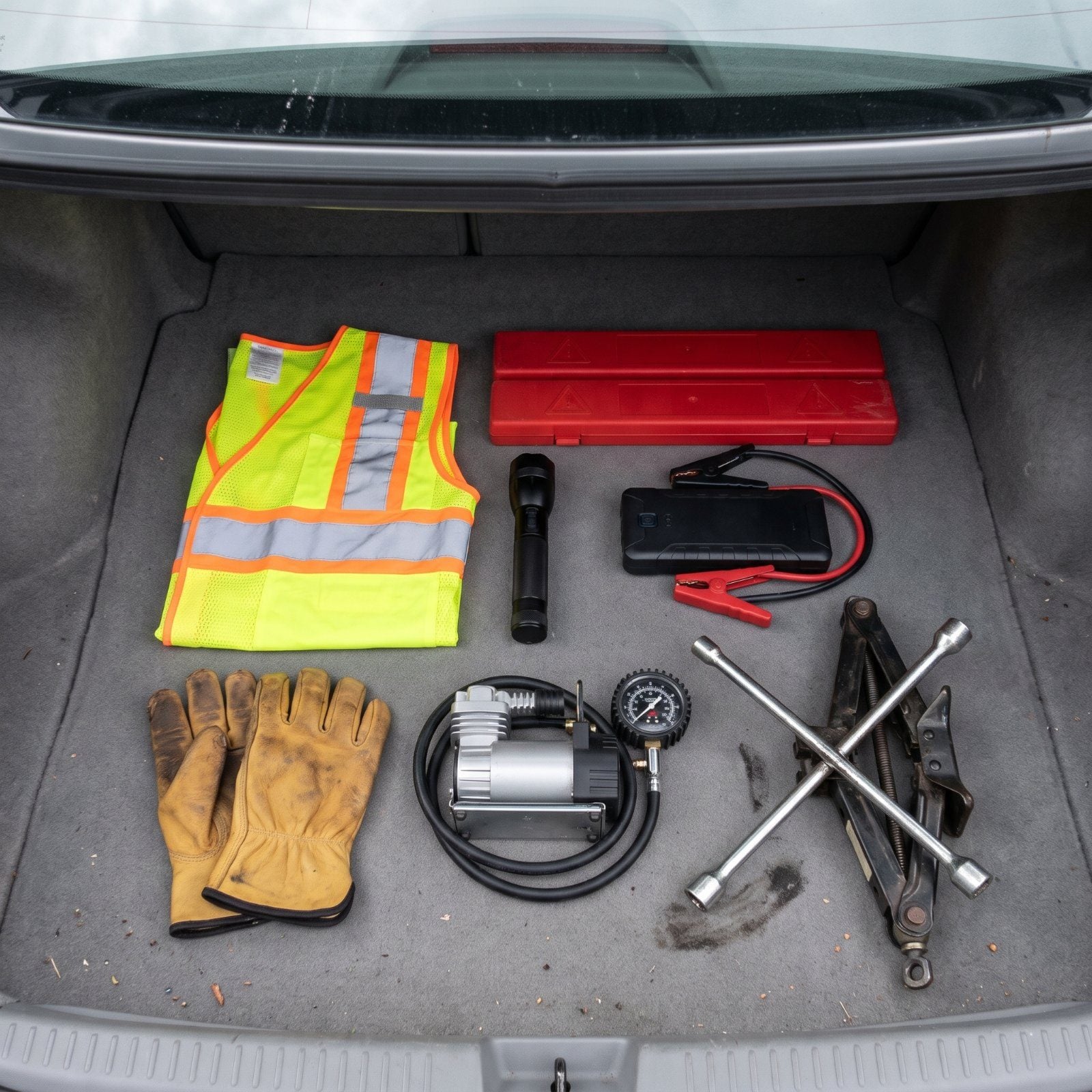
The flat tire never happens in the driveway. It happens on a two-lane road at dusk, half a mile past the last streetlight, with trucks coming over the hill faster than you’d like. That’s the moment a trunk full of the right gear earns its keep. Most drivers carry a sad jumble of jumper cables and an expired first-aid kit, then act surprised when none of it helps. The stuff below is cheap, it fits in a milk crate, and it works. Stock it once and forget about it until the night you’re glad it’s there.
Please note that some of the images in this article were created with the assistance of AI.
41. A High-Visibility Reflective Vest
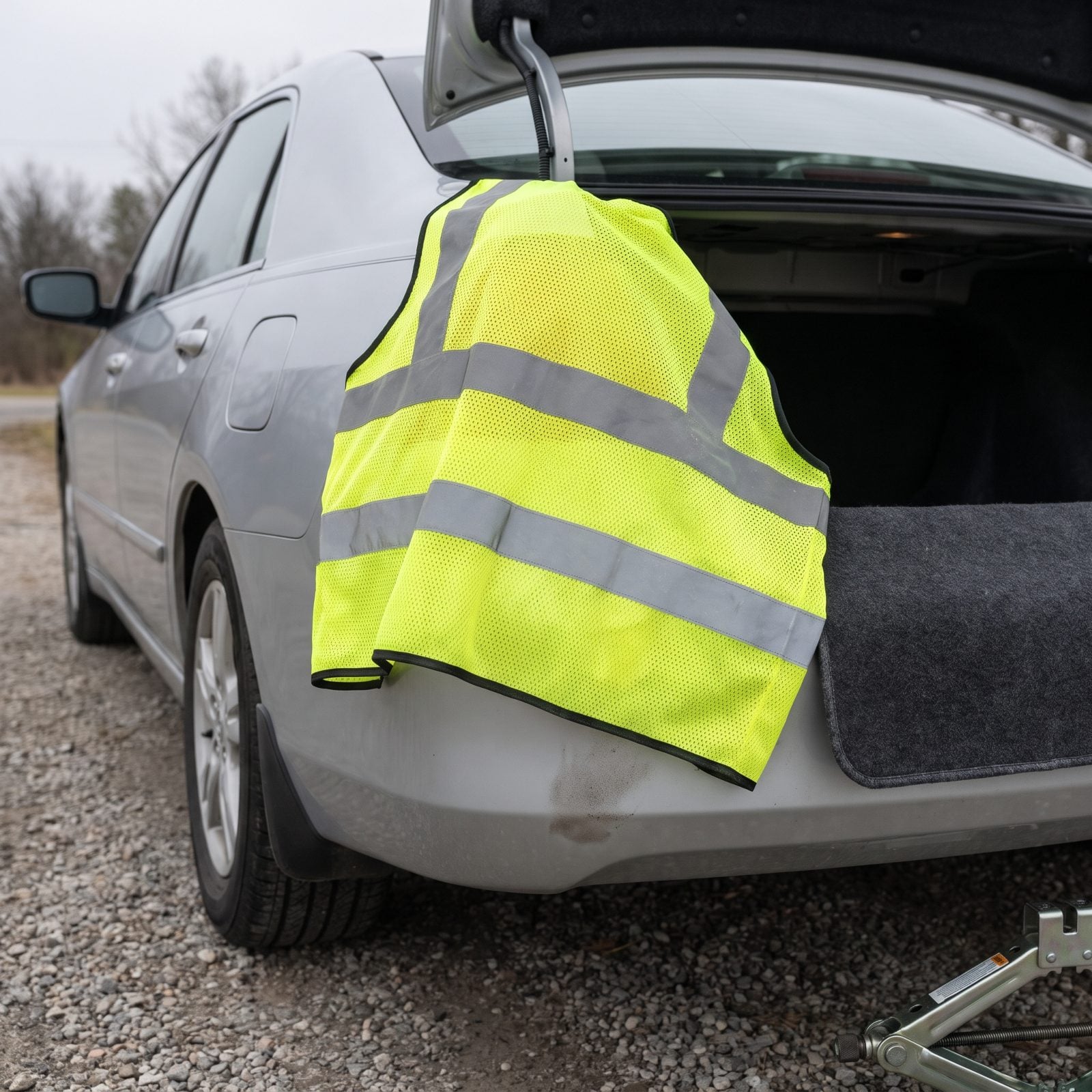
A vest is the cheapest insurance in your trunk and the one people skip. Ten bucks, weighs nothing, and the whole job is making a driver see you two seconds sooner — which at highway speed is a long stretch of stopping distance that might belong to you.
Get the kind with silver retroreflective stripes, not just bright fabric. Bright fabric reads as a smudge after dark. The tape throws headlights straight back and lights you up like a road sign.
40. A Set of Reflective Warning Triangles
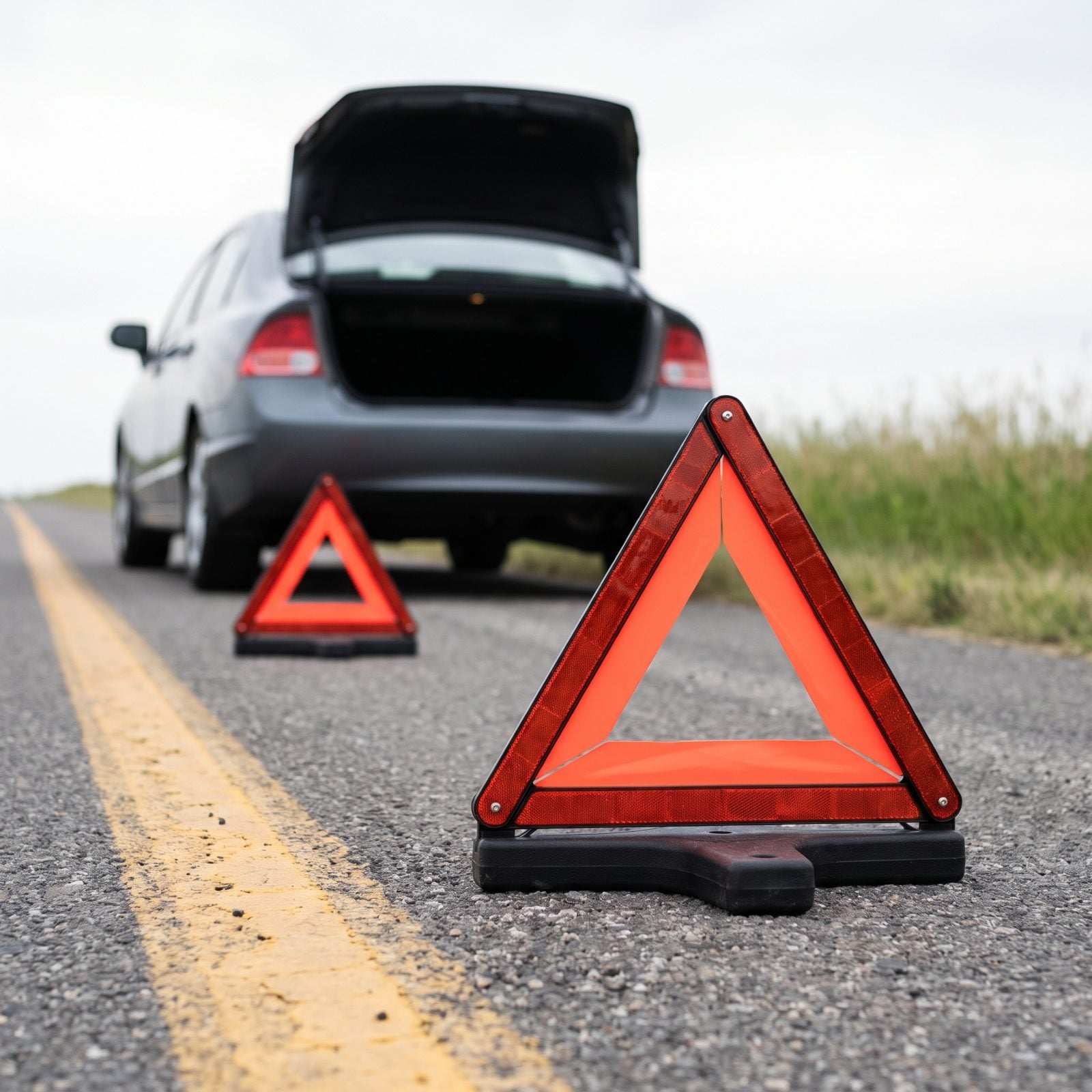
Flares were the old answer. Triangles are the better one — no flame, no shelf life, no burning yourself at the worst possible moment, and they keep working in the rain.
Placement is the part everyone gets wrong. Stagger them — one close behind the car’s bumper, the other well back toward approaching traffic. Space them back from the vehicle, farther on a highway than on a quiet road, so traffic gets the warning while there’s still room to react. Set the closest one first, then walk the others out, always facing oncoming traffic.
39. A Bright, Weatherproof Flashlight
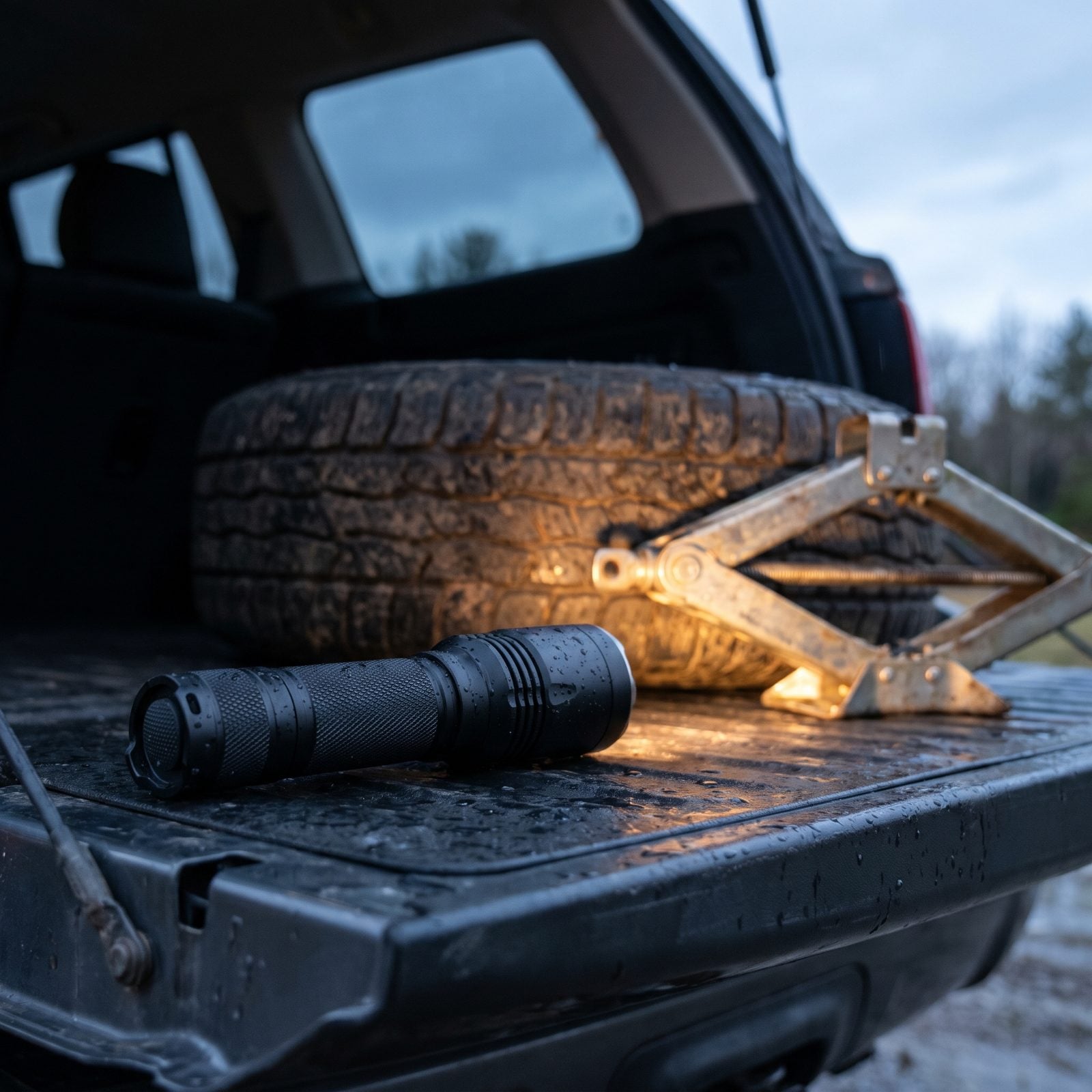
Your phone is not a flashlight. It’s a dim, slippery, battery-draining compromise that leaves one hand useless and your only communication device out in the rain. A real flashlight has a job and does it.
Look for something rated for water resistance, with a beam bright enough to read a tire sidewall and flood a wheel well at the same time. Better yet, grab a headlamp for changing a tire — it frees both hands and points wherever you look.
Check the batteries twice a year. A dead light in the glovebox is just a paperweight with good intentions.
38. A Fully Charged Portable Jump Starter
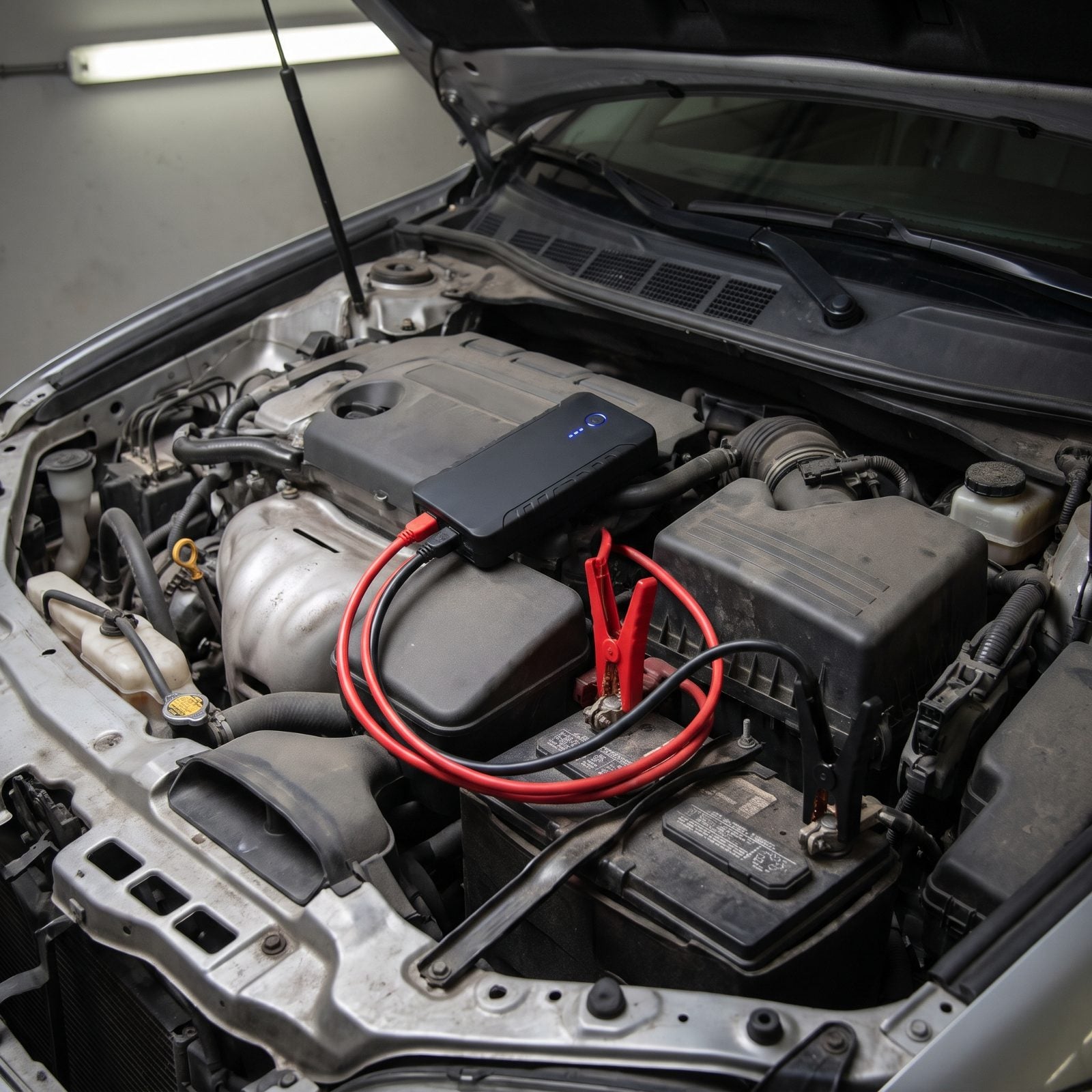
The lithium jump packs changed everything. A unit that fits in your glovebox now starts a dead V8 without a second car, without flagging down a stranger, without the little dance of trying to park two hoods nose to nose on a narrow shoulder.
Here’s the catch nobody mentions: they self-discharge. Leave one in the trunk for a year and it’ll be flat the day you need it. Charge it every three months or so. Most have a USB port too, which quietly turns it into a phone charger when the car battery is the thing that died.
37. A 12-Volt Tire Inflator
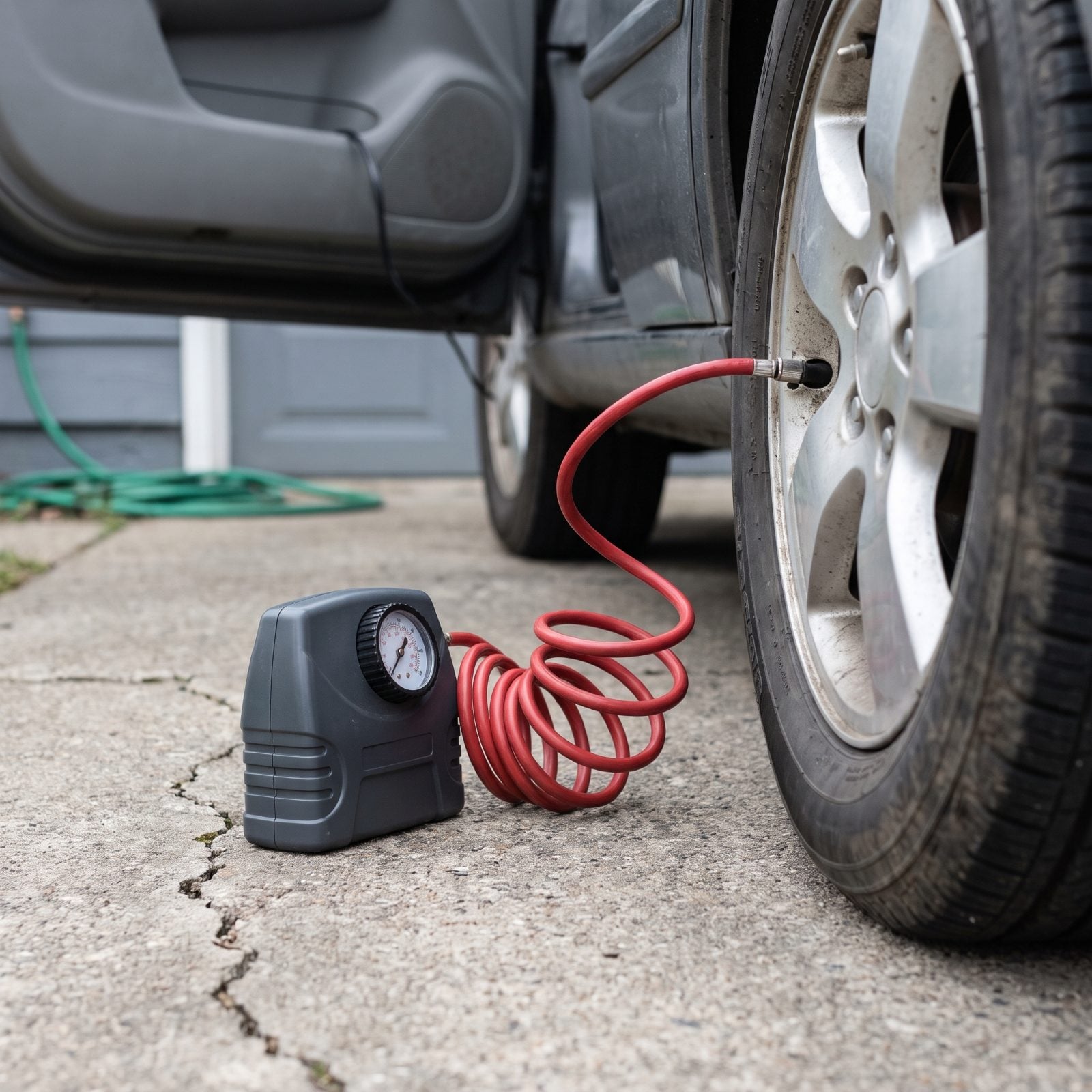
A slow leak isn’t always a tire change. Half the time it’s a nail you can limp to the shop on, if you can put air back in. A 12-volt inflator that plugs into the accessory socket turns a stranding into a ten-minute delay.
Cheap ones sound like a dying blender and take forever. Spend a little more for one that’ll fill a sedan tire in a couple of minutes without overheating. Pair it with a plug kit and you can handle most punctures on the shoulder instead of waiting on a tow.
36. An Accurate Tire-Pressure Gauge
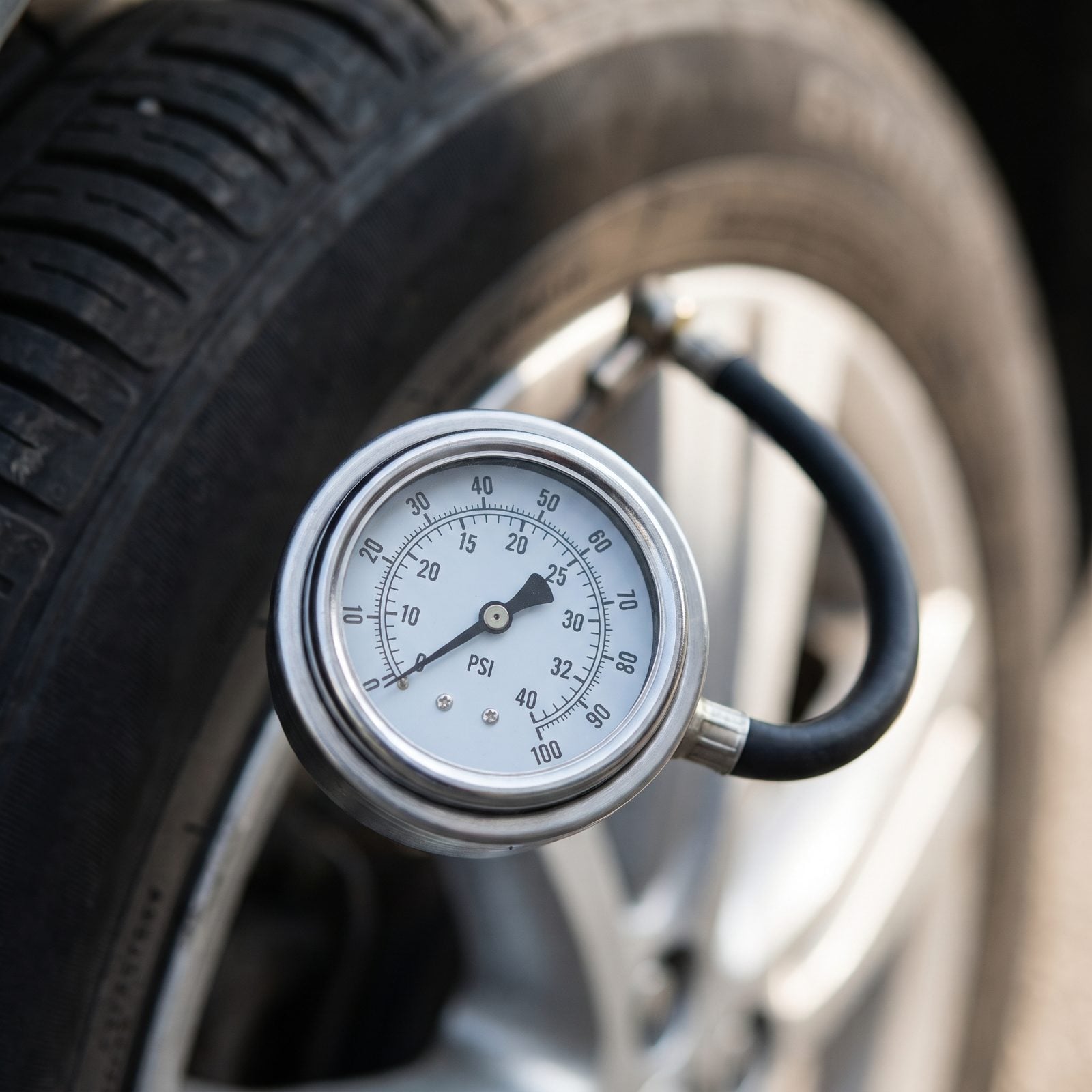
The gauge built into the gas-station air pump is a liar. Dropped a thousand times, calibrated never. Carry your own and trust nothing else.
A simple dial or pencil gauge costs a few dollars and holds its reading better than most digital units running on a dead button battery. Underinflation is the quiet killer. It builds heat, kills your fuel economy, and chews the outer edges off your tread months before you’d otherwise replace it. Check cold, before you drive, when the numbers actually mean something.
35. The Vehicle’s Correct Jack
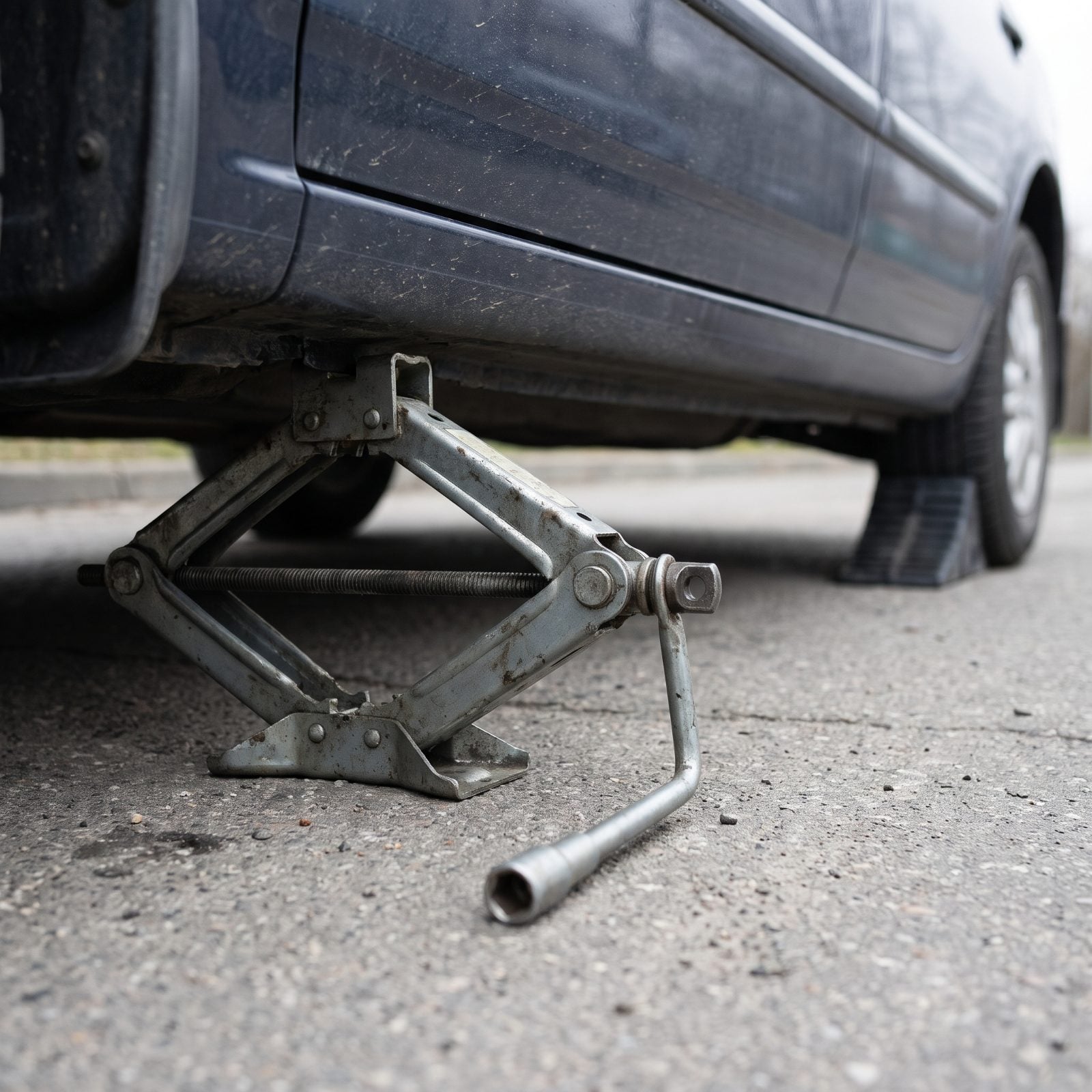
The factory jack is fussy, and it’s the right tool anyway. Carmakers put it there because it fits the exact lift points your car was designed to be lifted from. Put a jack anywhere else on a modern unibody and you’ll crease sheet metal or snap a plastic sill.
Know where those points are before you need them — usually a reinforced seam just behind the front wheels and ahead of the rears. Ground has to be firm and level. A tire changed in soft dirt or on a slope is a tire change that ends in a hospital.
34. A Full-Size Lug Wrench
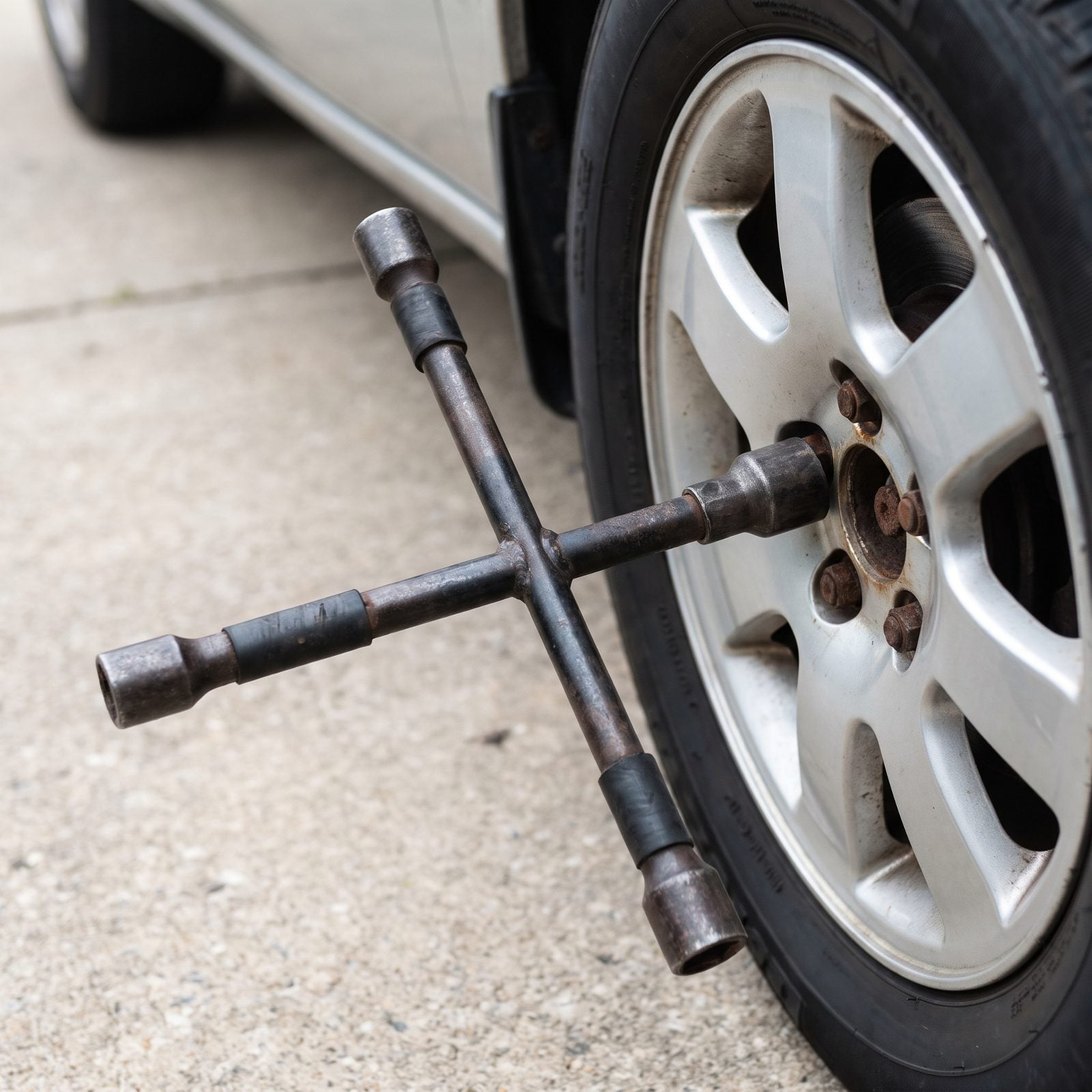
The stubby L-shaped wrench folded in with the spare is a torture device. It gives you no leverage, and lug nuts cranked on by an impact gun at the last tire shop are often torqued way past anything a tired arm can break loose with that thing.
A full-size cross wrench — the four-way kind — gives you real leverage and lets you push with your legs instead of yanking with your back. Confirm it fits your lug size before it lives in the trunk. And if your wheels have locking nuts, that special key had better be in there too, or the best wrench on earth is useless.
33. A Pair of Durable Work Gloves
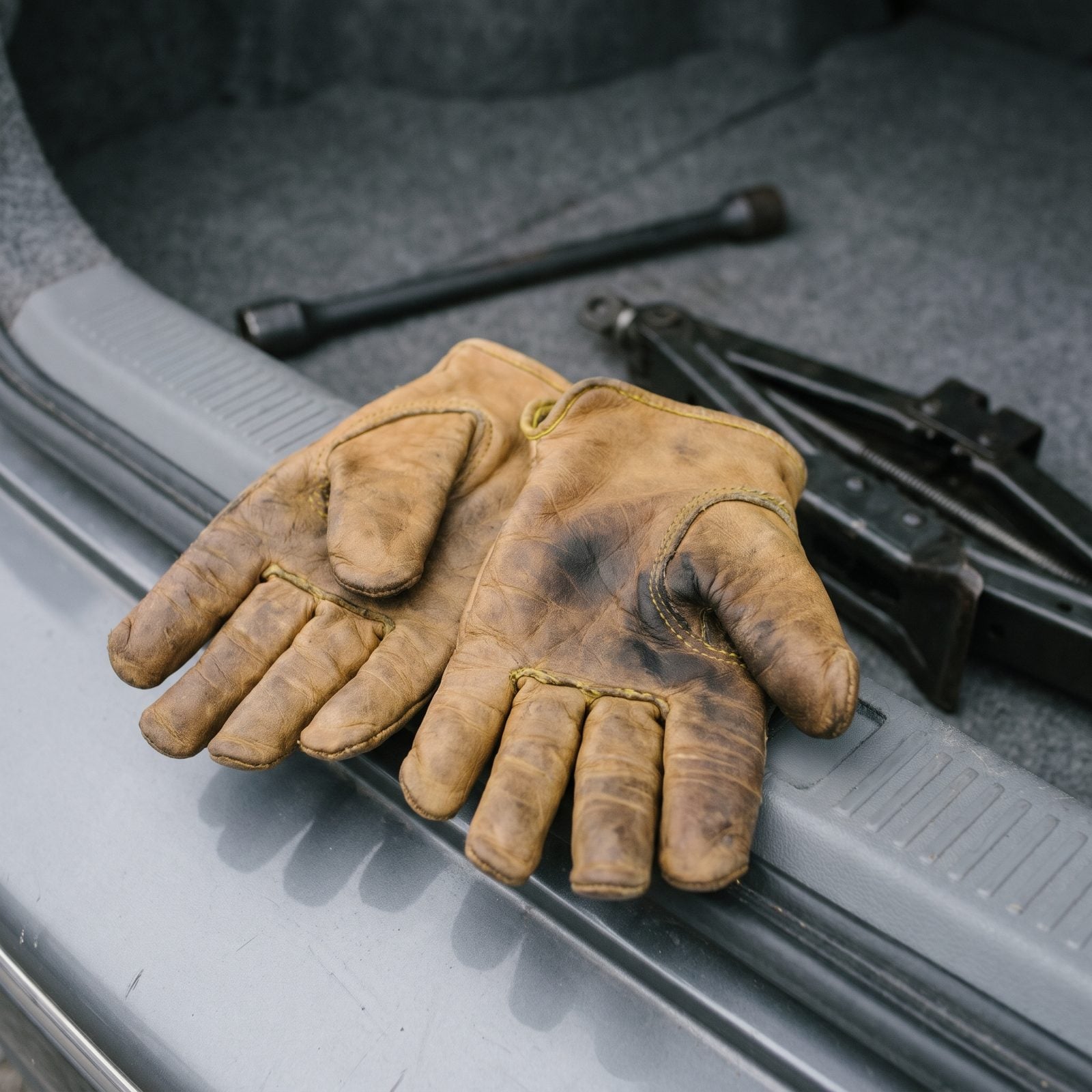
Everybody laughs at the gloves until they’re wrestling a road-grimed tire in 40-degree rain with hands that won’t close right. Then the gloves stop being funny.
Leather, or a leather-palm pair, gives you grip on a slick wheel, protection from the sharp edge of a brake rotor, and warmth that keeps your fingers working. A breakdown is slow, cold, and fiddly. Numb hands drop lug nuts into gutters and strip the ones they don’t drop. Toss a pair in. They weigh nothing, and they’ll be the reason you finish the job before the rain wins.
32. A Pair of Rubber Wheel Chocks
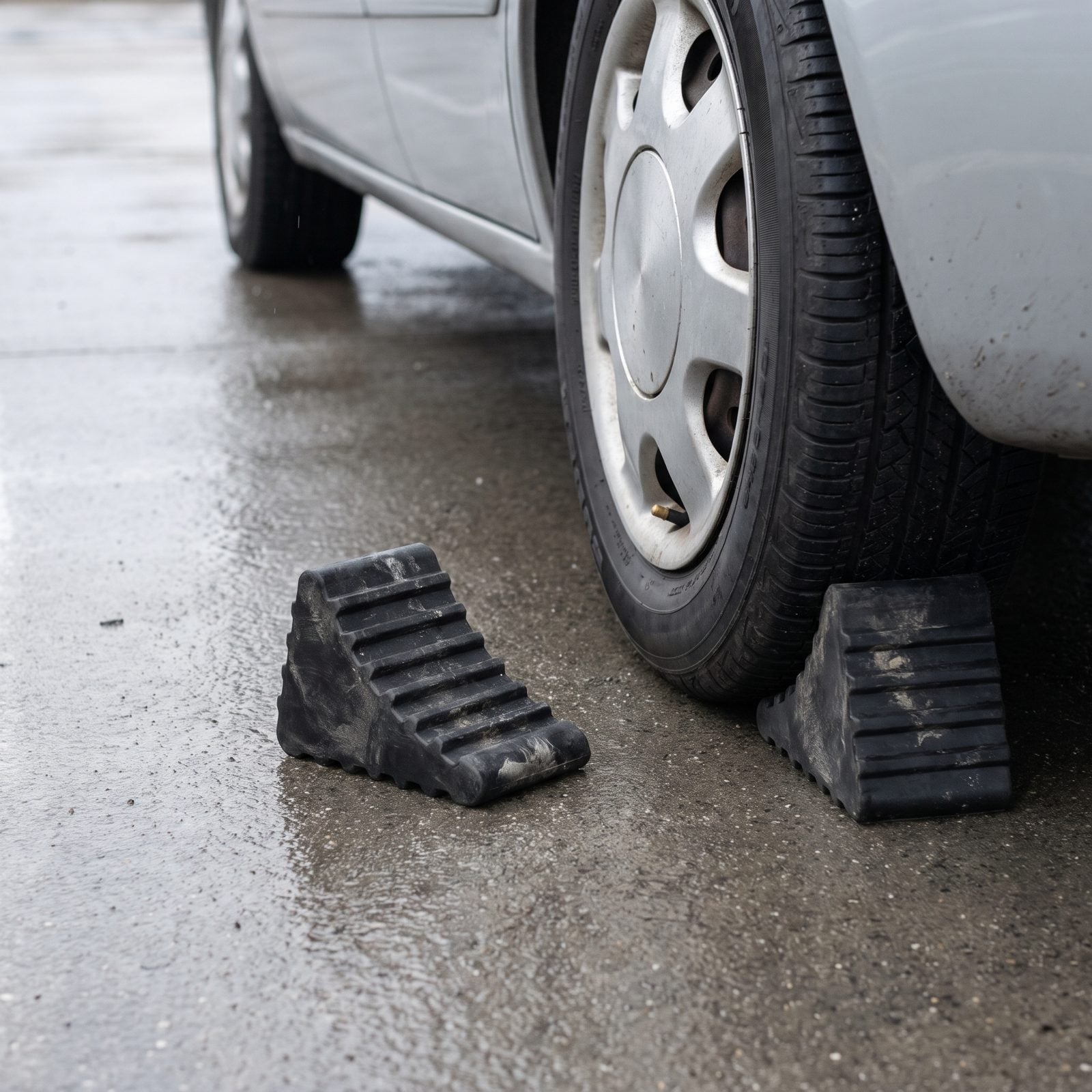
Nobody thinks about chocks until the jack starts to walk. Put a vehicle on a scissor jack on a slight grade, watch it shift an inch, and you’ll finally understand why the pros chock the opposite corner before they ever touch a lug nut.
A pair of rubber wedges runs about fifteen bucks and weighs nothing in the trunk. Set them against the downhill side of the tires that stay on the ground. That’s it. They keep a parked car from rolling while you’re kneeling next to two tons of metal.
31. A Tubeless Tire-Plug Kit
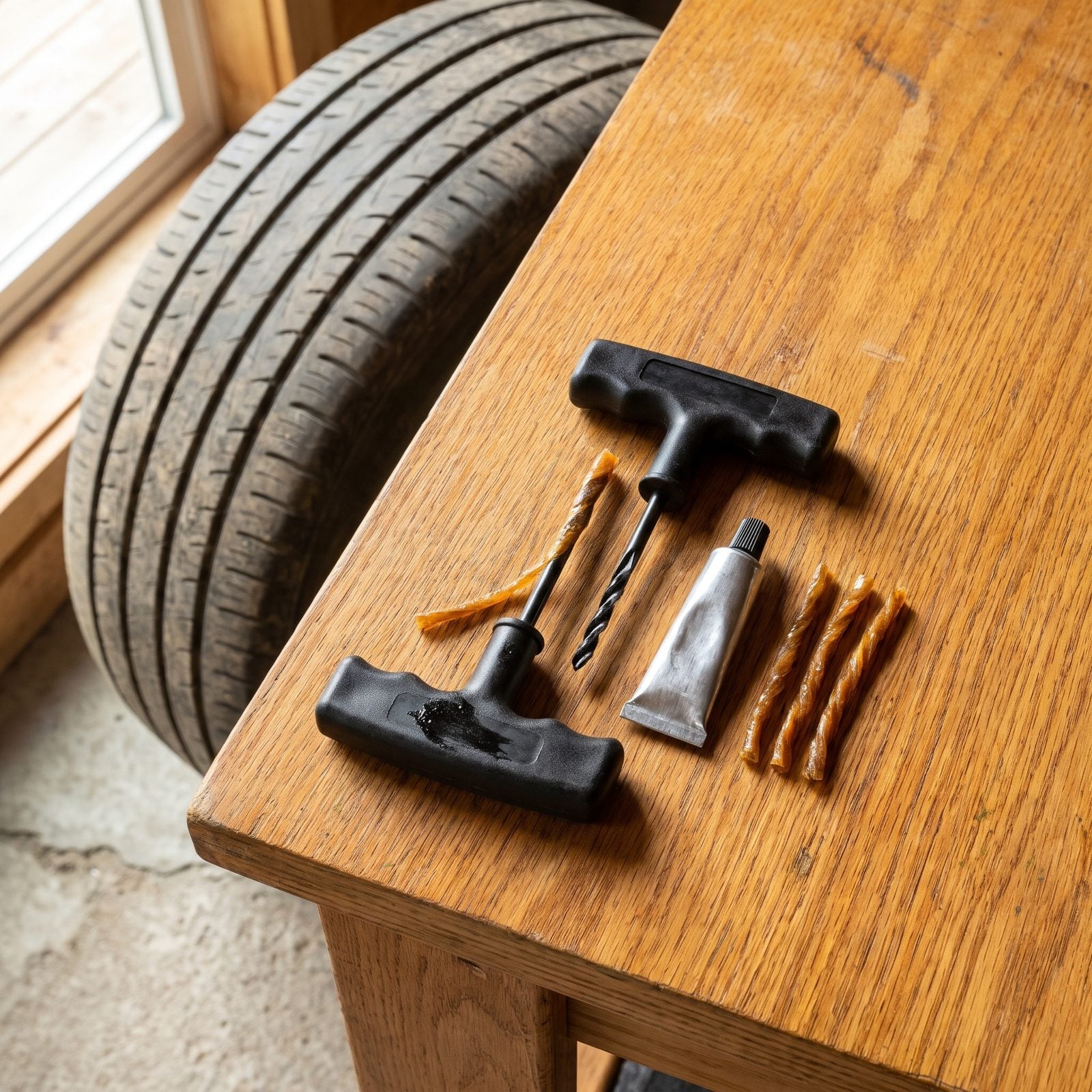
A nail in the tread used to mean a tow truck or a nervous limp home on the donut. A ten-dollar plug kit rewrites that math.
These kits fix punctures in the flat part of the tread — not the sidewall, and not a gash you could lose a finger in. You ream the hole, push a sticky rubber string through with the T-handle, trim it, and reinflate. Pair it with a plug-in compressor and you’re rolling again in fifteen minutes on the shoulder.
Treat the plug as a get-home repair, nothing more. Get the tire looked at properly once you’re off the road. But we’ll say this plainly: a plug has saved more of our road trips than any spare we’ve ever carried.
30. Portable Traction Mats
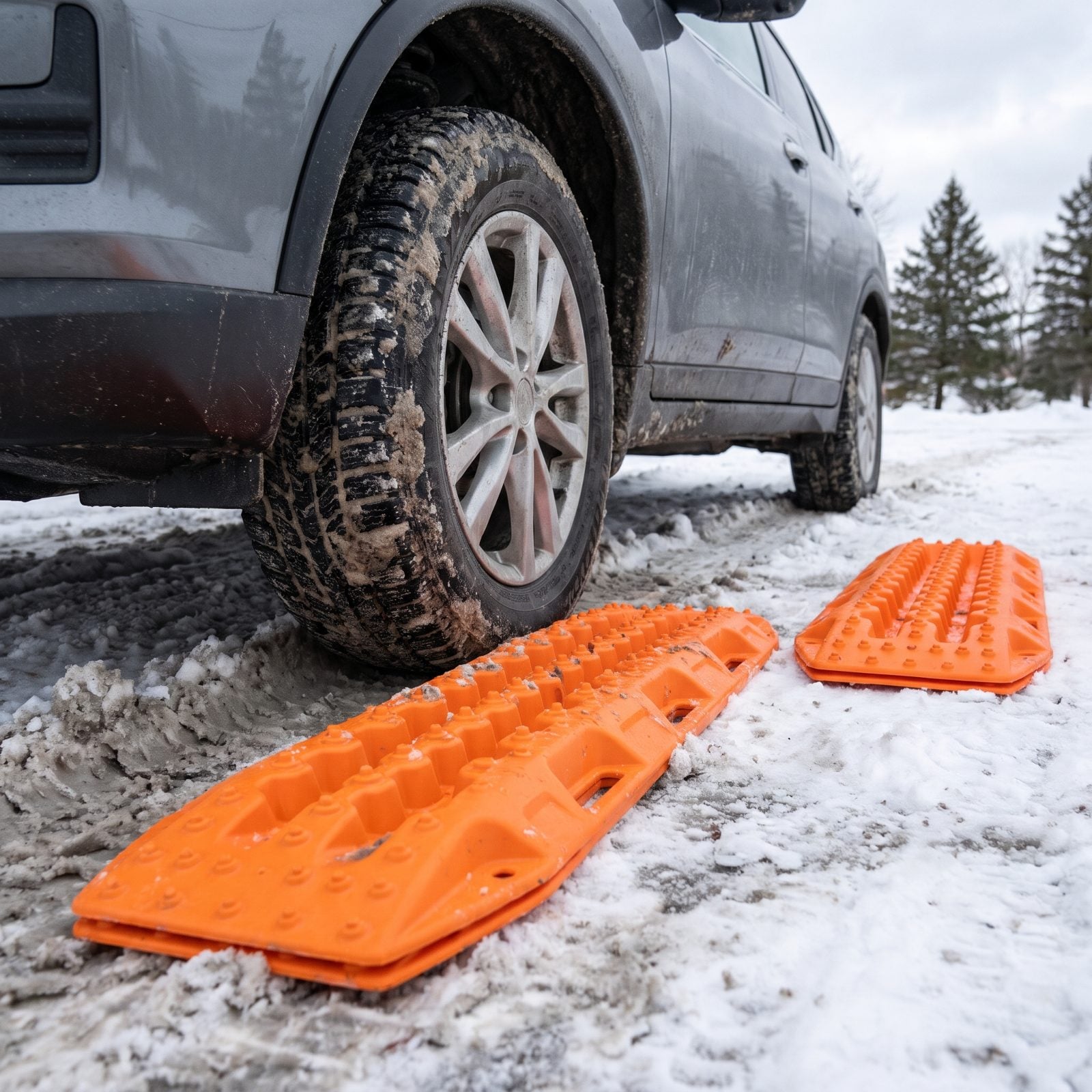
Spinning a tire in snow just digs the hole deeper.
Traction mats give the tread something to bite. Wedge the ribbed end under the drive wheel, ease onto the throttle — gently, because flooring it melts them — and the car crawls out instead of burying itself.
They work in sand and soft mud too, which earns them their trunk space on a beach-town trip or a muddy campground pull-out. A decent pair runs somewhere in the ballpark of a tank or two of gas. Nest them flat behind the back seat and you’ll forget they exist until the one afternoon they save you an eye-watering winch call.
29. A Compact Folding Shovel
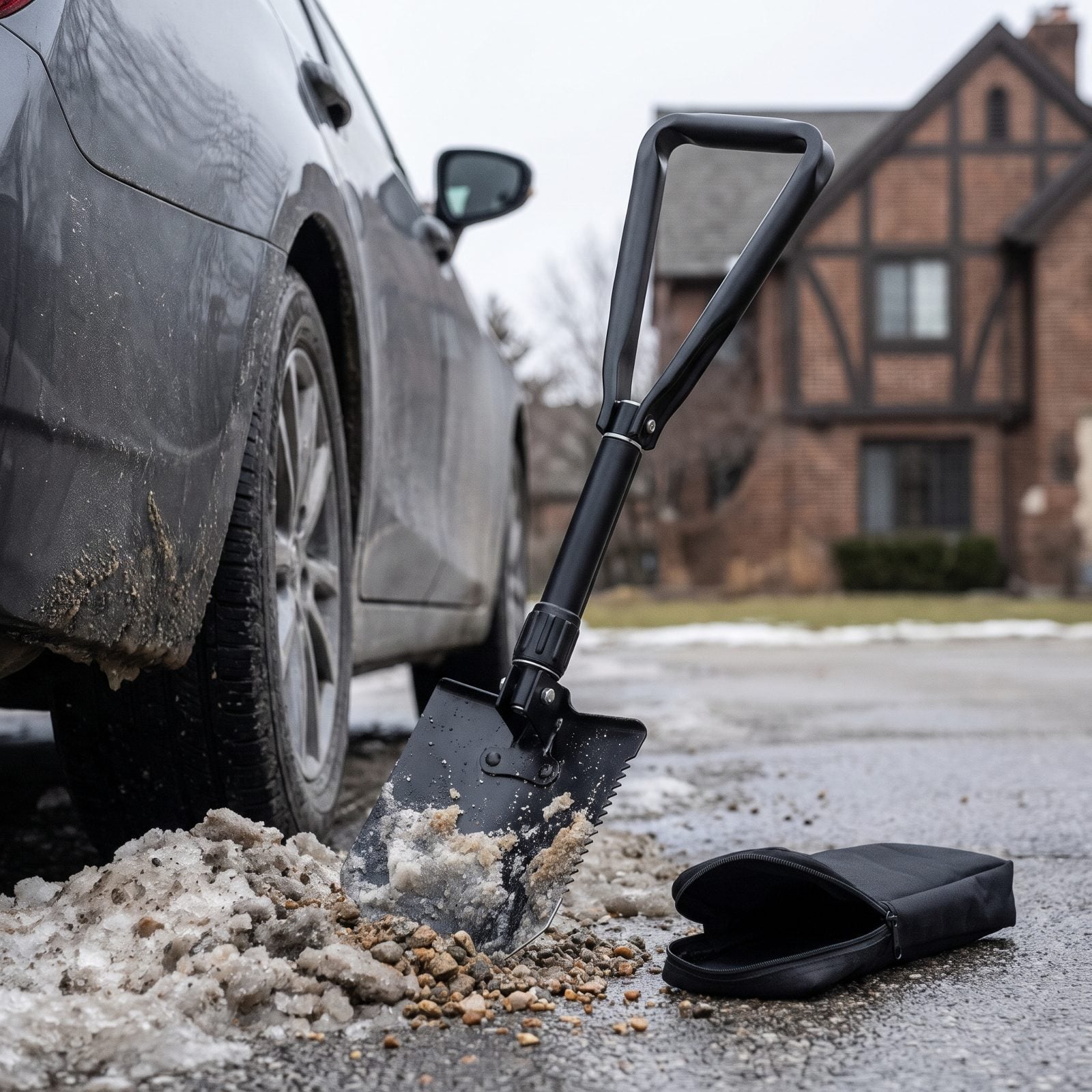
A folded steel shovel takes up about as much room as a water bottle, and it digs you out of things your bare hands never could.
Snow packed around the exhaust and tires. A wheel sunk in soft shoulder gravel. A drift sealing the driver’s door shut after a plow rumbled past. You clear the tailpipe so you can idle for heat without carbon monoxide creeping back into the cabin, then you dig a ramp of packed snow away from the drive wheels so the car has somewhere to go.
28. A Long-Handled Ice Scraper and Snow Brush
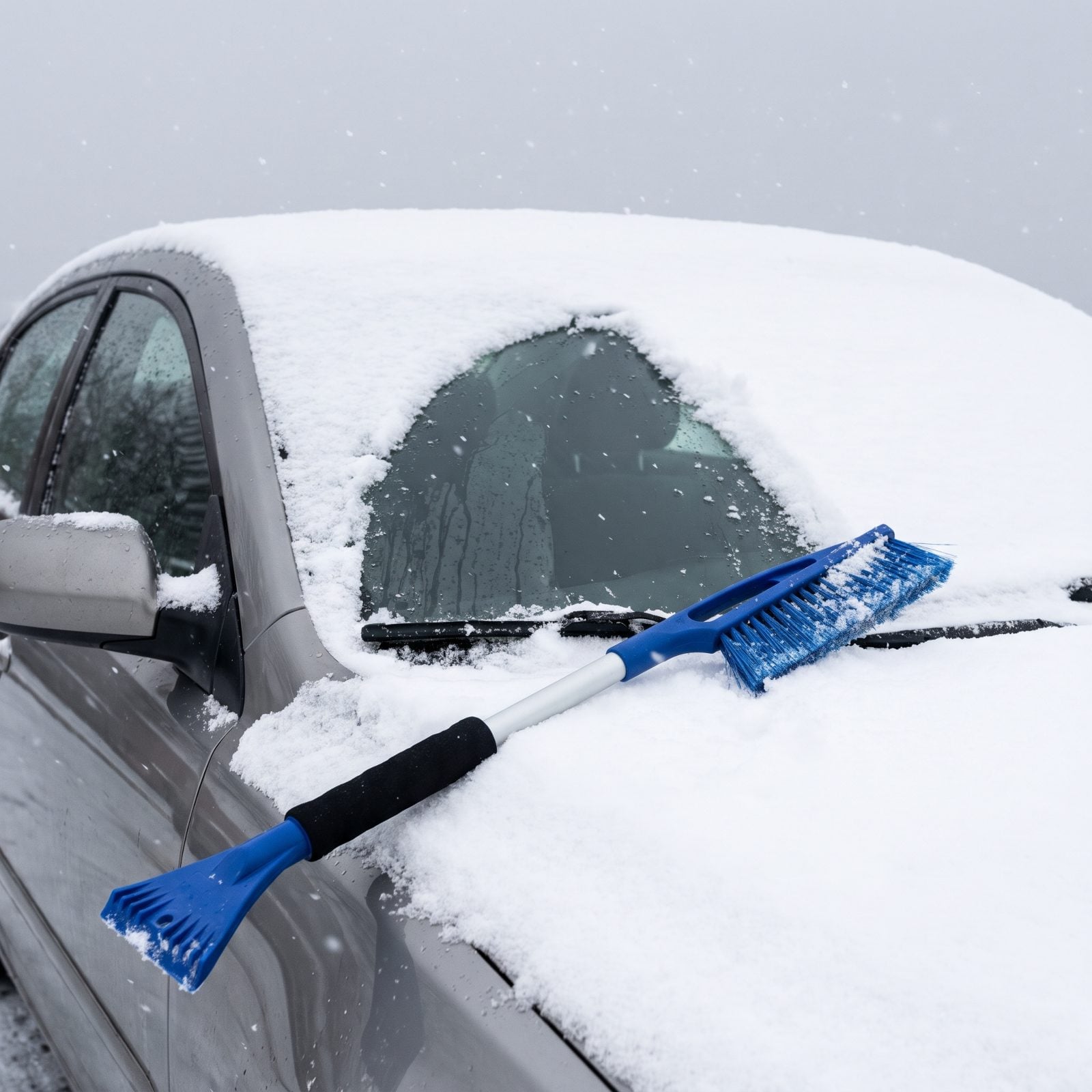
The six-inch scraper rattling around your door pocket is a joke on a real snow morning. You’ll be out there ten minutes trying to reach the far corner of the windshield, arm soaked to the elbow, breath fogging up everything you just cleared.
A telescoping brush with a wide foam head sweeps a full roof in a few strokes, and the extending handle lets you reach the center without clambering onto the bumper. Clear the roof too, not just the glass. That sheet of ice you leave up there? It flies off at highway speed and becomes the problem of whoever’s behind you. Rude. And in some states, a ticket.
27. A Warm Emergency Blanket
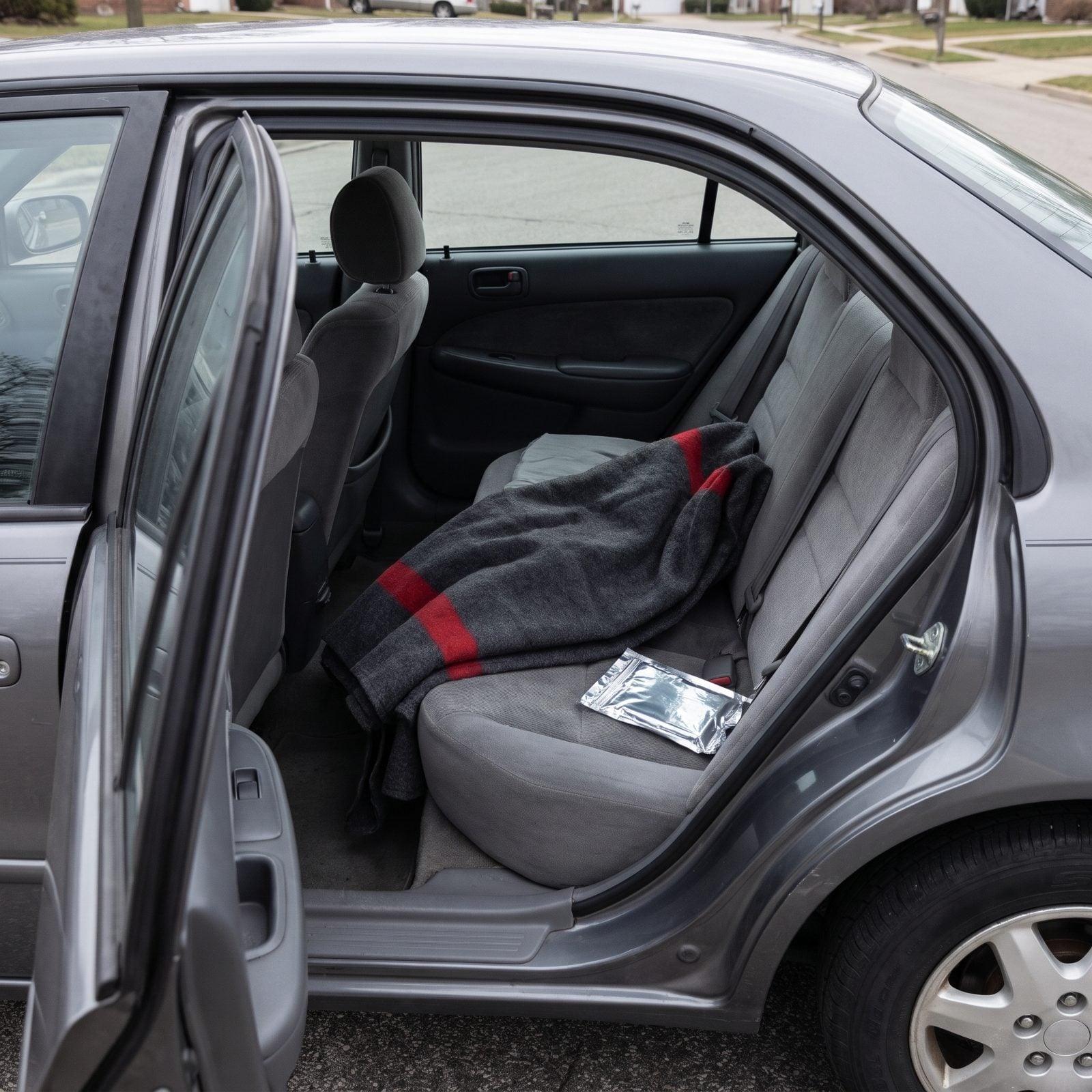
A stalled car in cold weather turns into a cold box fast. No engine, no heat, and the cabin drifts toward whatever it is outside within the hour.
Keep a real blanket back there, not just the foil space sheet. Wool or thick fleece holds warmth even when it’s a little damp — the thin mylar won’t. Carry both if you can. The foil one reflects body heat and folds down to the size of a deck of cards for the glovebox, and the wool one is what you actually want wrapped around you at two in the morning on a dark county road, waiting on headlights that don’t seem to be coming.
26. A Hooded Waterproof Rain Poncho
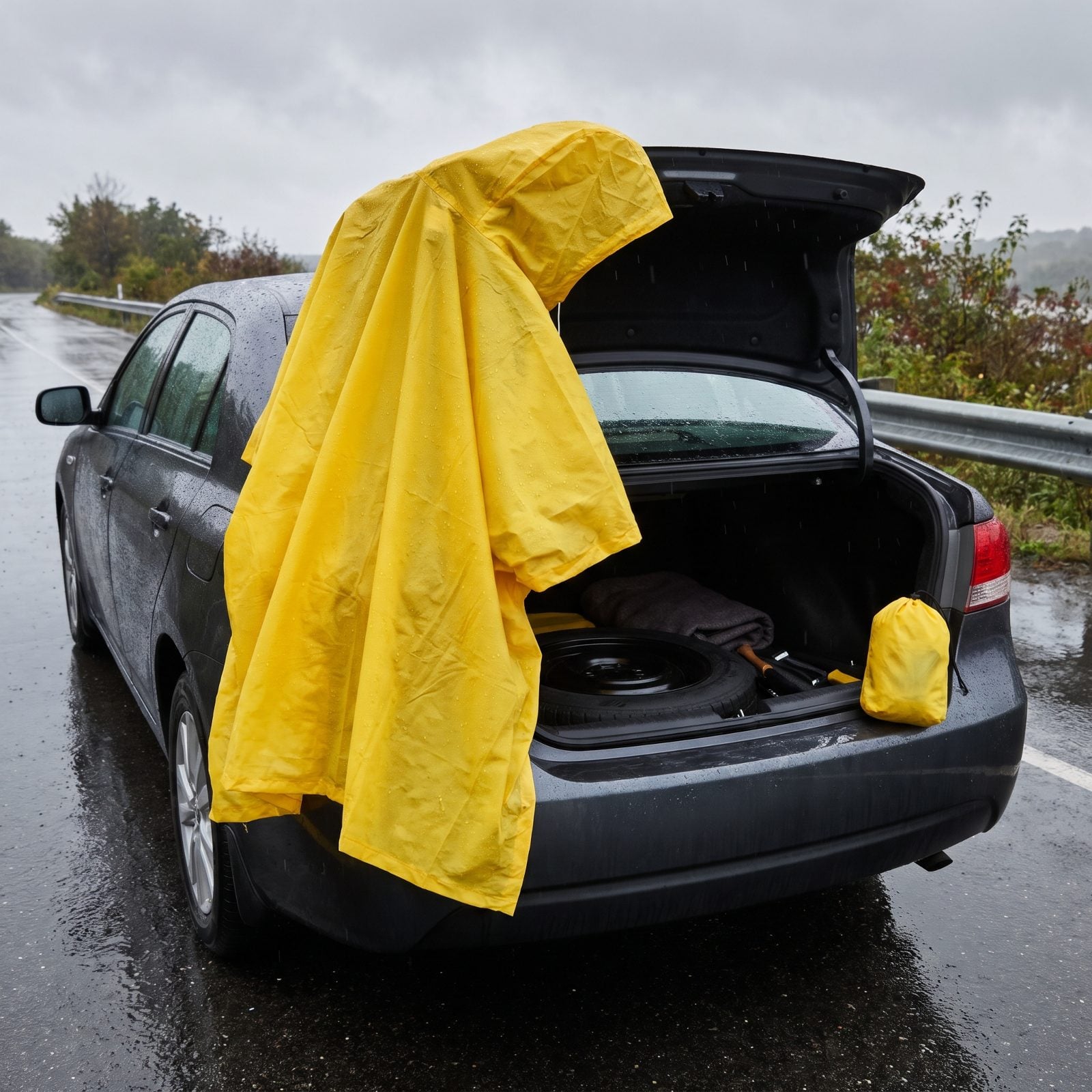
Change a tire in the rain without a poncho and you arrive wherever you’re headed cold, soaked, and in a foul mood. The job doesn’t wait for the weather to improve.
A packable hooded poncho keeps your core and arms dry while you kneel in the wet, and a high-visibility yellow one does double duty by making you easier to spot on a dim shoulder. The cheap ones tear on the first hard gust, so spend a little more for seam-taped vinyl or coated nylon. It balls up to fist-size and lives in the door pocket. You’ll bless it about twice a year.
25. Sturdy Closed-Toe Walking Shoes
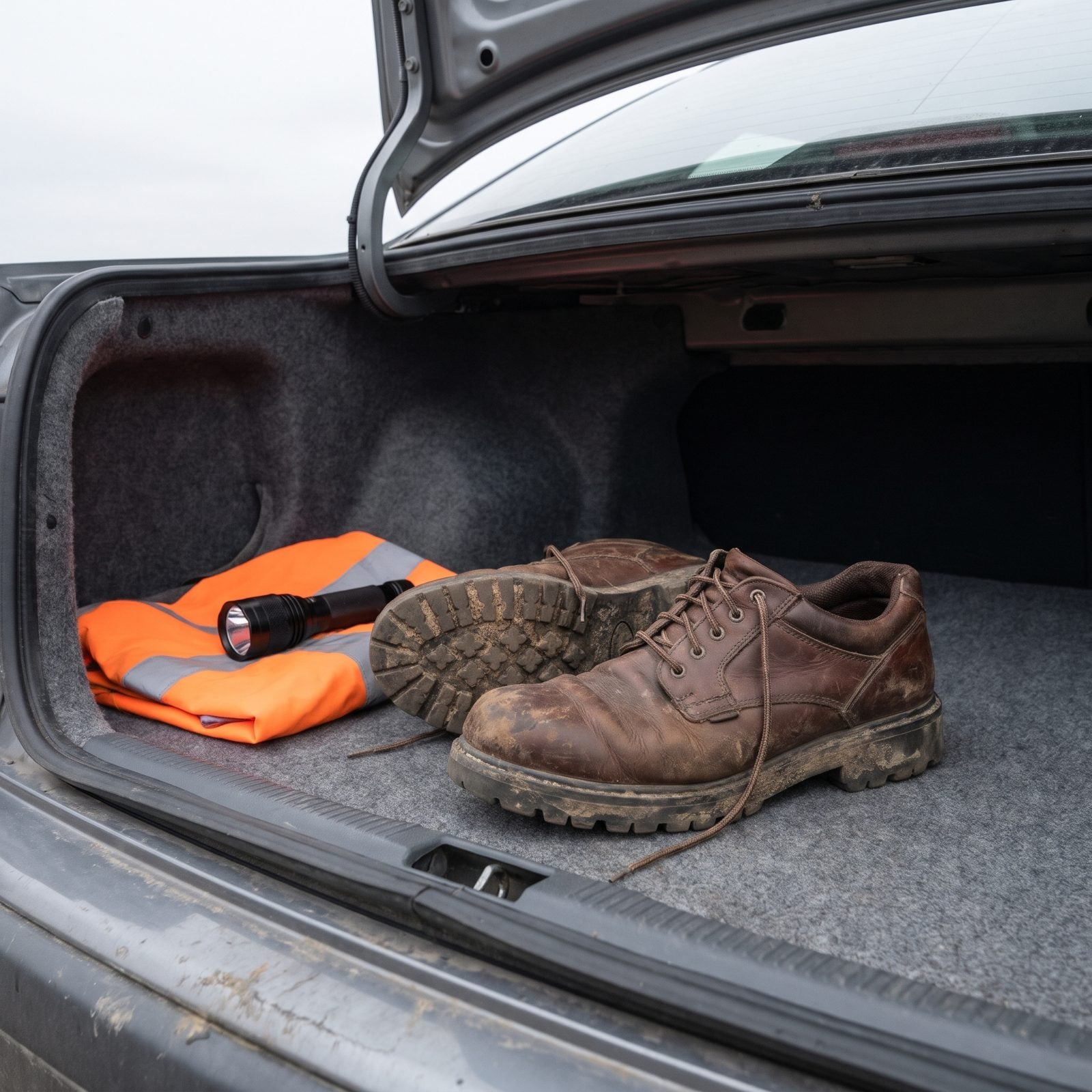
Picture this: you break down on the interstate on the way to a wedding, dressed for the occasion. Now you’re hoofing a half mile to the nearest exit in dress shoes or sandals, along a gravel shoulder, cars screaming past. Not fun. In winter, not safe either.
A beat-up pair of closed-toe shoes with real tread, tucked in the trunk, fixes this for basically nothing. Old hiking shoes or work boots you’d otherwise toss are perfect. You want grip for icy pavement and a toe that survives a dropped jack. Stuff a pair of warm socks inside them while you’re at it.
24. A Well-Stocked First-Aid Kit
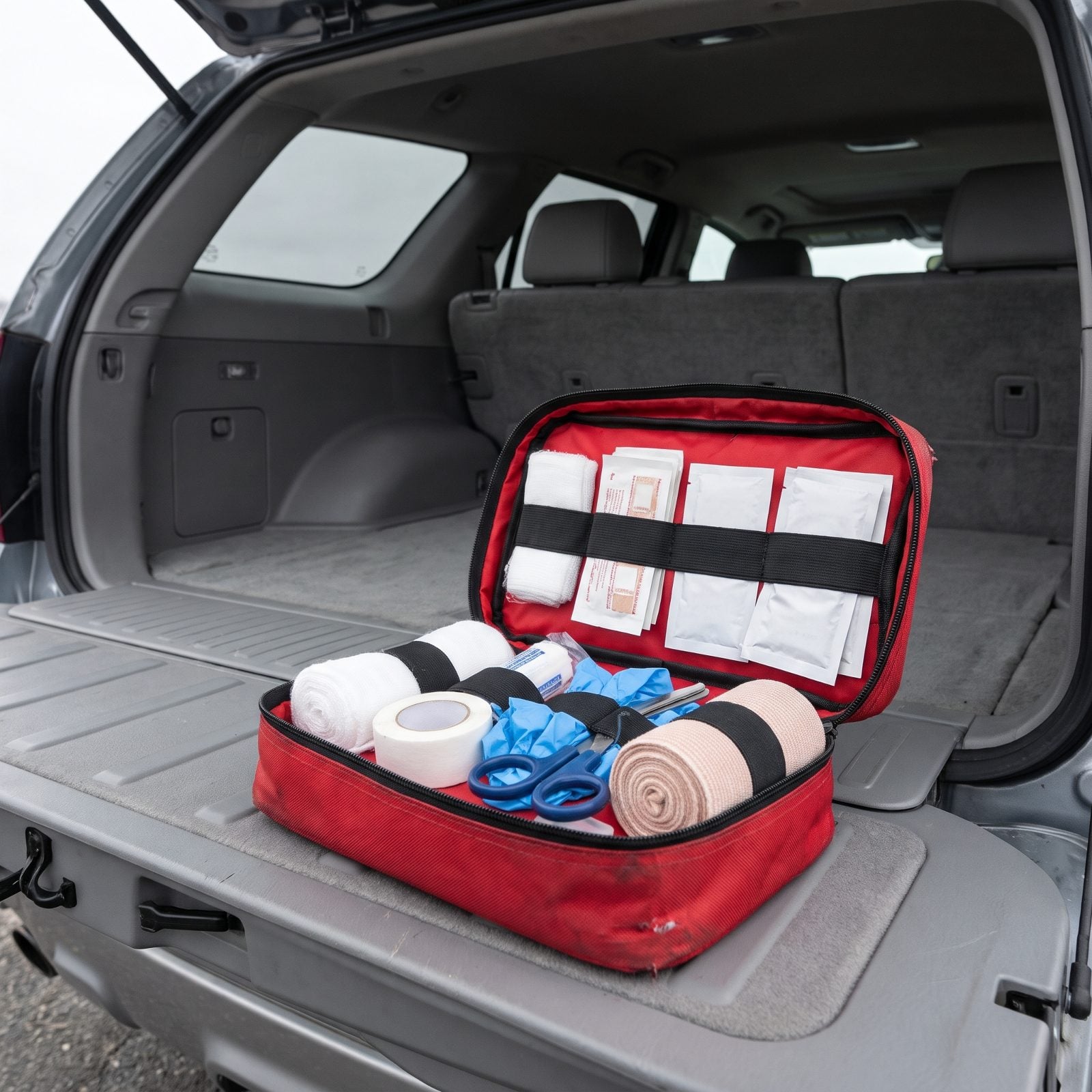
The twelve-bandage kit from the checkout aisle is better than nothing — barely. A proper roadside kit handles the stuff that actually happens around vehicles.
You want gauze and a pressure bandage for a deep cut, nitrile gloves, antiseptic, tweezers, scissors that’ll cut through seatbelt webbing, and a cold pack. Then add whatever’s specific to your crew: an EpiPen if someone’s allergic, kids’ fever reducer if they ride along.
Check it once a year. Adhesive dries out, ointments expire, gloves turn brittle and crack. Nothing worse than reaching for the kit in a pinch and finding a box of crumbs.
23. Several Days of Essential Medication
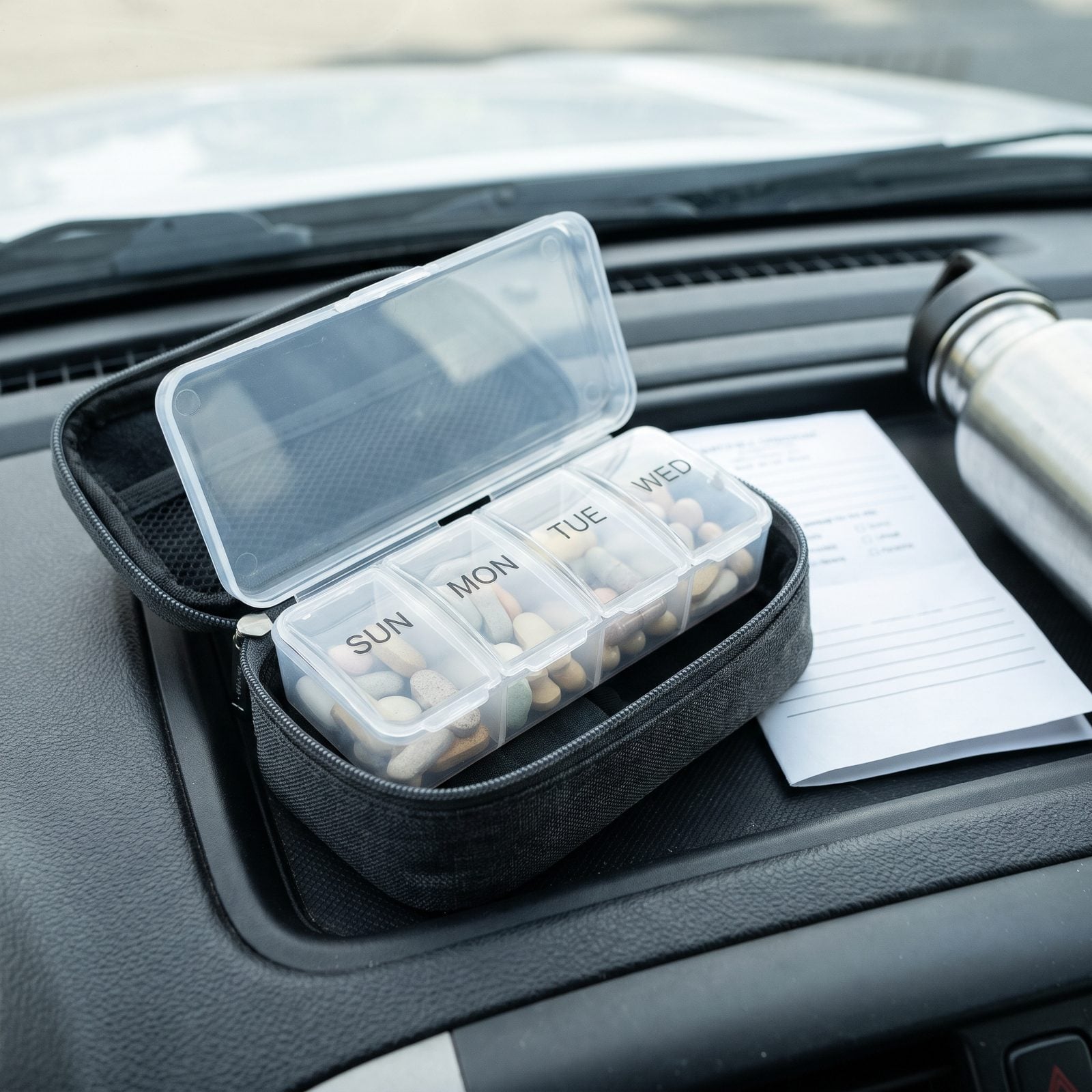
A breakdown turns a two-hour drive into an overnight, and that overnight turns into a missed dose. For a lot of us past forty, skipping blood pressure or heart medication for a day isn’t an inconvenience — it’s a genuine problem.
Stash a few days of your essential prescriptions in the car for any longer trip, sealed against heat in a small pouch, and rotate it so nothing expires. Keep a typed list of what you take and the doses. If you wind up in an ER three states from home, that scrap of paper answers the first ten questions they’ll fire at you.
Heat is the real enemy here. A glovebox in July cooks pills, and the dashboard right under the windshield is even worse. Pop the case open on the dash when you need a dose, but don’t leave it there: stow the pouch in the cabin, out of direct sun, and swap the supply when the seasons turn.
22. Sealed Bottles of Drinking Water
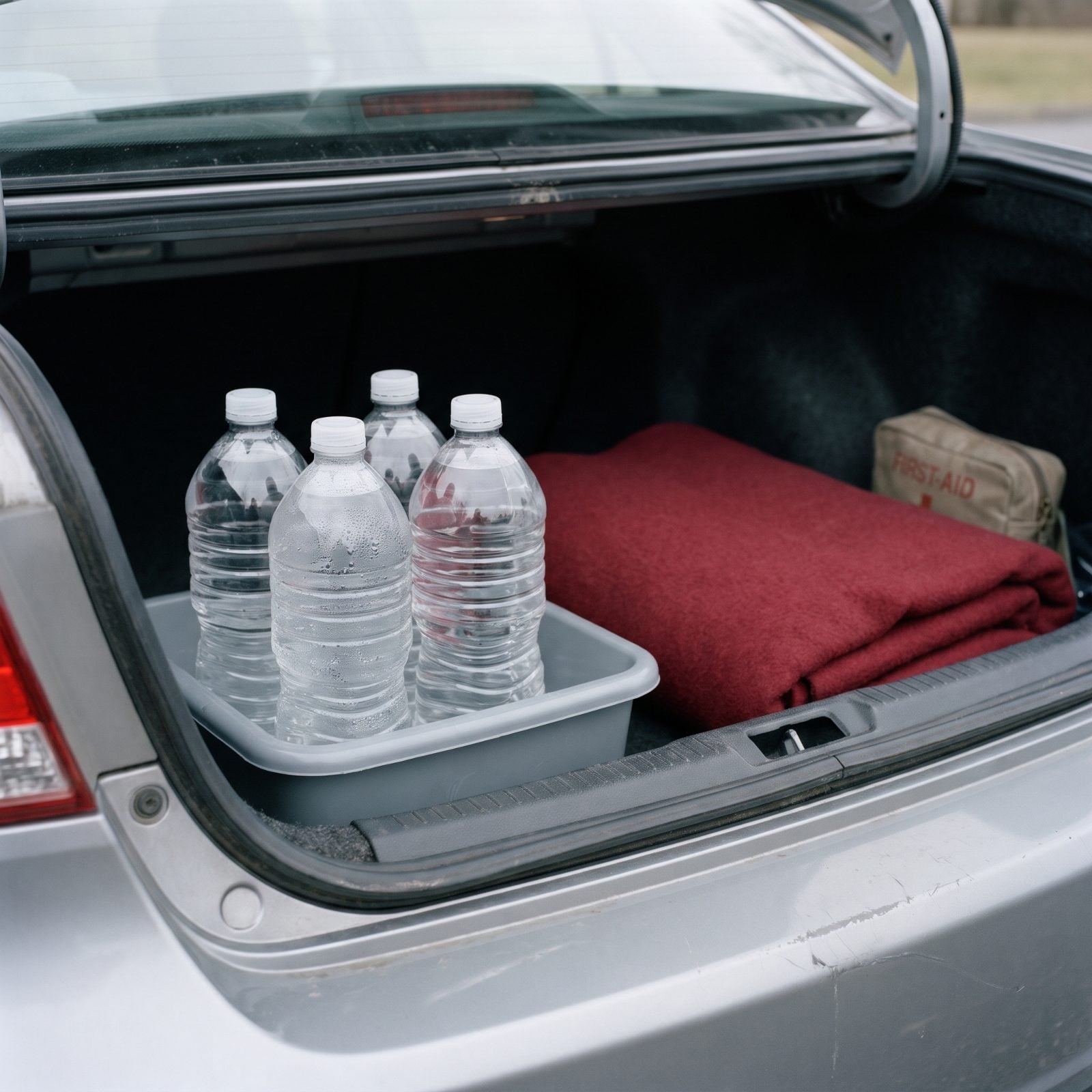
Water is the one thing you can’t improvise on the shoulder of a highway. A broken-down car in August becomes an oven fast, and dehydration dulls your judgment before you ever feel thirsty. So keep sealed bottles — not a refilled jug that’s been riding around for a year growing things you don’t want to think about.
Rotate them twice a year. The plastic breaks down in heat, and a trunk in July can hit temperatures that make last summer’s water taste like a garden hose. Four bottles is a sensible floor for one person, more if you drive with family or cross long empty stretches where the next exit is forty minutes away.
21. Shelf-Stable High-Energy Snacks
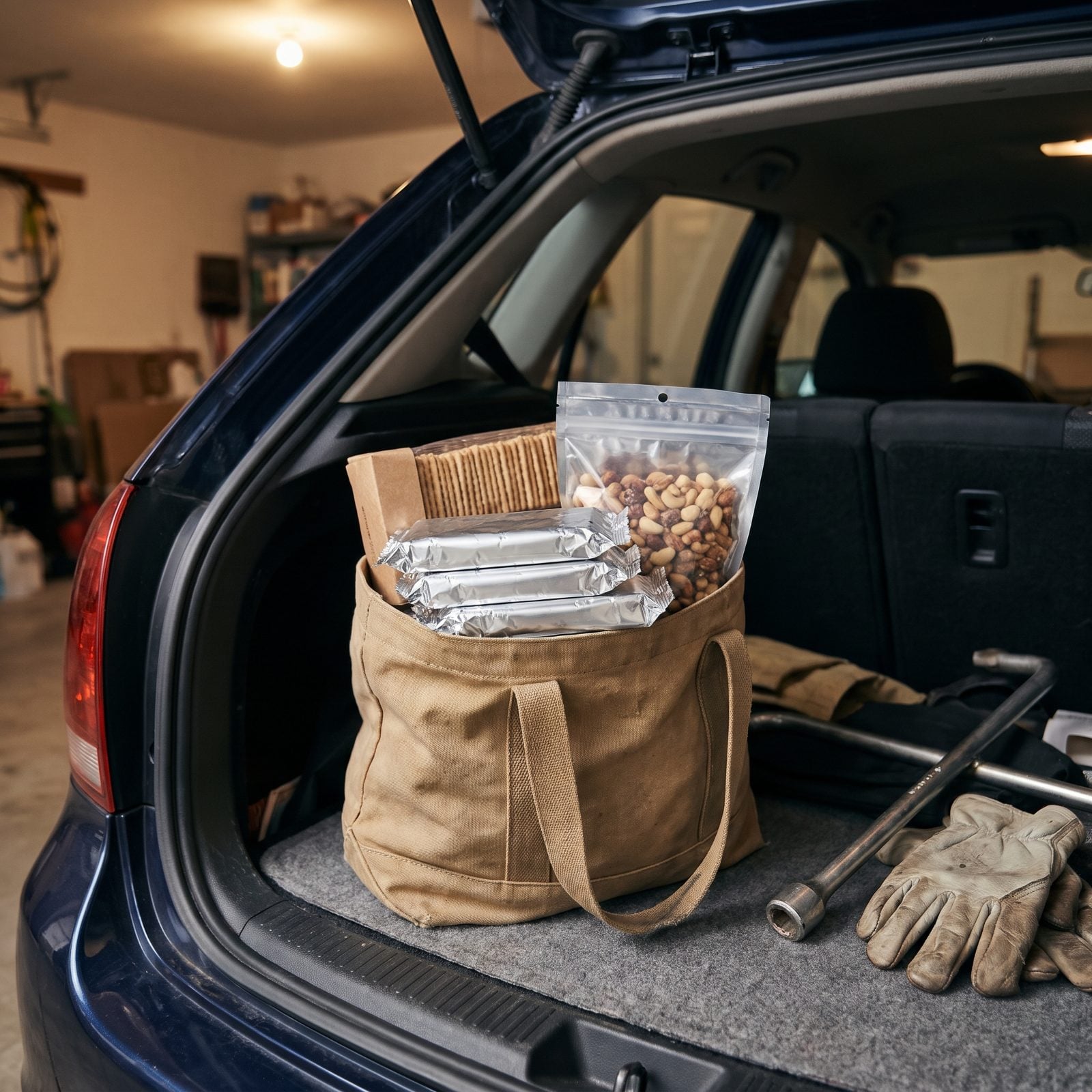
Hunger on the roadside isn’t about comfort. Low blood sugar makes you irritable and slow, exactly when you need to think clearly about whether to wait for a tow or walk for help.
Pick things that survive heat and cold without melting into a mess — nuts, jerky, dense energy bars, crackers. Chocolate turns to soup in a summer trunk and bricks up in winter, so skip it. Check the dates when you swap the water, and actually eat the old stuff instead of pitching it. A stash like this has gotten plenty of stranded drivers through a two-hour wait on a cold night without anyone losing their temper.
20. A Phone Charging Cable and 12-Volt USB Adapter
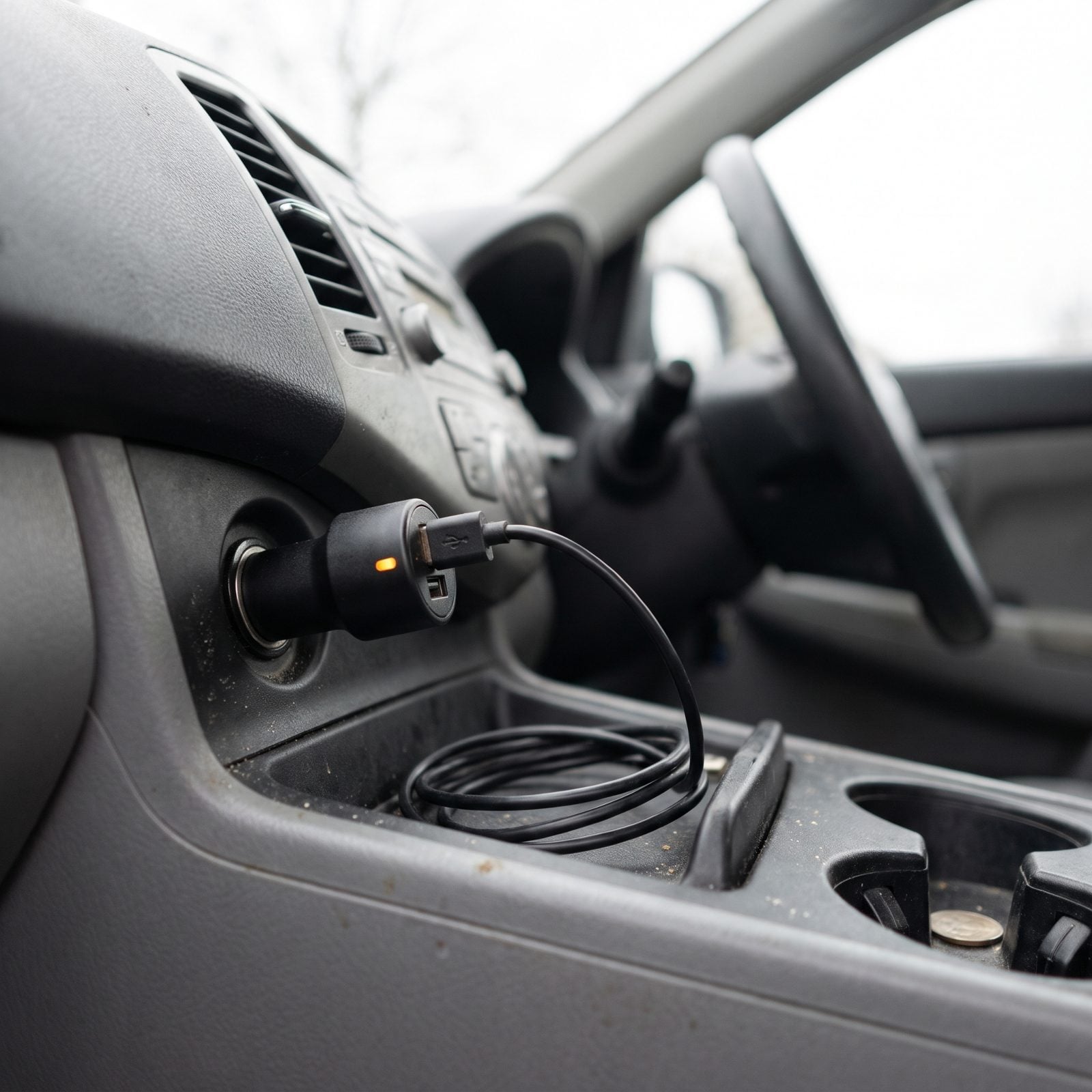
A dead phone is a stranded driver with no options. No map, no call for help, no GPS pin to hand the tow operator so they find you on the right side of the median.
The cable that lives in your car should be a cheap backup, not your daily one. Daily cables fray and vanish into the couch. Buy a spare, match it to your actual phone, and leave it in the glovebox so it’s always there. A simple 12-volt USB adapter in the dash socket pulls from the car battery, so you can top up even when the engine won’t start — as long as the battery still has life in it.
19. A Charged High-Capacity Power Bank
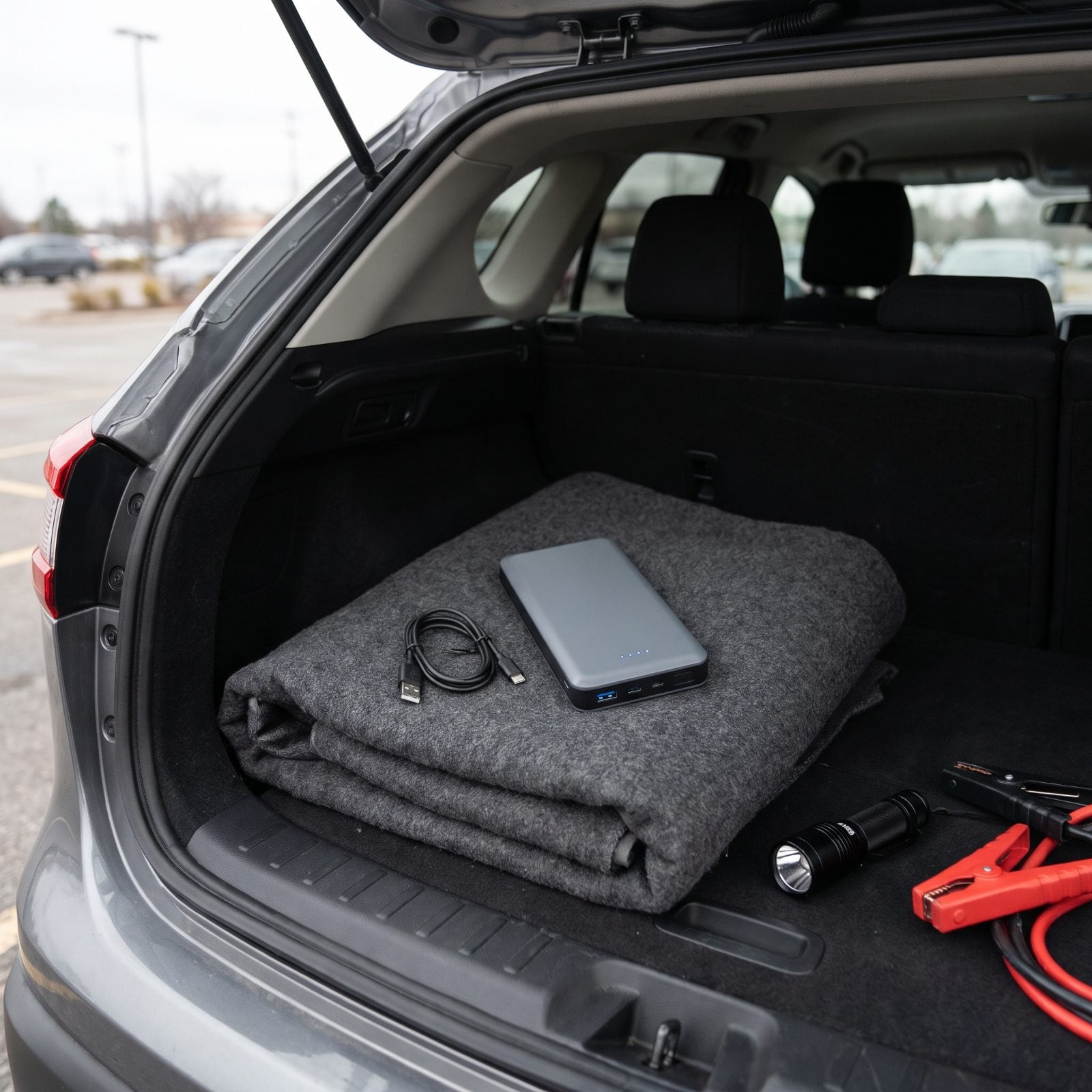
The adapter only works if the car’s electrical system does. A power bank doesn’t care whether the battery is dead, the alternator quit, or you’re sitting with the key off to save charge. It’s your independent reserve.
Size it right. A big power bank gives most phones several full charges — enough to ride out a long wait and still guide the tow truck in. Here’s the part nobody mentions: these units self-discharge slowly, and heat speeds it up. A bank you tossed in the trunk eight months ago might be sitting at half. Charge it when you do the seasonal supply check, and you’ll never be caught holding a brick.
18. A Printed Roadside-Assistance Card
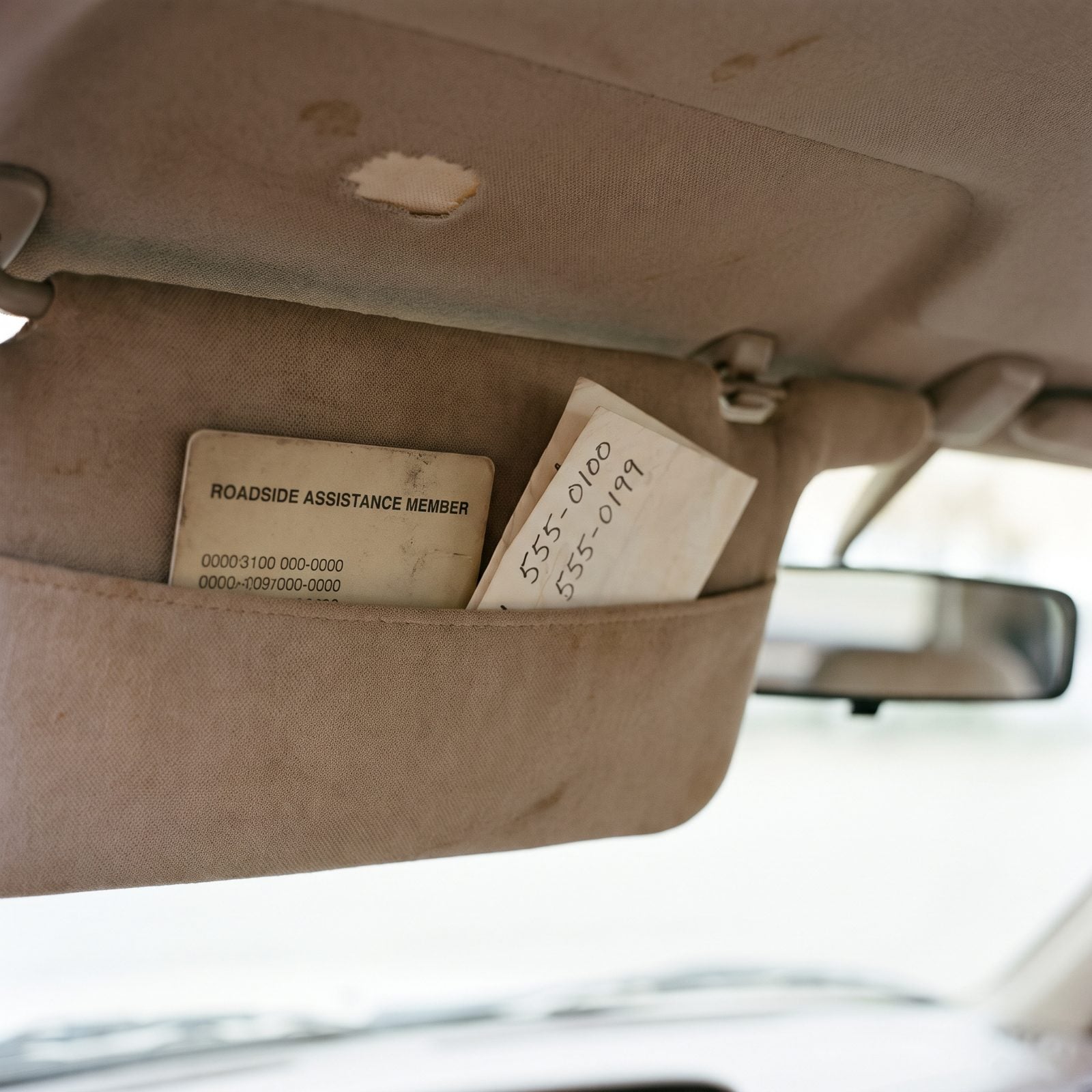
Your membership number lives on your phone, which is exactly the thing that dies when you need it most. A printed card in the glovebox or clipped to the visor doesn’t need a signal, a battery, or a working app.
Write the dispatch number big, and add a backup contact and your policy details on the same card. Picture yourself rattled on a dark shoulder with semis blowing past — you do not want to be squinting at a cracked screen trying to recall a password. A card you can read by flashlight gets help moving in half the time.
17. A Waterproof Vehicle-Document Wallet
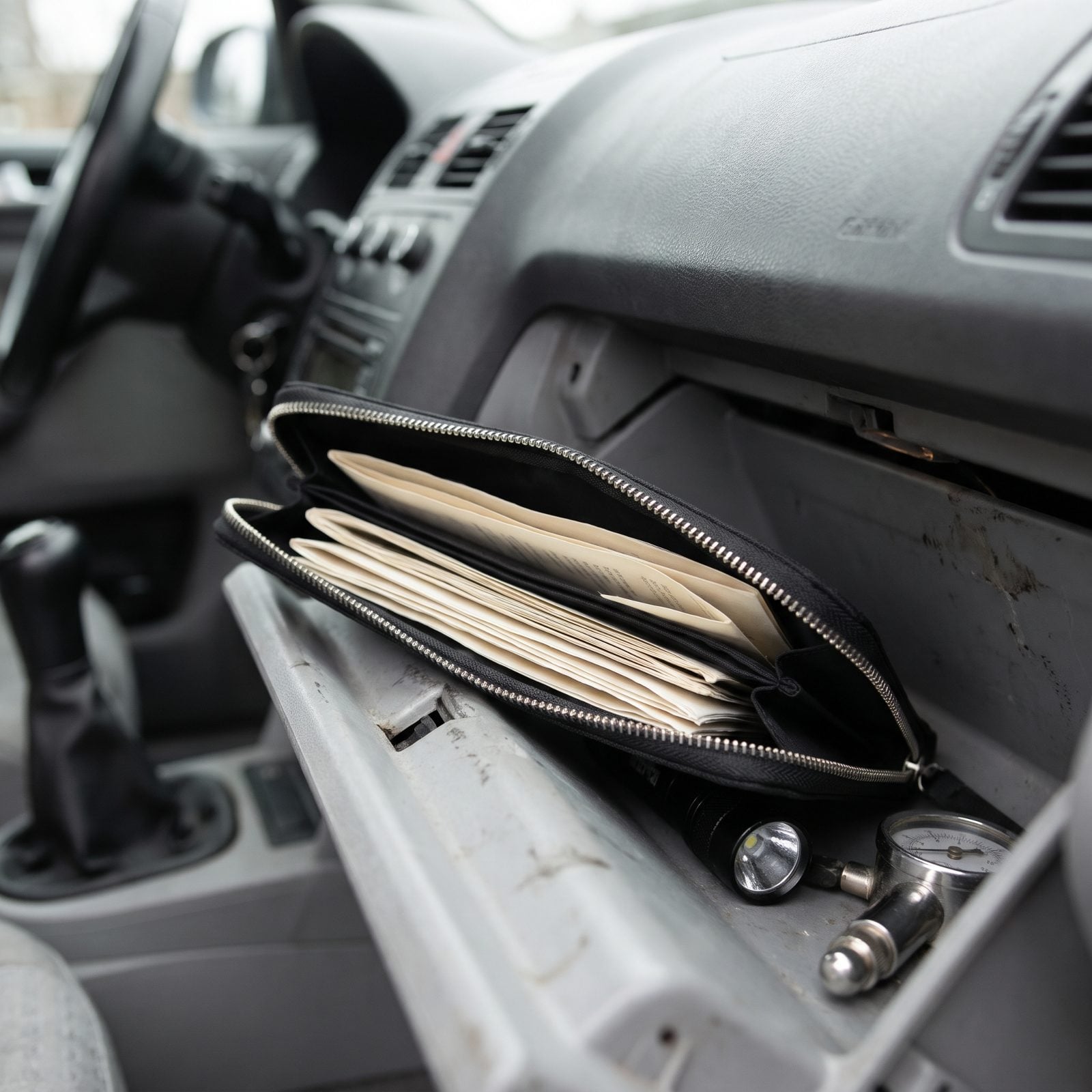
Registration and insurance proof turn to mush the one time your window leaks in a storm, or the day a coffee cup tips in the console. A sealed zip wallet keeps them flat, dry, and in one place.
Keep copies, not just originals, and store them separately from anything that identifies where you live when the car’s parked unattended. A tow operator, an officer, an insurance call after a fender-bender — they all want these papers fast. Fishing through a glovebox stuffed with napkins and old receipts while someone waits is a small humiliation you can skip entirely with one cheap pouch.
16. The Owner’s Manual
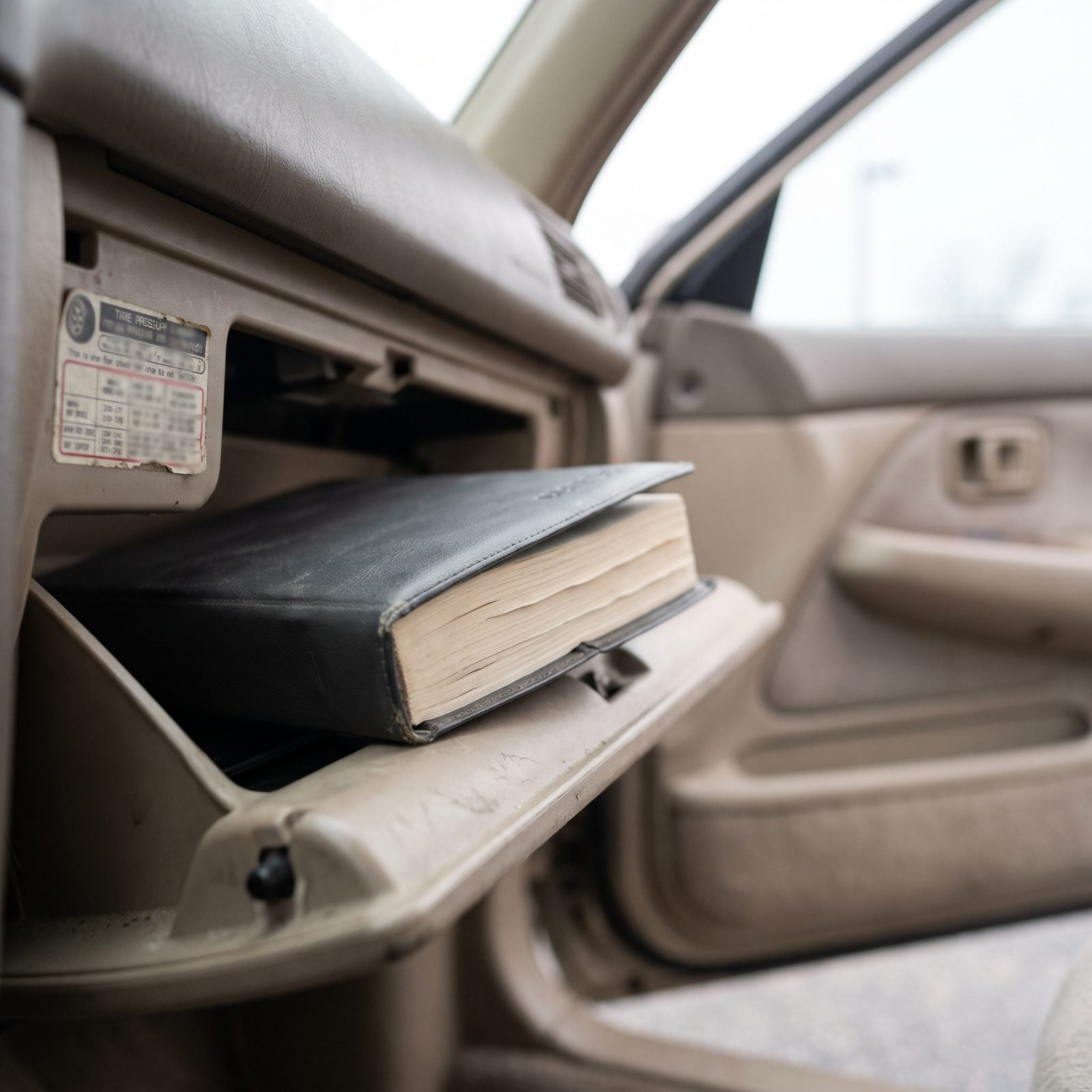
Everyone ignores the owner’s manual until the dashboard lights up with a symbol nobody recognizes. Then it’s the only thing in the car that tells you whether to pull over right now or keep rolling to the next exit.
It has the stuff you’ll scramble for on the shoulder: spare tire location, jack points, the exact tire pressure, which warning lights mean stop driving. Plenty of newer cars hide the spare or ship without one, and the manual is where you find out before you’re already stuck. Lost yours with a previous owner? Most makers post a PDF you can print and tuck away.
15. A Current Paper Road Map
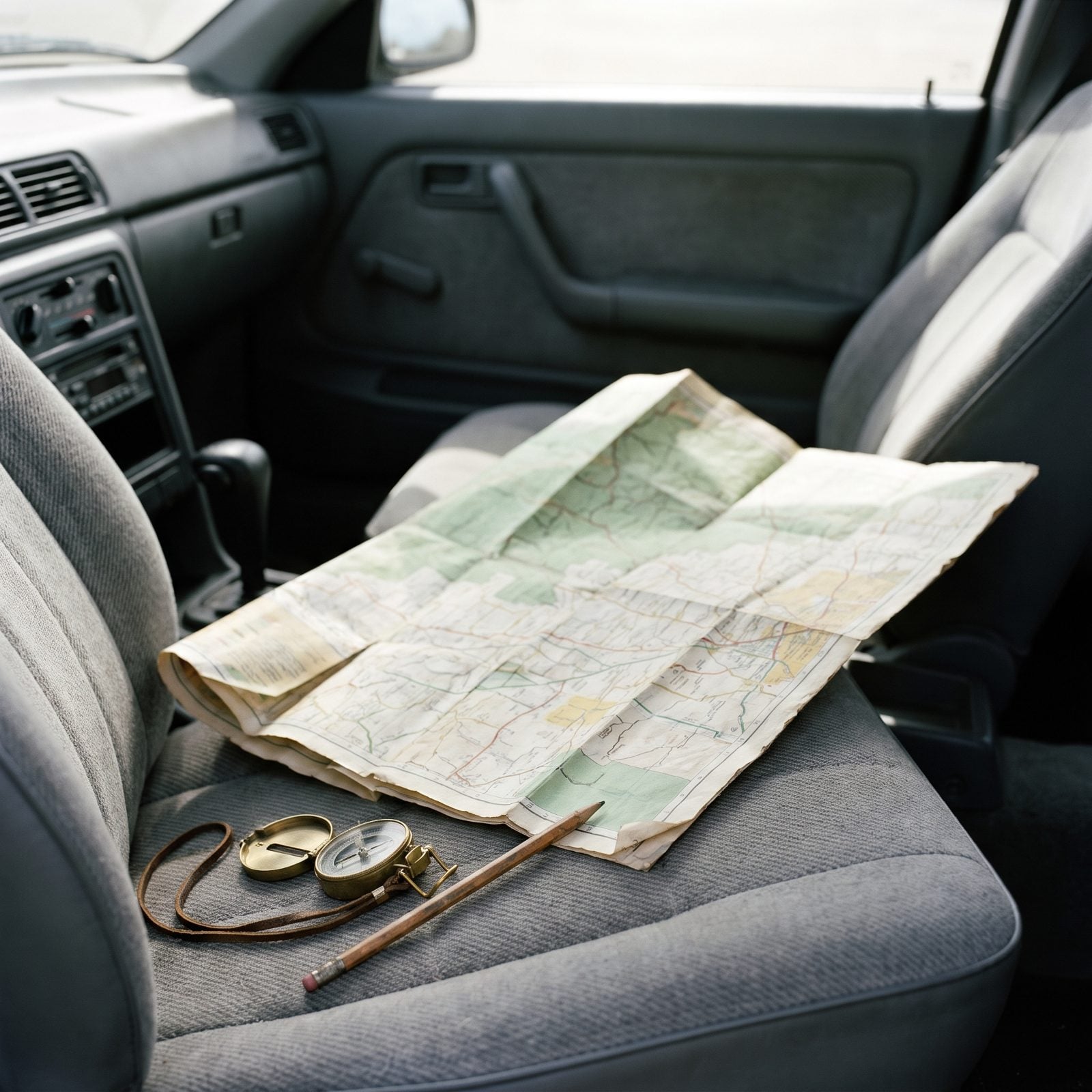
GPS fails in the places you most need it. Remote stretches of the Mountain West, the empty counties of West Texas, canyon roads that swallow a signal whole. A phone that can’t find a tower is a very expensive paperweight.
Paper doesn’t blink out. It shows you the whole region at once, which the little screen never does well — the nearest town, the alternate route around a closure, the fact that your next fuel is sixty miles ahead. Fold it to your travel corridor, keep it in the door pocket, and replace it every few years so new roads and changed routes actually show up.
14. A Combination Seatbelt Cutter and Window Breaker
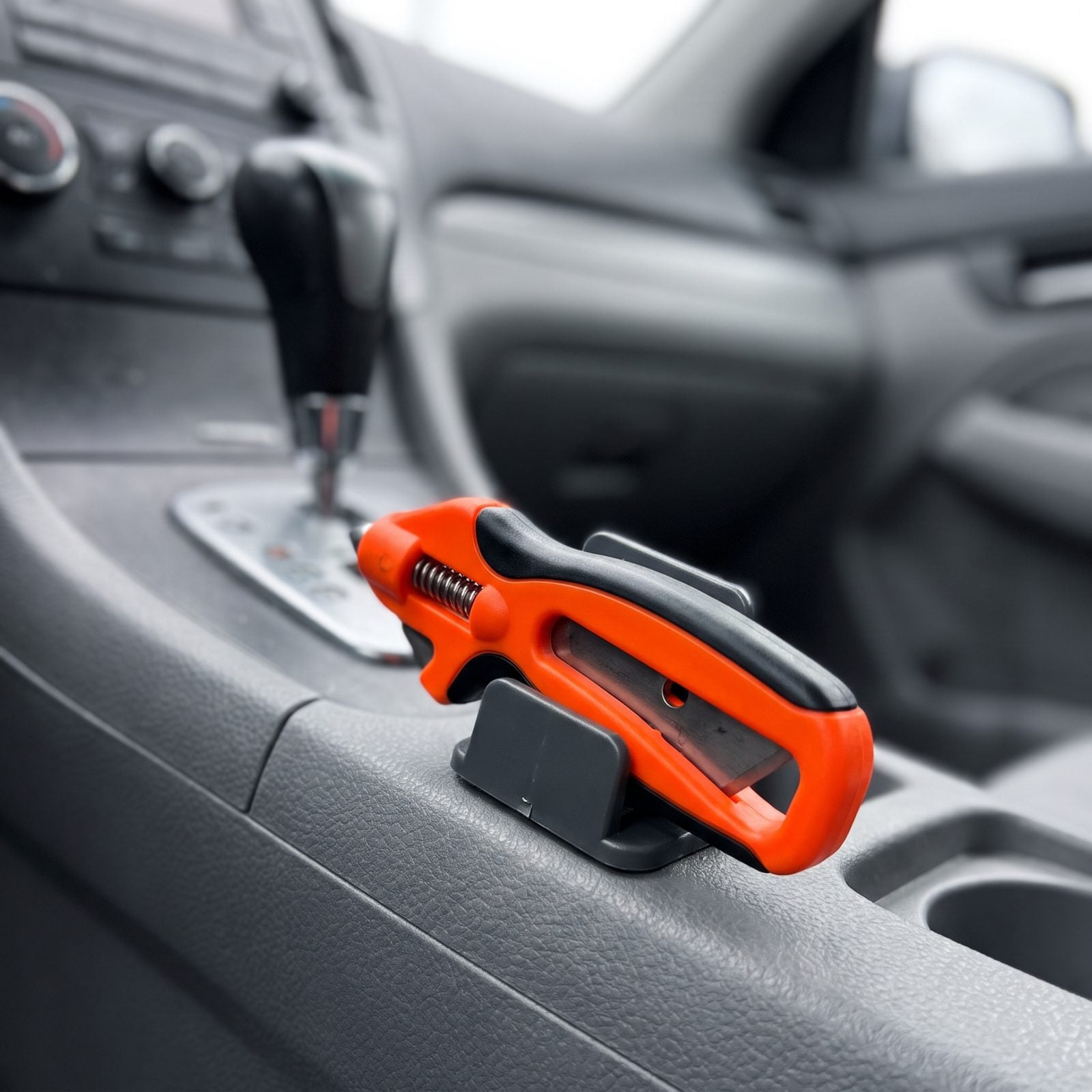
This is the tool you hope to never touch. A jammed door after a collision, a belt that won’t release, water rising, a fire you need to get clear of. Seconds decide everything, and no amount of pulling frees a stuck buckle.
What people get wrong is storage. A cutter buried in the trunk might as well be at home on the kitchen table. Mount it on the console or clip it to the seat base, somewhere you can grab it one-handed without looking. The spring-loaded point shatters tempered side glass with a tap, and the recessed blade slices a belt in a single stroke. Make sure everyone who rides with you knows where it lives.
13. An Automotive-Rated Fire Extinguisher
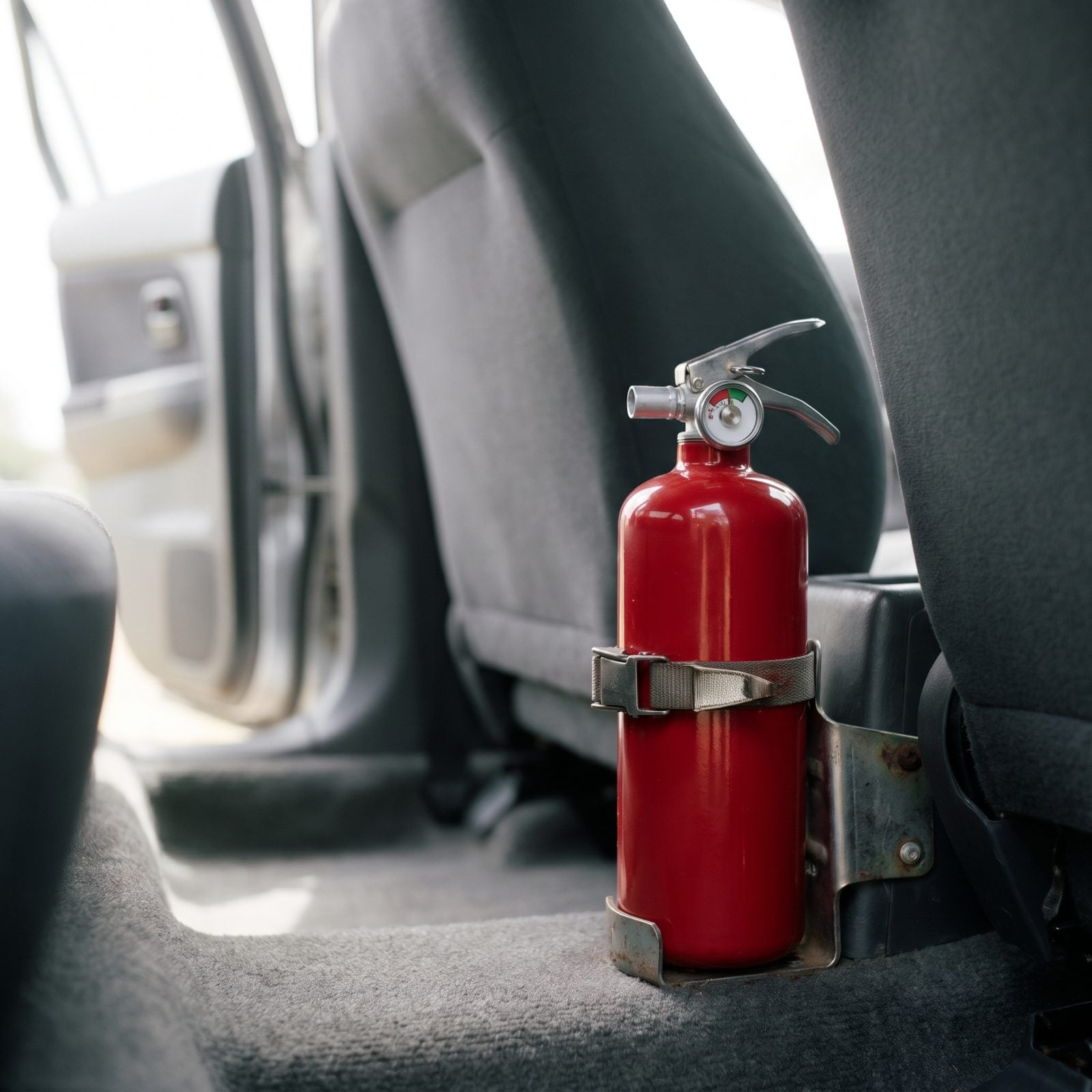
Car fires start small and go fast — an electrical short, a fuel leak on a hot manifold, a crash that ruptures a line. The window to knock one down before it owns the whole vehicle is short, and a working extinguisher within reach is the difference between a scorched engine bay and a total loss.
Buy one rated for automotive use, meaning it handles flammable liquids and electrical fires, not just paper and wood. Mount it in a bracket so it isn’t a flying missile in a crash, and keep it where you or a passenger can grab it without unbuckling. Check the pressure gauge twice a year. A needle that’s drifted out of the green means it’s dead weight.
12. A Compact Metric and SAE Tool Kit
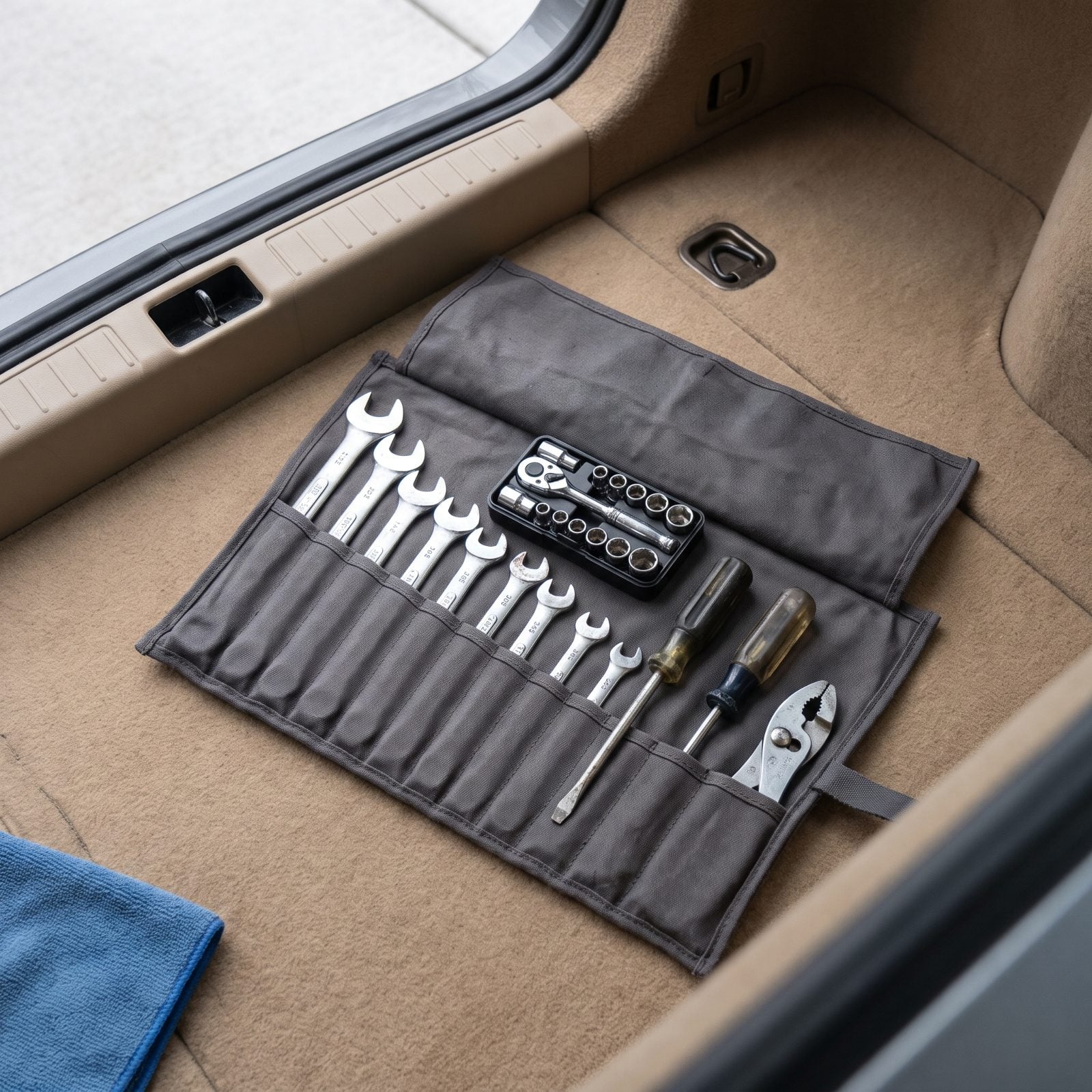
Most roadside headaches aren’t engine failures. They’re a loose battery terminal, a dangling splash shield, a license plate bolt rattling itself off, and a small kit with both metric and SAE wrenches handles the majority of what actually strands people.
Here’s the part nobody mentions: know which system your vehicle uses before you buy. Most imports and modern domestics run metric throughout, though a few older trucks still mix in SAE hardware. Guess wrong and you’ll round off a bolt head with the wrong-size wrench — a worse problem than the one you started with.
11. A Roll of Automotive Duct Tape
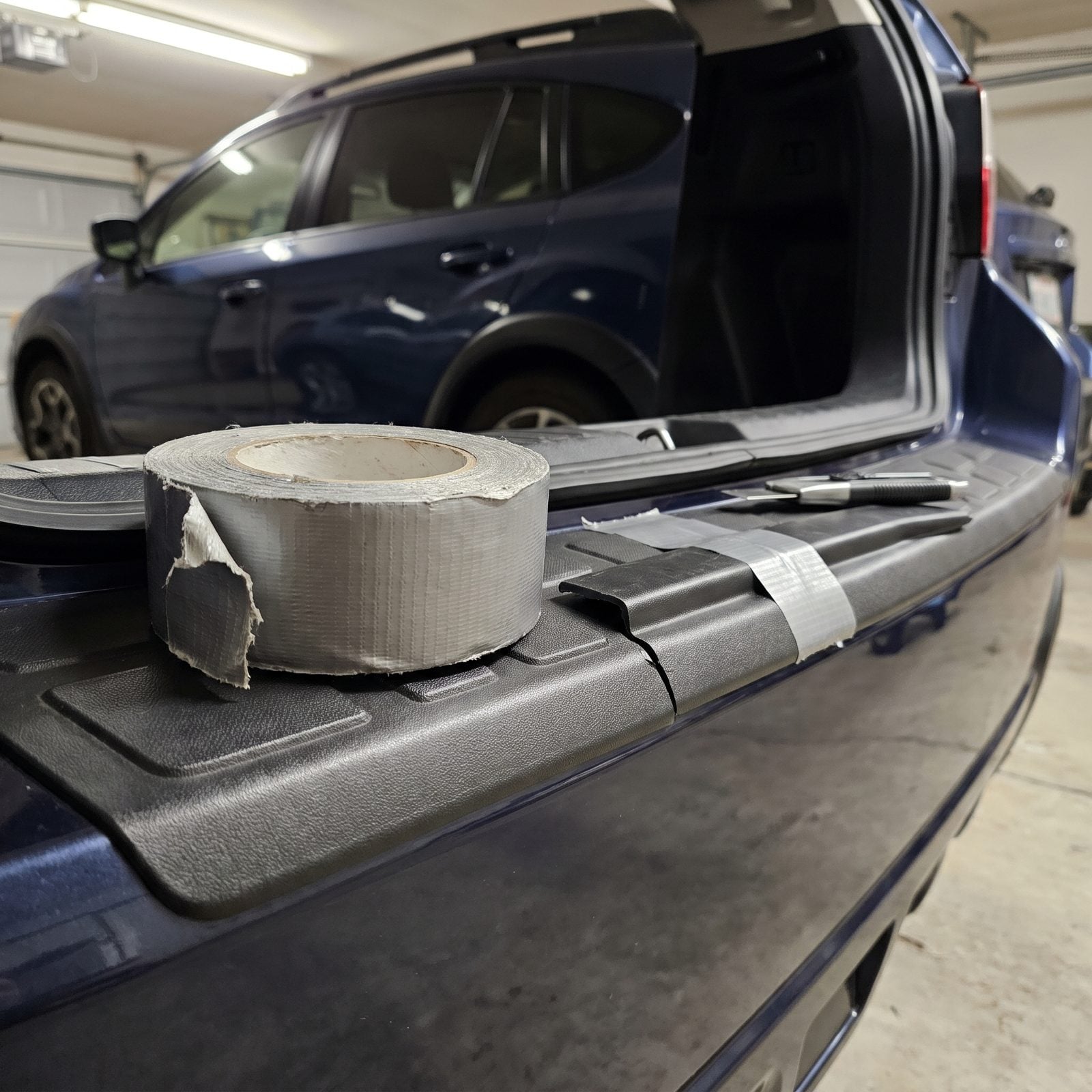
Duct tape won’t fix your car. It’ll get you home, which is a different and more useful goal.
A ripped bumper cover flapping at highway speed. A cracked coolant reservoir weeping overnight. A side mirror hanging by its wires, or a split radiator hose you can wrap just enough to limp to a shop. The cloth-backed automotive stuff grips better than the hardware-store silver and shrugs off engine heat the cheap rolls can’t touch. Keep one dedicated roll in the car and resist raiding it for moving boxes. You will raid it anyway. I always do.
10. A Pack of Heat-Resistant Zip Ties
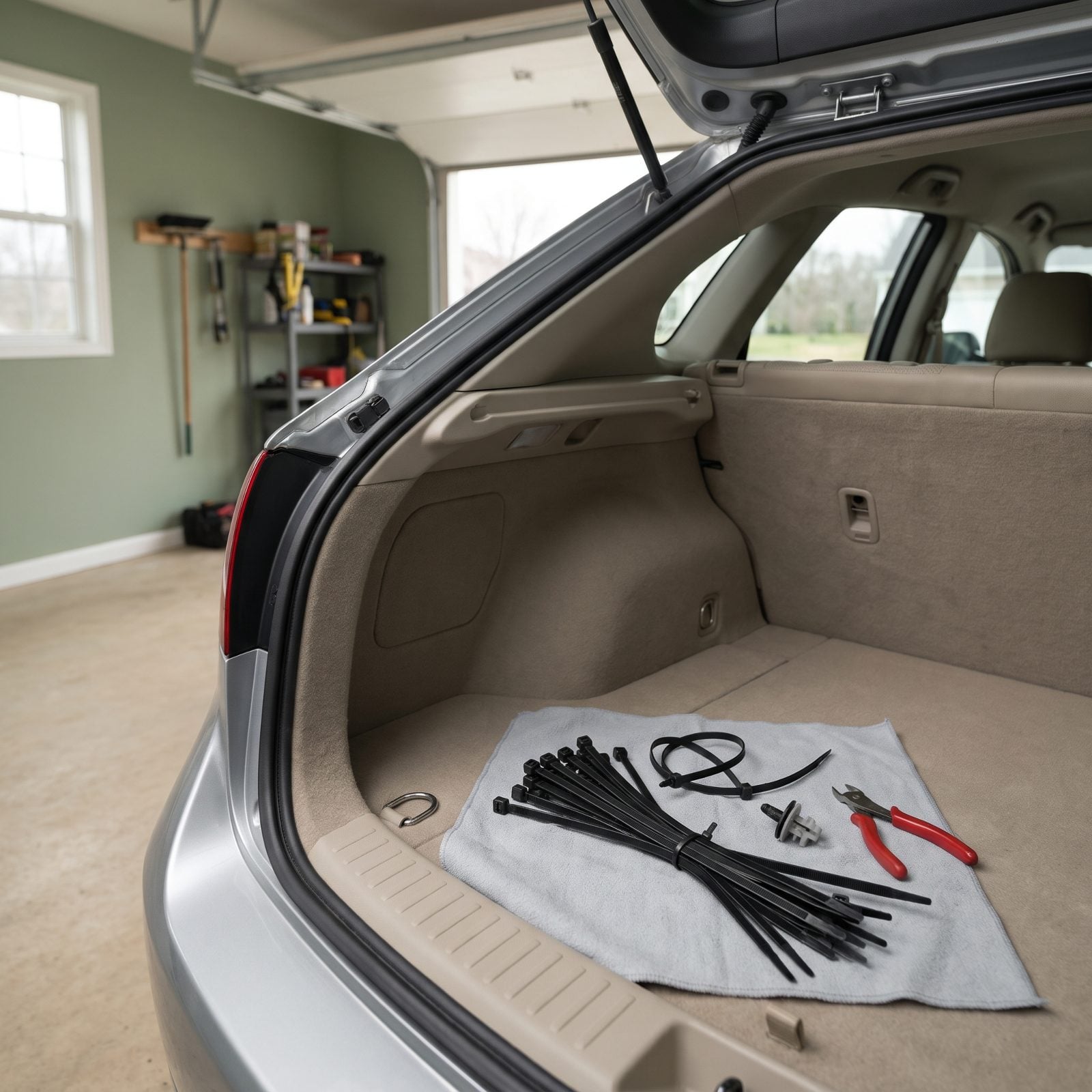
The plastic splash shield under your front bumper is held on by clips that love to pop. When one lets go on the interstate, you get a dragging, scraping noise that sounds like the whole car is coming apart.
It usually isn’t. A few zip ties cinch that shield back up and quiet it in a couple of minutes. Get the black heat-resistant kind rated well above engine-bay temperatures — not the white dollar-store ties that go brittle and snap near anything warm. They also wrangle a loose exhaust heat shield, a drooping wire harness, or a broken hood prop. For the money, nothing earns its trunk space faster.
9. The Correct Replacement Fuses
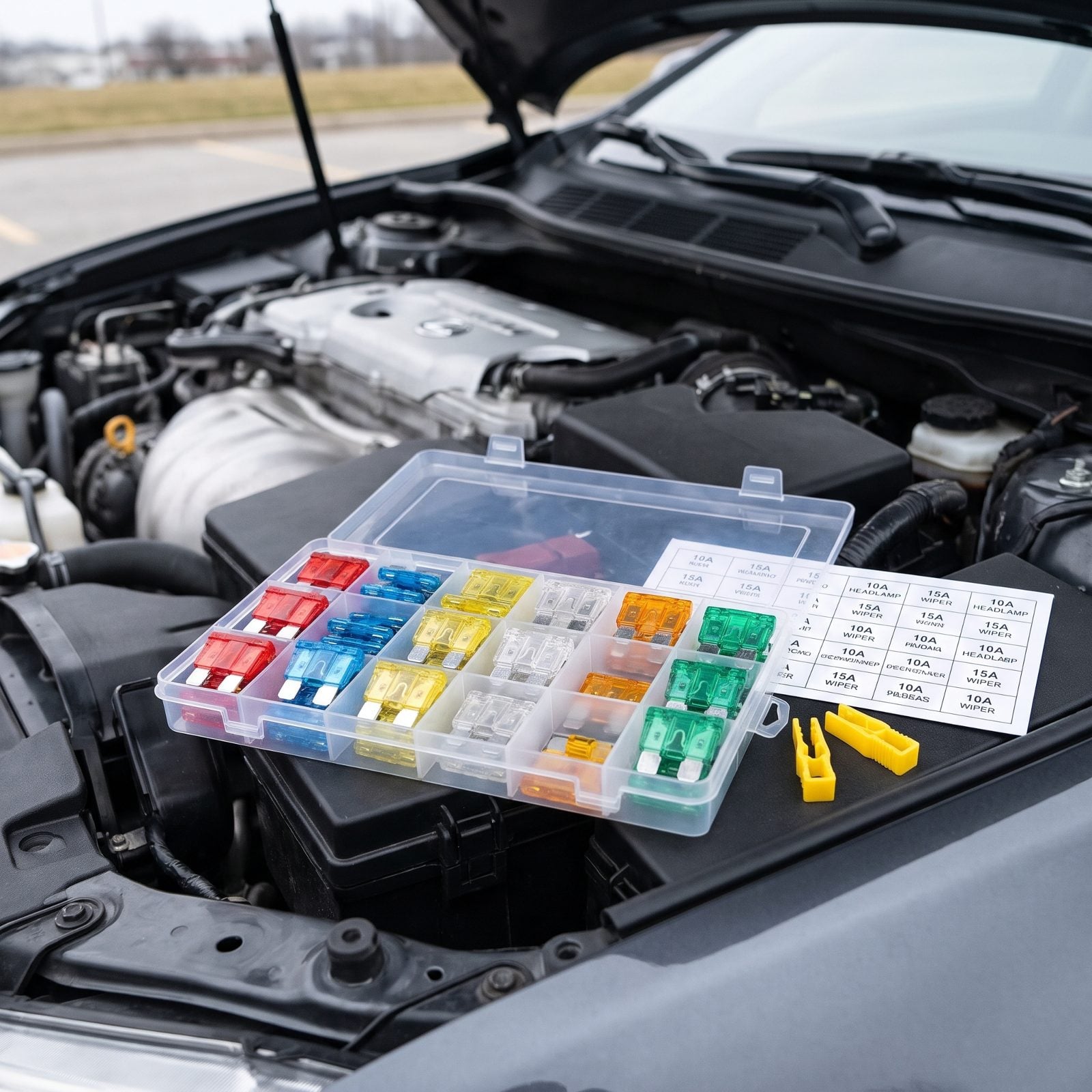
A blown fuse is a two-dollar problem that tows people to dealerships every day.
Lose a fuse and you can lose your fuel pump, your dash lights, your blower, sometimes the whole car. The replacement is a color-coded blade the size of a fingernail. Buy the assortment that matches your vehicle’s amperage ratings, keep them in the glovebox with the little plastic puller, and snap a photo of the fuse box diagram on your phone while you’re at it. One warning that matters: match the amperage exactly. Jam in a higher-rated fuse to stop it blowing and you’ve swapped a cheap inconvenience for the chance of melted wiring behind the dash.
8. A Sealed Bottle of Windshield-Washer Fluid

Run out of washer fluid behind a salt truck in February and the road vanishes. Your wipers smear a gray film across the glass and you’re driving half blind at seventy — the kind of danger people don’t take seriously until it happens to them.
A sealed gallon kept in the trunk solves it. Buy the right formula for your climate: winter mix that won’t freeze in the reservoir and lines up north, bug-cutting summer blend down south. And don’t ever top off the washer tank with plain water to save a buck. It freezes, cracks the reservoir, and now you’re buying a part instead of a jug.
7. A Bundle of Absorbent Shop Towels
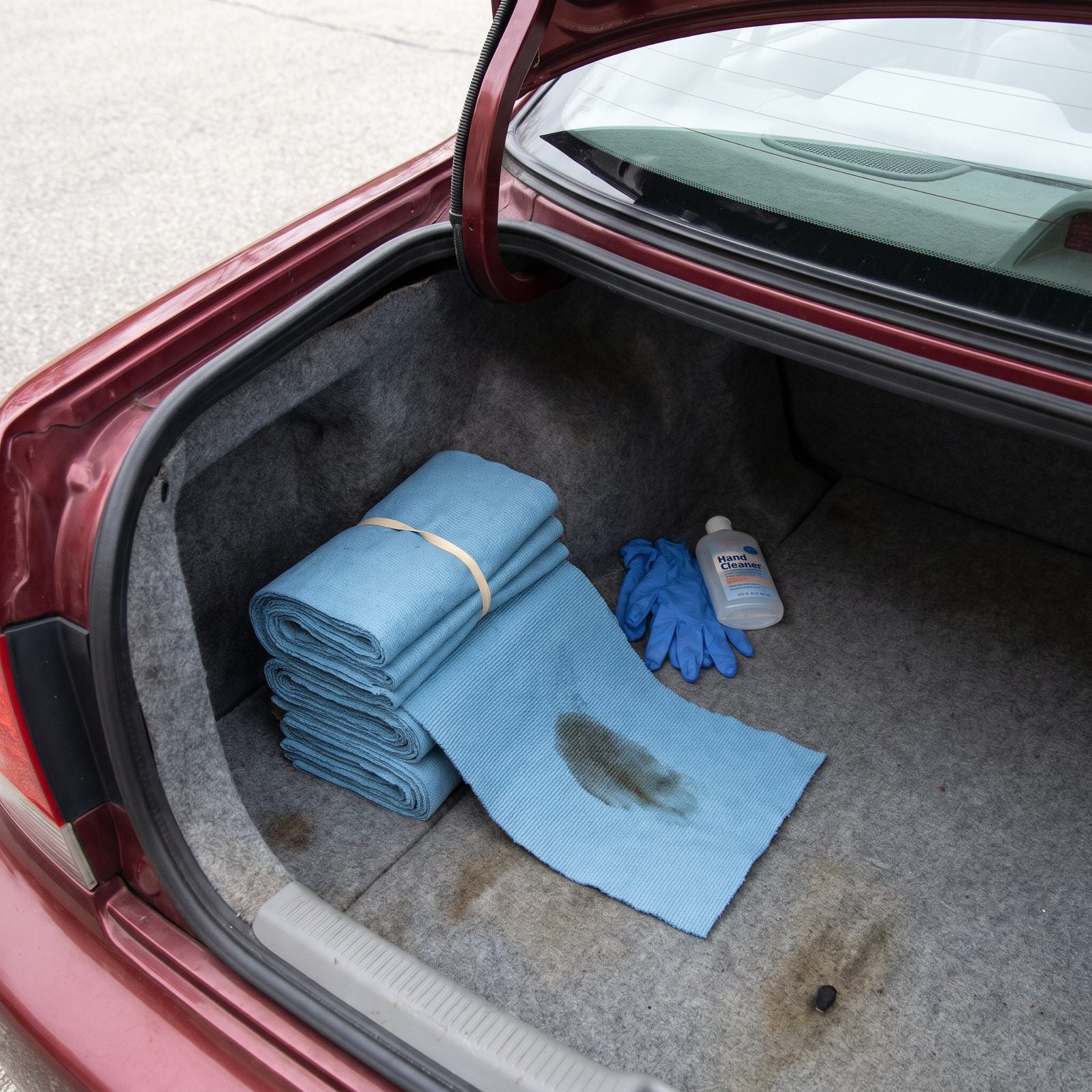
Everything roadside gets your hands filthy — checking the dipstick, topping off coolant, wrestling a splash shield, handling a battery terminal. Then grease and coolant and brake dust transfer onto your steering wheel, your phone, your door handle the second you climb back in.
A bundle of blue shop towels is the unglamorous hero here. They soak up a spill, wipe a dipstick clean, check oil color, pad your knee on cold pavement. Keep more than you think you need. You always burn through them twice as fast as planned.
6. One Sealed Quart of the Correct Engine Oil
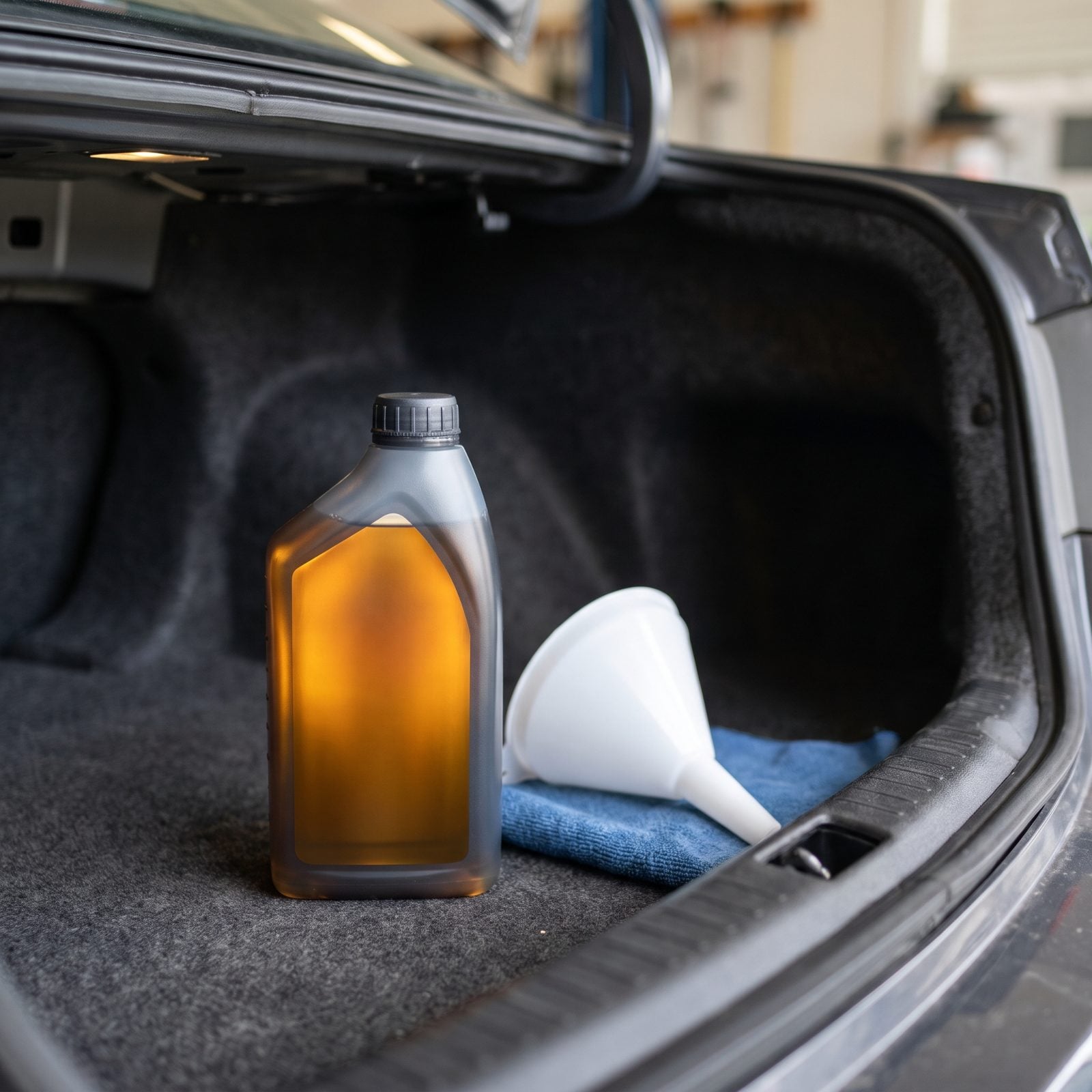
A quart of the wrong oil is a gamble you don’t need to take.
Modern engines are fussy about viscosity. Your manual spells out the exact grade, something like 0W-20 or 5W-30, and that spec isn’t a suggestion — the tight tolerances in a current motor depend on oil of a specific thickness reaching the right places fast. Pour in a thicker grade in a pinch and you can starve bearings. Too thin and you lose protection where it counts.
Keep one sealed quart of your engine’s exact oil in the trunk. If the low-oil light flickers forty miles from anywhere, you add enough to reach a station instead of gambling the drive on a dropping level. Check the dipstick before you add, though. Overfilling causes its own damage, foaming the oil and blowing seals.
5. Premixed Manufacturer-Specified Coolant
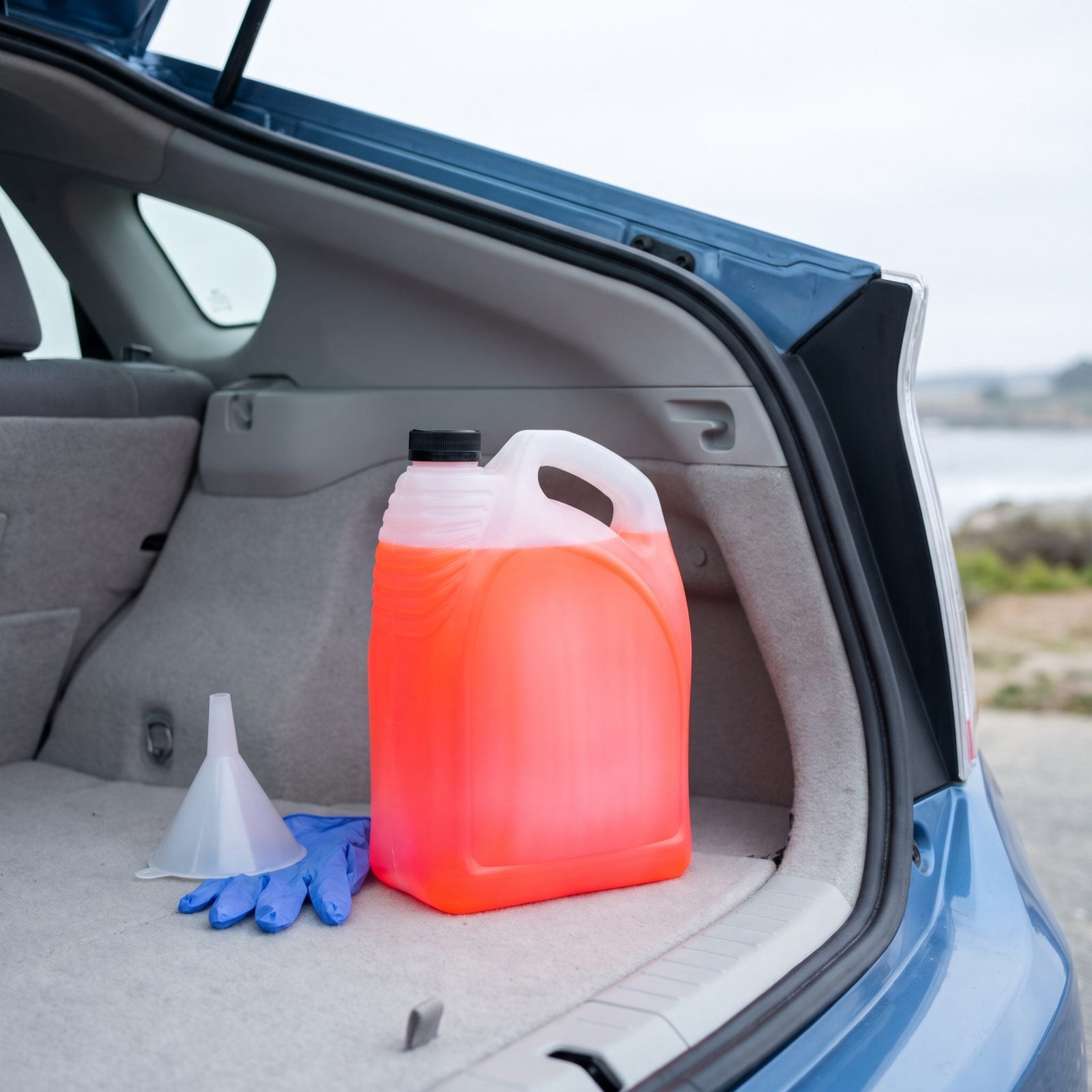
Coolant is where good intentions turn into expensive mistakes. People grab whatever green jug is cheapest at the parts counter and pour it into a system that wanted a totally different chemistry.
The colors are not interchangeable. Mix the wrong types and they can gel into a sludge that clogs your radiator and kills the water pump. Buy the exact coolant your manufacturer specifies, and buy it premixed so you’re not diluting concentrate with the wrong water on a hot shoulder.
A sealed jug in the trunk buys you options when the temp gauge starts climbing. A slow leak you can top off is a manageable drive home. Ignored, it’s a warped head and a repair bill with four digits.
4. A Preassembled Crash-Documentation Envelope
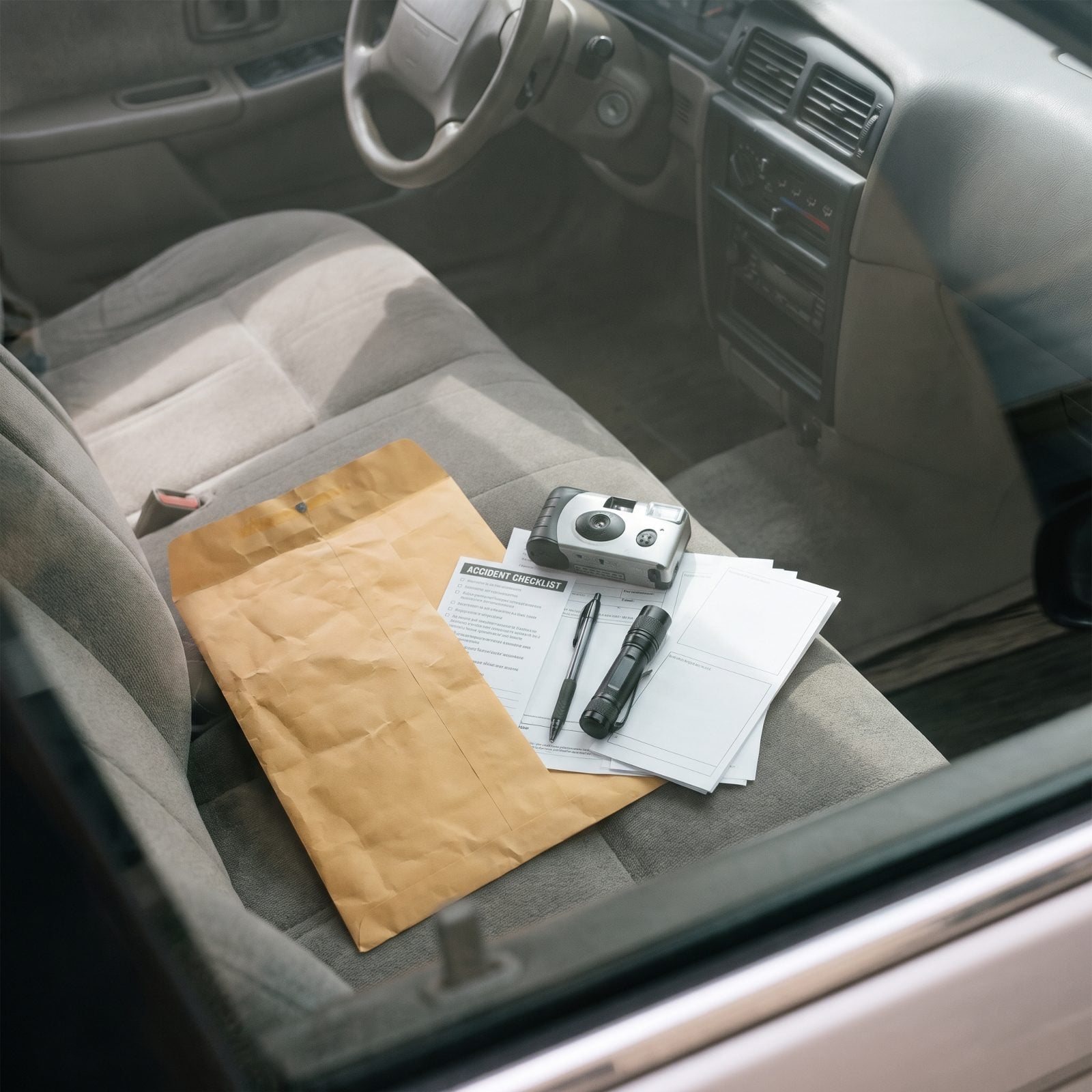
Nobody thinks clearly right after a collision. Your hands shake, adrenaline floods in, and the exact things you need to record are the things you’ll forget to ask.
So prep an envelope now, while you’re calm. Inside: a printed checklist of what to photograph and gather, a pen that works, a cheap flashlight for night scenes, and a card with your insurance policy number and the non-emergency numbers you might need. The checklist is the heart of it. Make sure yours spells out, in plain words: other driver’s name, plate, insurance, photos of all four corners of both cars, the scene, any skid marks, the other driver’s damage before anyone moves.
A clear head follows a printed list. A rattled one invents a list later, in the claims office, after it’s too late.
3. A Securely Stored Spare Vehicle Key
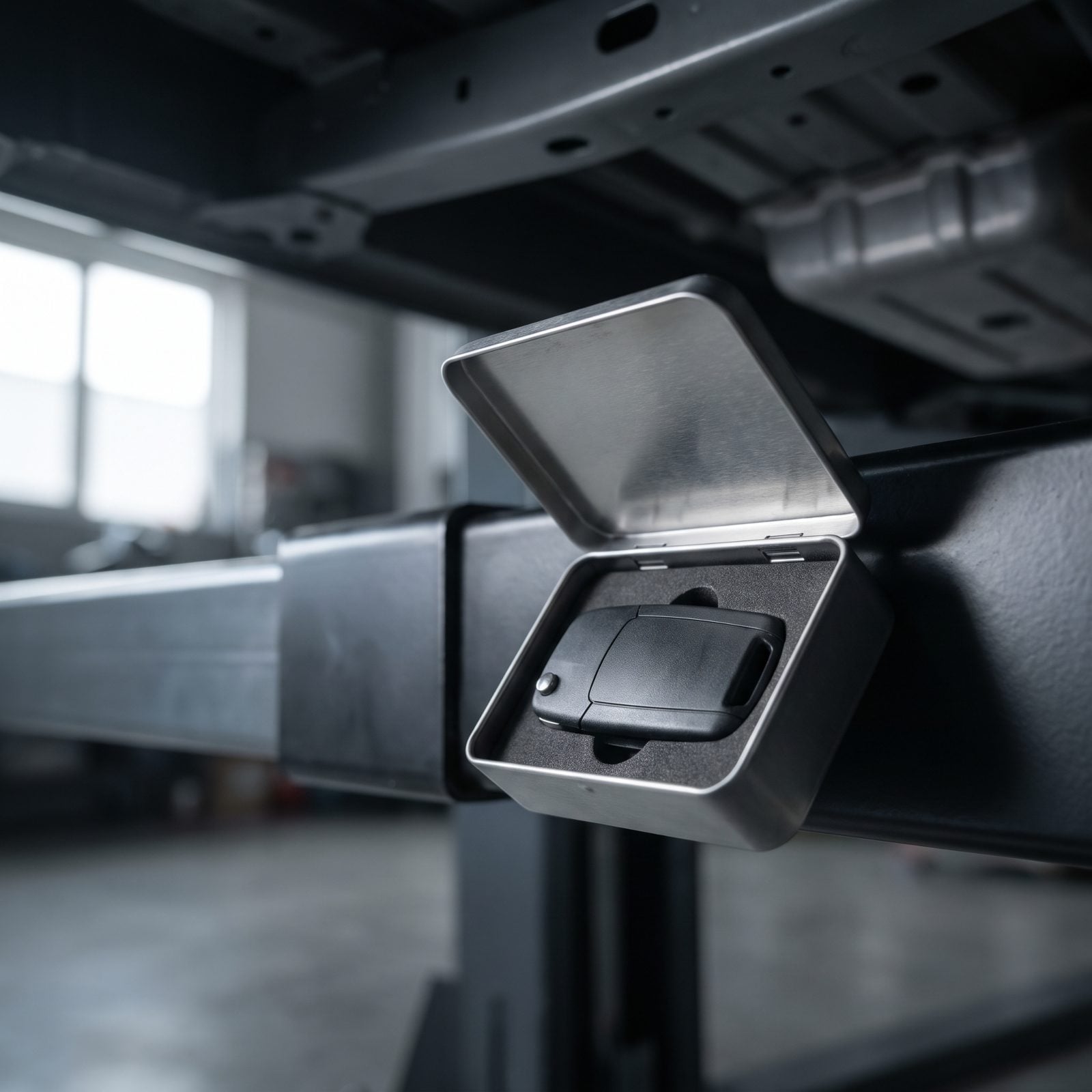
Lock your only key fob inside a running car at a gas station and you’ll learn fast what a dealer charges to cut and program a modern replacement. For a lot of vehicles that means a stack of cash and a tow, because the fancy proximity keys can’t be copied at the hardware store anymore.
A spare solves it for a fraction of that. The trick is storing it somewhere useful without creating a theft problem. A hidden magnetic lockbox is one option. A spare left with a trusted neighbor or a family member is another. What you don’t do is bury the only backup in a junk drawer at home, where it’s no help the day you’re stranded forty miles out.
2. The Wheel-Lock Key: The Tiny Socket That Decides Whether You Change That Tire
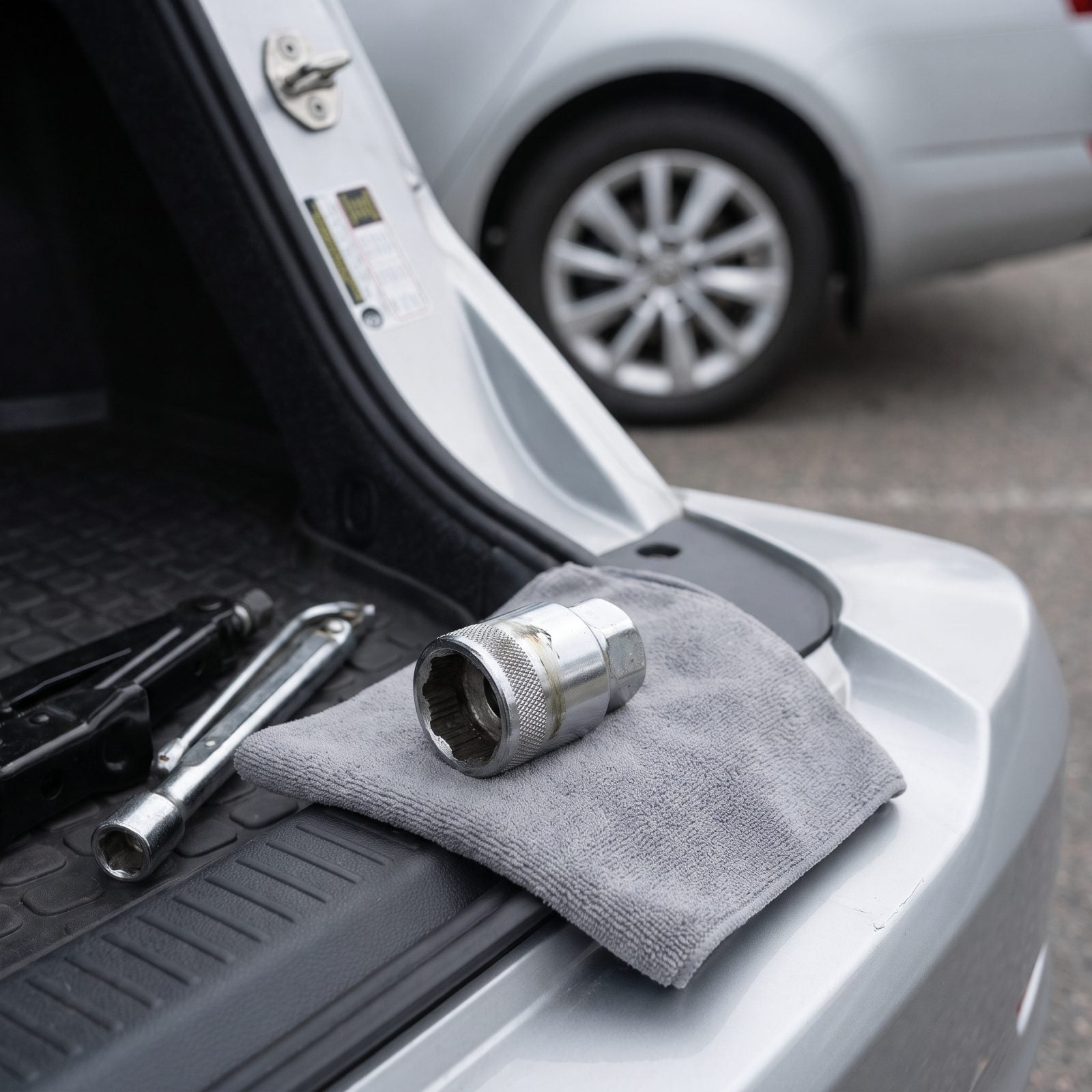
Most people have never held it. It lives in a felt pouch under the trunk floor, or in the glovebox, or nowhere at all because the last tire shop walked off with it. That little splined socket is the only thing on earth that fits the locking lug nut on each of your wheels, and without it the wheel stays bolted on — not for you, not for the tow driver, not for anybody kneeling at the roadside.
We learned this the annoying way, down in the gravel at dusk with a perfectly good spare and a standard socket that just spun on the one nut that mattered. The pattern is unique to your car, keyed like a deadbolt. Lose it and you’re looking at a drill-out or a special extractor set, which is a rotten way to spend an afternoon when all you wanted was to swap a flat.
1. The Vehicle’s Removable Tow Eye: The Screw-In Hook Hiding Behind Your Bumper Cap
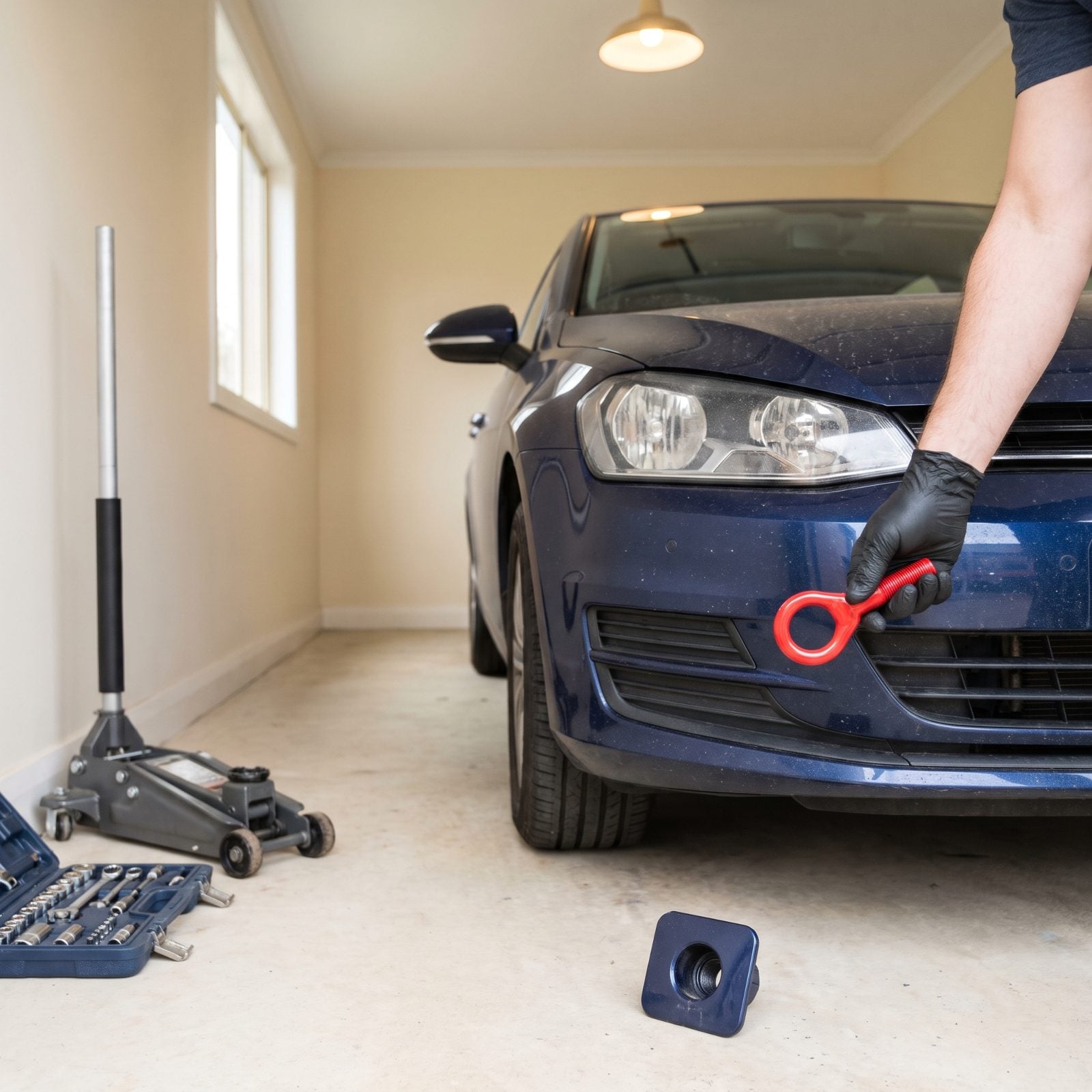
On most modern cars there is no fixed hook to grab. Reach under the front and all you find is smooth plastic, nothing to loop a strap around. Your actual recovery point is a threaded screw-in eye that rides in the toolkit, and it bites into a threaded socket hidden behind a small square cap in the bumper cover.
Here’s what nobody tells you. The thread is often reverse-handed, so it tightens the opposite way your hands expect. Flatbed drivers know this cold. A panicked owner at 11pm usually doesn’t, and ends up watching a winch cable get looped around something never meant to carry that load — a control arm, maybe, or a trailer bracket.
Find yours now. In daylight, in your own driveway, before any of it matters. Learn where the socket sits, which pocket the eye hides in, which way the thing threads. That five-minute scavenger hunt is the whole gap between a clean pull and a bent panel.