
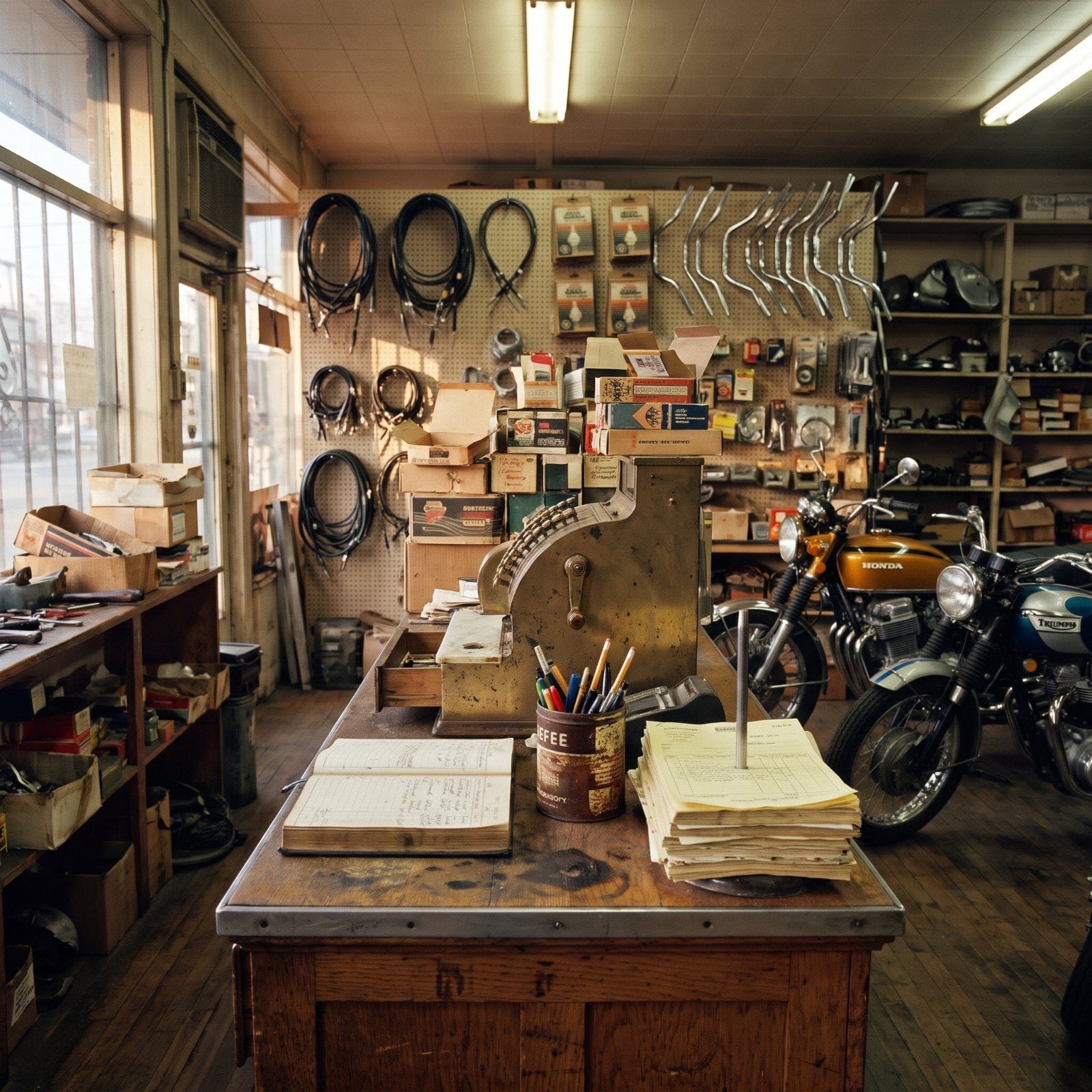
The door chime, the parts man wiping his hands on a shop rag before he’d touch your money, the blue haze of someone test-firing a two-stroke out back. That was a motorcycle shop in the 1970s. No touchscreens, and no ordering a part from a warehouse three states away. If the shop didn’t have it hanging on a hook or stuffed in a drawer, you waited, or you made it fit. We wandered back through that world, counter by counter and bin by bin, to look at the stuff that kept a Honda CB or a Triumph Bonneville running when you did the work yourself.
Please note that some of the images in this article were created with the assistance of AI.
46. The Oil-Darkened Wooden Parts Counter
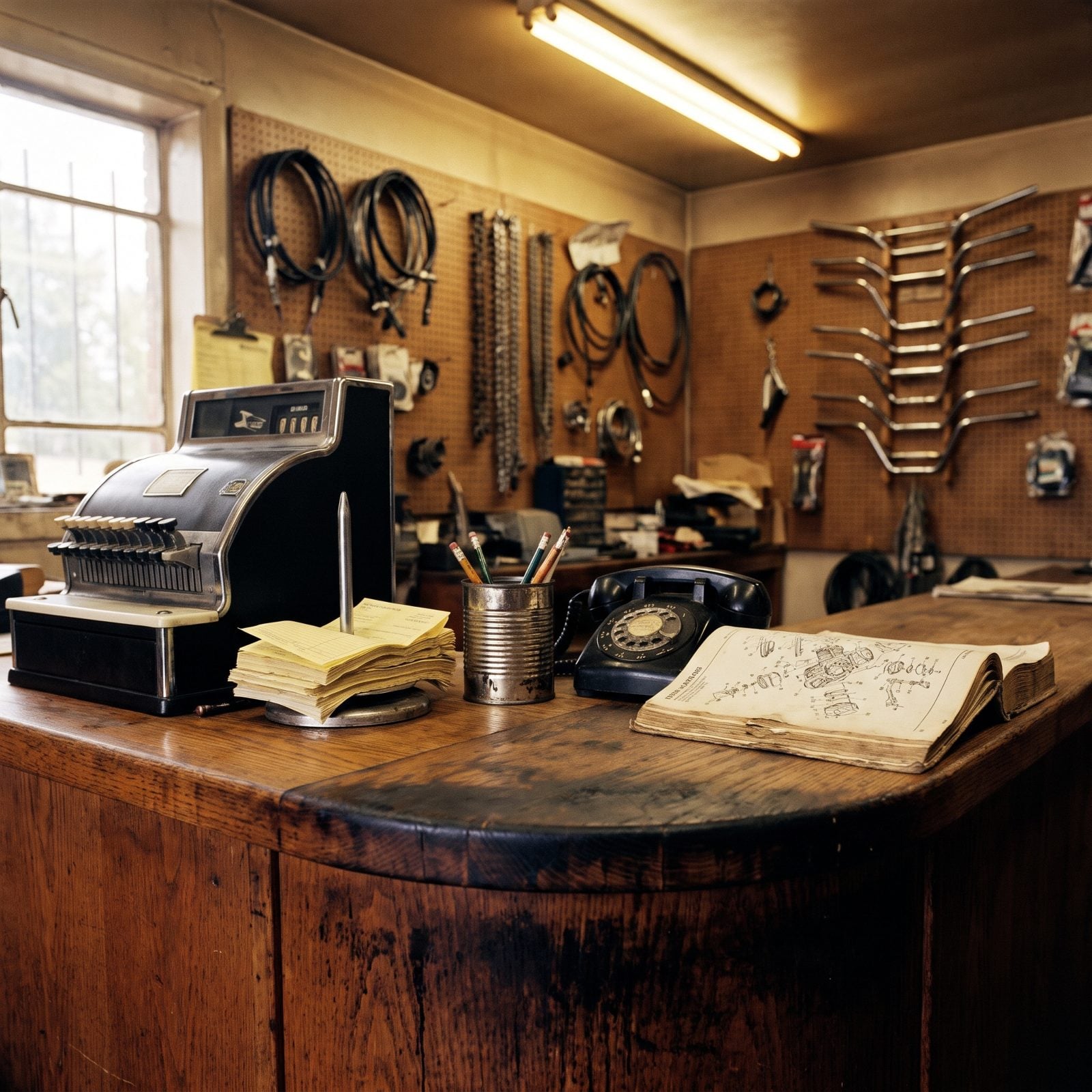
The counter was the altar. Oak, usually, worn to a dark gloss at the two spots where men leaned to argue about jetting and spark timing. You didn’t reach behind it — that was the parts man’s country, and he guarded it like a border.
Everything happened here: the carbon-copy order slip on the spindle, the grease pencil marking a box, the catalog flipped open to an exploded diagram while he traced a part number with a blackened fingernail. The whole economy of keeping a bike alive ran across three feet of stained wood.
45. Pegboards Packed With Throttle and Clutch Cables
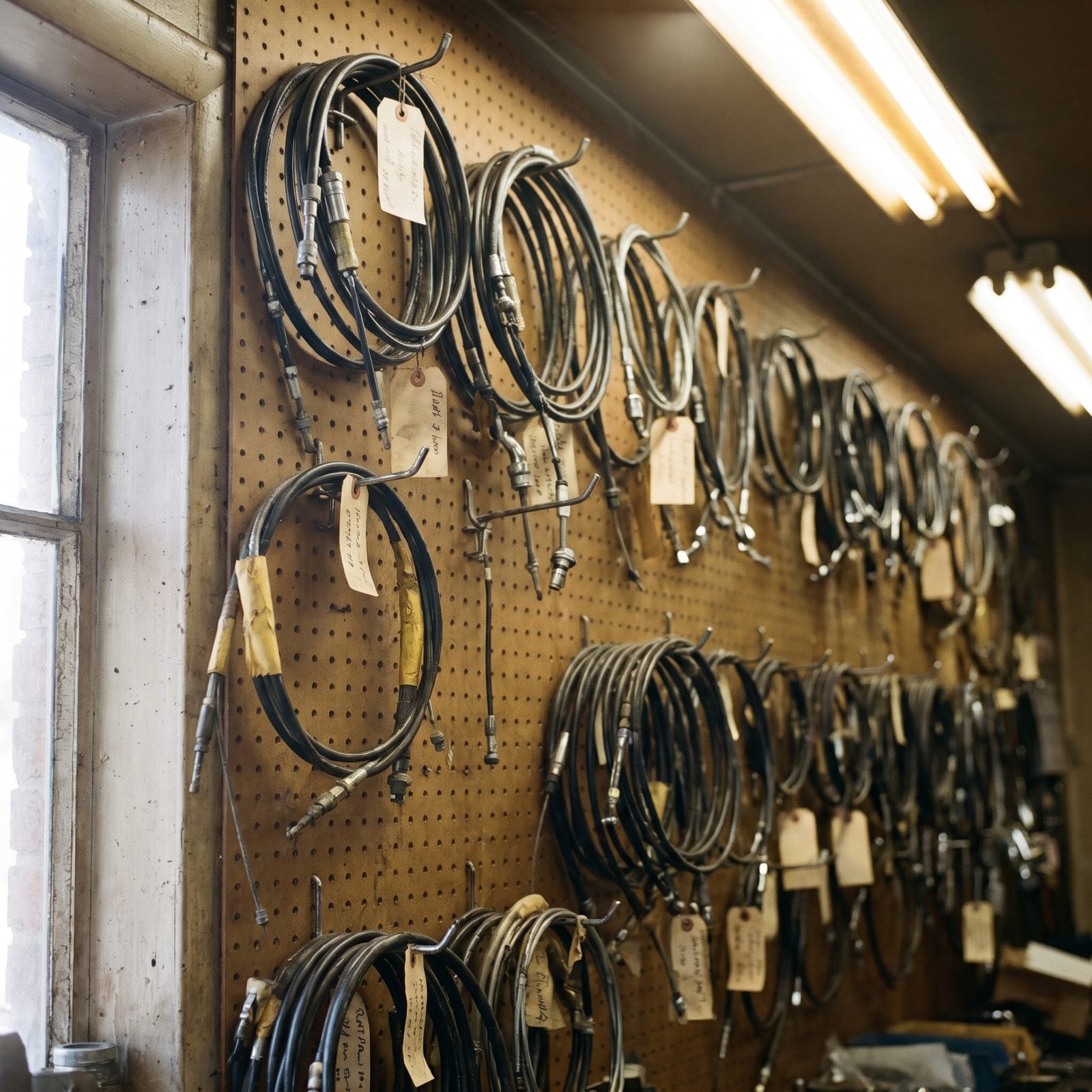
A good cable wall looked like a loom somebody abandoned halfway through. Hundreds of loops, hung by model, each tagged in pencil because nobody trusted the printed number alone.
Cables failed more back then. The housings stretched, the inner wire frayed strand by strand until one morning your throttle stuck or your clutch went dead at a light. So the parts man kept them thick on the hooks — Honda in one cluster, British bikes in another — and he could usually match yours by feel, running the old one through his fingers like a rosary.
44. Tiny Drawers of Carburetor Jets
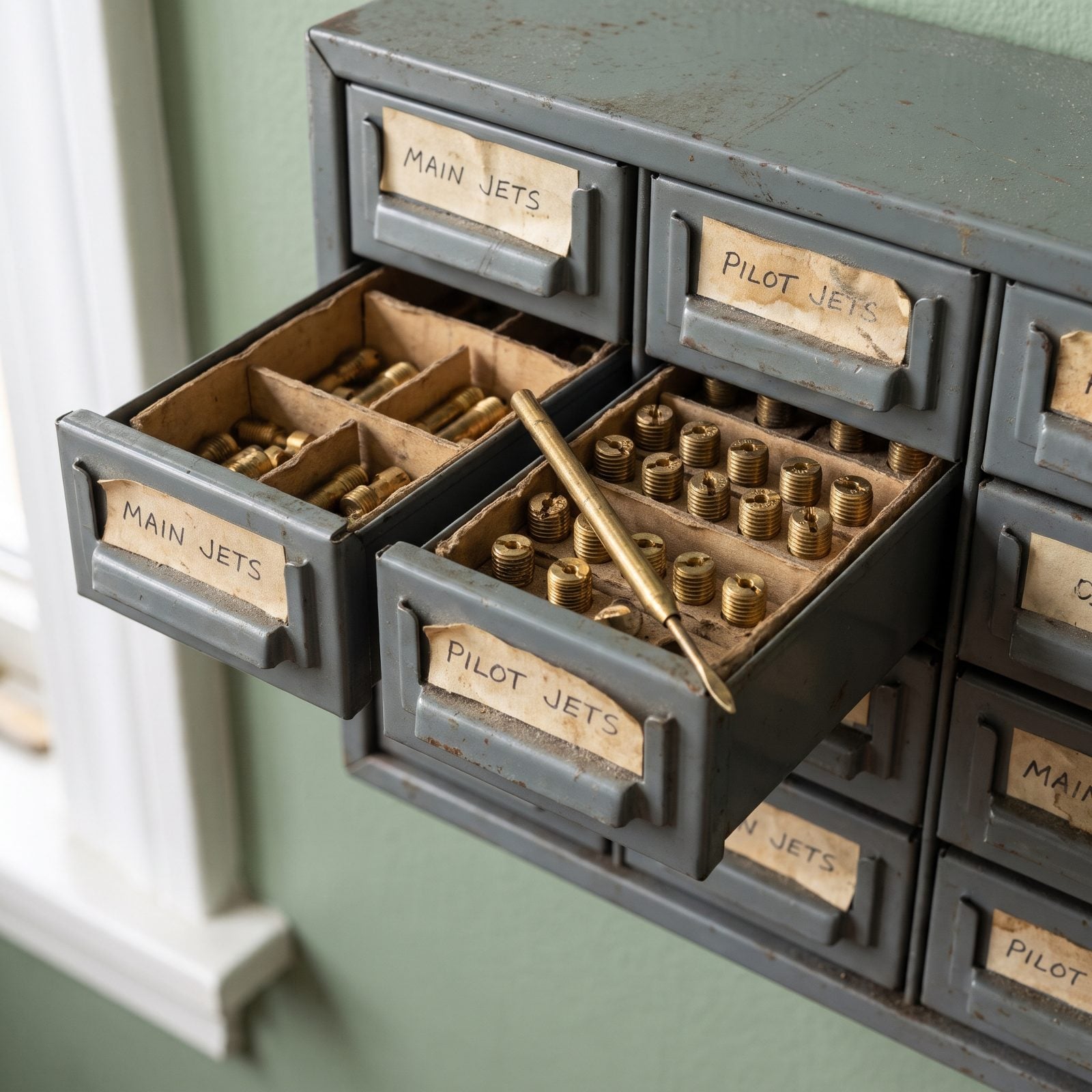
Pull one of these little steel drawers and you got a smell first — brass, old cardboard, a whiff of carb cleaner. Inside, rows of main jets and pilots no bigger than a shirt button, each stamped with a size you had to hold up to the light to read.
This was tuning before anyone plugged anything into anything. Moved to altitude? Swapped the pipes? You came in and bought a different jet, screwed it in, and chased the mixture by ear and by the color of the plug.
43. Bins of Ignition Points and Condensers
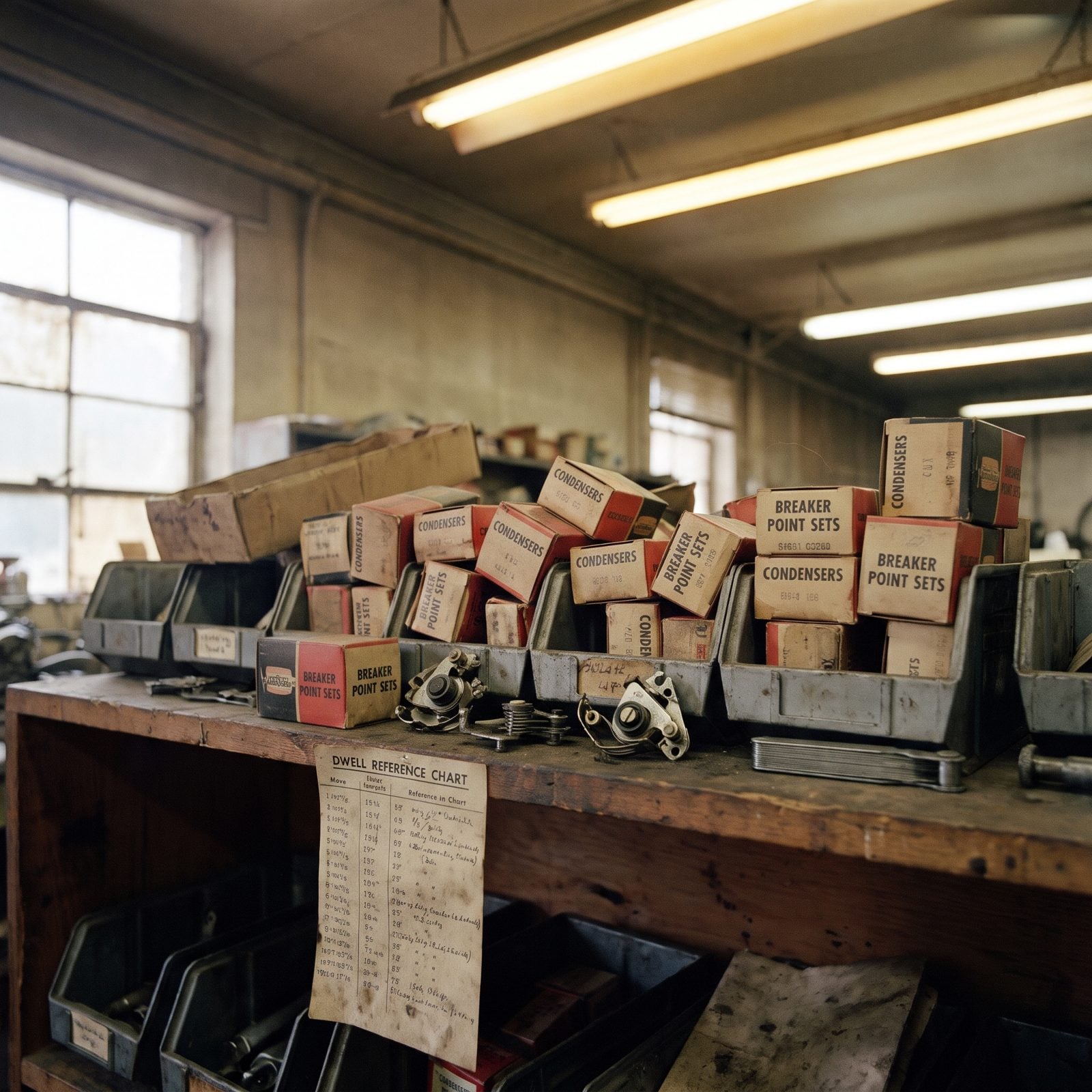
Points and condensers were parts you bought on a schedule, like oil. The little tungsten contact burned and pitted every few thousand miles, the gap wandered, and the bike started hard or missed on one cylinder.
So the bins stayed full. You’d grab a set, a new condenser if the old one looked suspect, and a feeler gauge if you’d lost yours again. Setting the gap on the kitchen table was a rite of passage. Electronic ignition killed this whole shelf by the early eighties, and plenty of old hands never forgave it for taking the ritual away.
42. Bulk Motorcycle Chain Sold by the Link
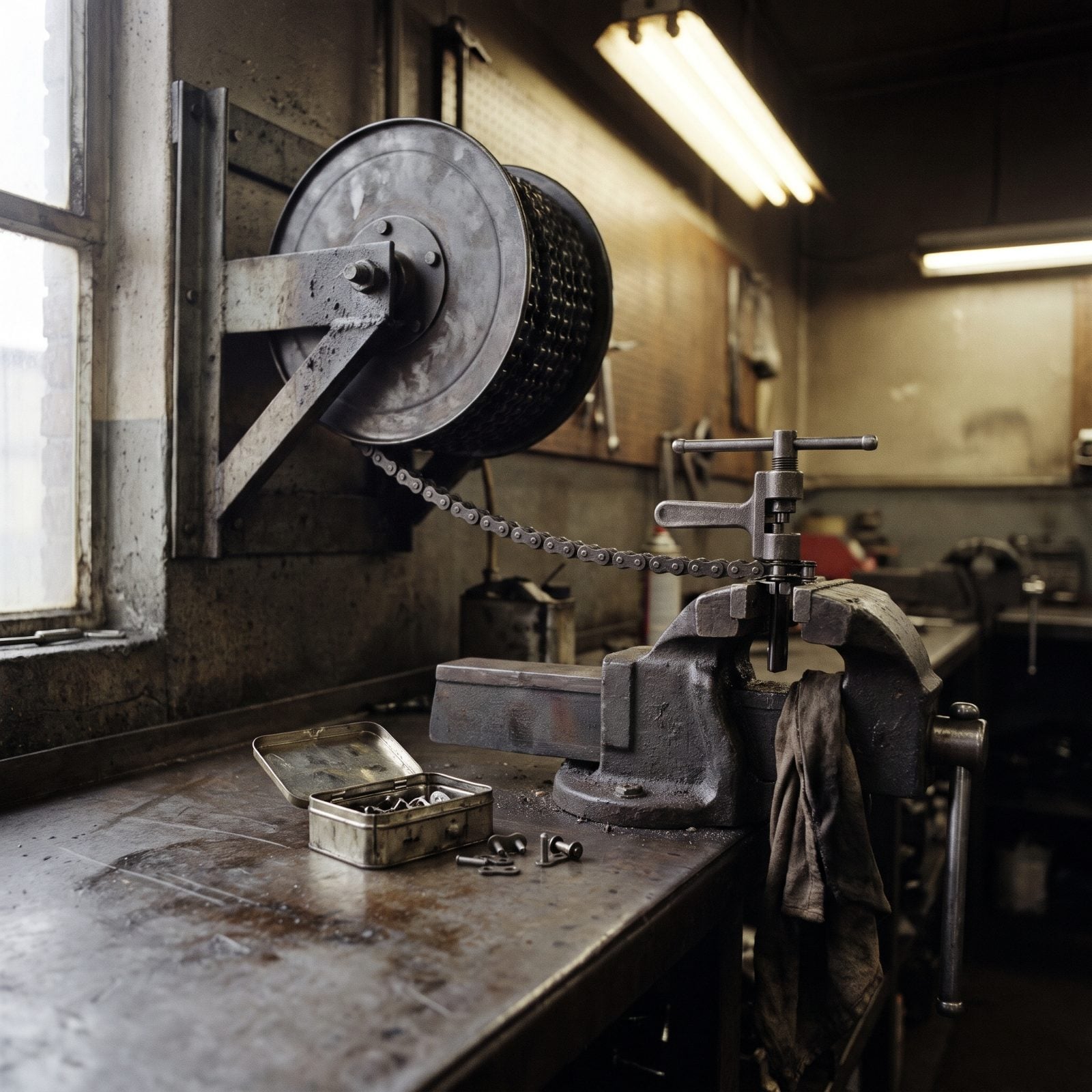
You didn’t buy a chain in a sealed box with a QR code. You bought it by the foot, cut to your bike off a greasy coil on the wall.
The parts man measured your old chain, counted the links, pulled fresh chain off the spool and ran it into the breaker clamped in the vise. One sharp push, the pin dropped out, and you walked out with exactly what you needed plus a master link in a twist of paper. Five minutes, and cheaper than the pre-packaged stuff ever ran.
41. A Wall Covered With Steel Sprockets
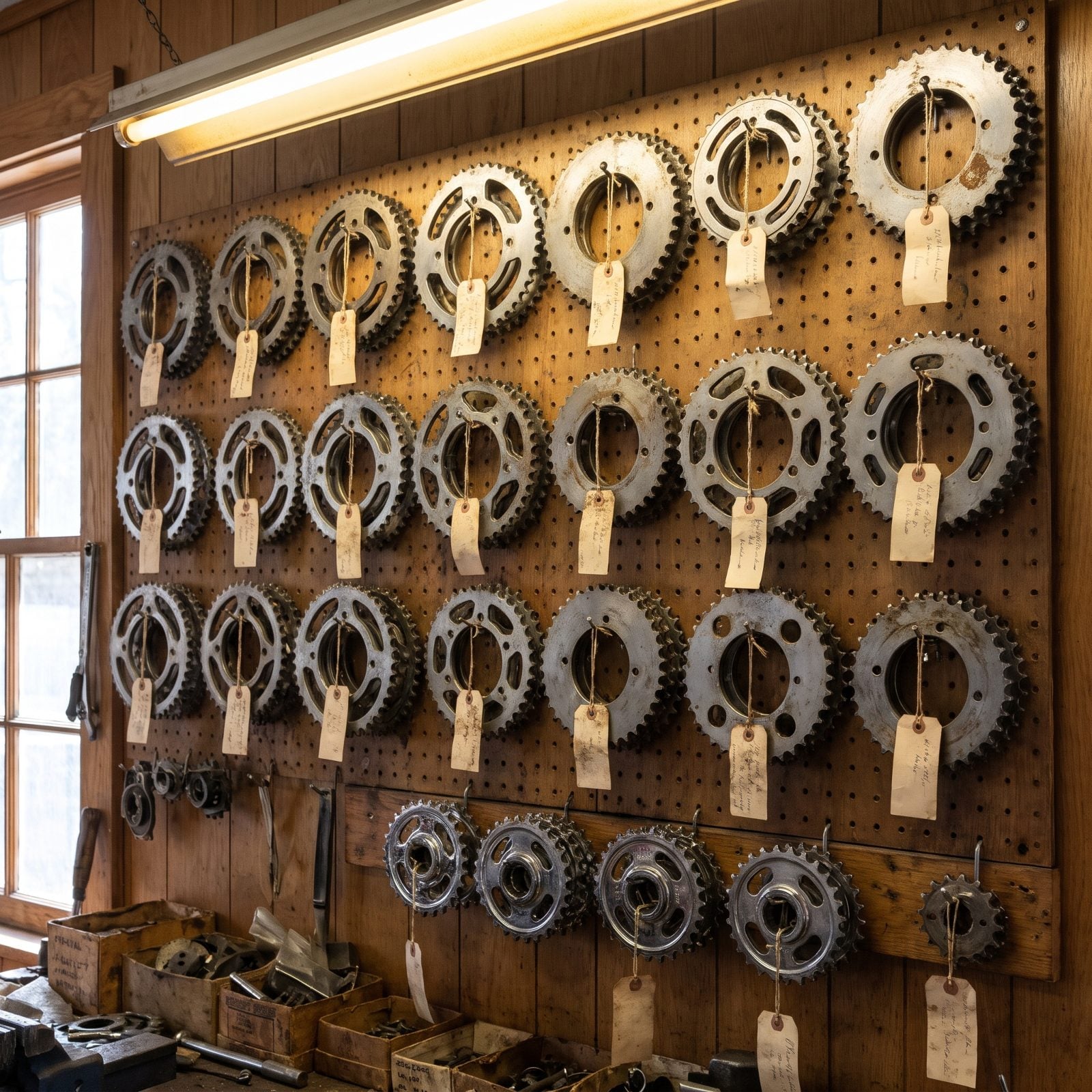
Row upon row of toothed steel discs, hung by tooth count, from little countershaft sprockets to big rear ones the size of a dinner plate.
This wall was about gearing, and gearing was personal. Highway riders wanted more teeth up front for top speed. Trail riders went the other way — taller sprocket out back for low-end grunt up a hill. For the price of a sprocket and an afternoon you could change the whole character of a bike, and the wall let you shop the options with your eyes.
40. Motorcycle Tires Stacked to the Ceiling
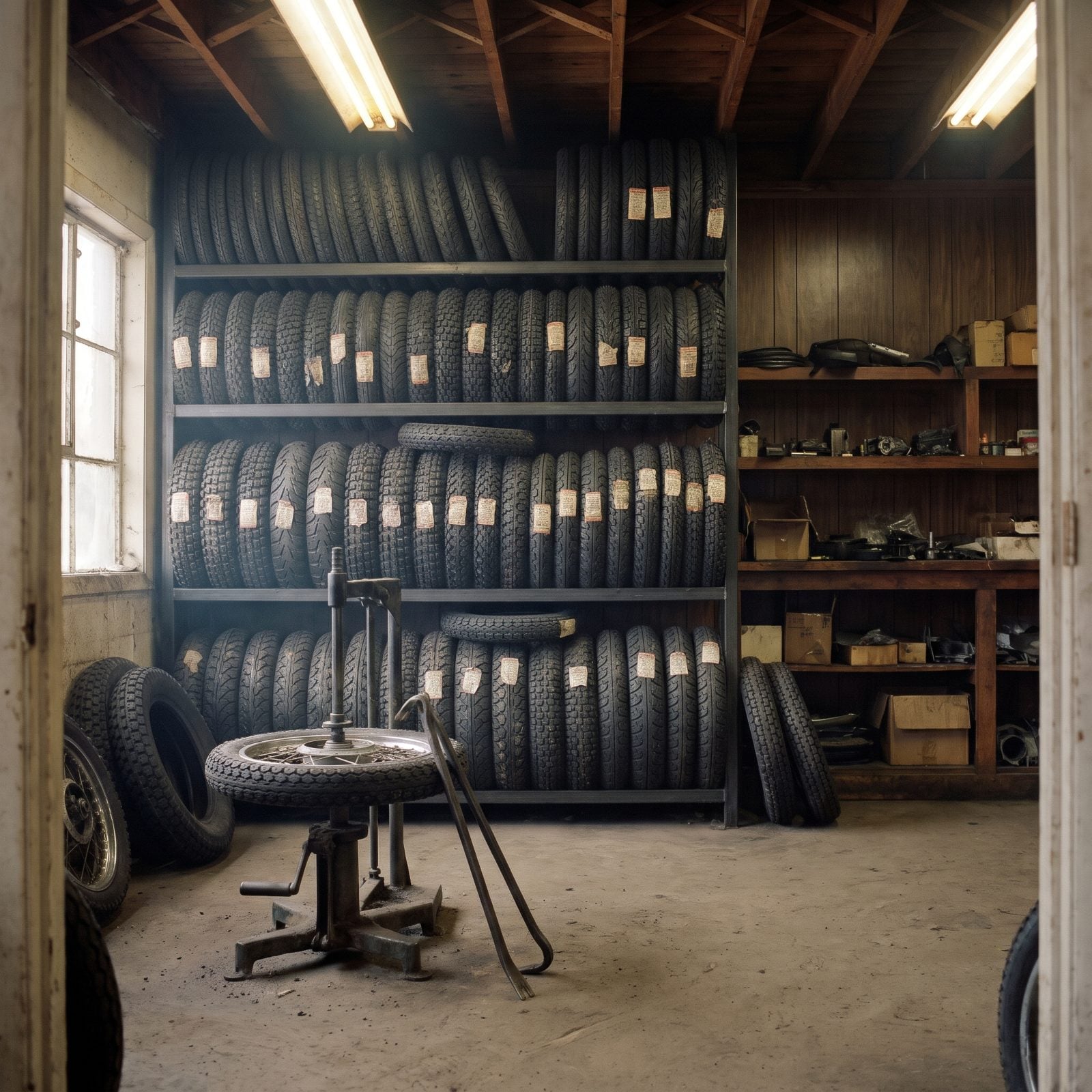
The tire wall smelled before you saw it. Raw rubber, that sweet chemical weight hanging in the air near the back of the shop where the columns climbed to the rafters.
Street treads on one side, knobbies for the dirt crowd on the other, sizes chalked on the sidewalls. A kid could spend an hour back there just looking at tread patterns and dreaming about the bike he’d buy once he saved up. The parts man would pull your size with a long hook and roll it to the changing stand up front, and you’d hear the pry bars working before you finished paying.
39. Cardboard Inner-Tube Boxes and Vulcanizing Patch Kits
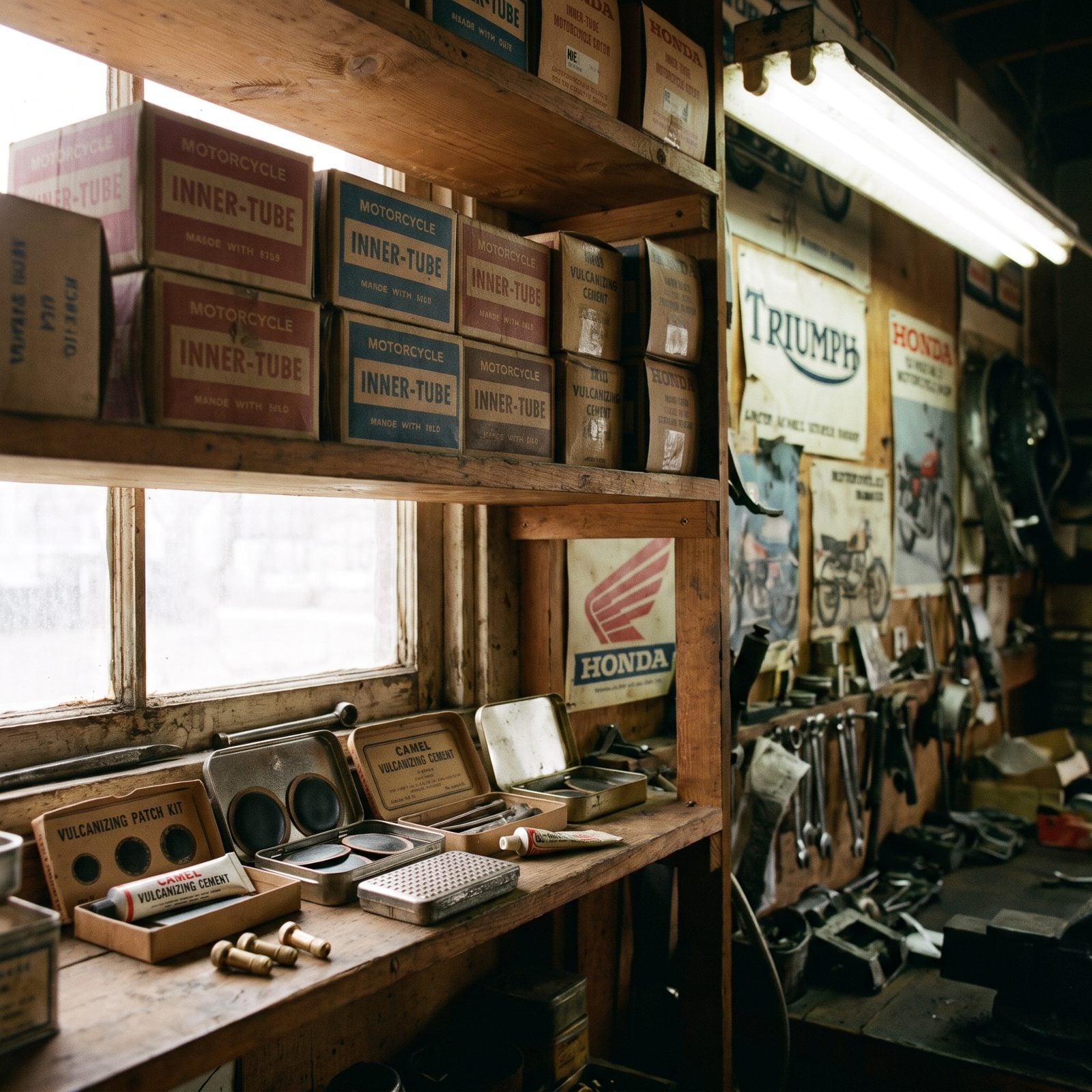
Flat cardboard boxes of inner tubes, stacked like library books, each printed in two colors because that’s all the printing budget allowed.
Next to them sat the little patch kits, and those are what most riders actually reached for. A round patch, a tube of rubber cement, a metal scuffer to rough up the rubber, and a match if you ran the hot-vulcanizing kind. A flat on a Sunday ride didn’t mean a tow. It meant pulling the wheel, finding the hole in a puddle of spit, and fixing it on the shoulder. The kit cost pocket change and saved your whole day more times than you could count.
38. The Tall Rack of Replacement Wheel Spokes
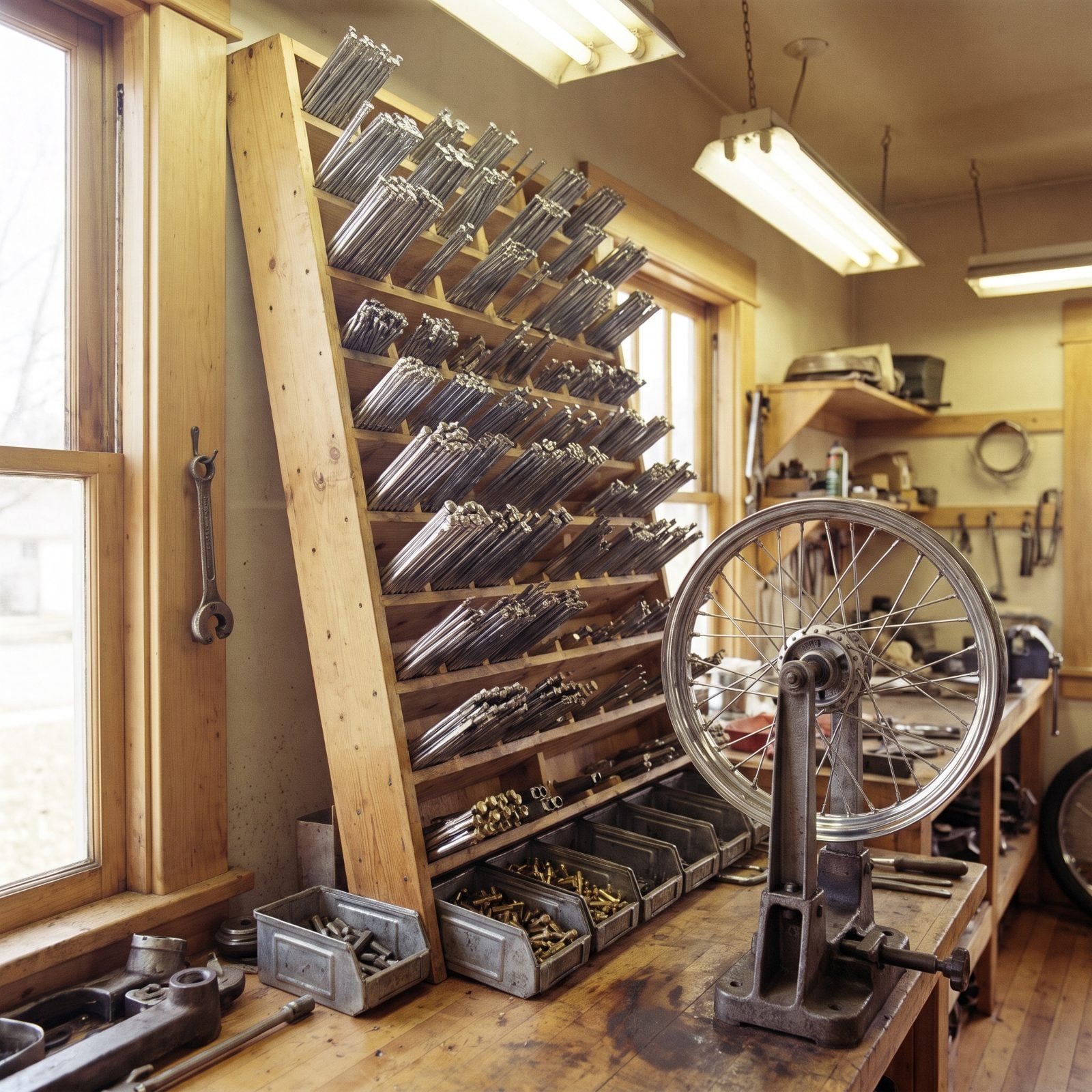
Stand in front of the spoke rack and you got hypnotized a little. Chrome spokes nested in angled slots by length, catching the light in parallel rows, nipples in bins below like loose change.
Spokes broke. Hit a pothole hard, land a jump wrong, and you’d hear the ping and feel the wobble. The parts man would measure your old one, find the match, and if you were lucky point you toward whoever in town could true a wheel. Replacing one spoke was cheap. Ignoring it until three more let go turned a five-minute fix into a bent rim.
37. Chrome Exhaust Pipes Suspended Overhead
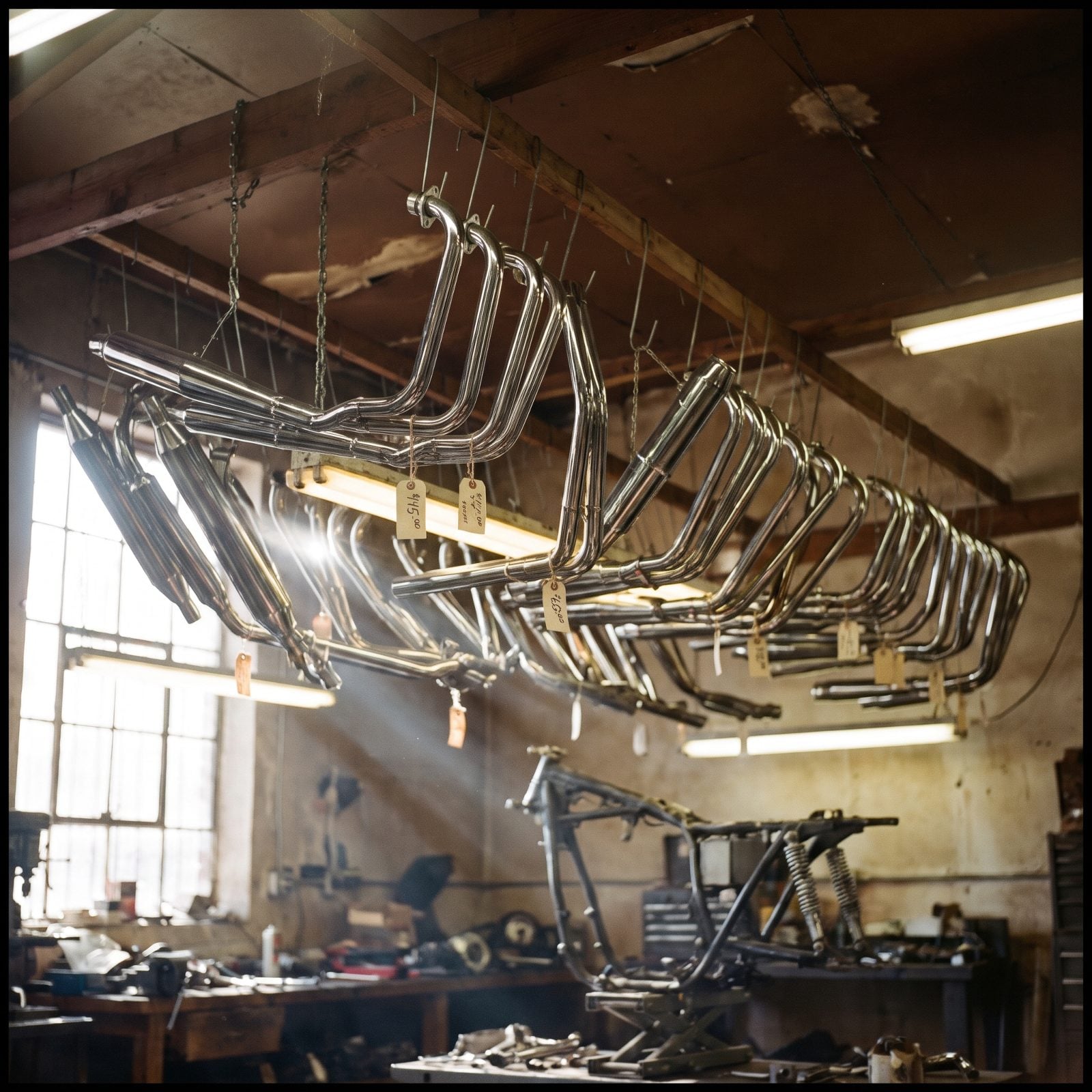
Look up. That’s where the pipes lived, hung from the rafters on wire and chain, turning slow in the draft and throwing chrome light around the room.
Headers, straight-throughs, those upswept scrambler pipes every teenager wanted. A new exhaust was the first mod most riders made, as much for the sound and the look as the power. You’d walk in for a cable and leave an hour later still staring up at the ceiling, doing the math on whether you could swing a set this month.
A shop you could smell from the sidewalk and hear from the parking lot was a shop doing it right.
36. Milk Crates Filled With Used Takeoff Parts
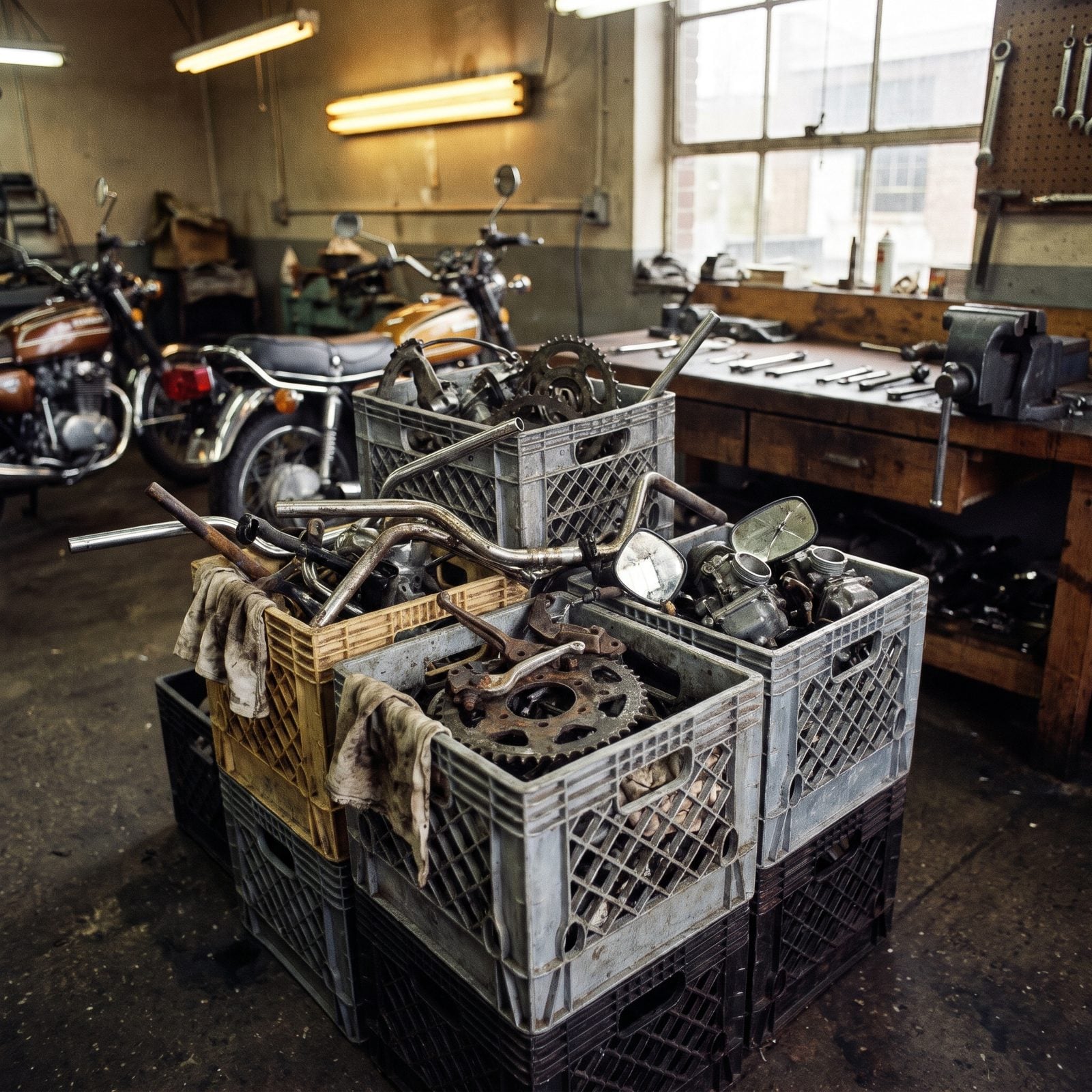
Every real shop had them. Crates of parts nobody could bear to toss, pulled off trade-ins and crash jobs, sorted by a system only the owner understood.
You dug through them because the new part was backordered six weeks and your bike was down now. A used clutch lever for a buck beat a shiny one you’d wait a month to get, and some of that chrome had three owners before you.
Half of it was junk. The other half saved a Saturday ride, and the trick was knowing which was which before you handed over the dollar.
35. A Wooden Bargain Bin of Discontinued Parts
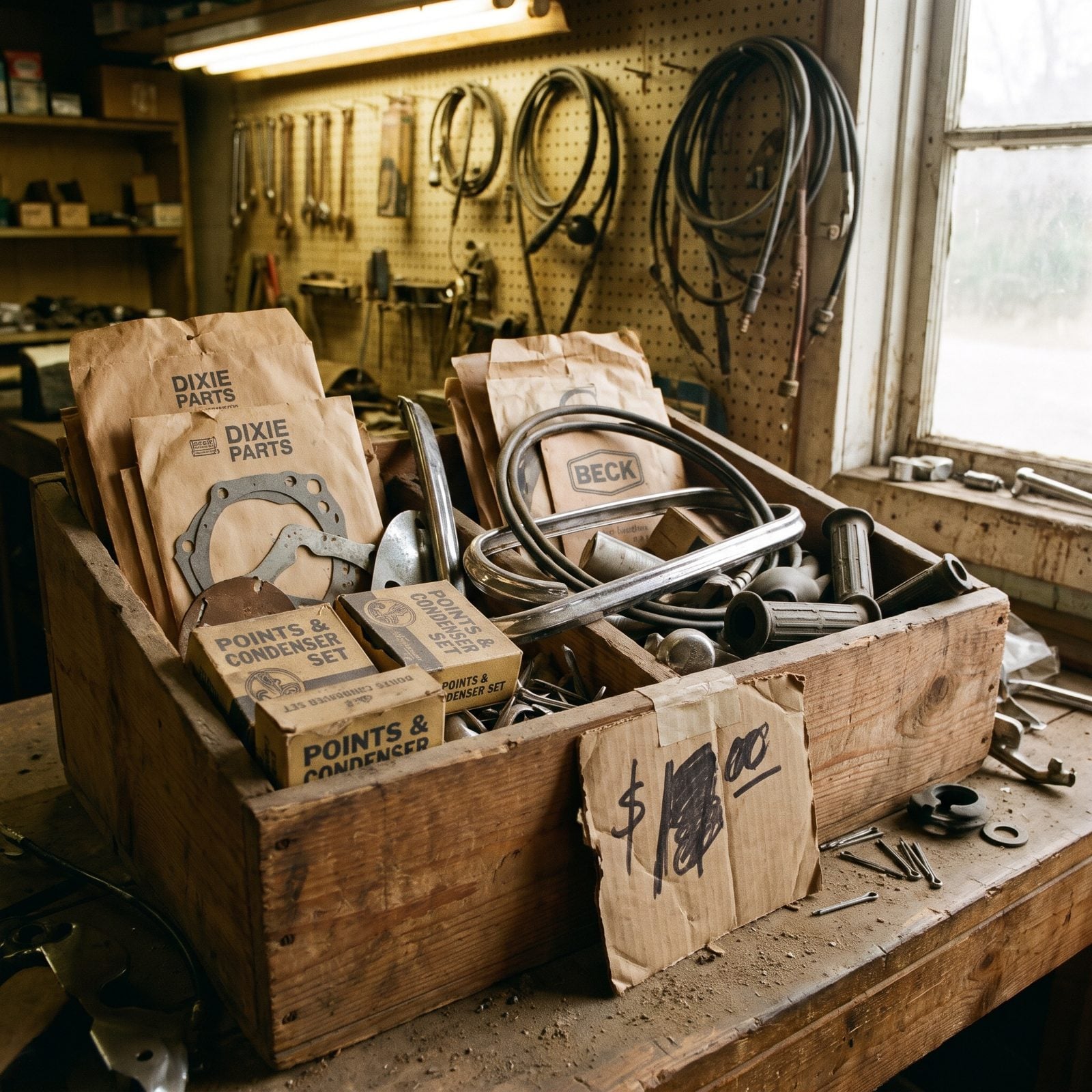
The bin where orphaned parts went to wait for the one rider who still needed them.
Models got discontinued fast back then. When a line died, the leftover inventory got dumped into that wooden bin at a quarter on the dollar — gaskets for a bike they stopped making in ’68, points for something British that was already more rumor than machine.
34. Pyramids of Quart-Sized Metal Oil Cans
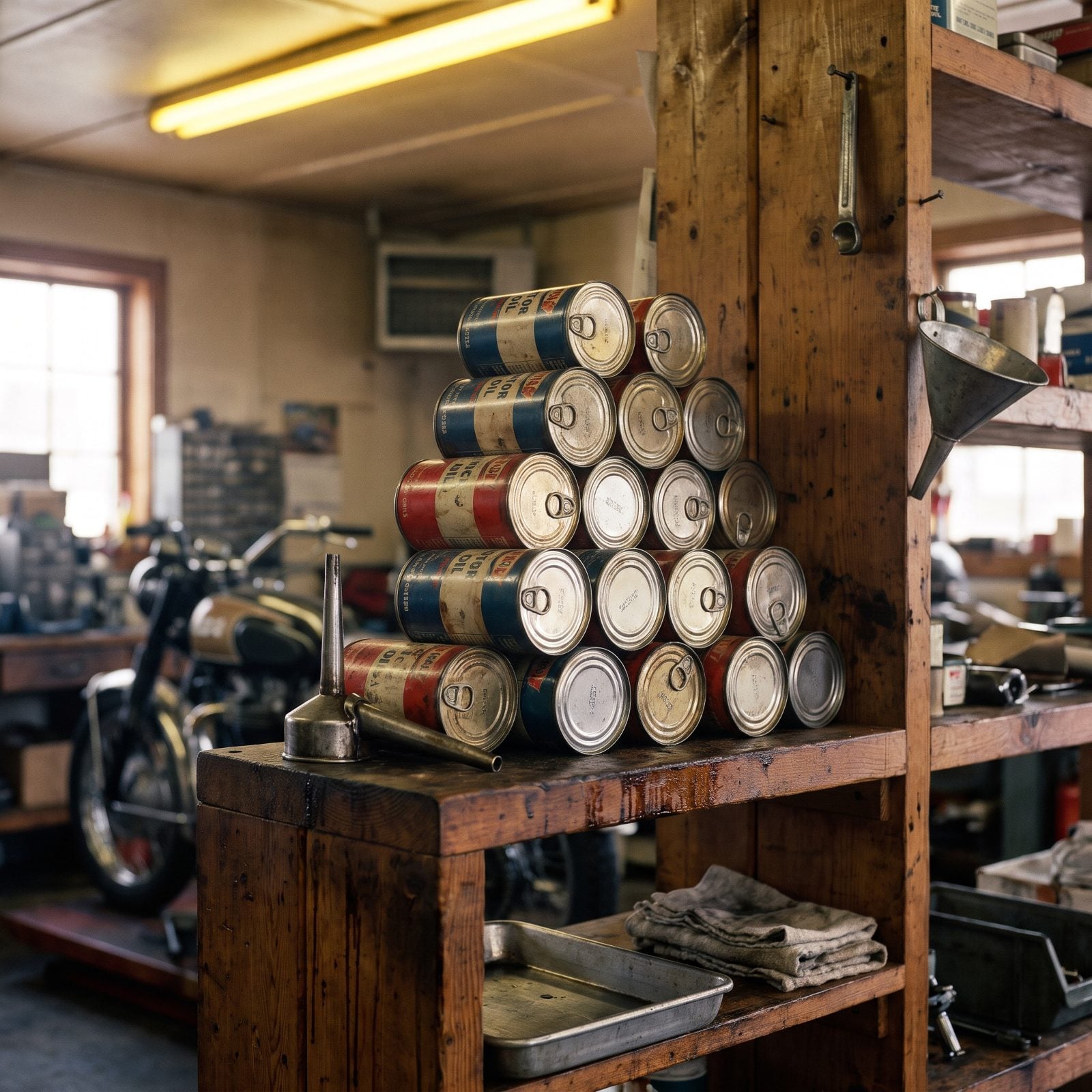
Oil came in steel, not plastic. You yanked the ring-pull on the lid and poured, and the empty can clanged in the barrel like a little bell.
That pyramid on the shelf was inventory and billboard both. Labels faced out, and you judged the place a little by how straight the stack stood.
Nobody recycled anything. The cans went in the trash and the oil went where oil went. We know better now. Back then, popping a quart was just part of the weekend.
33. Thick Paper Parts Catalogs With Dog-Eared Pages
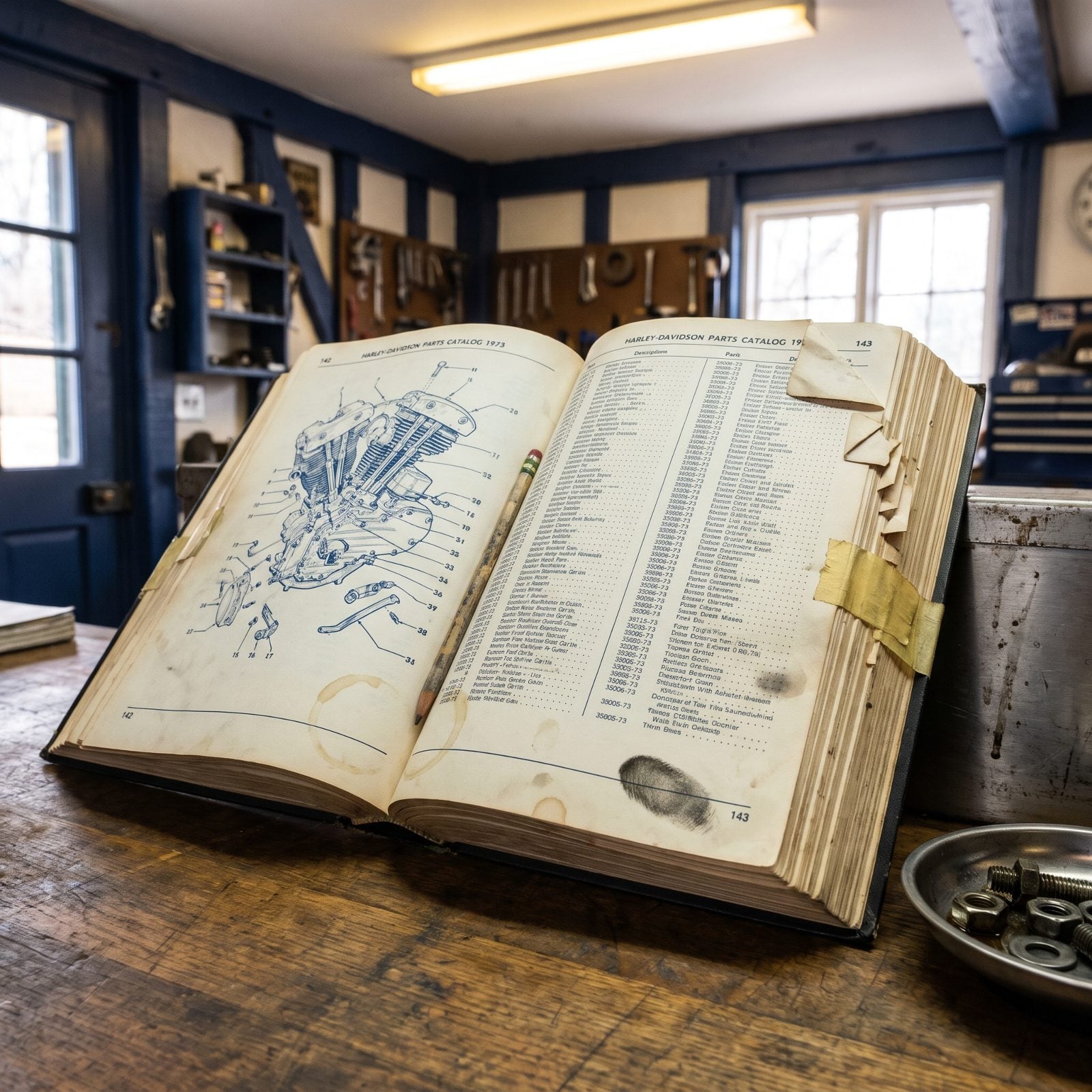
Before a screen could show you an exploded diagram, there was the catalog. Phone-book thick, printed small, heavy enough to prop a door.
You and the counter guy would lean over it together, a finger tracing down a column of part numbers, matching the little drawing to the thing in your hand. The dog-eared pages told you which bikes came through most — Honda sections went soft as cloth.
Finding the right part number was a two-person job, and the catalog was the referee.
32. Factory Shop Manuals Covered in Mechanics’ Notes
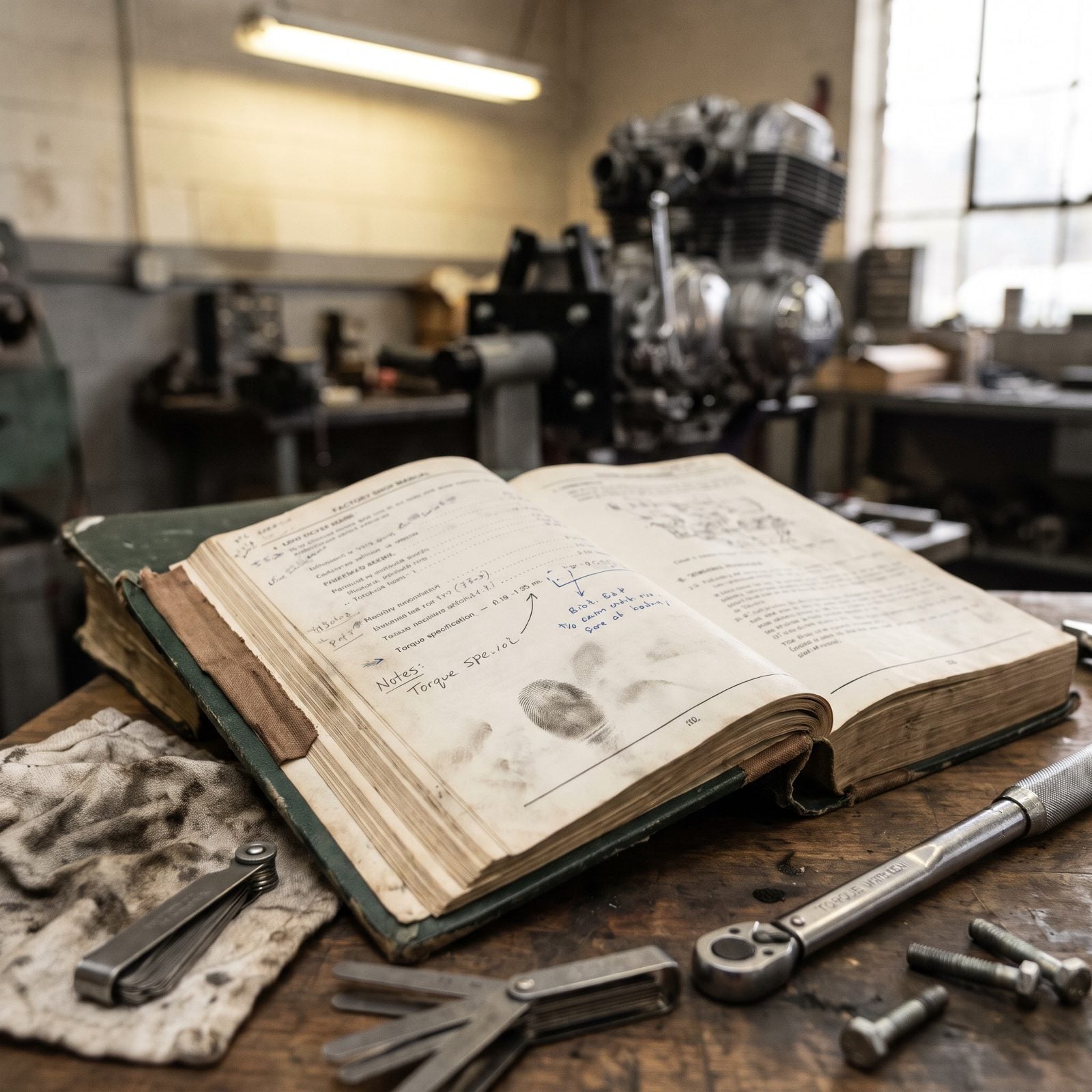
The factory wrote the manual. The mechanic rewrote it in the margins.
Every shop had that one copy, binding held together with tape, pages fat with handwritten corrections — a torque spec crossed out and replaced, a note beside a tricky carb sync that said, in pencil, “book is wrong, do it this way.” That scribble was worth more than the printed page.
31. Carbon-Copy Repair Orders Written by Hand
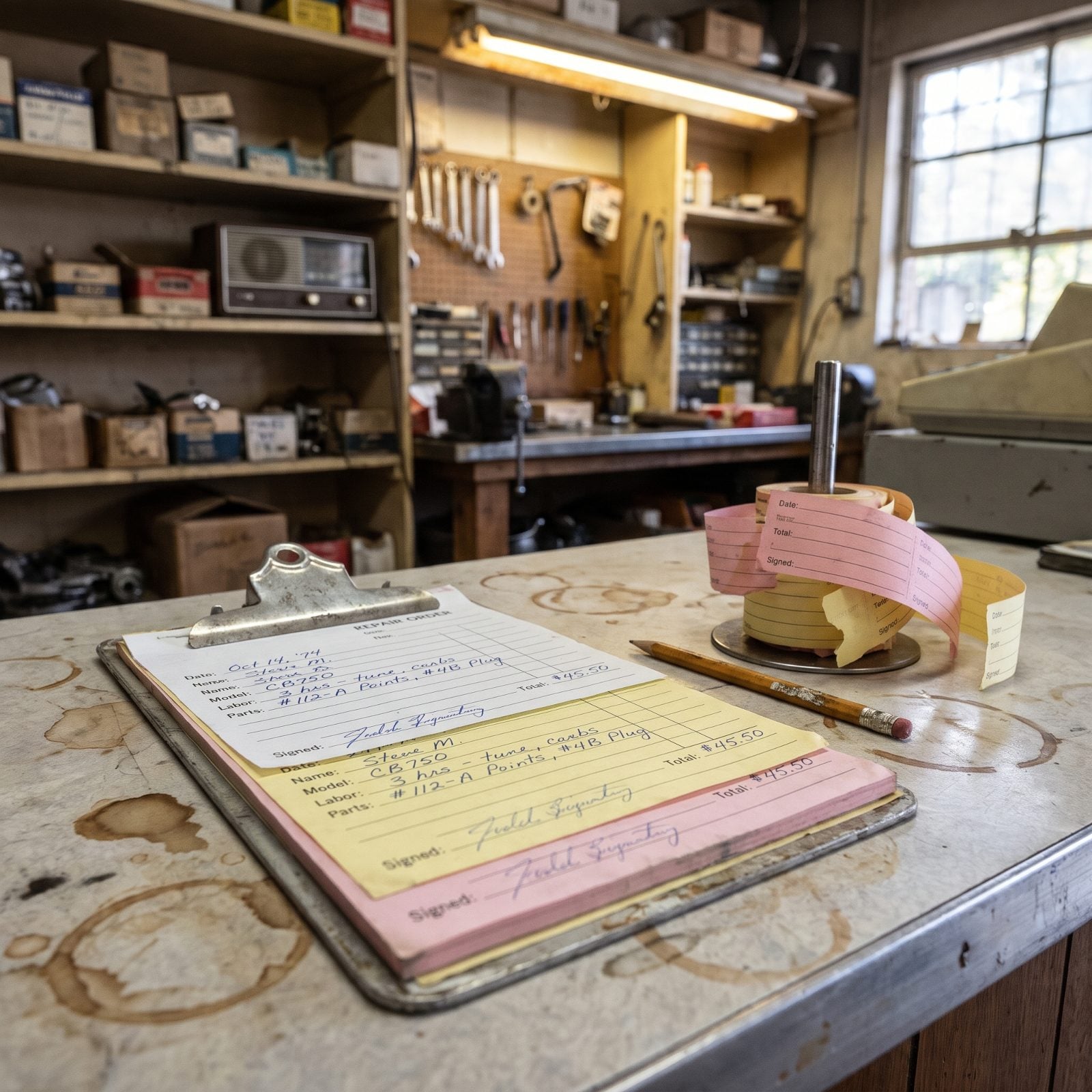
No printer. No tablet for a signature. A three-part carbon form and a pencil that had to press hard enough to reach the pink copy underneath.
You got the yellow sheet with the shop’s scrawled estimate on it. The hours were honest or they weren’t, and you learned which shops were which.
The writing was often terrible. You’d squint at “replaced L/F fork seal, bled brakes” and trust it anyway, because that handshake was the whole warranty.
30. A Heavy Mechanical Cash Register
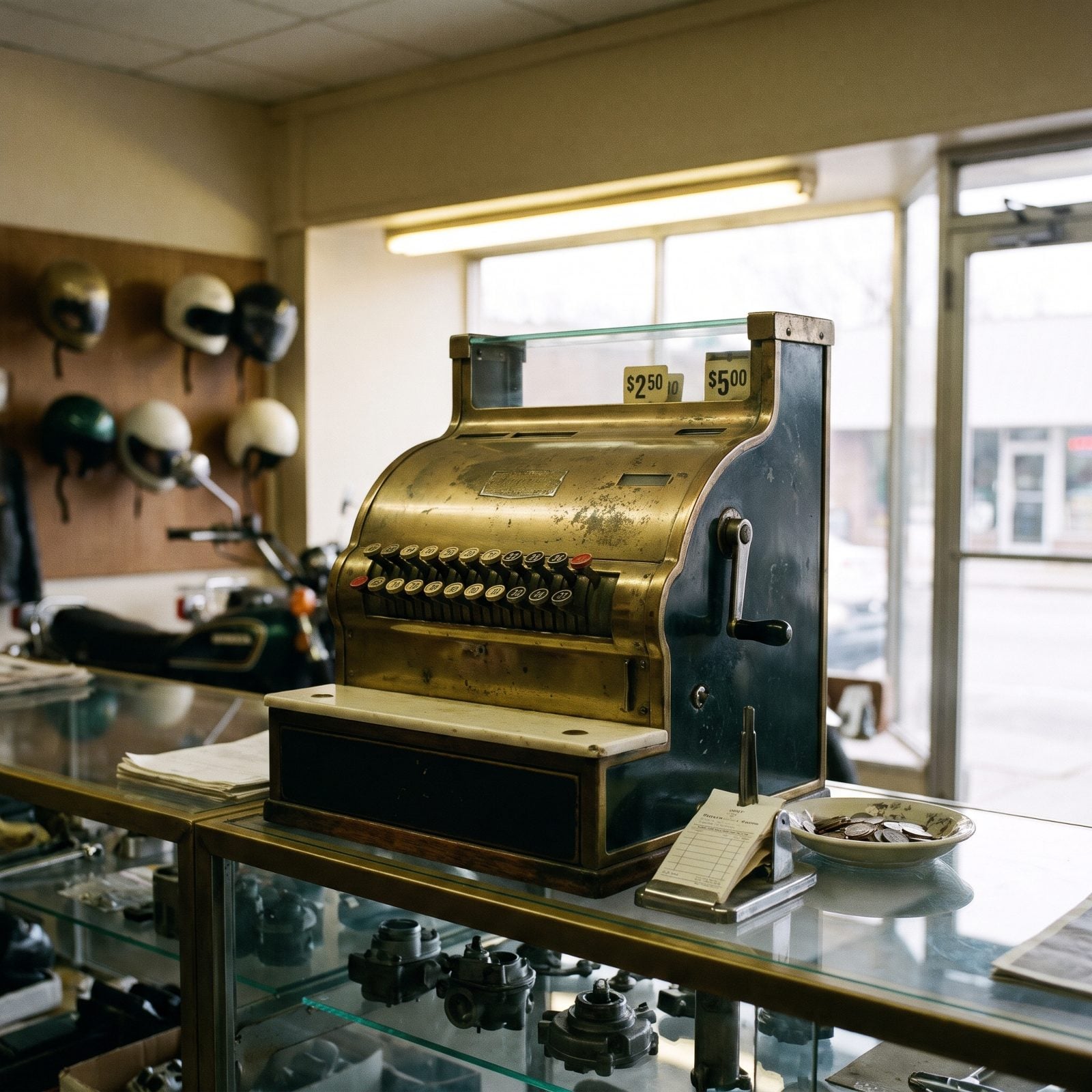
It weighed as much as a small engine and sounded like one. Punch the keys, pull the lever, and the drawer shot open with a bell loud enough to hear in the back.
No screen told the customer the total. Little tabs popped up in the glass window and you read it off like a scoreboard, and your change got counted back into your palm out loud, the old way almost nobody bothers with anymore.
29. The Countertop Rotary Telephone
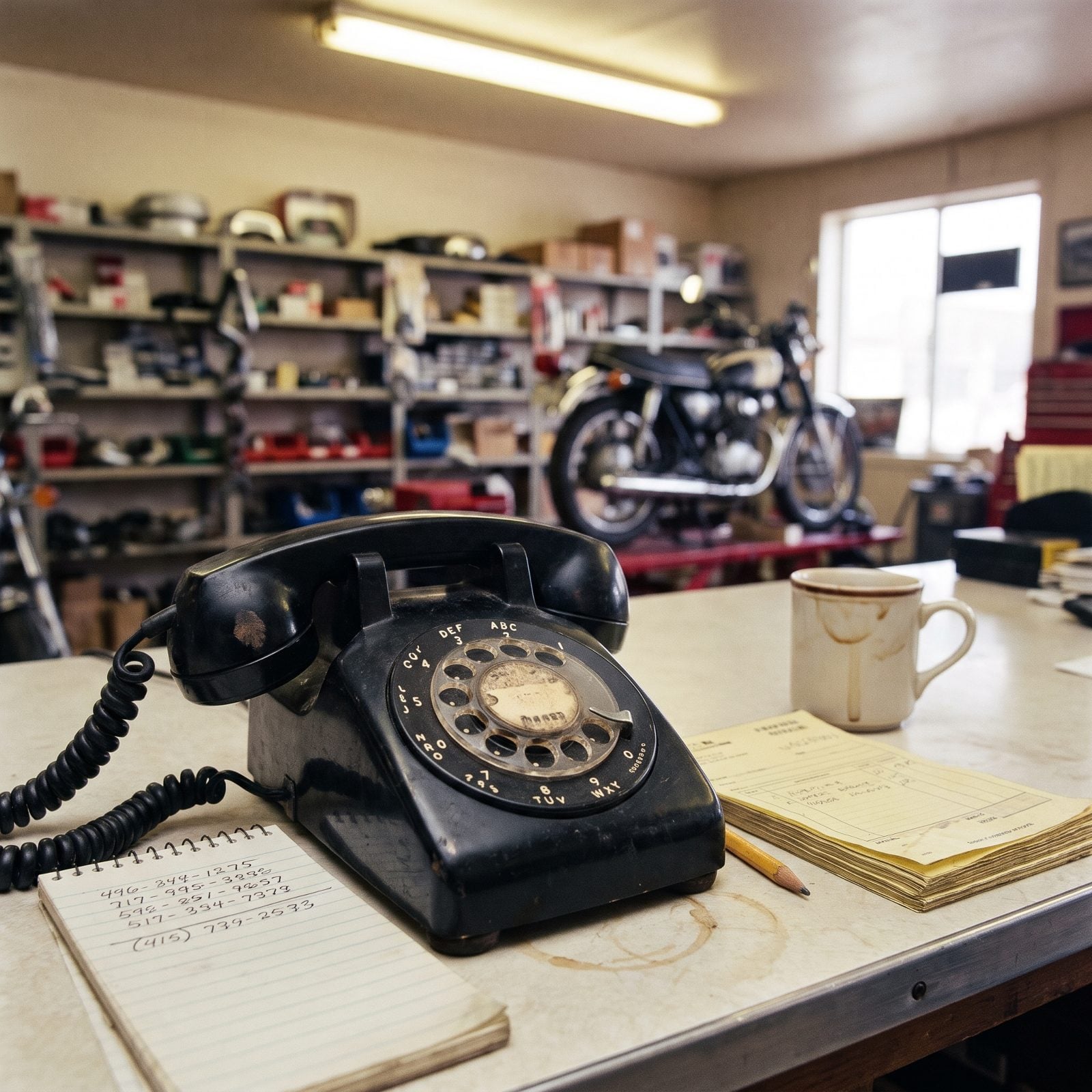
One line. That was it. If the counter guy was on it, you waited, and so did whoever was calling about their part.
The receiver wore a permanent grease smudge from hands that never fully came clean. The cord stretched just far enough to let him grab a catalog off the shelf while he talked, and dialing a parts distributor meant spinning that wheel seven times, waiting for it to clack back after each number.
28. A Percolating Coffee Pot With Mismatched Mugs
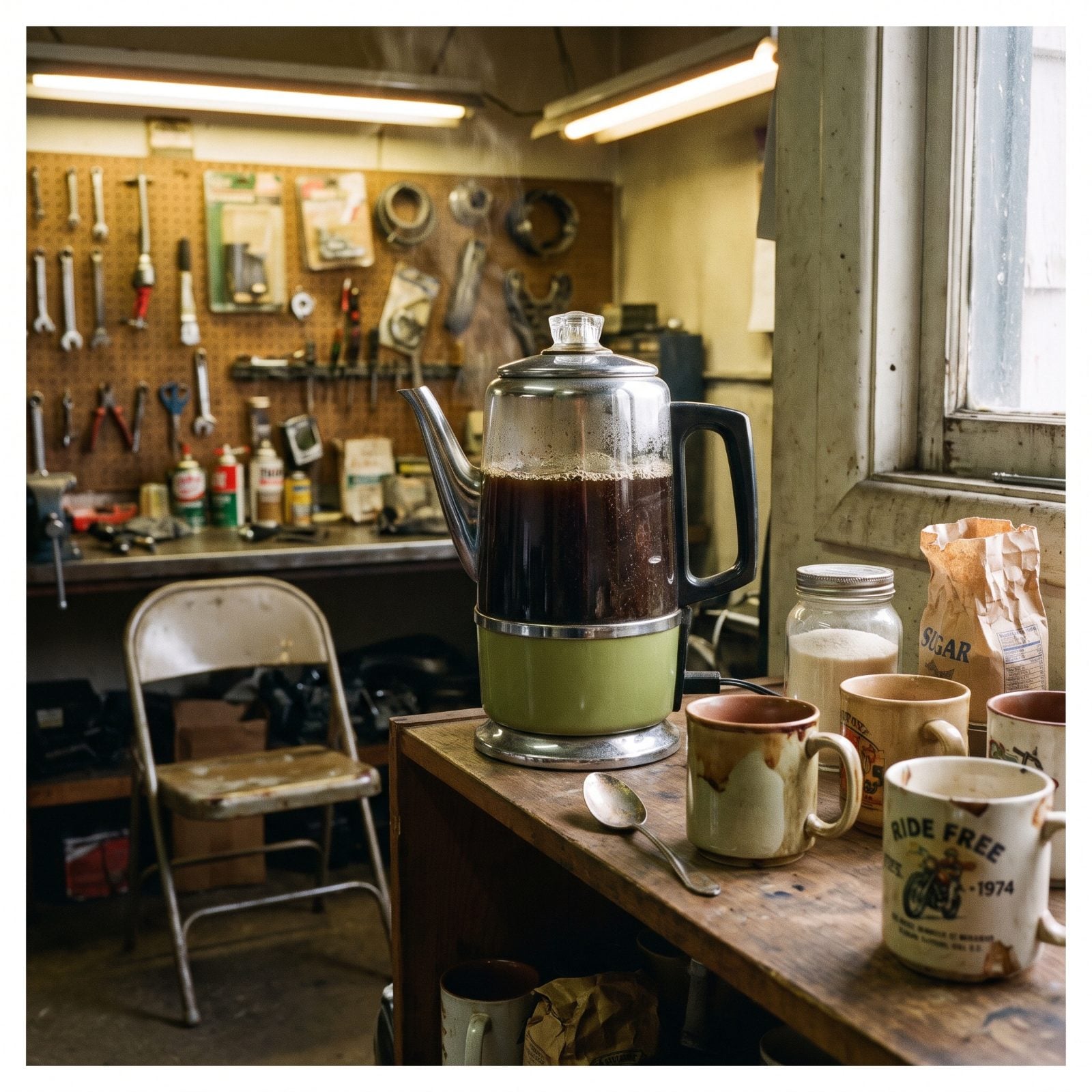
The social engine of the whole place sat in the corner, burbling.
No two mugs matched. One had a dealership logo worn half off, one was somebody’s from home that never went back. The coffee ran strong and a little burnt, free if you were a regular or looked like you might become one.
That corner was where the real business happened. Riders hung around, swapped where the cops were running radar, argued Triumph versus Honda, and talked themselves into or out of the used bike on the board. The coffee was the excuse. The talk was the point.
27. The Corkboard of Used Bikes and Parts for Sale
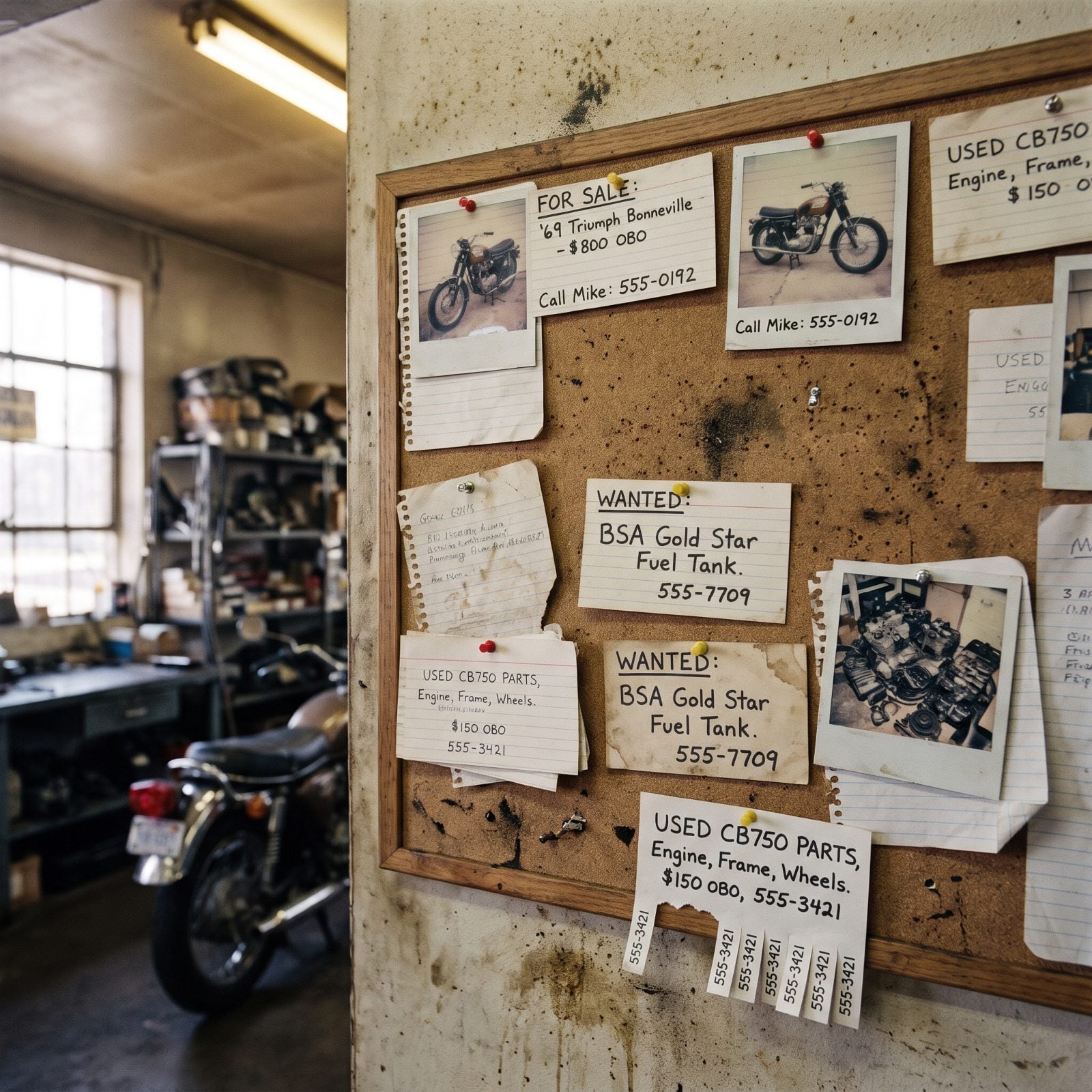
Craigslist before there was a wire to plug it into. A square of cork by the door, layered with index cards gone soft and yellow.
Somebody’s clean 650 for sale with a blurry Polaroid thumbtacked beside the card. A box of spares, cheap, call after six. Riding gear from a guy who’d quit after a scare and wanted it gone. You read the whole board every time you walked in, buying or not.
26. Free Paper Road Maps Marked With Favorite Routes
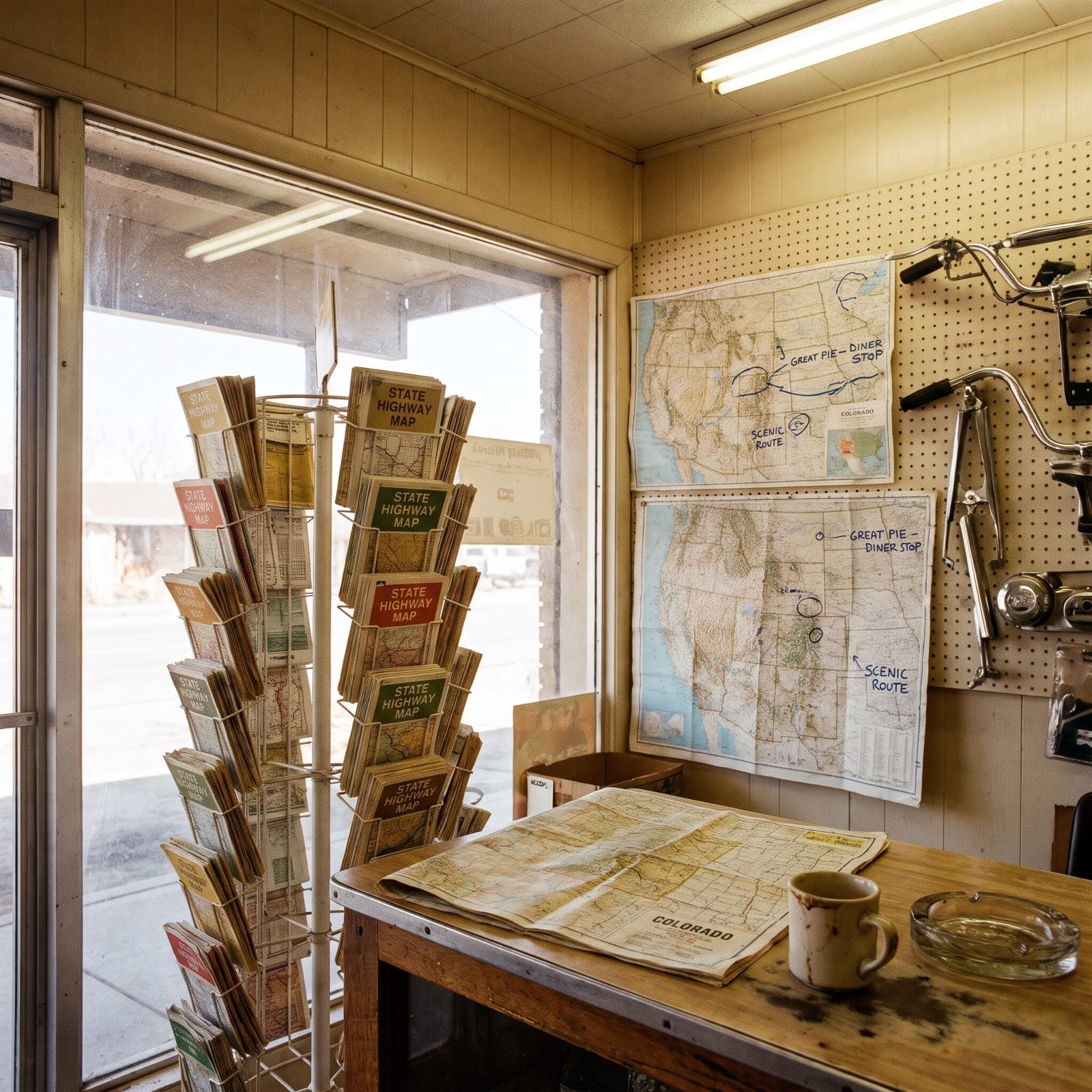
The maps were free, and that was half the point. A rider would wander in for a chain and leave with three state maps folded wrong and a route drawn in pen by whoever happened to be behind the counter.
Those ink lines mattered. They skipped the interstate on purpose, sent you over the pass with the good pavement, and warned you off the stretch with the gravel wash-out nobody ever fixed. A paper map didn’t reroute you. It just sat there and trusted you to read it.
25. Framed Posters of Road Racers and Motocross Heroes
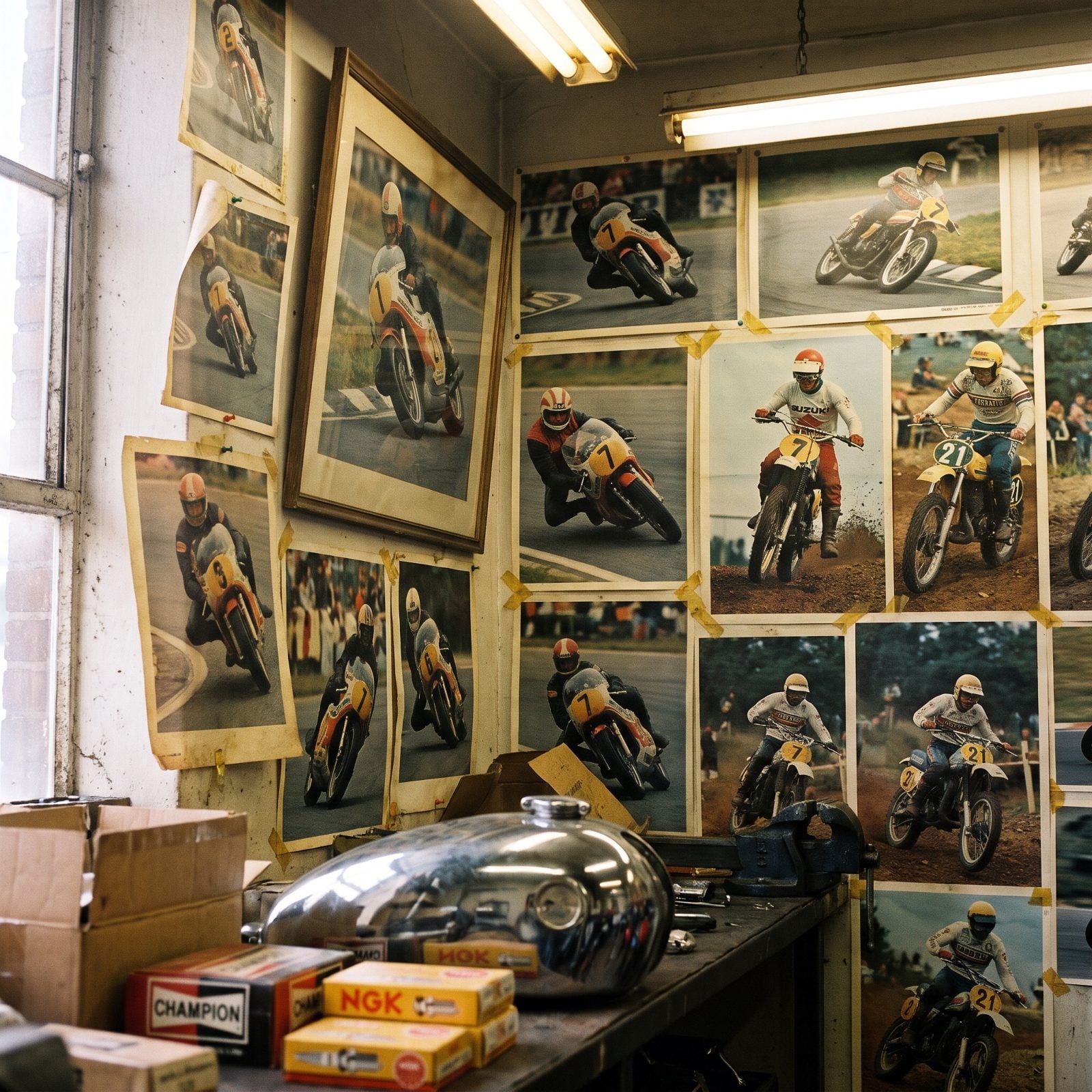
Every shop had a wall. Racers knee-down in a corner or charging through the mud, dirt flung in a rooster tail behind the rear wheel, a number plate catching the light. Nobody dusted them, and the sun did its slow work on the ones near the window, bleaching the reds first.
You looked at those posters the way kids look at anything they want to become. The heroes up there raced on bikes you could almost afford, which made the whole thing feel close enough to touch. That was the shop’s quiet sales pitch, and it worked better than any salesman ever could.
24. A Trophy Shelf From Local Races
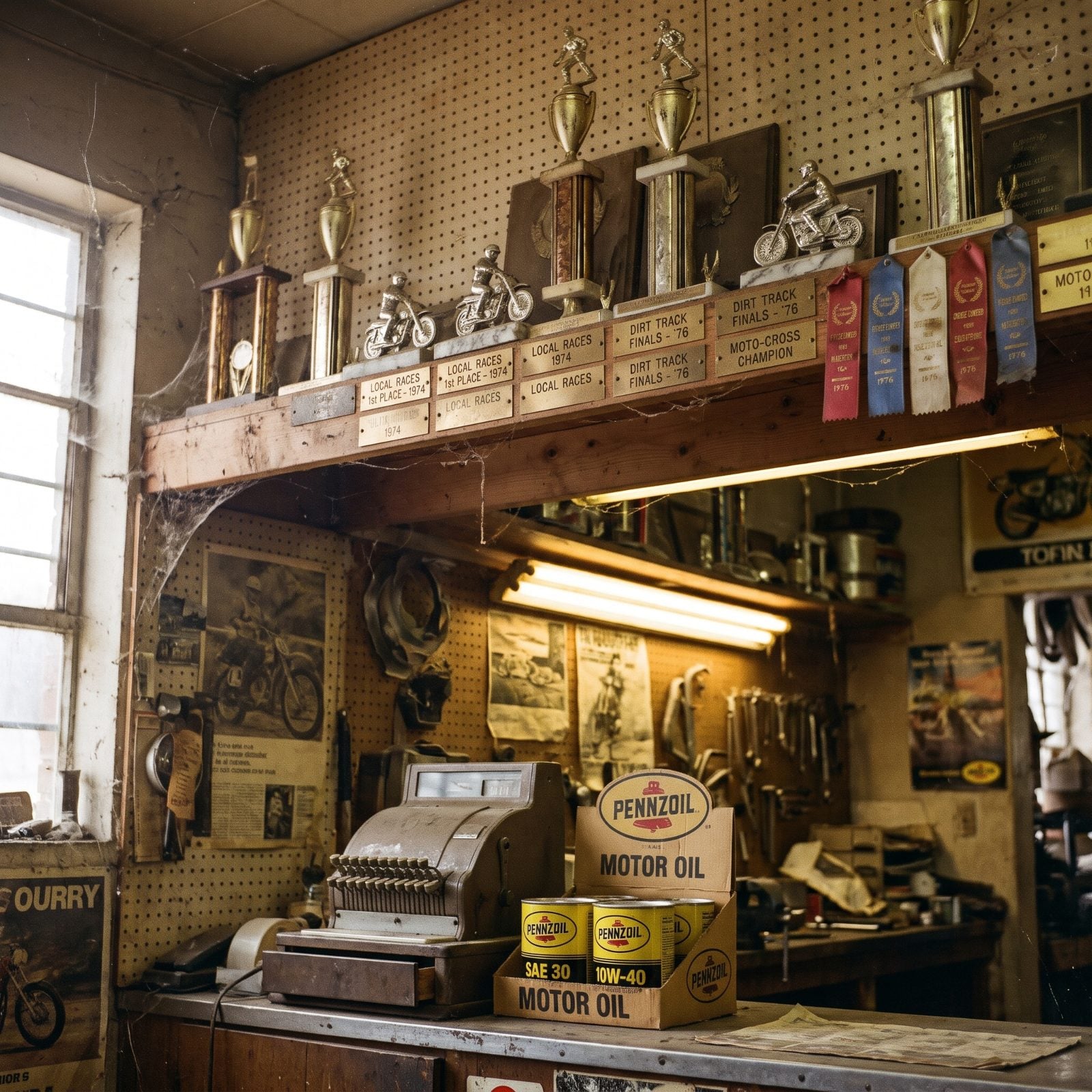
Up near the ceiling, where only the dust bothered to go, sat the trophies — little gold riders leaning into corners that existed thirty years earlier on a dirt oval outside town.
These weren’t for sale and weren’t in any brochure. They were proof. The guy turning your wrench had gone fast once, maybe still did on weekends, and the engraved brass plate said so. You trust a shop more when the mechanic has crashed and gotten back up.
23. A Glowing Neon Sign in the Front Window
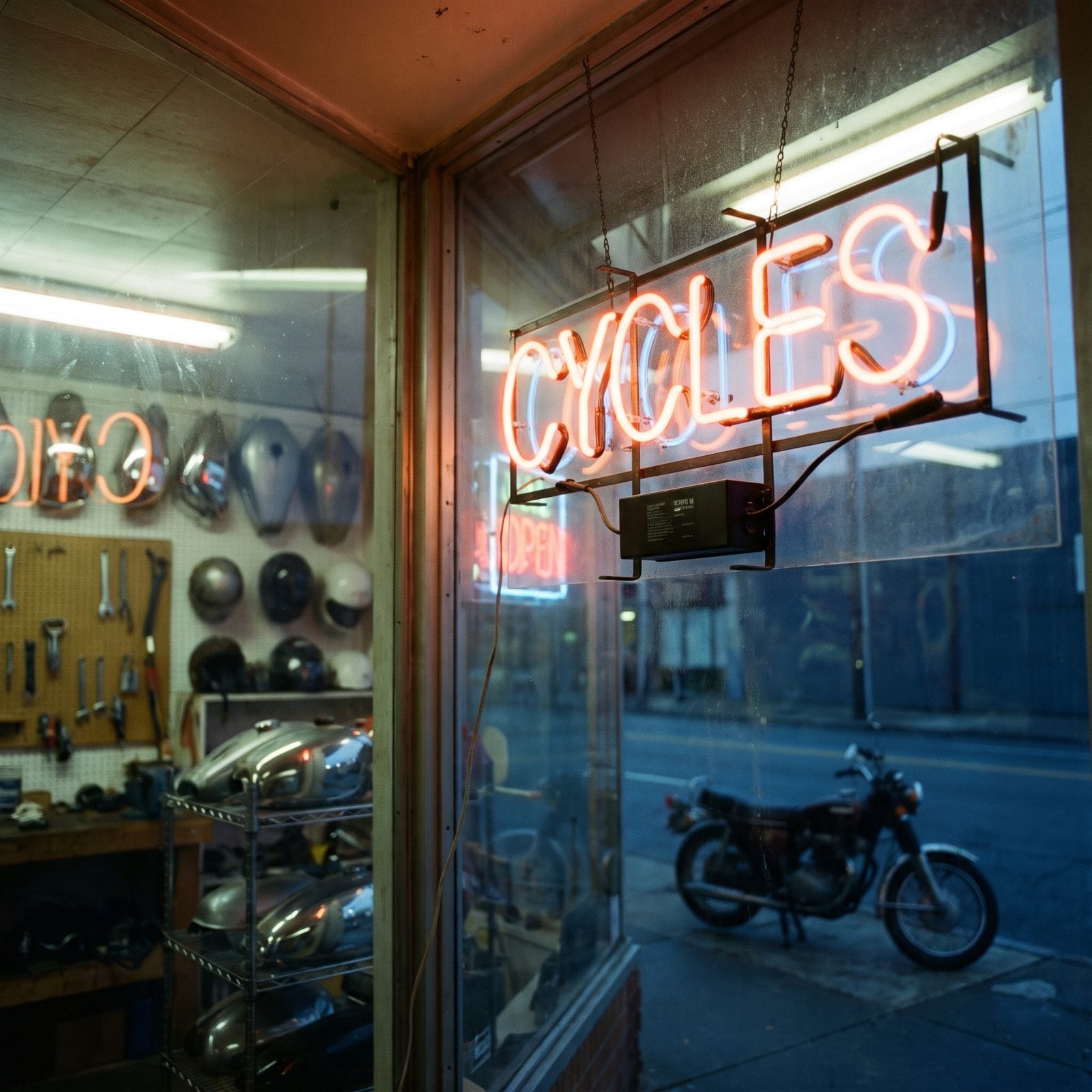
The neon came on before the lights inside did. A warm orange hum in the front window, low enough that you only noticed it when somebody flipped it off.
Here’s what a lot of people miss about old neon: it was never bright. It glowed. Modern signs blast you. Neon just sat there in the glass, warm and a little uneven where the tube had been bent by hand, and on a wet night the color smeared across the sidewalk like somebody had spilled it.
22. New Motorcycles Parked Handlebar to Handlebar
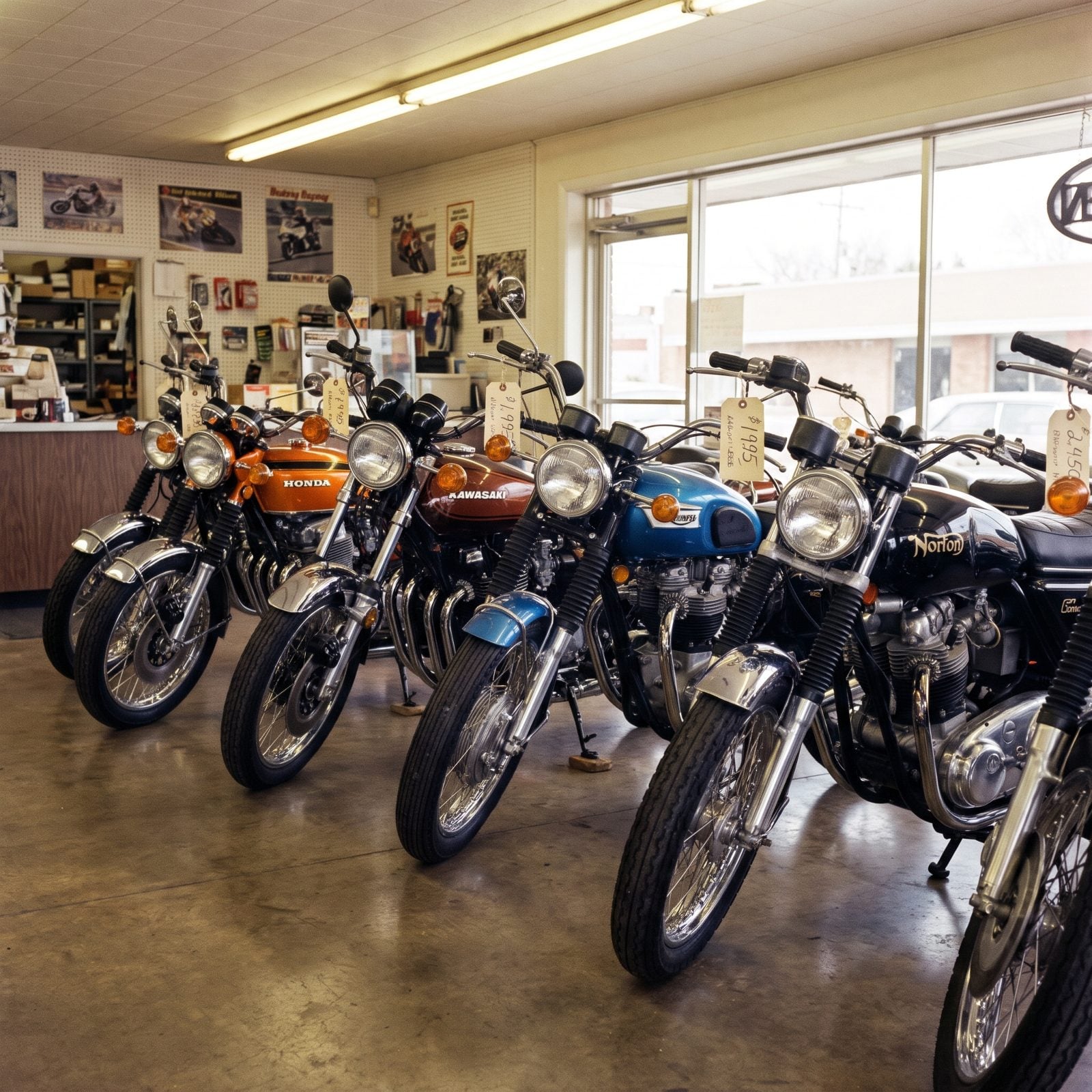
They packed them in tight — handlebar nearly touching handlebar, angled just so, a whole row of new machines bouncing the overhead tubes off candy-orange and root-beer-brown tanks.
Standards, mostly. Round headlight, upright bars, a seat you could actually sit on for a full day. No fairings, no screens, nothing to hide the engine. You walked the row with your hands in your pockets because touching felt rude, and you knew within three bikes which one you’d ride home if the money were different. It never was. But you knew.
A showroom floor in 1974 smelled like new rubber, fresh chain lube, and whatever the salesman had for lunch.
21. Trade-Ins With Handwritten Price Cards
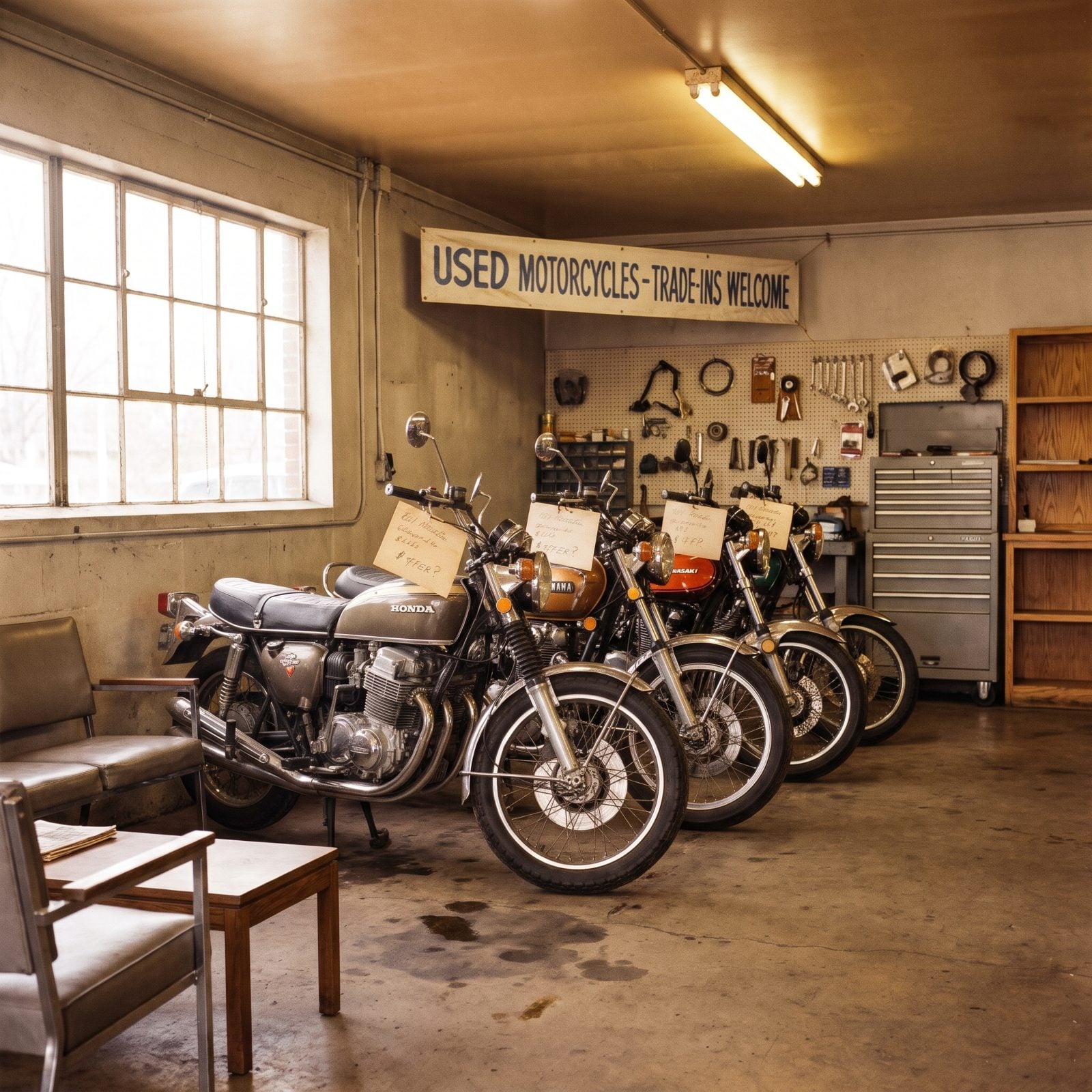
Along the far wall lived the trade-ins. Scuffed seats, a cracked side cover, a tank that caught the light wrong where somebody had touched up a scratch with a brush that didn’t match.
The price cards told the real story. Grease pencil on manila card stock, hovering at handlebar height just above the headlight, the number usually crossed out at least once and lower the second time around. A trade-in was a gamble and everybody knew it, which is why the card sometimes said “runs good” and sometimes just gave the price and let you draw your own conclusions.
20. Shelves of Open-Face Helmets With Snap-On Visors
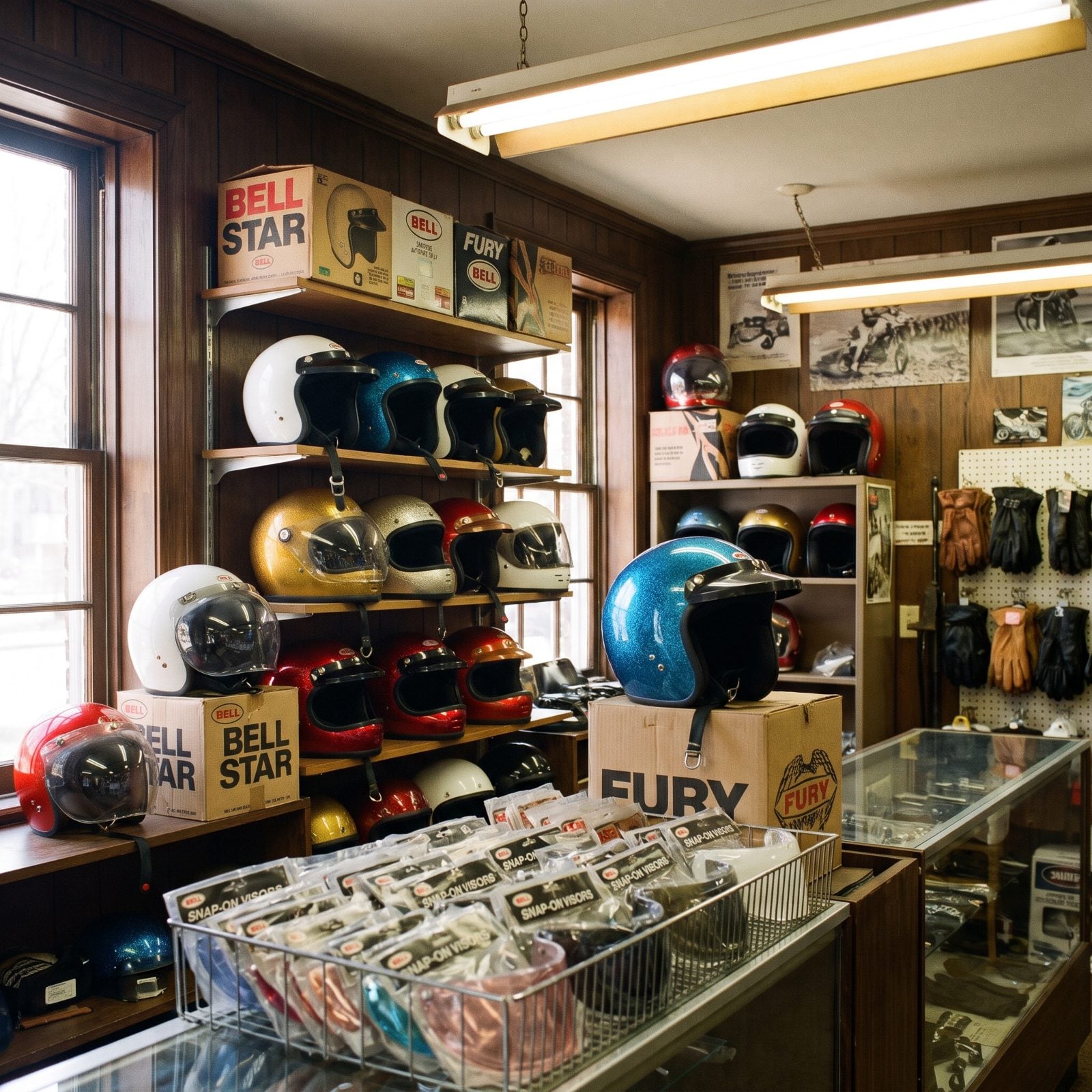
Rows of them. White, metalflake blue, a candy red that sparkled when you tilted it. Open-face, three-quarter shells with the snap-on visor clipped across the front and a chin strap that ended in a D-ring.
Now, the open-face was a product of its time, and we know a lot more about head injuries today. But there’s no denying the look. You snapped the clear visor on for rain, the smoke tint for sun, and the thing sat on your head light as a hat. The metalflake ones still turn up at swap meets, and grown men still pick them up and set them down slow.
19. A Rack of Bubble Shields and Riding Goggles
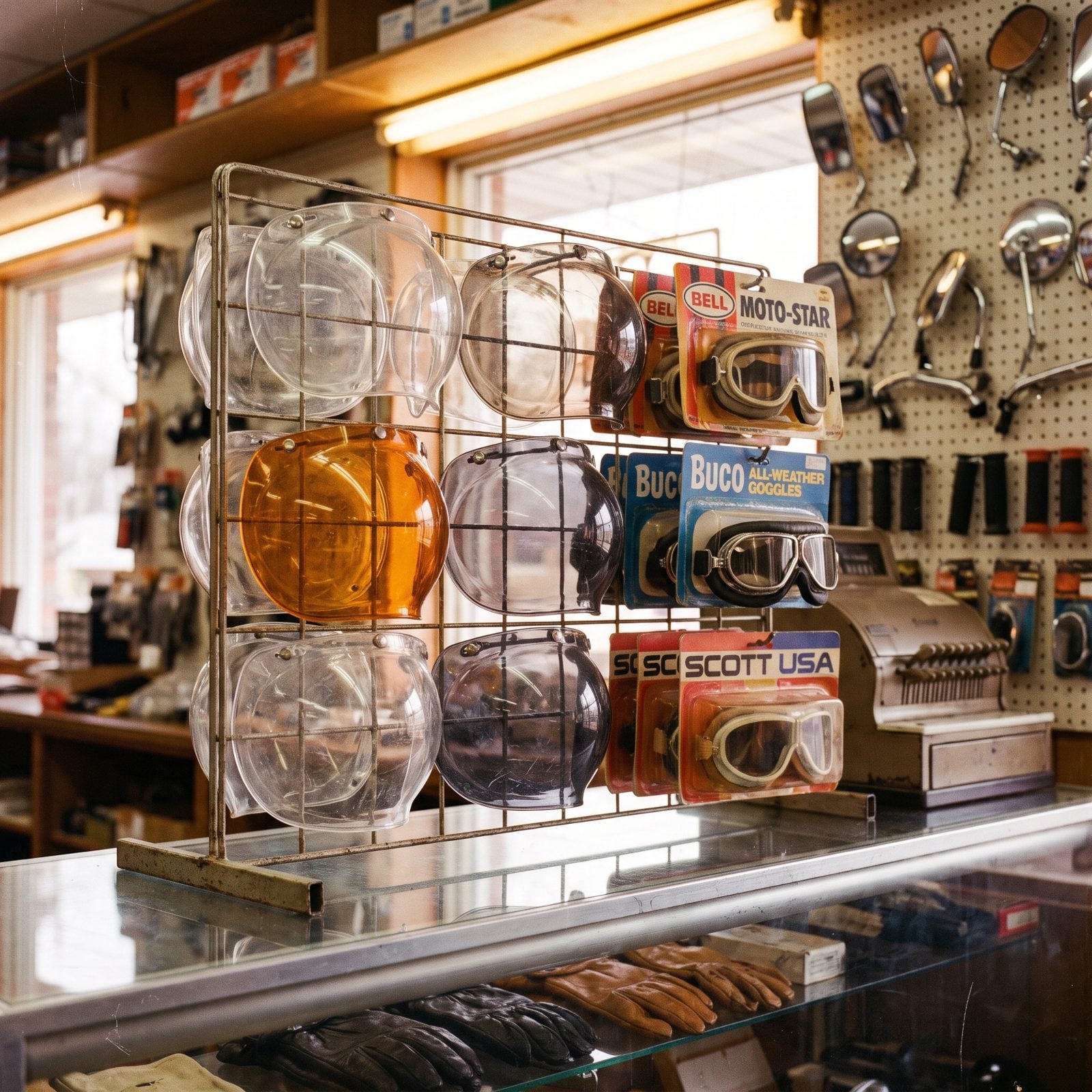
The bubble shields caught your eye first — curved acrylic domes in clear, amber, and a smoke tint that made everything look like a photograph from a good summer. They snapped onto the open-face helmets and bugged out in front of your chin like something off a fighter jet.
Next to them hung the goggles. Foam-rimmed, elastic strap, the kind that left a red ring around your face after a long ride. Cheap, simple, and they kept a bee out of your eye at fifty. Nobody oversold them. They sat on the peg in their cellophane packets and did one job.
18. Heavy Leather Riding Jackets That Needed Breaking In
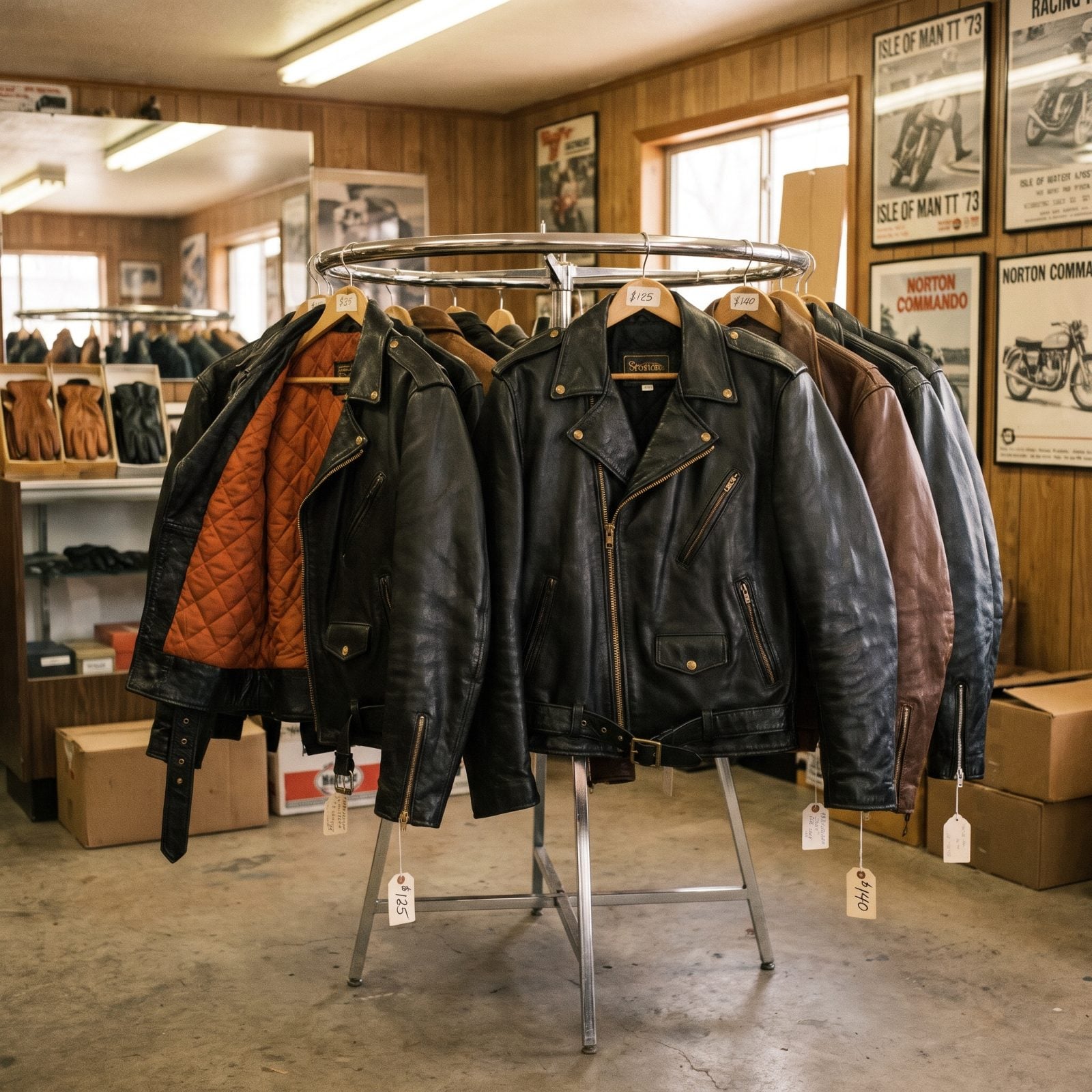
A new leather jacket off the rack was practically furniture. Stiff as a board, the collar standing at attention, the zippers fighting you every inch. You bought it knowing it would hurt your shoulders for a month.
Then it gave. A good hide broke in slow, learned your arms, softened at the elbows, and twenty years later it fit you and nobody else. That’s the trade with real leather — costs you comfort up front, pays you back for decades. You could smell the rack from across the shop, that heavy tanned-hide smell, and it meant you were somewhere serious.
17. Sturdy Engineer Boots Displayed Near the Counter
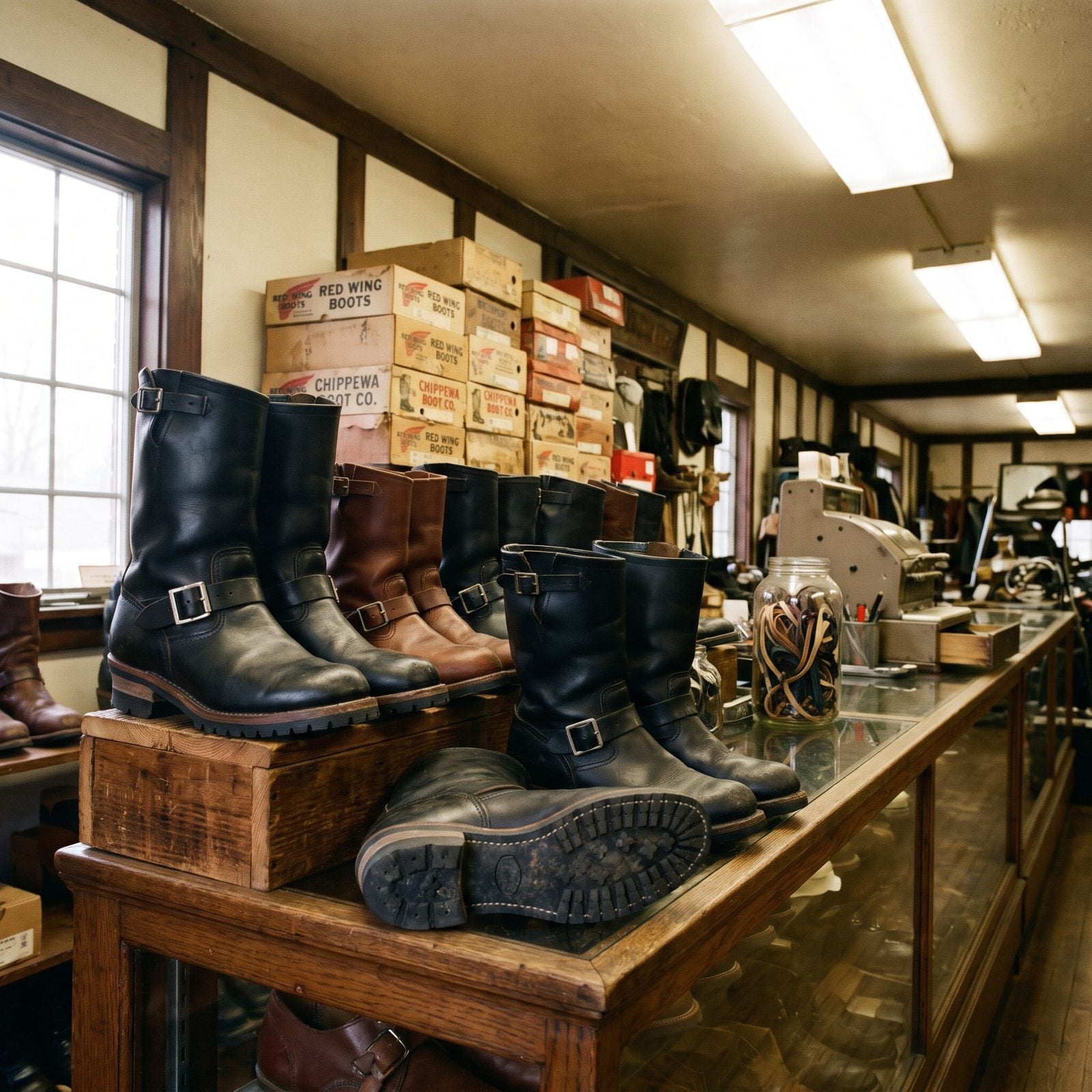
Right by the register, where you’d see them while the sale rang up, sat the engineer boots. Black leather, tall pull-on shaft, a buckle across the ankle and another over the instep, soles thick enough to stand on a hot pipe without flinching.
These were work boots that found a second life on a bike, and they outlasted everything else you owned. No laces to catch on a peg. You could resole them twice and they’d still have years left. People paid real money for a good pair and figured it cheap, because a cheap boot is a boot you buy again next year.
16. Wide Leather Kidney Belts Built for the Long Haul
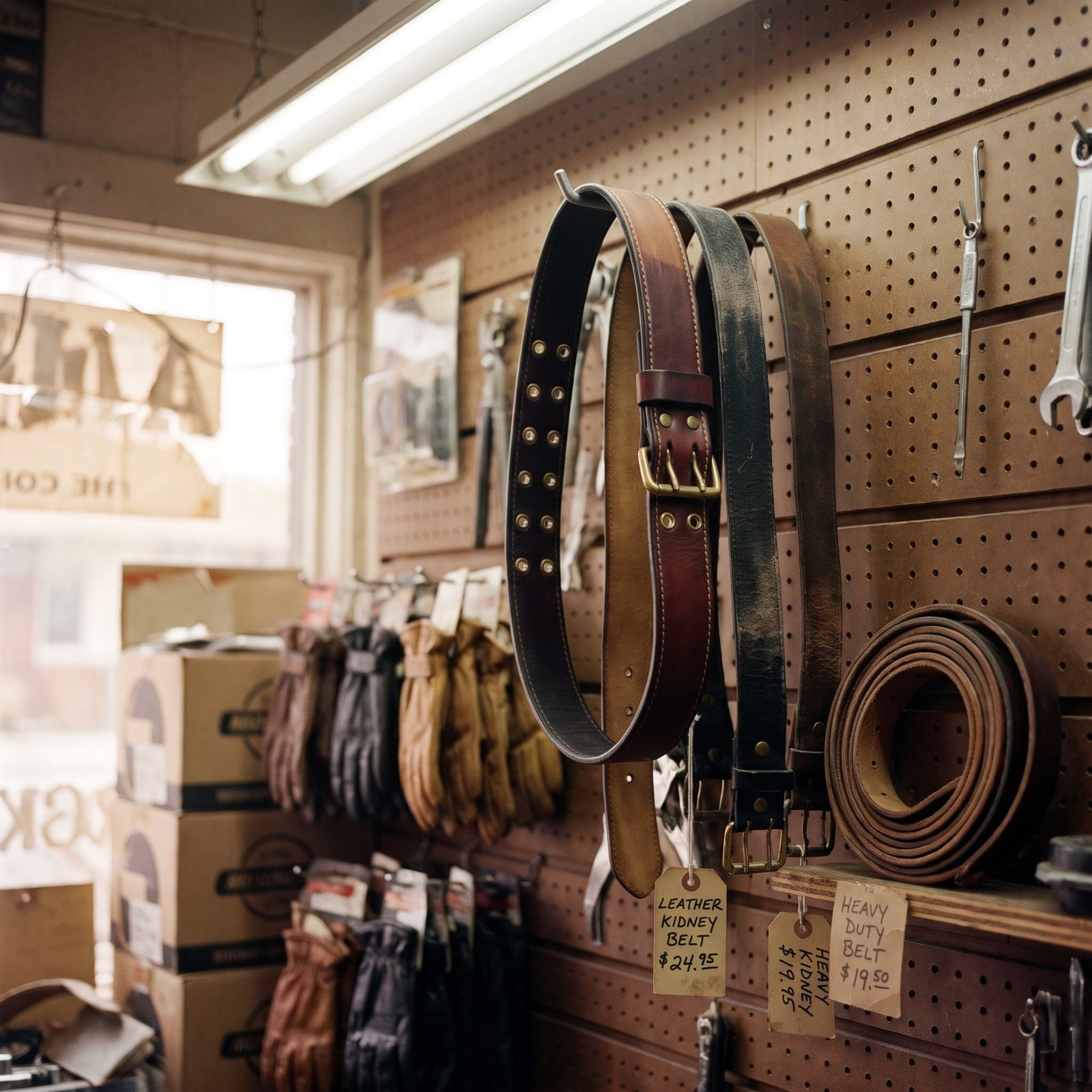
Before back braces had a marketing department, riders cinched a thick strap of leather around their middle and called it good. The kidney belt earned its name honestly. On a rigid-frame bike pounding down a cracked state highway your lower back takes every pothole the seat springs miss, and that stout strap of hide kept your organs from rearranging themselves over 400 miles.
Shops sold them off pegboard hooks, right between the gloves and the goggles. Oxblood, black, saddle tan. The good ones had a double-prong buckle and a double row of brass eyelets so you could cinch the thing right into your gut.
15. The Glass Counter Full of Club Patches and Enamel Pins
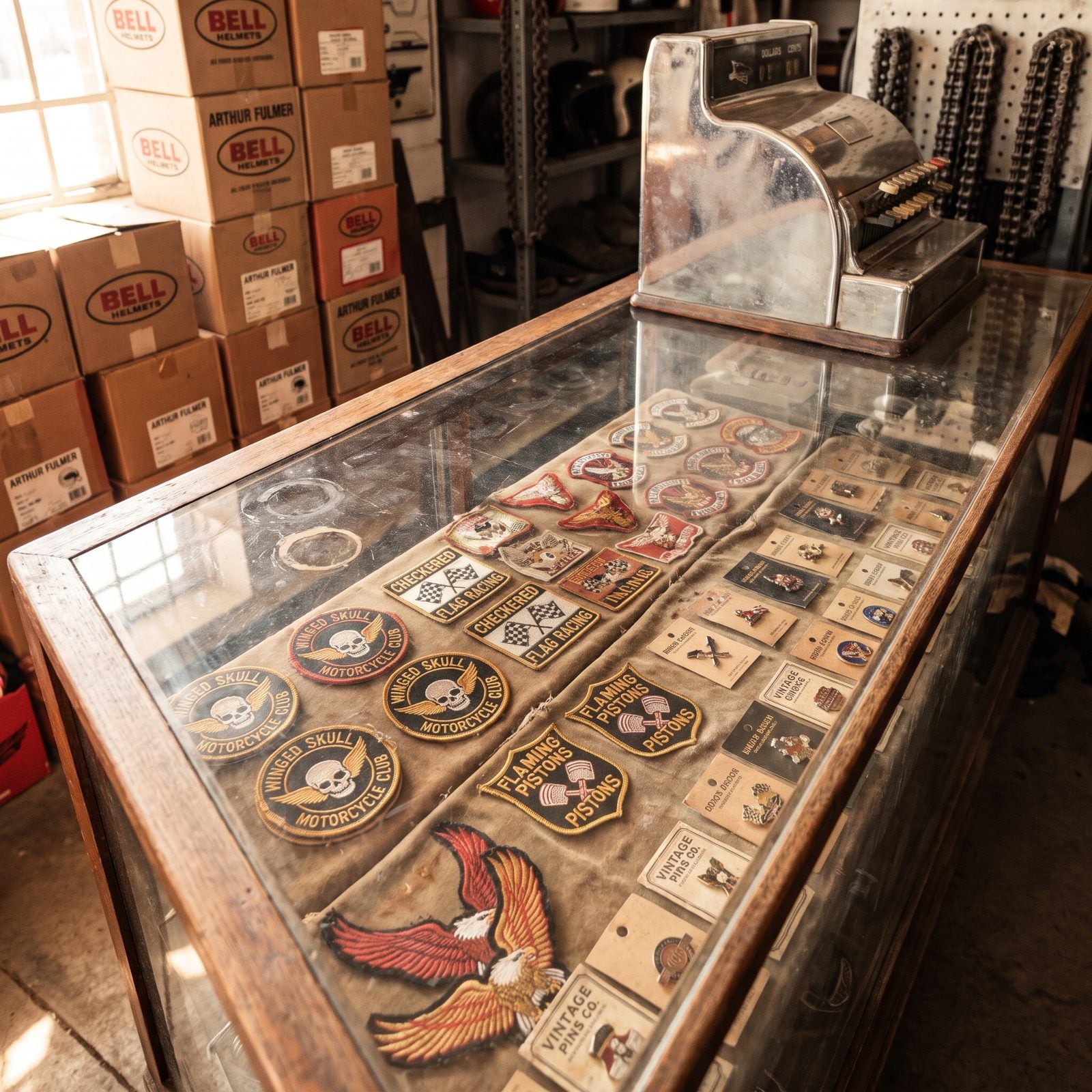
Every shop had the glass case by the register. You came in for a throttle cable and left thirty minutes later still hovering over the patches.
Winged skulls. Checkered flags. Flaming pistons stitched in gold thread on black twill. The enamel pins sat on little cardboard cards, a quarter apiece, and you bought one because it said something about you that you couldn’t quite put into words. That case did triple duty — bulletin board, gift shop, personality test. Spend five minutes leaning over it and the counter guy already had you figured out.
14. A Service Bay You Could Watch From the Showroom
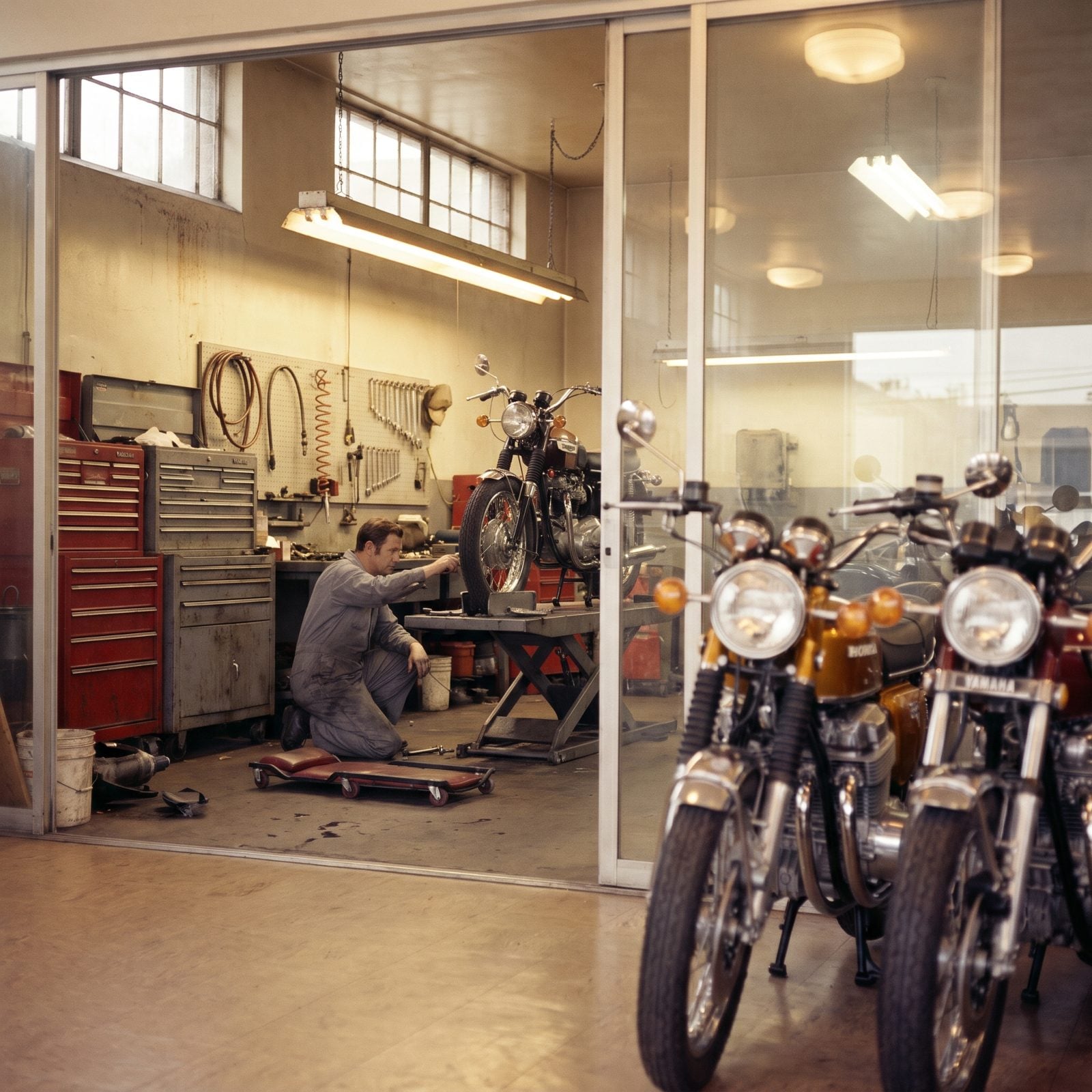
Some shops put a plate-glass window between the showroom and the service bay, and it was the best free entertainment in town. You could stand there with a cup of vending-machine coffee and watch a mechanic pull a top end apart.
There was a reason for the glass beyond theater. Nothing builds trust like watching the work happen — a customer who can see the wrench turning doesn’t lie awake wondering what he’s paying for. Same trick a good diner pulls with an open kitchen. Show people the craft and the bill stops looking suspicious.
13. The Steel Lift With the Diamond-Plate Top
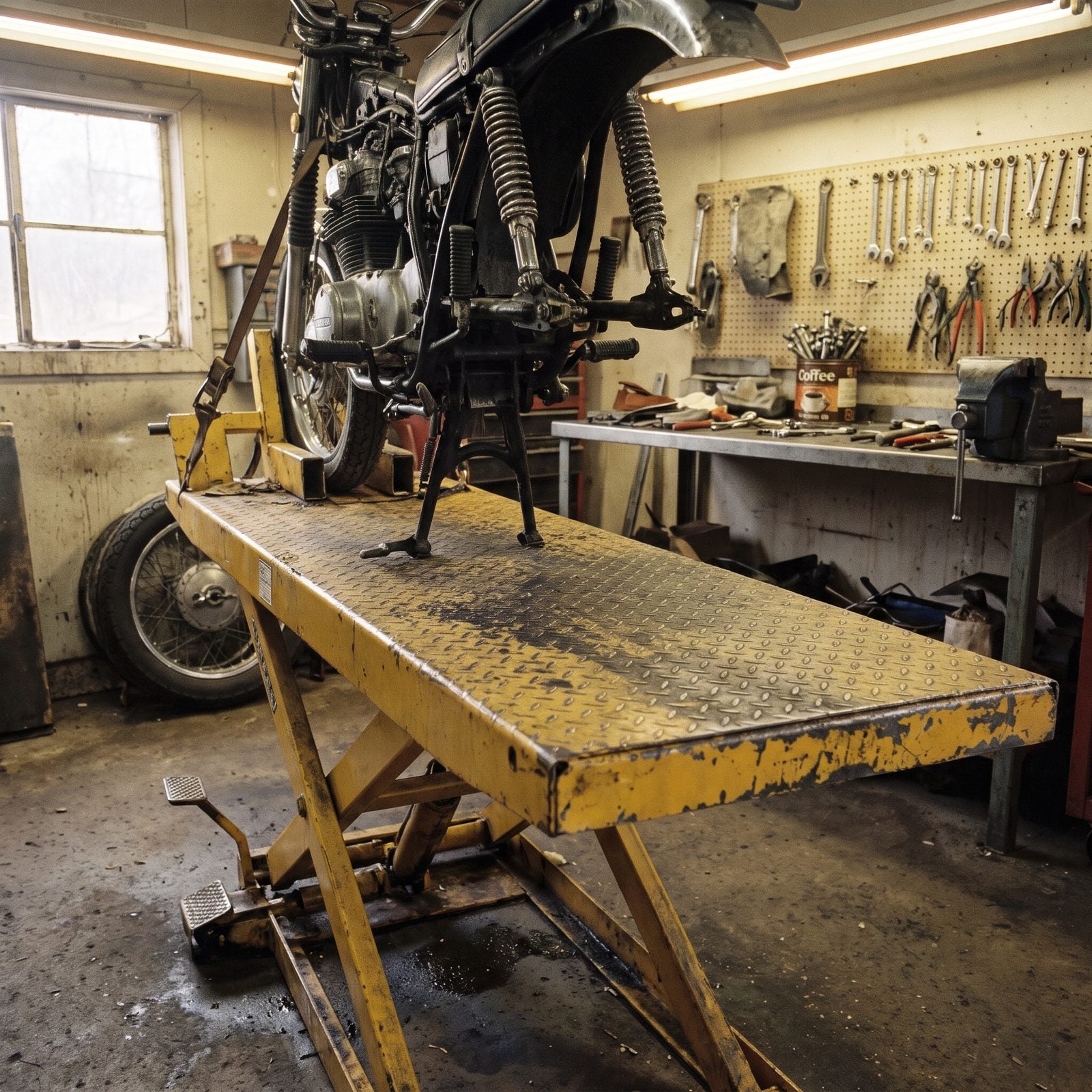
A good lift changed everything about how a shop worked. Diamond-plate on top for grip, a foot pedal to pump it up, and enough steel underneath to hold a dresser without a wobble.
The diamond-plate wasn’t decoration. Oil drips, and a smooth deck becomes a skating rink the first time someone kicks over a drain pan. That raised pattern gave boots and dropped sockets something to catch on. The yellow paint wore off the edges within a year and nobody ever repainted it, because scuffed yellow told you the lift had earned its keep.
12. The Hand-Cranked Wheel-Truing Stand
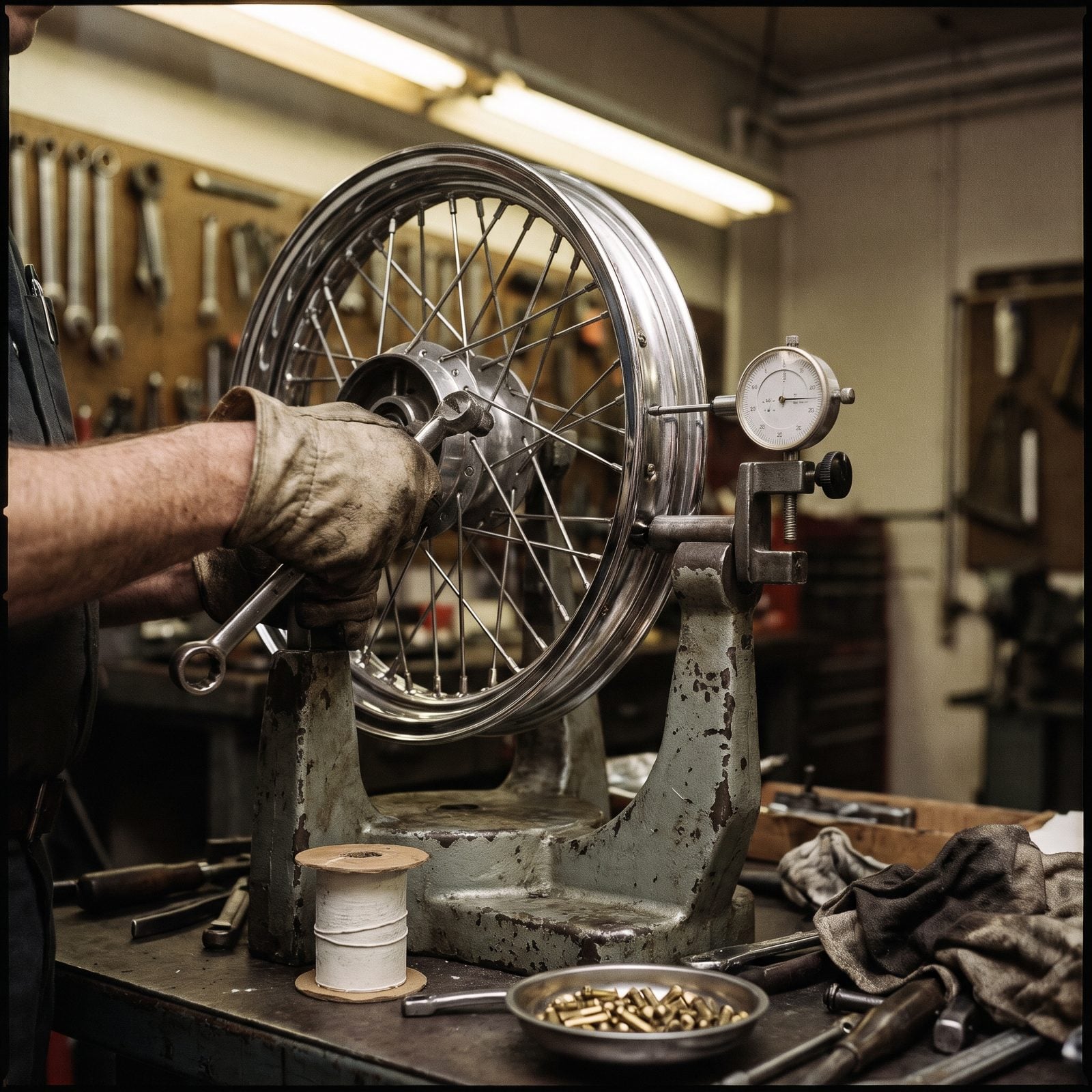
Truing a wheel is patience turned into a skill. The wheel sits in the stand, a dial gauge rests against the rim, and you watch for the spot where the needle swings. Then you set a spoke wrench to a nipple, give it an eighth of a turn, check the gauge again. And again.
No machine did this. It was ear and eye and feel, a quarter-turn at a time, until the rim ran dead straight. A rider who clipped a curb and folded a rim came in, and a couple hours later rolled out on a wheel that looked untouched. That stand separated a parts-swapper from a real mechanic.
11. The Bench-Mounted Chain Breaker and Riveting Tool
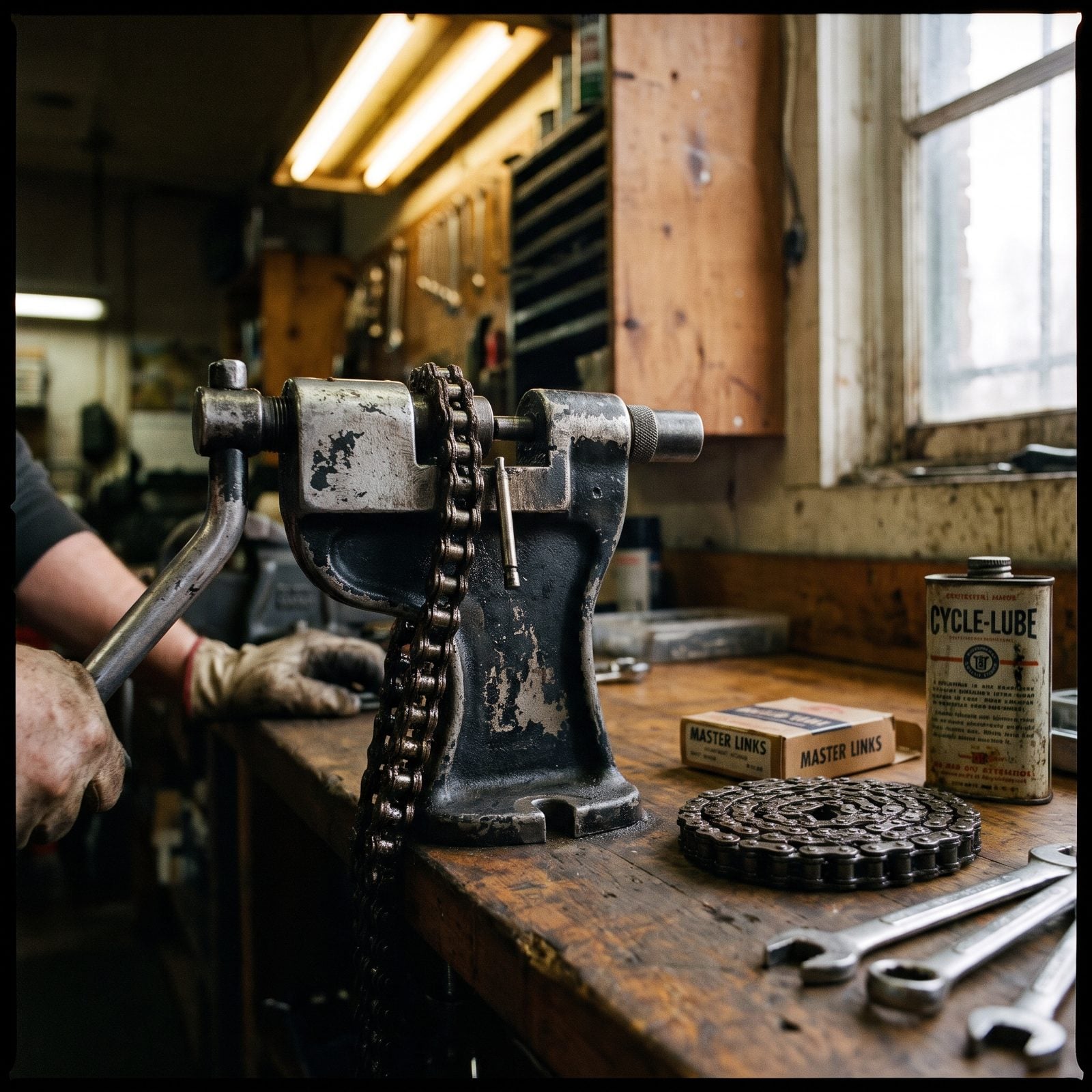
Chains didn’t come pre-sized. You bought a length, measured it against the old one, and pressed out a pin to cut it down. That’s what the chain breaker was for — a stubby cast-iron tool bolted to the bench, worn shiny on the handle.
Riveting the master link closed was the part people got wrong. Peen it too little and the link let go at highway speed. Too much and you cracked the side plate. The old hands did it by feel: a couple firm presses, then a tug test with both thumbs before anyone rolled it out the door.
10. A Row of Carburetor Vacuum Gauges for Synchronizing
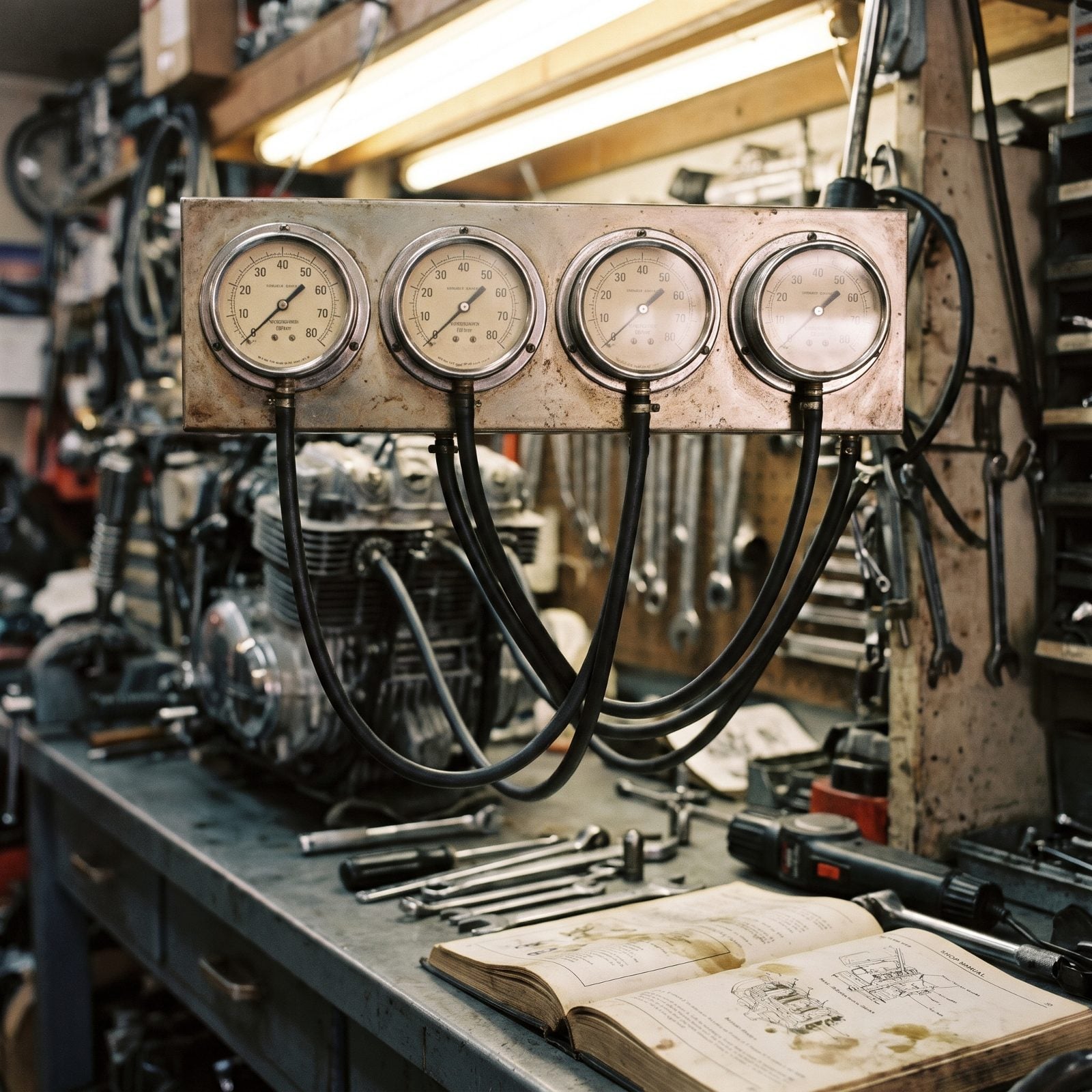
A four-cylinder bike with four carbs out of sync runs like it’s gargling. Rough idle, flat midrange, a buzz that numbs your hands by lunch. The fix lived right here: four round gauges in a row, hoses looped and waiting to be teed into each intake, all four needles ready to dance.
Crack the throttle and watch them. A needle sitting higher than the rest means that cylinder’s doing more than its share, and a tiny turn of an adjuster screw brings it back in line. When all four settle together the engine smooths out like someone flipped a switch. One of those jobs where the payoff is obvious the second you nail it.
9. The Timing Strobe for Dialing In Ignition Points
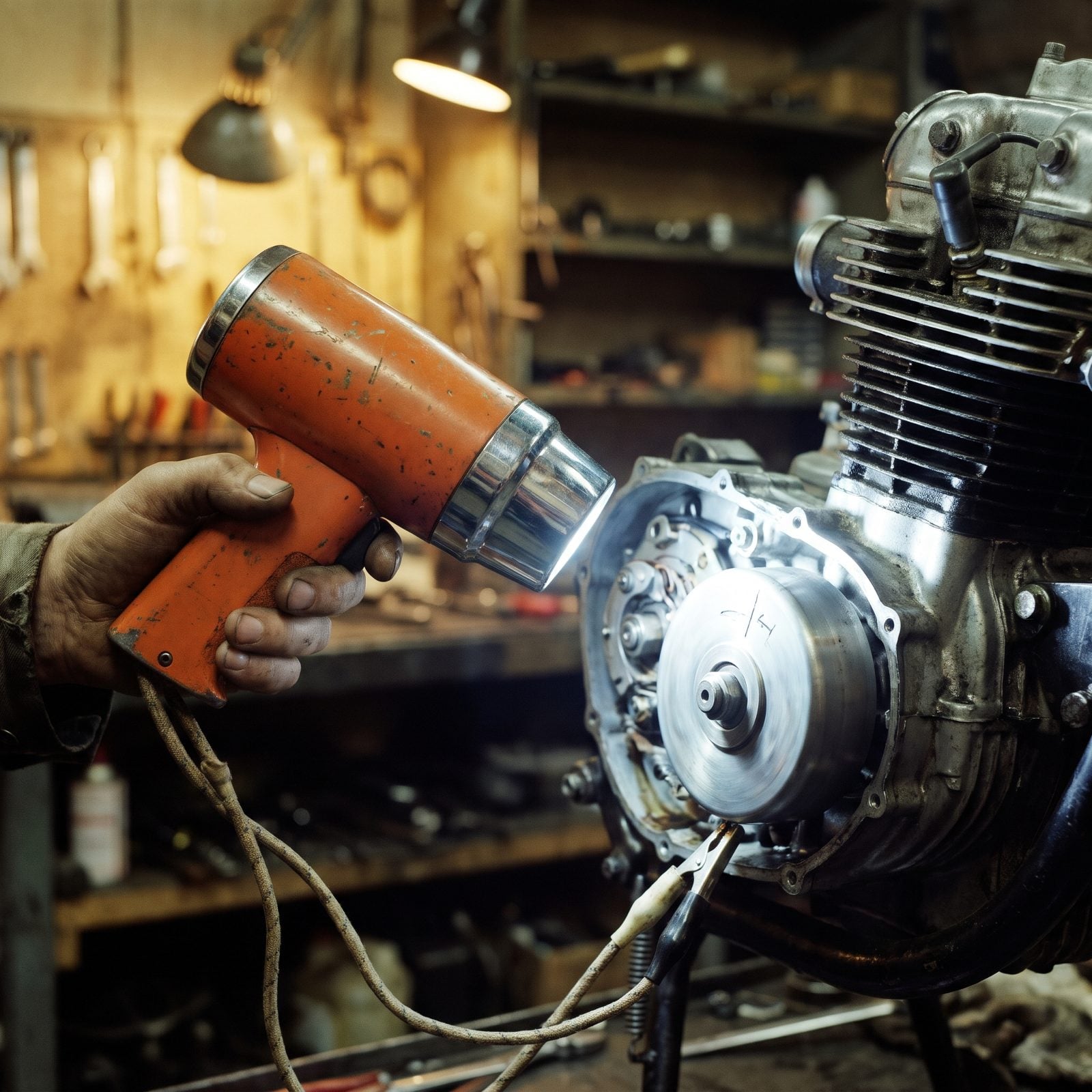
Points ignition drifted. Ride a few thousand miles and the spark starts firing a touch late or a touch early, and the bike tells you about it with hard starts and a flat spot off idle.
The timing light was how you caught it. Clip the leads on, pull the side cover, aim the nose at the mark on the rotor, rev the engine. Every firing, the strobe flashed and froze the spinning mark in place. Sat where the manual said? You were good. If not, nudge the plate until the flash parked it dead on. Electronic ignition eventually killed most of this, but in the ’70s a timing light lived in every drawer.
8. The Solvent Parts Washer With the Flexible Spout
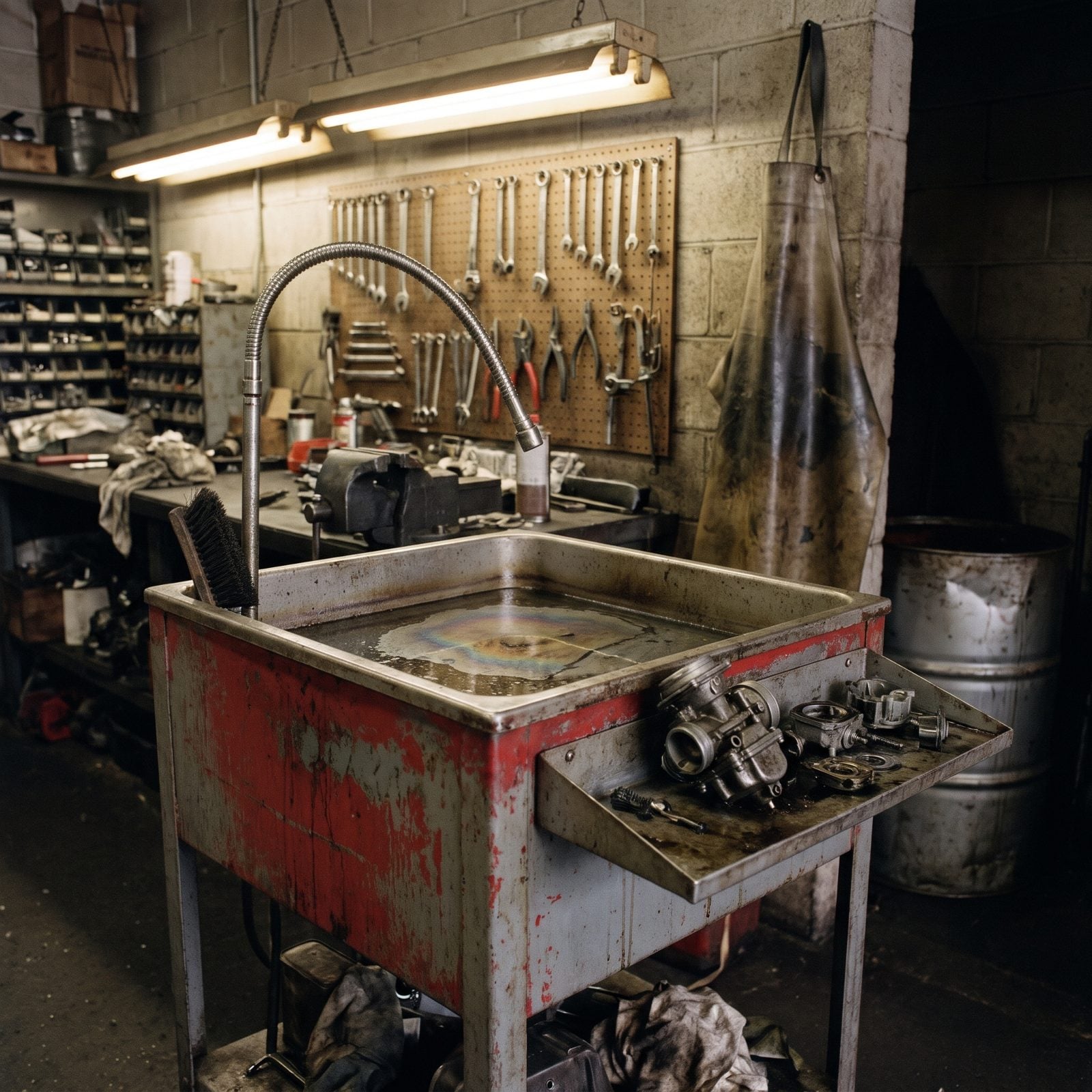
Every shop had one tucked in a corner, usually near the back door for the smell. A steel tub of cloudy solvent, a gooseneck spout you could bend over the parts, and a brush with half its bristles worn flat.
You dropped a gummed-up carburetor in there and scrubbed until the varnish let go and the aluminum came back bright. The solvent recirculated through a little pump, so the spout always had flow. It got filthier by the month, and nobody drained it until it quit doing much of anything.
7. The Bench Grinder Throwing Sparks Out the Back
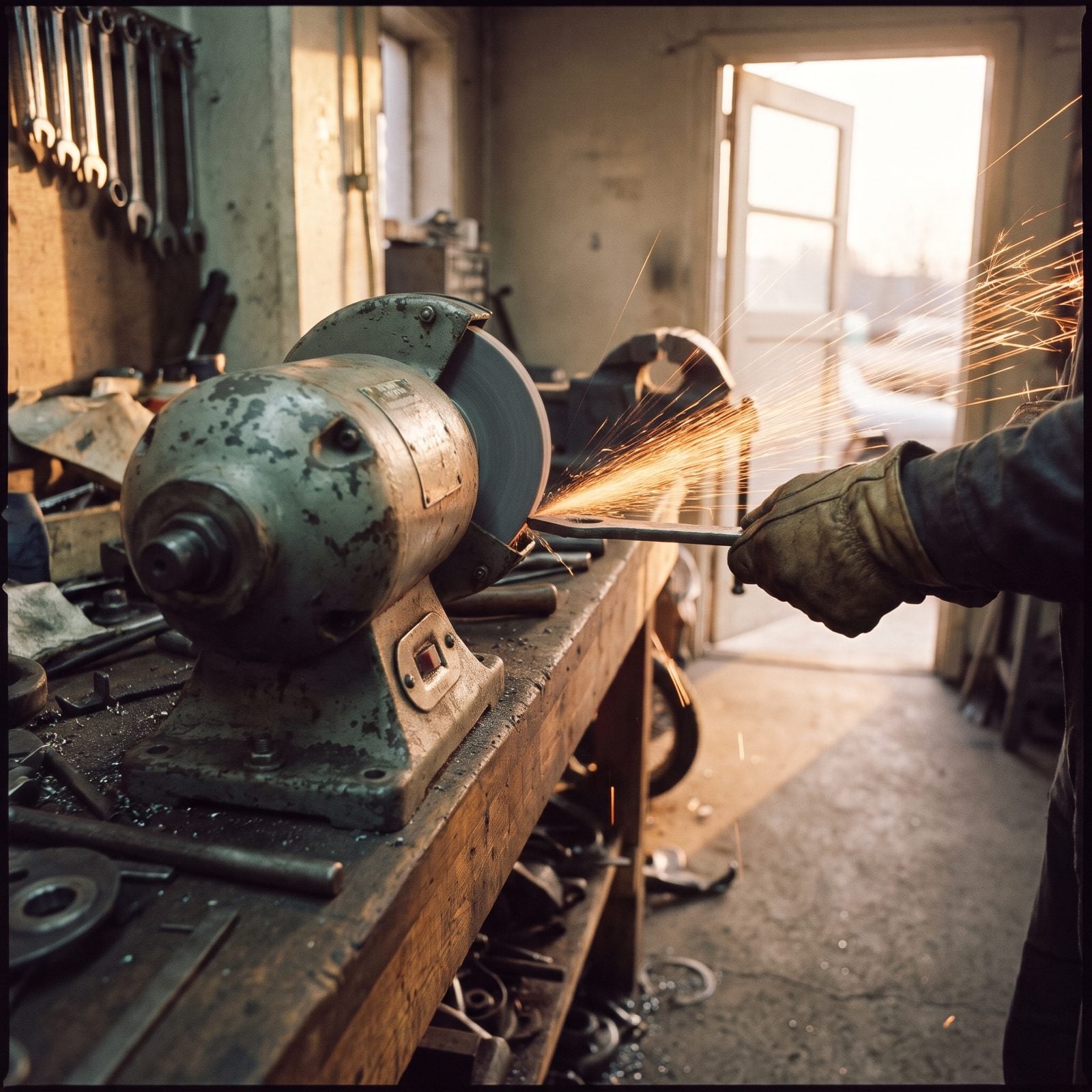
The grinder lived by the back door for a reason. Sparks fly, and nobody wants a fountain of hot steel landing in a drip pan.
It did a hundred small jobs nothing else could — dressing a burred bolt, shaping a bracket, knocking the mushroom off a cold chisel. Grind a part on a warm afternoon with the back door open and the sparks arced out into the daylight like a little fireworks show. That corner smelled like hot metal and kept a pile of gray dust nobody ever quite swept up. And the sound alone, that rising whine when the wheel bit, told everyone in the building that real work was going on.
6. The Cable-Making Bench With Solder Pots and Ferrules
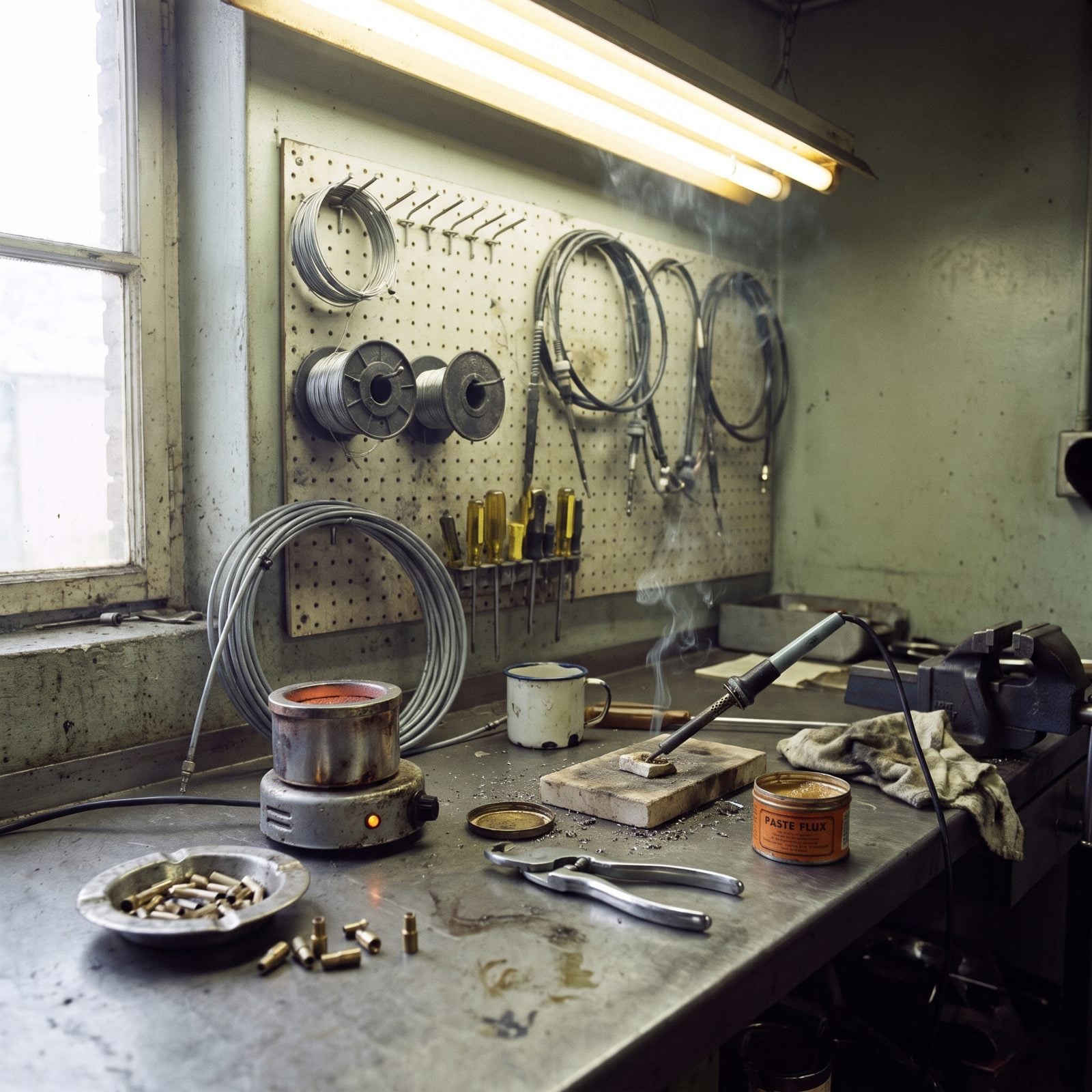
Before you could buy a universal cable kit sealed in a blister pack, a throttle or clutch cable got made on the spot while you waited. Thread the inner wire, seat the brass nipple, drop it in the solder pot, cut the outer to length. Five minutes of a mechanic’s time and you rode home.
The solder pot ran the whole show. A little crucible of molten metal that smelled sharp and tinny, flux smoke curling up under the fluorescents, and every ferrule in that ashtray was a different thread pitch. The guy at the bench knew them by feel, which is a thing you simply cannot buy anymore.
5. A Charging Shelf of Lead-Acid Batteries Being Filled
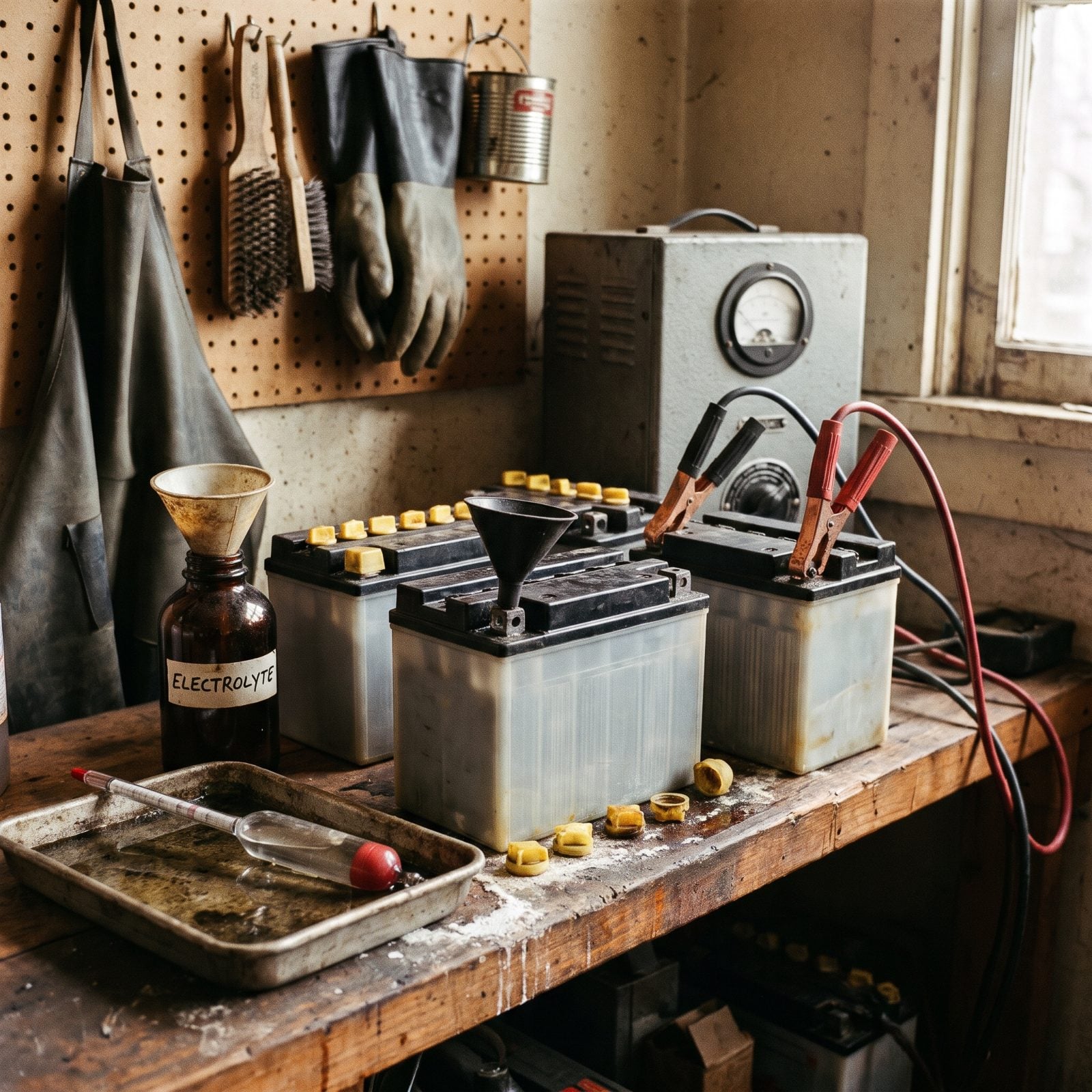
Batteries came dry. The acid came separate, in a dark bottle you did not want to tip over, and somebody poured the electrolyte in, screwed the cell caps down, and parked the whole lot on a shelf to charge overnight on a transformer the size of a toaster.
State of charge got read off a hydrometer. Squeeze the bulb, suck up a sample, see where the little float sat. High in the fluid meant healthy; low meant you were pushing your luck. And the shelf always smelled faintly of acid, corrosion crusting white on the wood where a drip had wandered.
4. A Hand-Lettered Board Showing Labor Rates
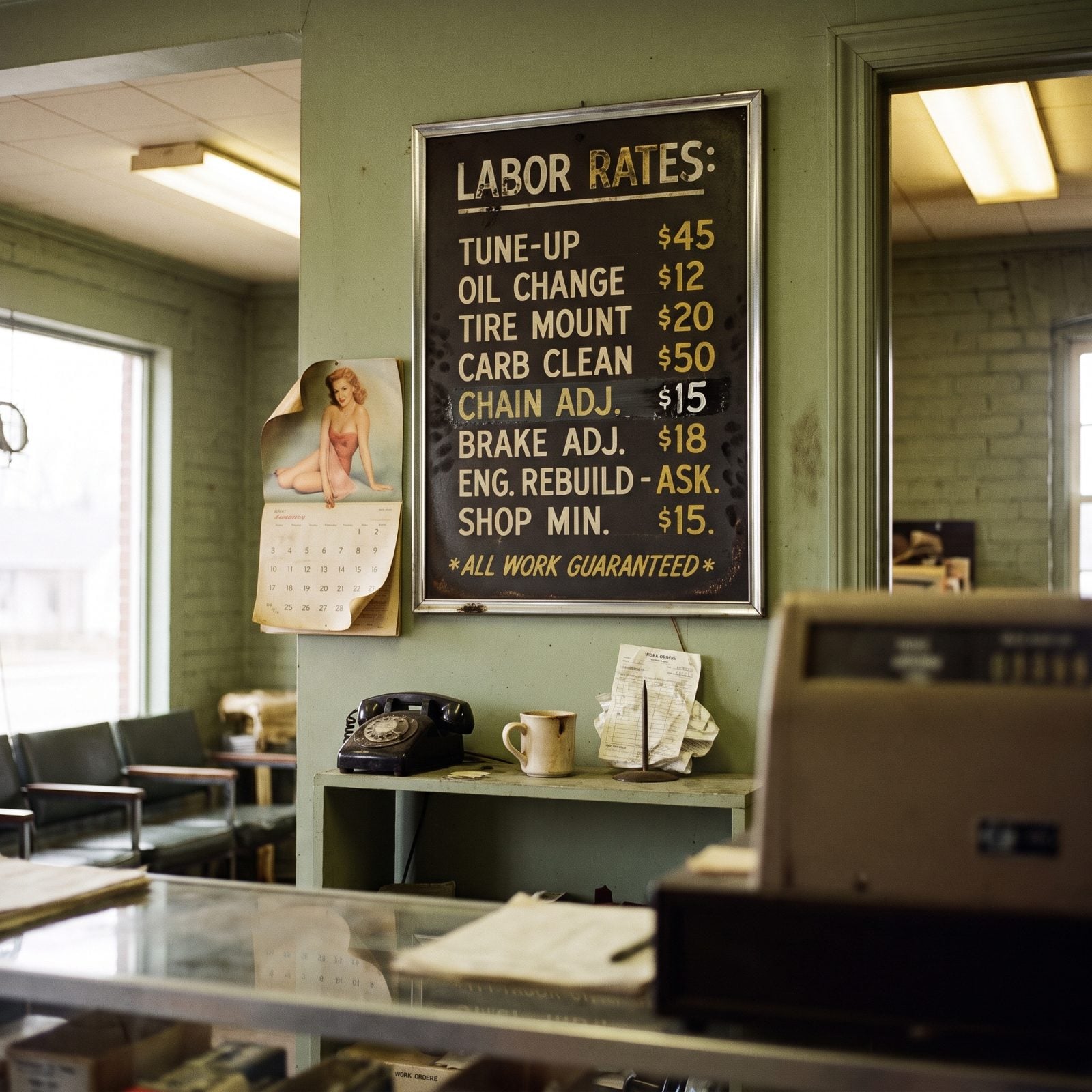
No printed menu of services. No tablet at the counter. Somebody painted a board by hand, white enamel on dark masonite, and hung it a little crooked above the till.
Those prices told you everything about the place. One line always looked painted over and redone, because rates crept up and nobody bothered reprinting a thing. You read it, nodded, and knew what the valve adjustment was going to run before you ever handed over the keys.
The honest shops put the numbers on the wall where everyone could see them. The ones that wouldn’t, you learned to drive past.
3. Oily Sawdust Swept Across the Workshop Floor
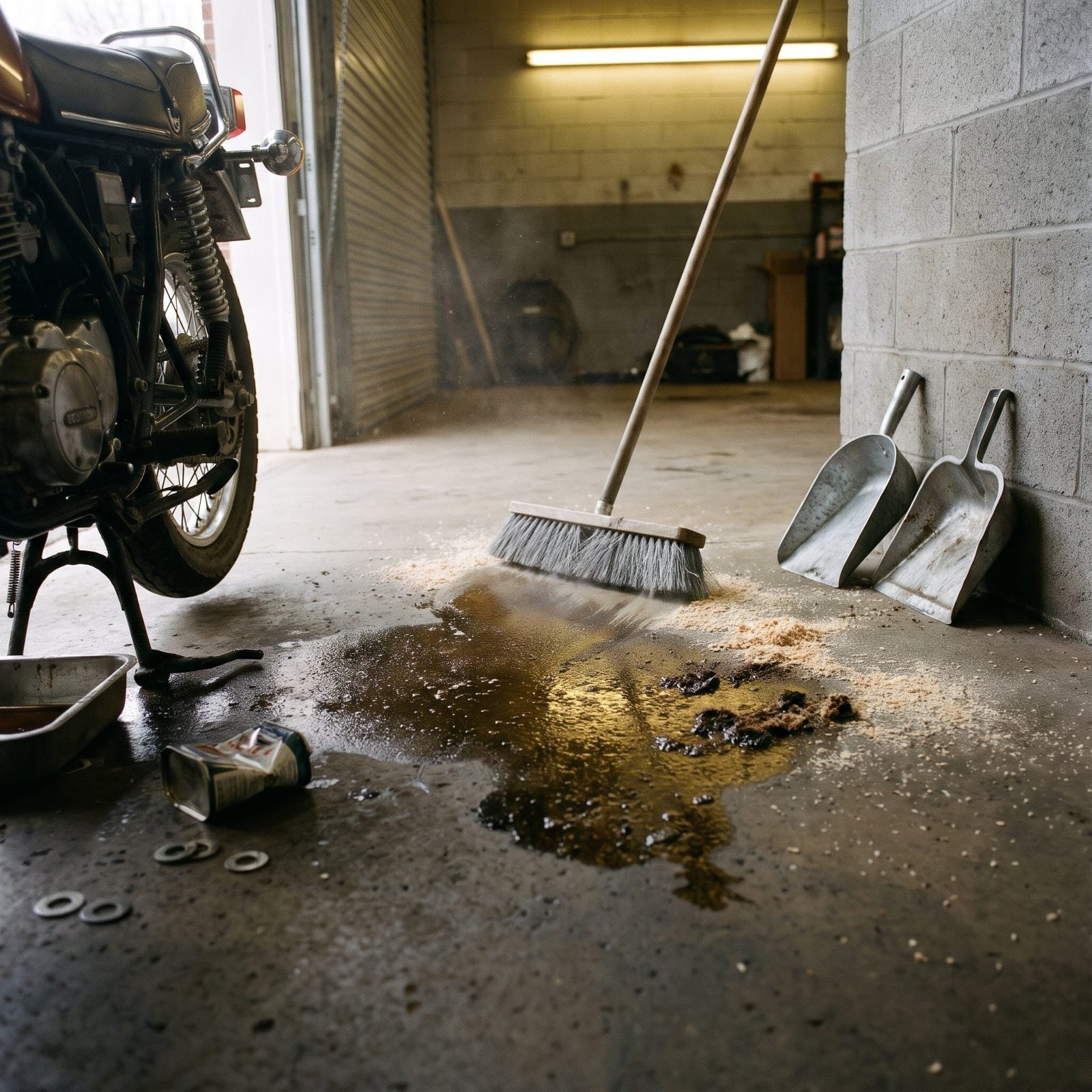
Every shop kept a bag of sawdust by the door. Oil hit the concrete, you threw a handful down, let it soak, and swept it into clumps the color of wet gingerbread. Cheap, fast, and it kept you from going down on your backside crossing the bay.
The smell was half the point. Pine dust and spilled gear oil and two-stroke mix, all ground into that slab over years until you could scrub it a hundred times and never get the scent back. Modern shops use absorbent granules and spill kits now. Fine. They do the job. They just don’t smell like anything.
2. Blue Two-Stroke Haze Drifting From the Service Door
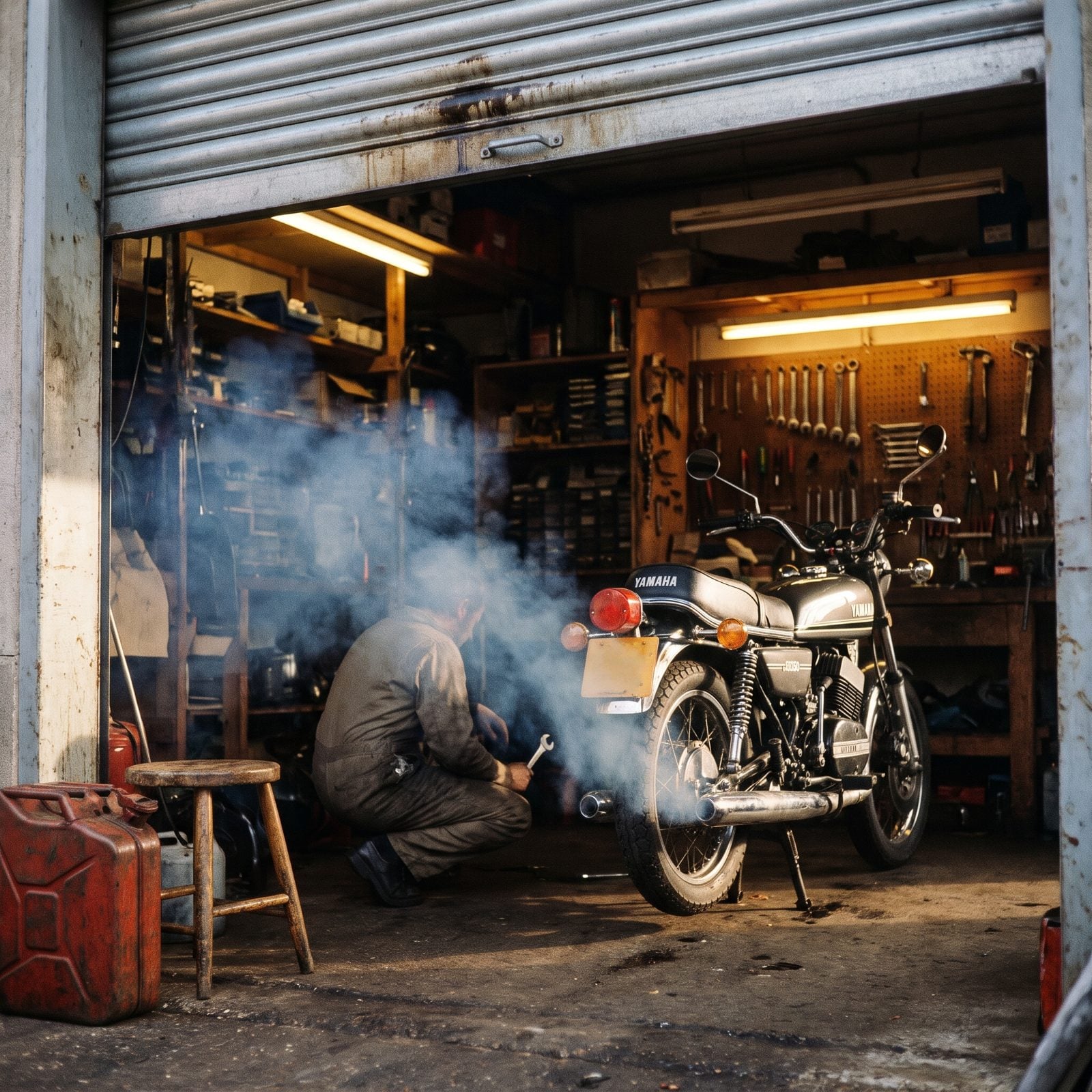
You knew a shop worked on two-strokes the second you walked up. That sweet, oily blue haze hanging in the doorway, catching the afternoon light in a solid beam, premix burning, the whole smell climbing into your clothes to stay for a week.
A mechanic would blip the throttle to clear a plug and fog the whole bay for a second. Nobody flinched. That was the sound and smell of a thing running right. Grow up around it and the haze is pure nostalgia; walk in cold and it just makes your eyes water.
1. Saturday Riders Bench-Racing Around the Counter
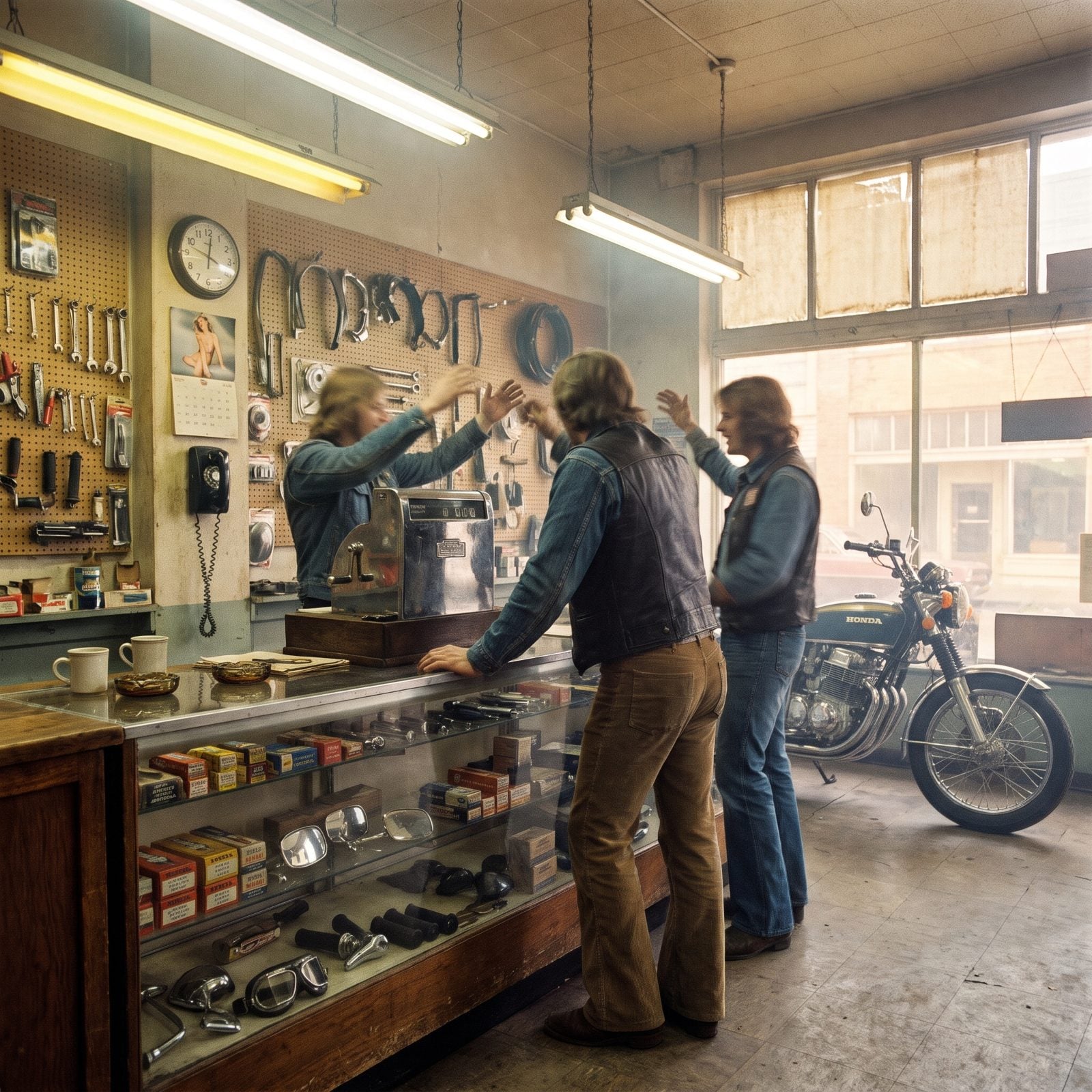
Saturday morning was the real draw. Guys showed up without needing a single part, leaned on the big wooden counter, and talked. Who ran what down at the strip. Who scored a deal on a used triple. Who dumped his bike taking a corner too hot and lived to lie about it afterward.
They called it bench racing — no bikes moving, all the drama. The parts man kept half an ear on it while he topped up the coffee mugs, and the place filled with the rustle of a road map spread across the wood and the low hum of men who’d rather be nowhere else on earth.
You can’t order that online. That counter was the forum before anybody had heard of a forum, and the moderation was the parts man telling you your carb story was nonsense.