

The extension cord snaking across the garage floor finally got me. Tripped over it in the dark, coffee everywhere, and right there on the concrete I decided the garage needed to grow up. Most of us treat it like a closet with a door. But it can be a workshop, a charging station, a wash bay, and a vault for the toys, all at once. The upgrades below aren’t gadgets for the sake of gadgets. They solve the annoying stuff: slow charging, cold concrete, tripped breakers, cables you trip on. Here’s what actually earns its keep.
Please note that some of the images in this article were created with the assistance of AI.
80-Amp Level 2 EV Charging Station

An 80-amp Level 2 unit adds real range fast, enough to claw back a chunk of your pack every hour if the car can take the full current. Most people run a 40-amp charger and then wonder why they’re still topping off come morning.
Here’s the catch nobody mentions. An 80-amp charger needs a 100-amp dedicated circuit, and that’s a serious wire run. If your panel is already tight, the charger is the easy part. The electrical work is where the money goes.
Smart Electrical Load-Management Panel

You want to charge the truck, run the dryer, and fire up the welder without springing for a bigger service. A smart load-management panel watches your total draw and throttles the charger down when the house suddenly needs the juice.
This is the upgrade that saves you from a pricey service upgrade. Instead of adding capacity, you manage what you already have. The charger backs off when the AC kicks on, then ramps back up when things quiet down. You never notice it working. That’s the point.
Ceiling-Mounted Retractable Charging Cable
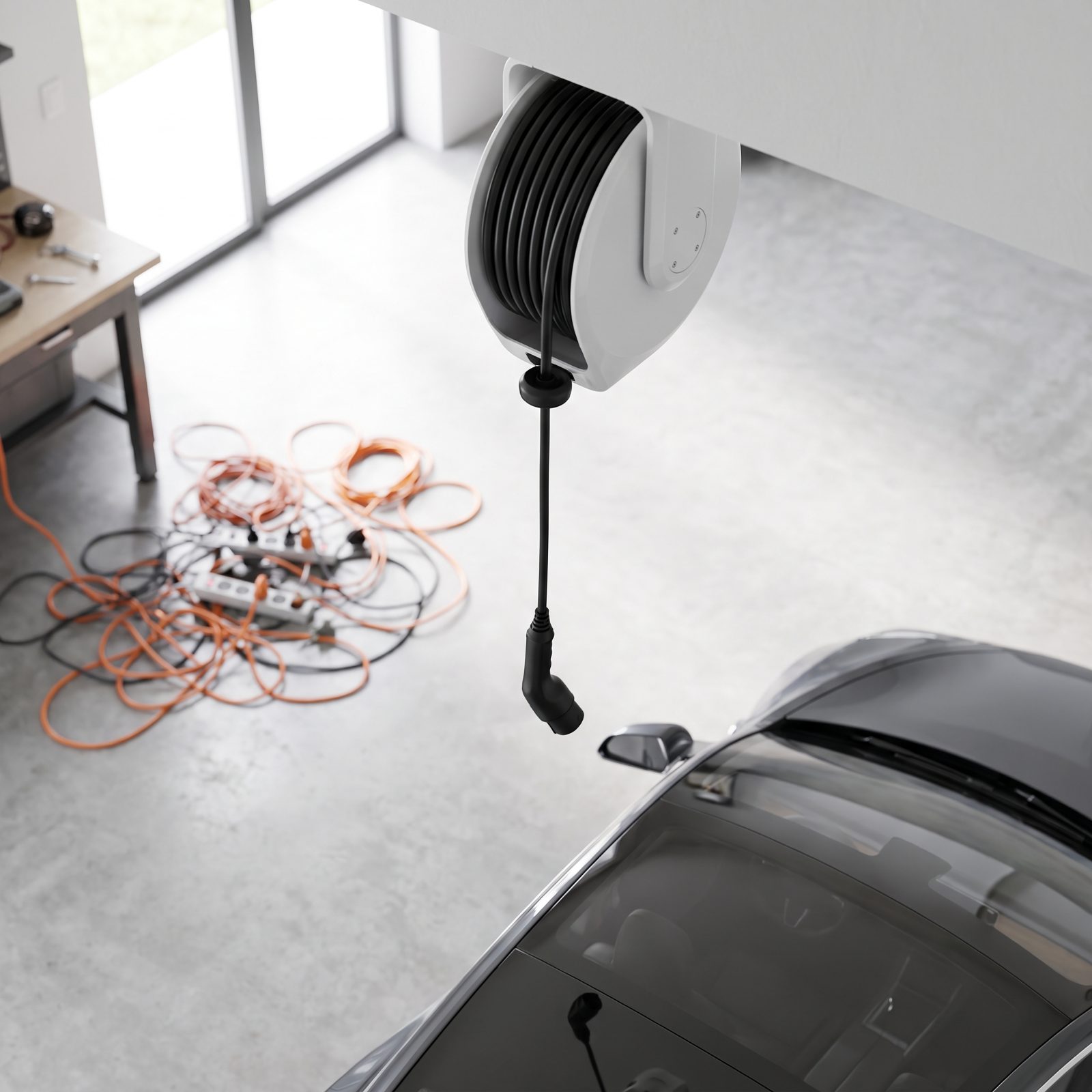
Remember tripping over the cable? A ceiling reel fixes that for good. The cable drops from above, you plug in, and when you’re done it retracts up and out of the way.
Then there’s wear. A cable dragged across concrete day after day frays at the jacket, but up on a reel it lasts years longer and your floor stays clear for actual work. In a two-car bay where cables cross paths, that alone pays for the thing.
Wall-Mounted Home Battery Backup
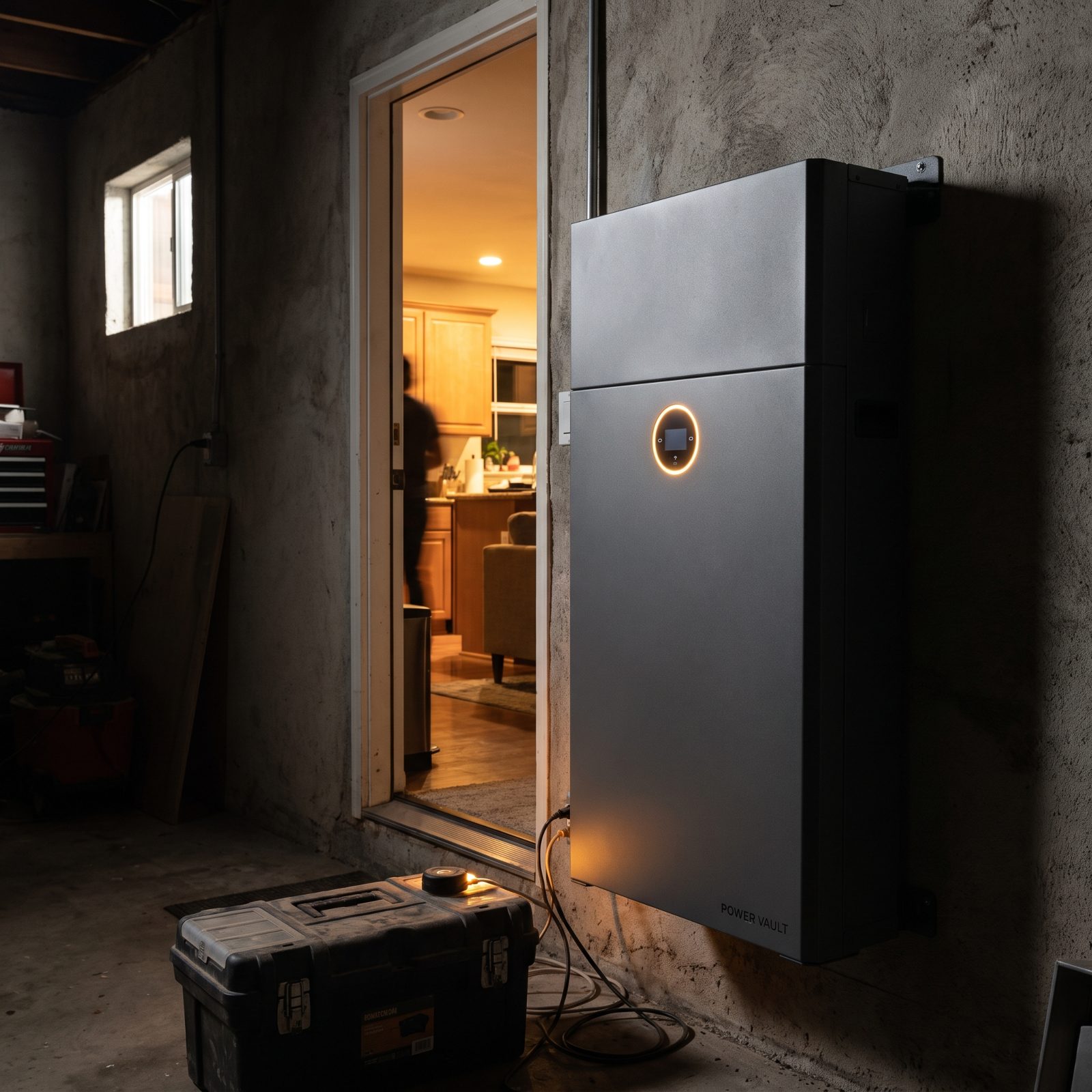
A wall battery turns your garage into a quiet power vault. When the grid drops, the house keeps running. When rates spike in the evening, you pull from stored daytime solar instead of buying expensive peak power.
Here’s where people go wrong: they size it for the whole house and choke on the price. You don’t need to. Back up the circuits that matter, the fridge, some lights, the modem, and the charger if you want it, and you cut the cost hard. A single mid-size unit covers the essentials for most homes.
High-R Insulated Garage Door

The single biggest hole in your garage’s thermal envelope is the door. A thin steel panel is basically a radiator pointed at the outdoors. Swap in a high-R insulated door, look for R-16 or better, and the whole space feels different.
This matters more than ever. Cold batteries charge slowly, and a cold EV bleeds range just sitting there. Keep the garage 15 or 20 degrees warmer than outside and your vehicles, your tools, and your toes all thank you.
It also cuts road noise and quiets the door when it runs. Small thing. You notice it every morning anyway.
Space-Saving Jackshaft Door Opener
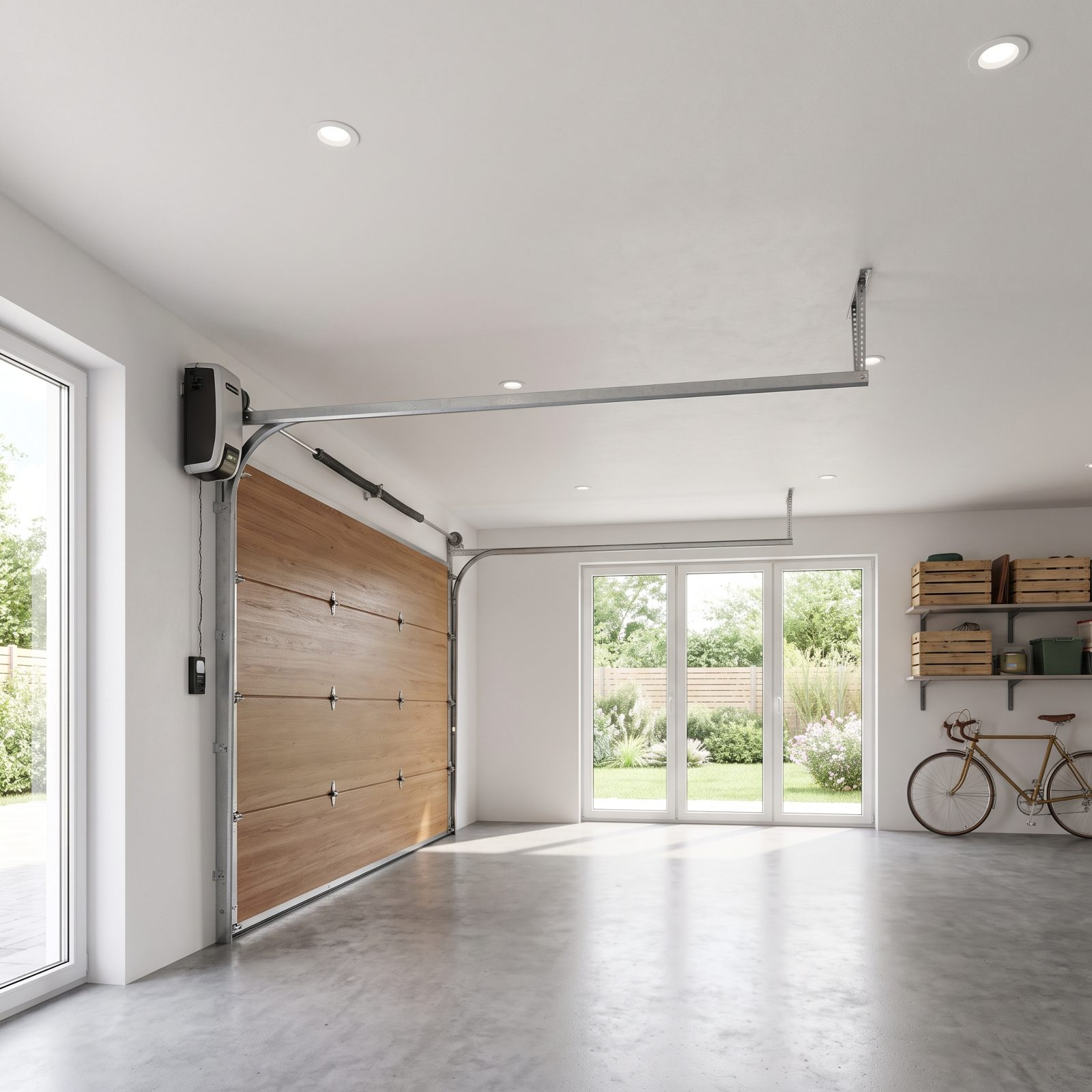
A jackshaft opener mounts on the wall beside the door instead of running a rail down the center of your ceiling. And that freed-up ceiling is where the real win hides.
Suddenly you can hang overhead racks, mount a lift, or stash the kayaks up high without a motor unit in the way. In a garage with a tall vehicle or a low ceiling, it’s the difference between a usable space and a cramped one. Quieter too, since the motor isn’t bolted to a vibrating rail over your head.
Camera-Equipped Smart Door Controller

Did you leave the door open? Now you can check from the driveway at a diner three states away and close it from your phone.
The camera version adds something that matters: you see who’s in there. Delivery left on the floor, kid grabbed the bike, or something’s off and you want a look. Package theft and garage break-ins are real, and an open door is an invitation.
Polyaspartic Floor Coating
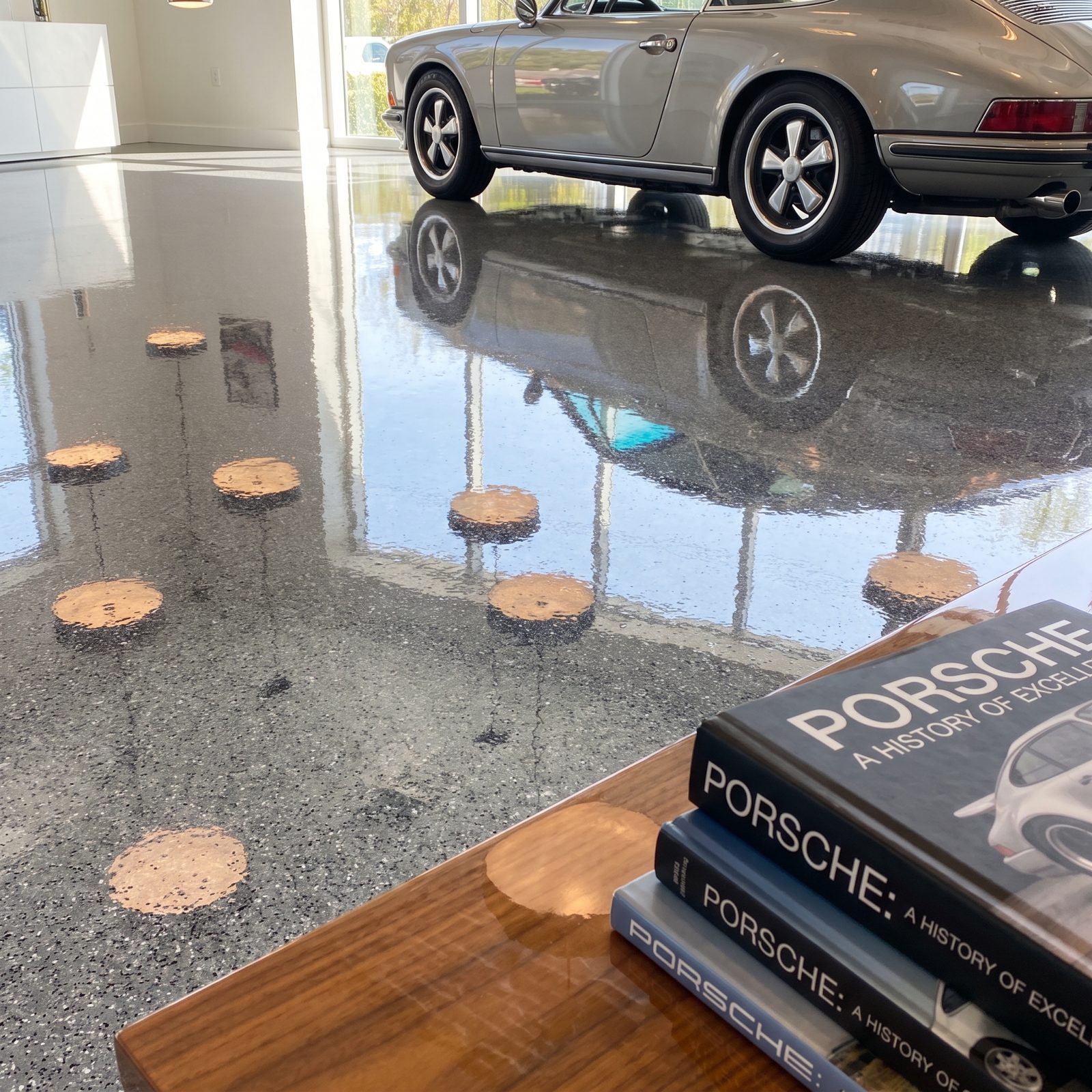
Epoxy was the standard for years. Polyaspartic is what the serious shops use now, and for good reason.
It cures fast. You can often walk on it the next day and park on it within a day or two, versus a week for epoxy. It shrugs off hot tire pickup, road salt, and the brake fluid you’ll inevitably spill. UV stable, so it won’t yellow near the sunny door.
The downside is honest: it costs more, and it hardens so fast that a DIY job can go sideways before you’ve finished a section. This is one I’d hand to a crew that does it every week.
Sloped Floor With a Central Trench Drain
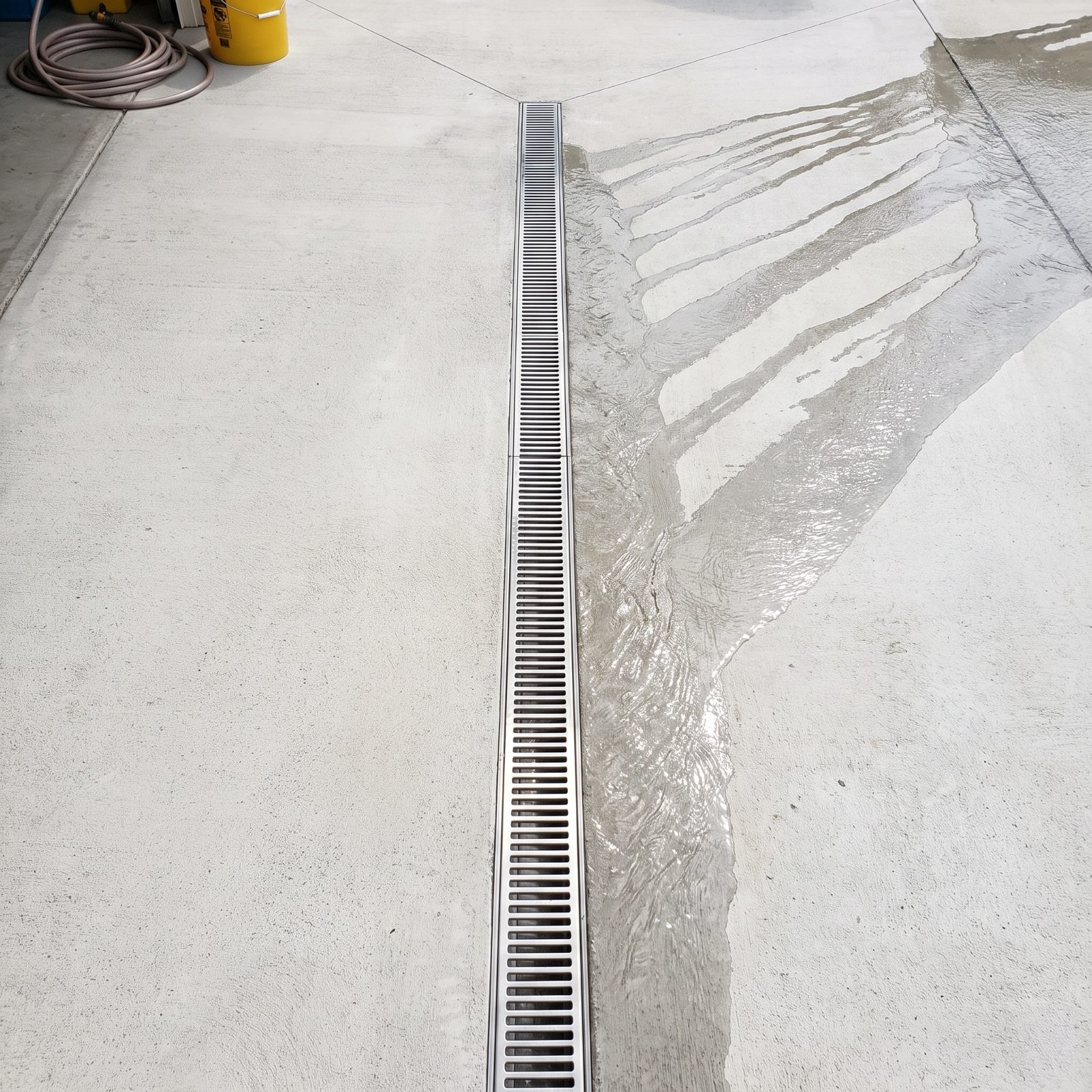
Wash the car in the garage and the water has to go somewhere. Without a drain it pools, freezes in winter, and seeps under everything you own.
Pour the floor with a slope to a central trench drain and the garage becomes a real wash bay. Melting snow runs off instead of sitting in a sheet under your tires. Detailing in January stops being a fantasy.
This is a pour-day decision, not a retrofit. You can’t easily add proper slope later, so if you’re building or redoing the slab, get it right before the concrete’s wet.
Hydronic Radiant Floor Heating

Heated air rises and leaves your feet cold. Run hydronic tubing through the slab and you heat the floor itself, so the warmth starts where you stand and works up.
For a garage, this is the comfort upgrade that changes everything. The whole slab becomes a low, even heat source. Polished concrete feels warm instead of icy. No vents blow air around, no radiators steal wall space, and you can actually stand in your socks by the garden doors in December without regretting your choices.
It goes in before the pour. Retrofitting radiant into existing concrete is possible, but ugly and expensive. Plan it while the slab is still a plan.
Ductless Mini-Split for Year-Round Garage Climate Control

A garage that swings from scorching in July to freezing in January is a garage you avoid half the year. A ductless mini-split fixes both ends — one wall-mounted head, one small outdoor condenser, no ductwork to run through finished walls.
Budget for a single-zone install that varies with square footage and who does the labor. The thing people get wrong? They size it like a bedroom. But a garage has a giant uninsulated door and a concrete slab that fights you all day. Insulate the door first, or you’re cooling the driveway.
Retractable Exhaust Extraction Hose That Pulls Fumes Straight Outside

Cold starts are the dangerous ones. Rich mixture, choke on, carbon monoxide pouring out while you let it warm. A ceiling-mounted retractable extraction hose clamps near the tailpipe and is meant to vent it outdoors, powered by an inline fan. A leaking hose or failed seal sends those fumes straight back into the room, so check every joint.
These started in commercial shops. The home versions are modest money for the reel and nozzle, a bit more once you add a dedicated fan and cut a wall penetration. If you ever run an engine with the door down, even for a minute, a properly sealed system is the quietest insurance in the building.
Connected Carbon-Monoxide Monitoring You Can See From Inside the House
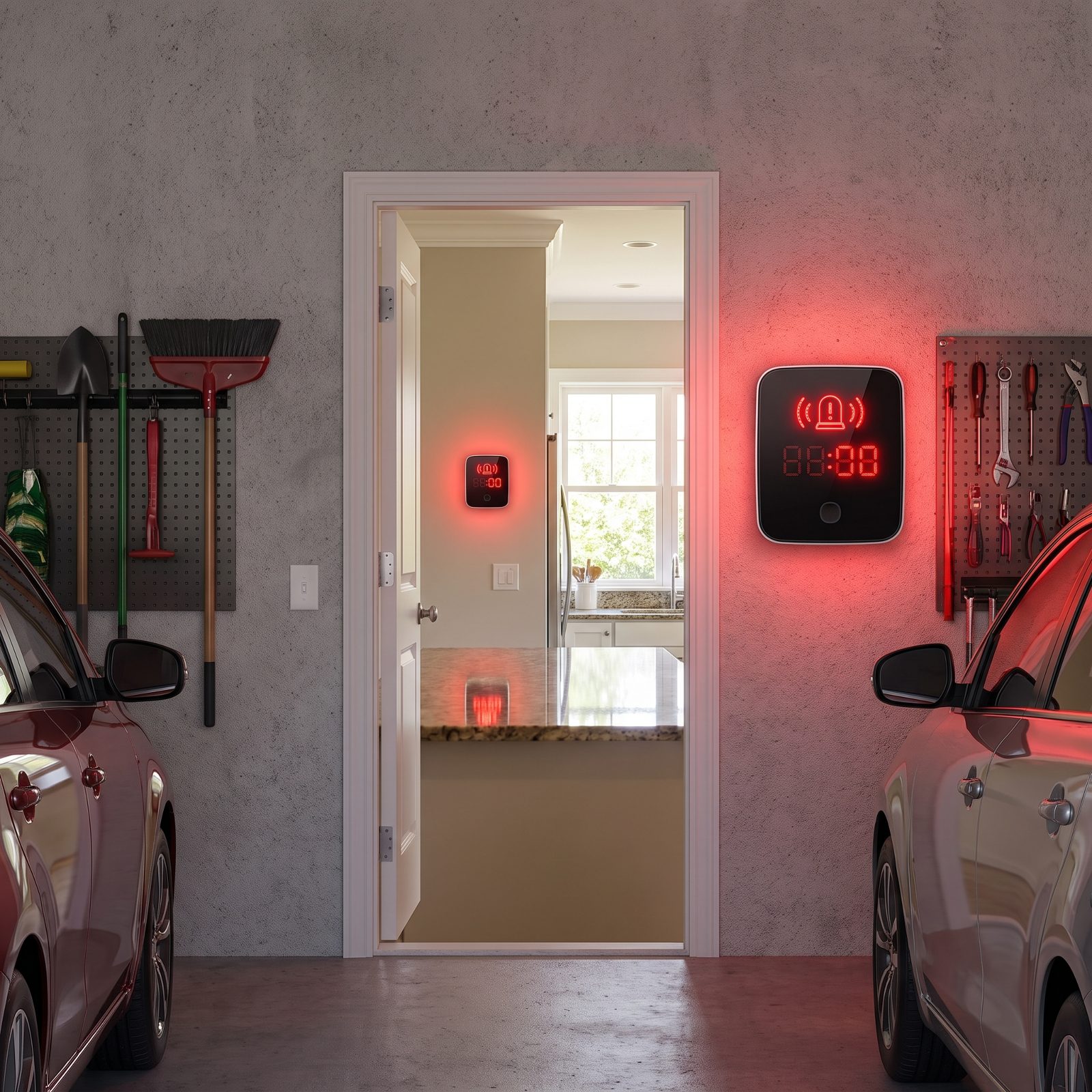
That cheap battery unit chirping in the corner was never designed for a garage. It’s built for a kitchen. A connected CO monitor pushes alerts to your phone, so the alarm that matters reaches you even when you’re asleep upstairs and the garage is empty.
Mount it at breathing height near the vehicle, not on the ceiling. CO mixes with air — it doesn’t rise like smoke. People put these up high out of habit, then wonder why the reading lags.
Fine-Dust Air Filtration for When You Sand, Grind, or Cut

Brake dust, sanding grit, grinding sparks that settle as fine powder over everything — including your lungs. A ceiling-hung air filtration unit pulls that from the air and runs it through a filter stack while you work.
Woodworkers have used these for decades. Garages caught on late. A good one moves a lot of air and runs quiet enough to forget it’s on. Buy one rated for a bigger room than yours. Undersizing is the classic blunder — then you’re left wondering why the haze still hangs after you cut a brake line flare.
Color-Accurate Ceiling LED Grid That Shows True Paint Color
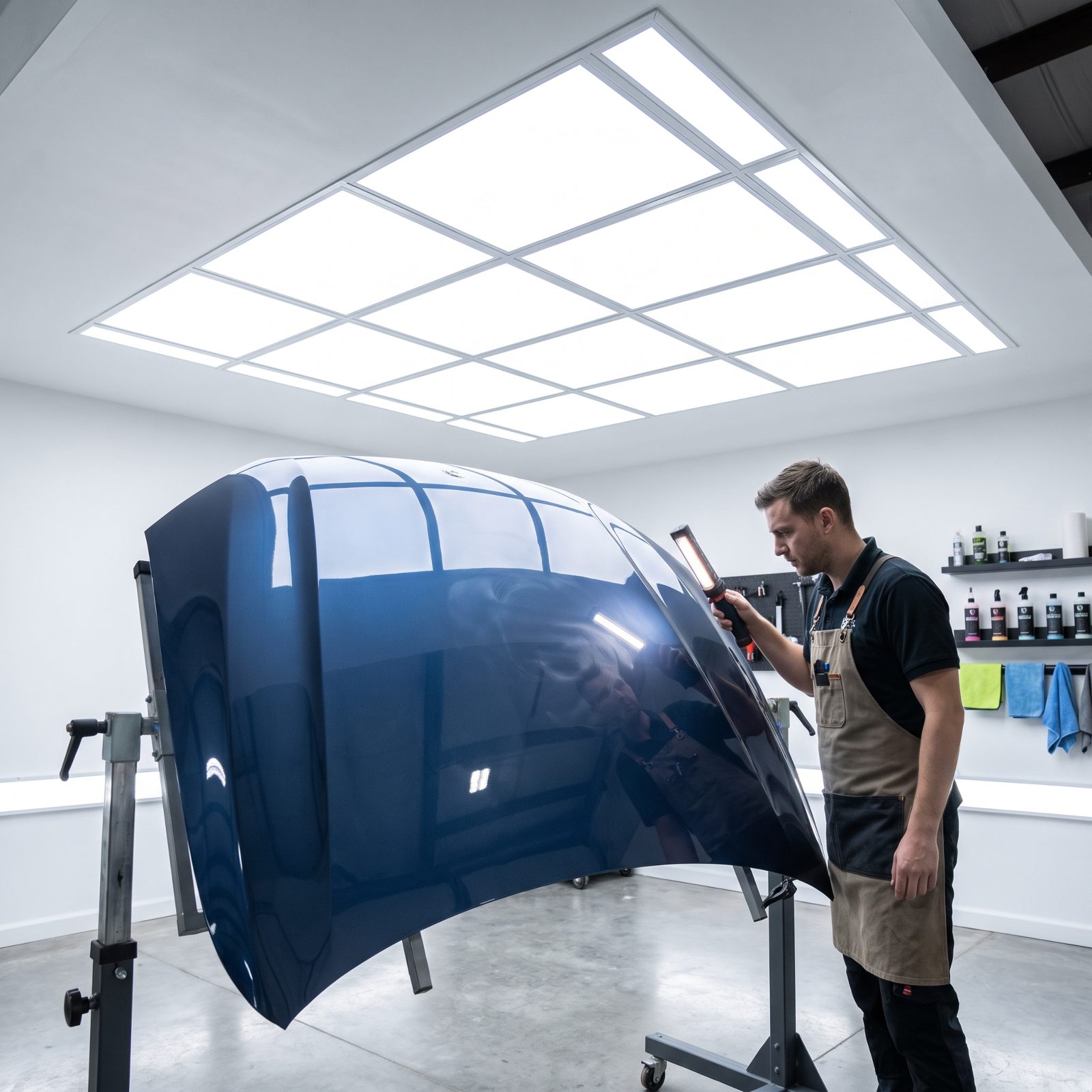
The yellow bulb in the old shop light is lying to you. Detailers know this. Swirl marks, holograms, missed polish, a color mismatch on a touch-up panel — all of it hides under warm, low-CRI light.
A ceiling grid of LED panels at 5000K and a CRI above 90 shows paint the way daylight does. You’ll catch the flaw in the garage instead of in the parking lot sun, where it’s too late.
Budget for coverage, not brightness. Even, overlapping light with no dark corners beats one blinding fixture.
Articulating Under-Hood Task Light That Stays Where You Put It
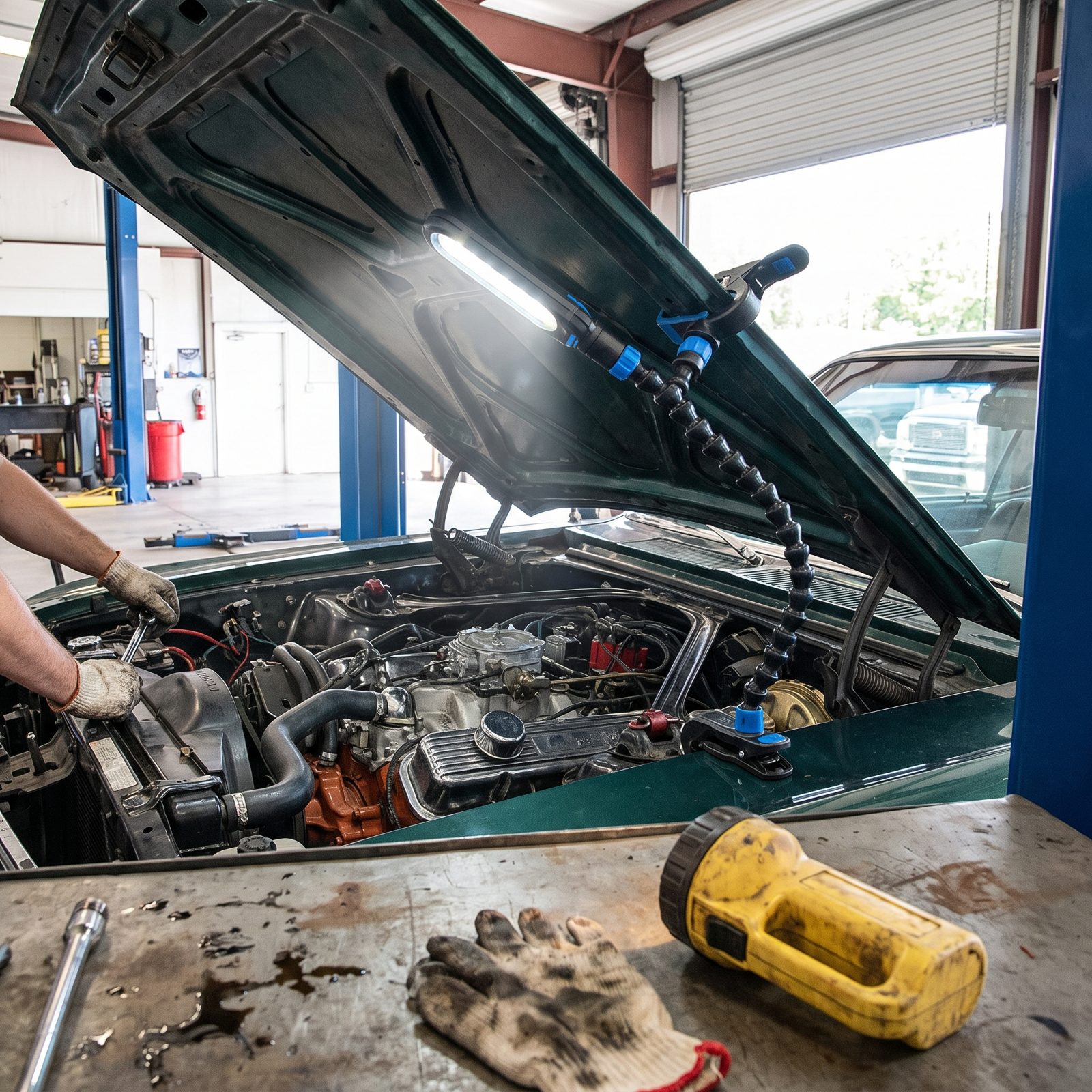
You know the dance. Flashlight in your teeth, knuckles in the dark, dropping the socket into the oil pan. An articulating under-hood light ends it. A telescoping bar spans the engine bay, or a magnetic gooseneck clamps where you need it, and the light follows your work instead of your other hand.
Get one rechargeable with a magnetic base and a hook. The corded ones tangle in the fan shroud at the worst moment. It’s a cheap fix that pays for itself the first night you can actually see the bolt you’re cursing at.
Modular Wall Cabinet System That Grows With Your Tool Habit

The open shelf is where good intentions go to gather dust. A modular cabinet system closes it off, so brake cleaner, rags, and half-used bottles live behind a door instead of coating everything in grime.
Buy a line that sells individual pieces, not a fixed set. Your needs in two years aren’t your needs today. And steel beats MDF in a garage every time — MDF swells the first time it meets a damp concrete floor or a spilled coolant jug, then the doors stop closing square.
Heavy-Duty Slatwall Panels That Turn a Bare Wall Into Storage

Pegboard sags and tears out the first time you hang a real load. Slatwall doesn’t. The horizontal grooves accept hooks, baskets, and brackets that lock in, and PVC panels shrug off the moisture that would rot a plywood wall.
Here’s the advantage: nothing is permanent. Move a hook, add a shelf, reconfigure the whole wall in an afternoon when you bring home a new floor jack or a set of ramps. Rate the panels by weight capacity per linear foot and don’t cheap out — the whole point is hanging the heavy stuff the pegboard couldn’t hold.
Rolling Mechanic’s Workbench That Follows the Job
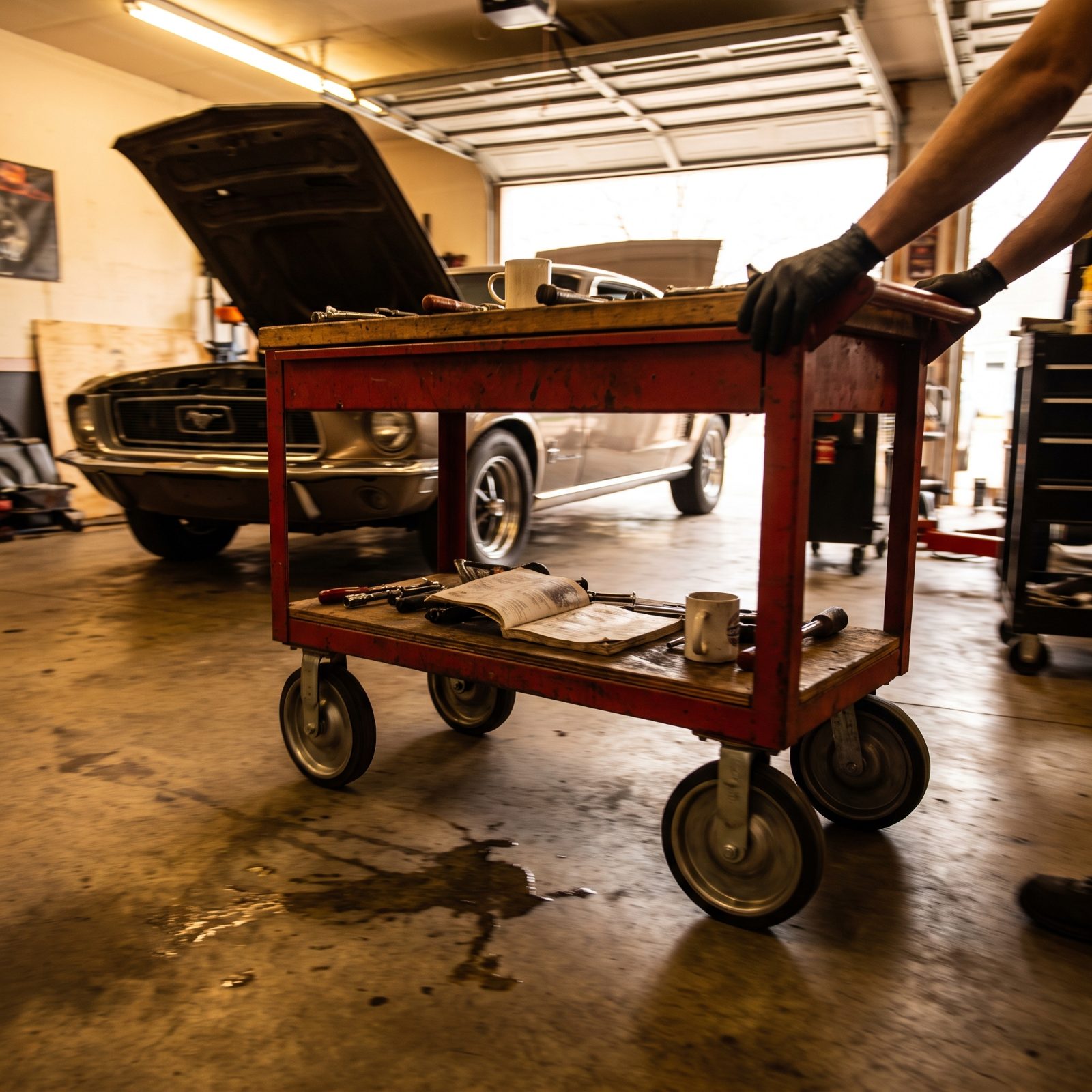
The bolted-down bench is always in the wrong spot. A rolling two-shelf cart brings your tools, the manual, and a flat surface to the car instead of the other way around.
Look for big steel casters, a solid wood top you won’t baby, and a lower shelf sturdy enough that it doesn’t tip when it’s loaded with wrenches and sockets. Roll it up beside the car, do the job, roll it back against the wall when you need the floor for the car.
Lockable Flammable-Liquids Cabinet for Gas, Oil, and Solvents
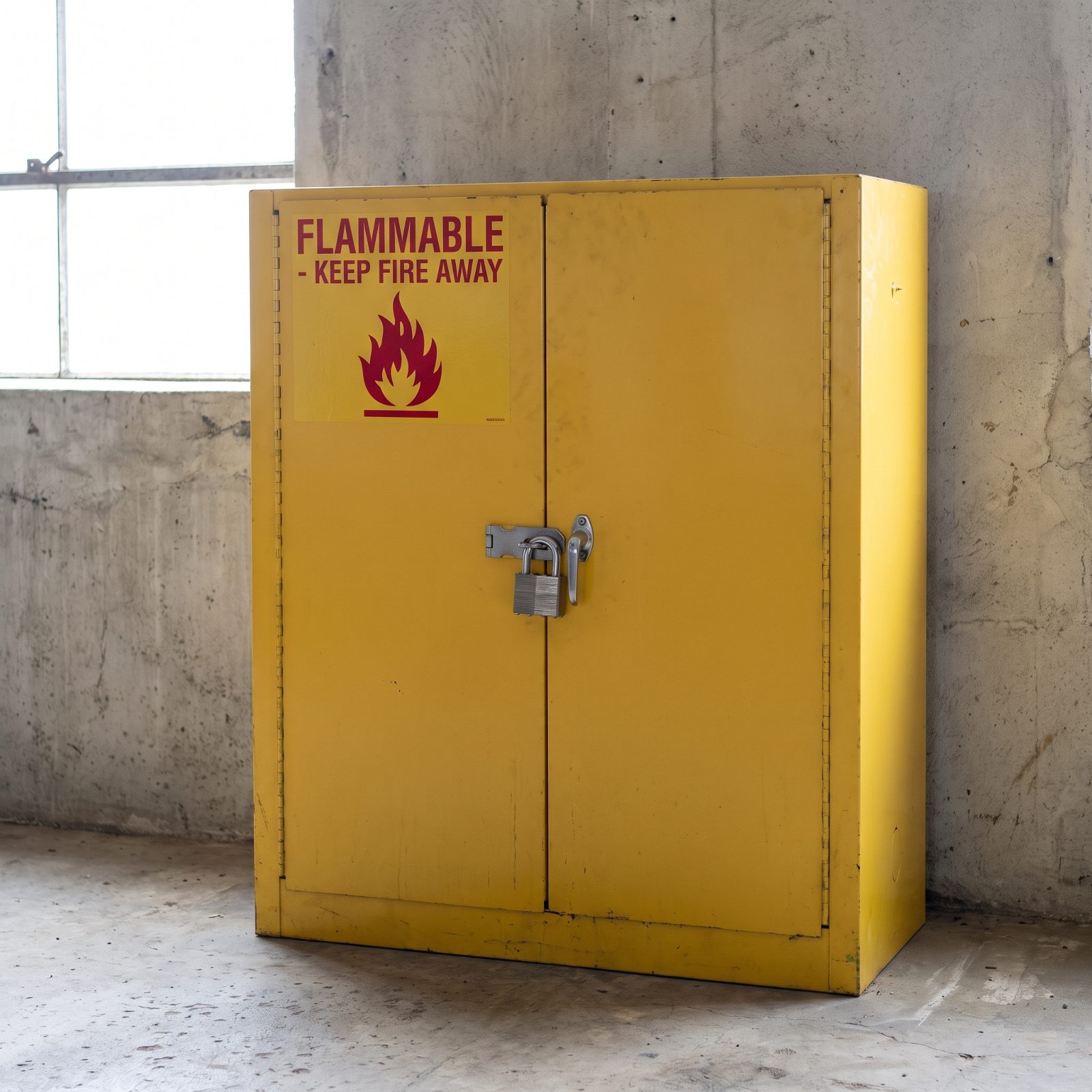
The gas can on the shelf next to the water heater is the setup for a bad day. A proper flammable-liquids cabinet is double-walled steel with a self-latching door and a vent, built to keep the contents from feeding a fire.
The real ones carry a safety rating. The look-alike metal cabinet at the discount store does not. You’ll pay more for a genuine rated unit, and that’s the money worth spending. Keep it away from the furnace and the dryer, lock it if kids are around, and stop storing gasoline where a pilot light can find it.
Built-In Cordless-Tool Charging Drawer
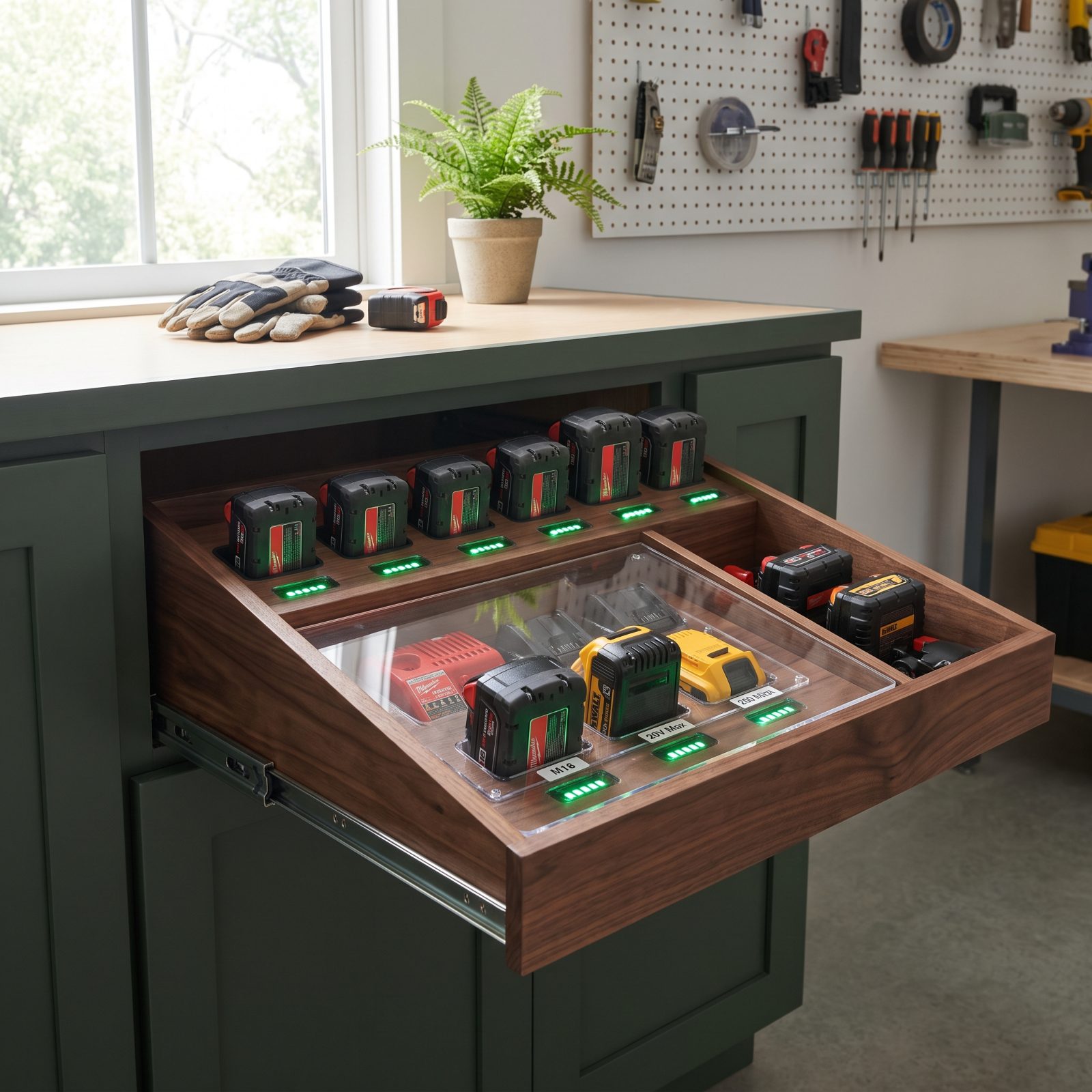
Loose batteries are a tax you pay in dead drills. You reach for the impact driver on a Saturday and it just clicks at you — flat — because the charger’s been buried behind a paint can since March.
A charging drawer fixes that for good. Batteries drop into recessed cradles, the drawer closes, everything tops off out of sight. No wall of blinking bricks on the bench. The charger cords loop over the drawer’s back edge instead, so give them enough slack, or route them through a cable carrier, so they don’t snag when the drawer shuts. Open the drawer, grab a full pack, go.
Wire it to a single switched circuit so the whole bank sleeps when you flip the lights off. Simple. It’s the kind of thing you don’t notice until the day you stop hunting for a charged battery entirely.
Wall-Mounted Tire and Wheel Rack
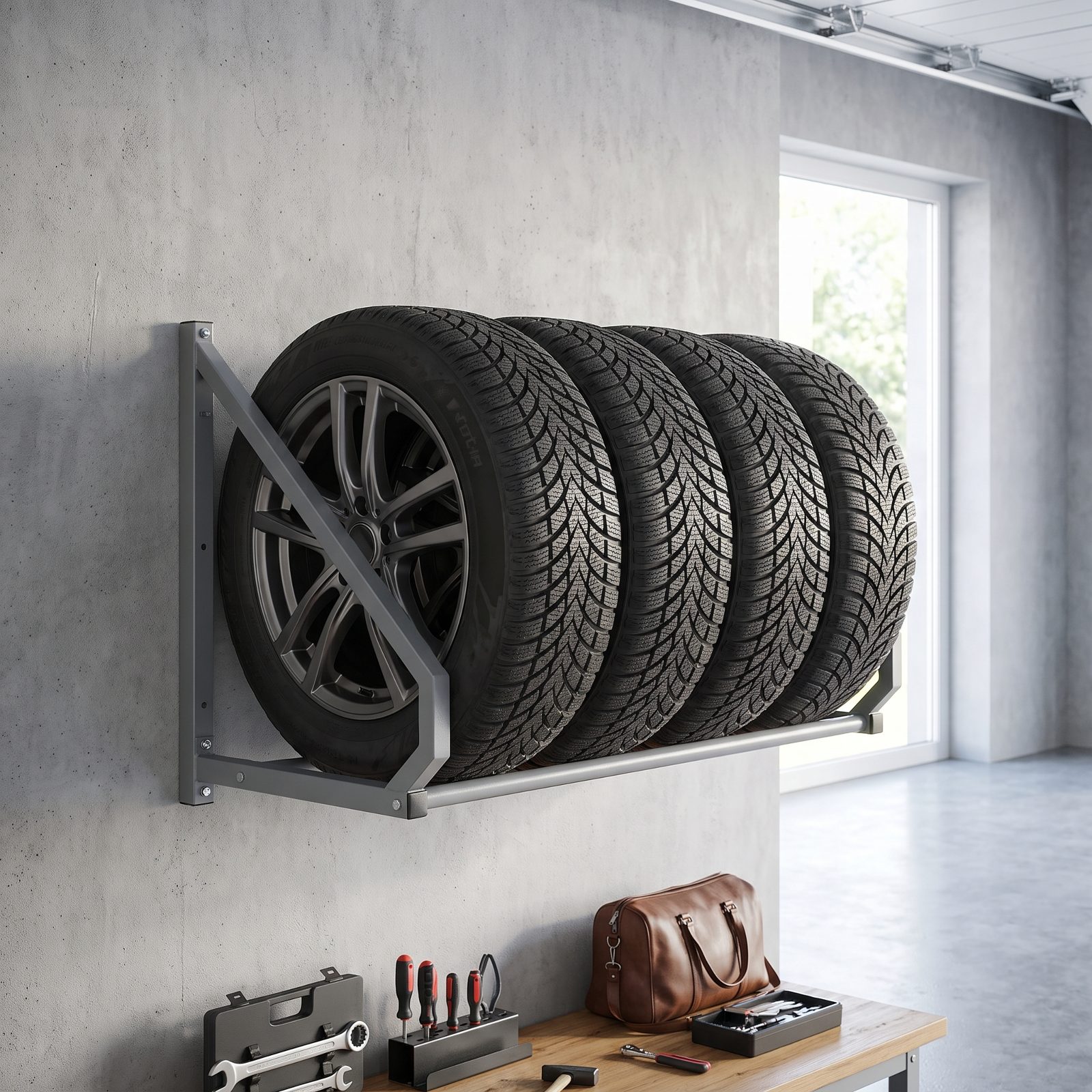
Seasonal tires are the heaviest thing most people own that they refuse to store properly. They end up leaning in a corner, slowly going oval on the bottom, collecting spiders.
Bolt a rated rack to the studs and the problem disappears into vertical space you weren’t using anyway. Four wheels off the floor, sidewalls supported, out of the sun that cracks rubber over a long winter.
Ceiling Hoist for Roof Boxes
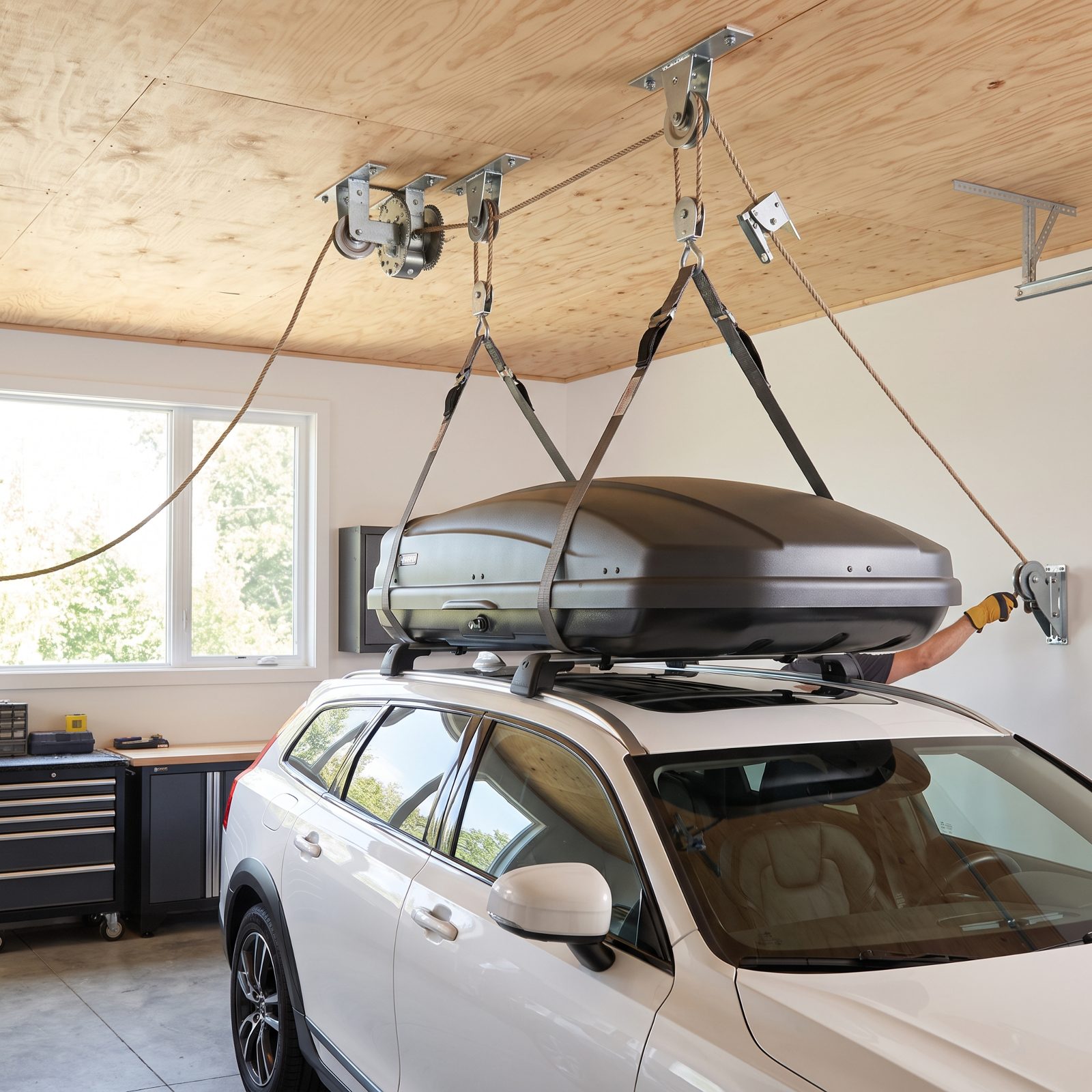
A roof box is fifty-odd pounds of awkward. Wrestling it onto the car alone is how backs go out and paint gets scratched, usually in the same ten minutes.
A ceiling hoist turns that into a crank job. The box lives overhead all year, up where it bothers nobody, and you winch it straight down onto the rails when a trip comes up. One person, no ladder, no neighbor you owe a beer.
Rate the hoist well above your box’s weight and lag-bolt it into real joists — not drywall, not a prayer. Cheap hoists and heavy loads make a bad pairing right above where your car lives.
Central Vacuum With a Vehicle-Length Hose
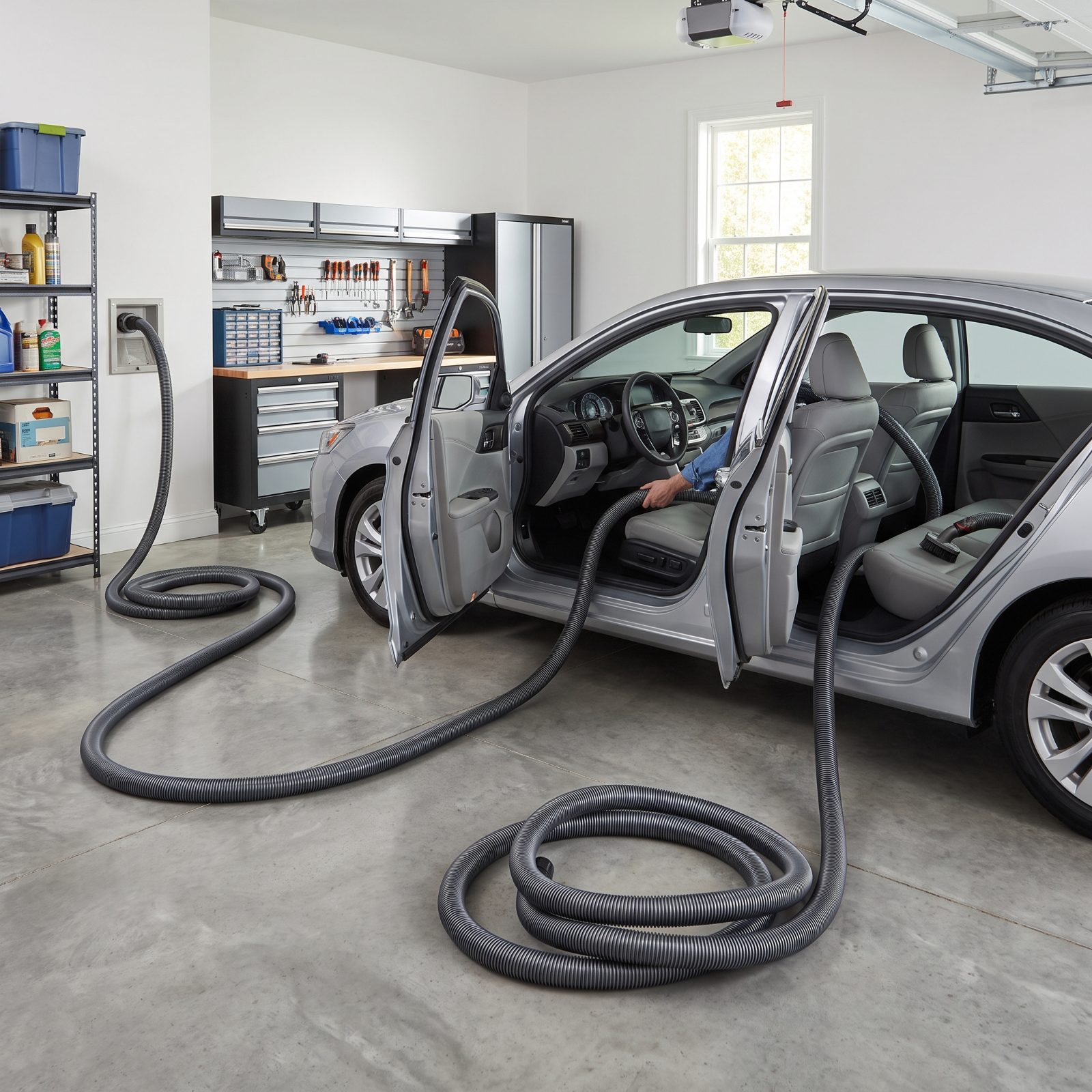
The shop-vac in the corner is a liar. It promises to clean your car and delivers a hose two feet too short, a cord that snags on everything, and a roar that wakes the whole house.
A wall-mounted central unit with a hose long enough to reach the front footwells, plus a second loose hose coiled on the floor for the back seat, changes the math entirely. Pull the hoses out, do the whole cabin without unplugging and replugging a thing, and the motor noise sits outside the wall where you parked it. All the dirt collects in one canister you empty maybe once a season. That’s it.
Retractable Water Hose Reel
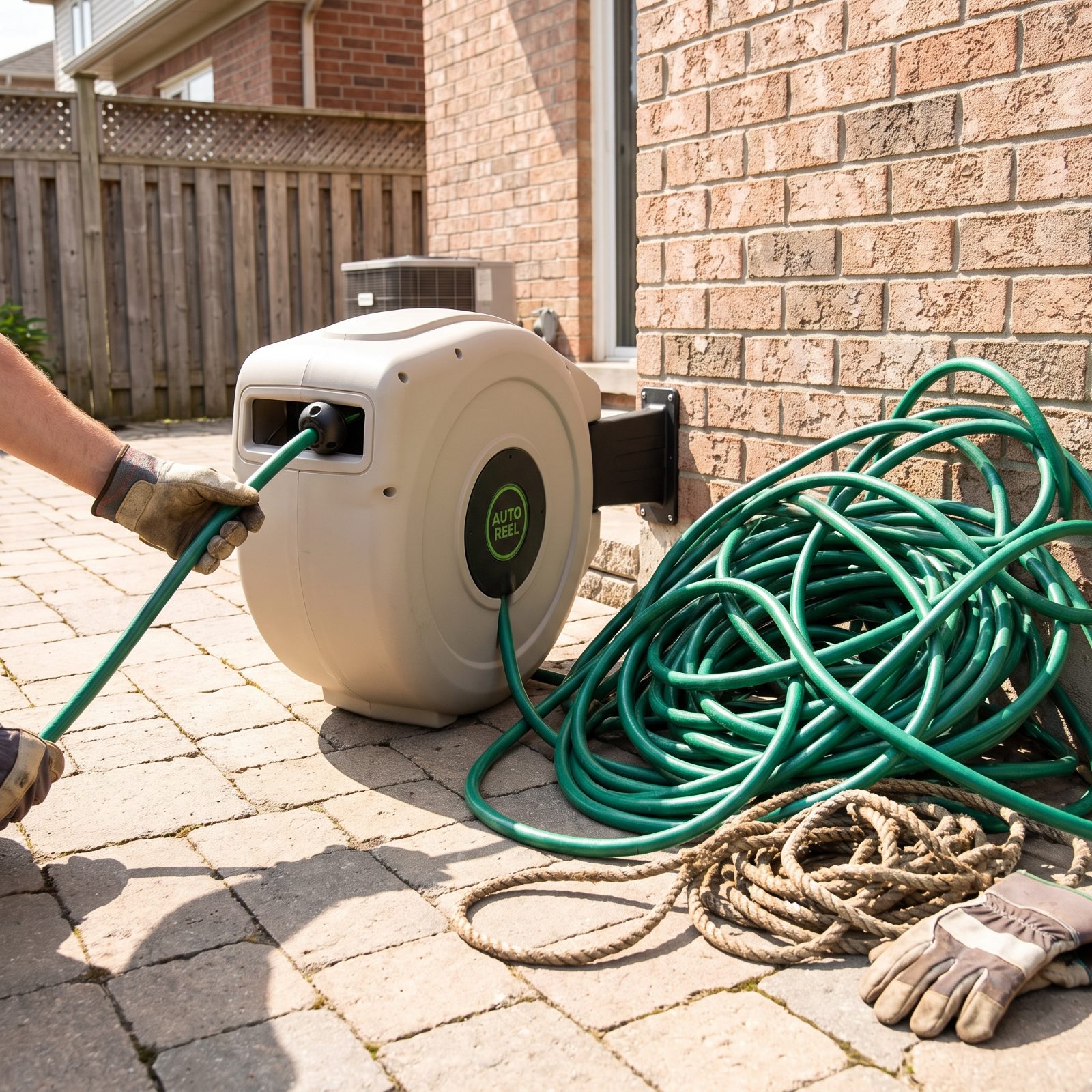
Nobody misses coiling a hose. It’s the single most-ignored chore in any garage, which is exactly why most hoses live in a kinked heap that leaks at the fitting and trips you on your way to the car.
A retractable reel ends the whole ritual. Pull out what you need, give it a tug to release, and the spring walks it back onto the drum — straight, no kinks, no puddle left behind. Mount it near the wash spot and feed the old tangled heap onto the drum once; from then on, the hose stops being a floor hazard the second you let go.
Wall-Mounted Pressure-Washer Station
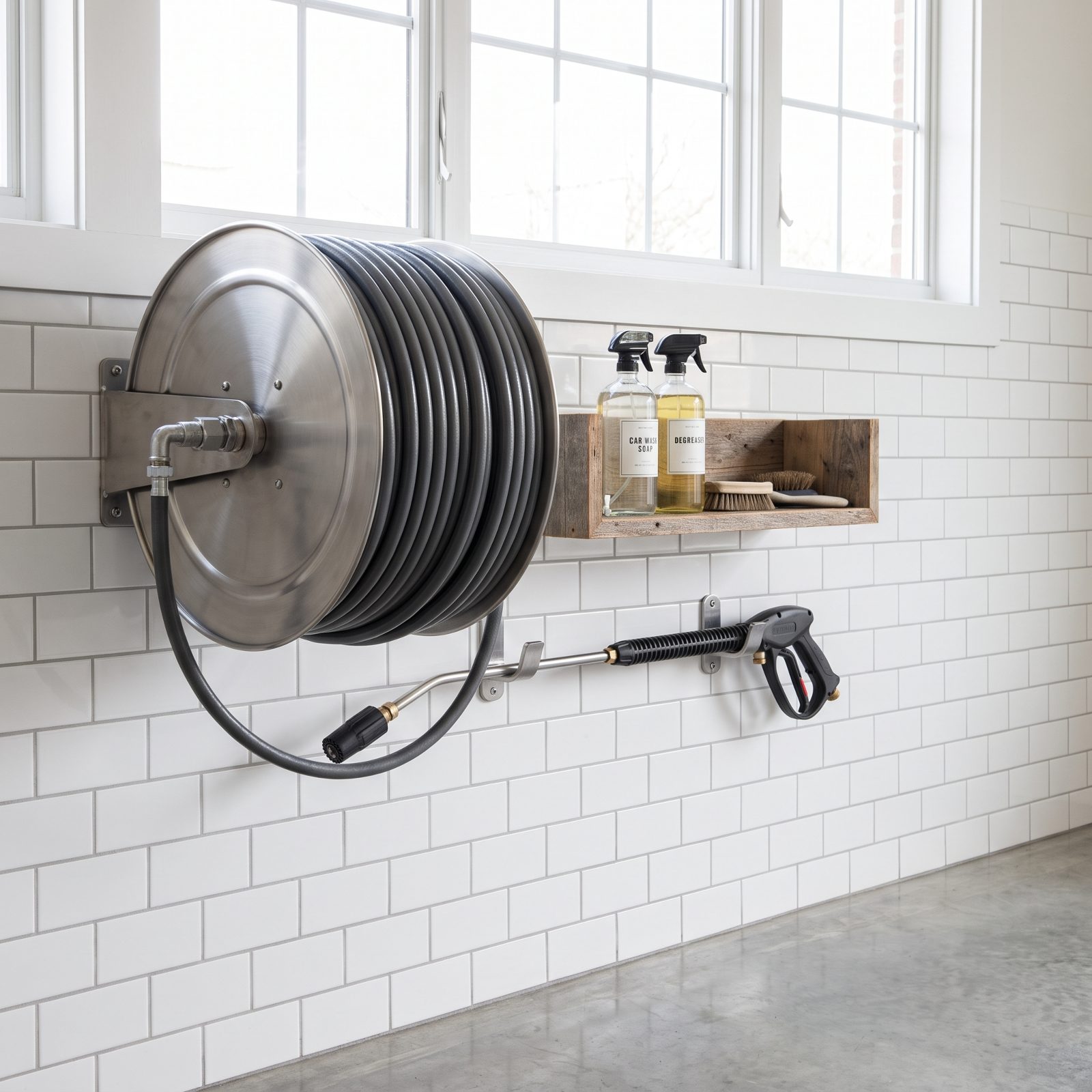
A pressure washer on the floor is a trip hazard that also happens to clean your wheels. It rolls. The hose tangles. The trigger gun ends up somewhere under the workbench by Tuesday.
Mount the whole station on the wall and most of the clutter’s gone, plus the unit stays off wet concrete — which its electrics appreciate more than you’d think. Main hose on a reel, wand in a bracket, detergents and brushes lined up on a shelf so you grab the right one without squinting at it. The short leads still hang in long loose loops, so clip them up before they reach the floor.
Retractable Waterproof Wash-Bay Curtains

Overspray goes everywhere. Wash a car inside and suddenly the toolbox, the drywall, and that box of holiday decorations are all getting a rinse they never asked for.
Retractable curtains on a ceiling track draw a wet line in the sand. Pull them around the bay, wash, and the water stays in the zone with the floor drain. Done, and they slide back against the wall so the garage goes back to being a garage.
Get vinyl heavy enough that it hangs flat instead of billowing, and make sure the track clears your tallest vehicle. A curtain that drapes on the roof? Pointless.
Deep Utility Sink for Detailing Tools
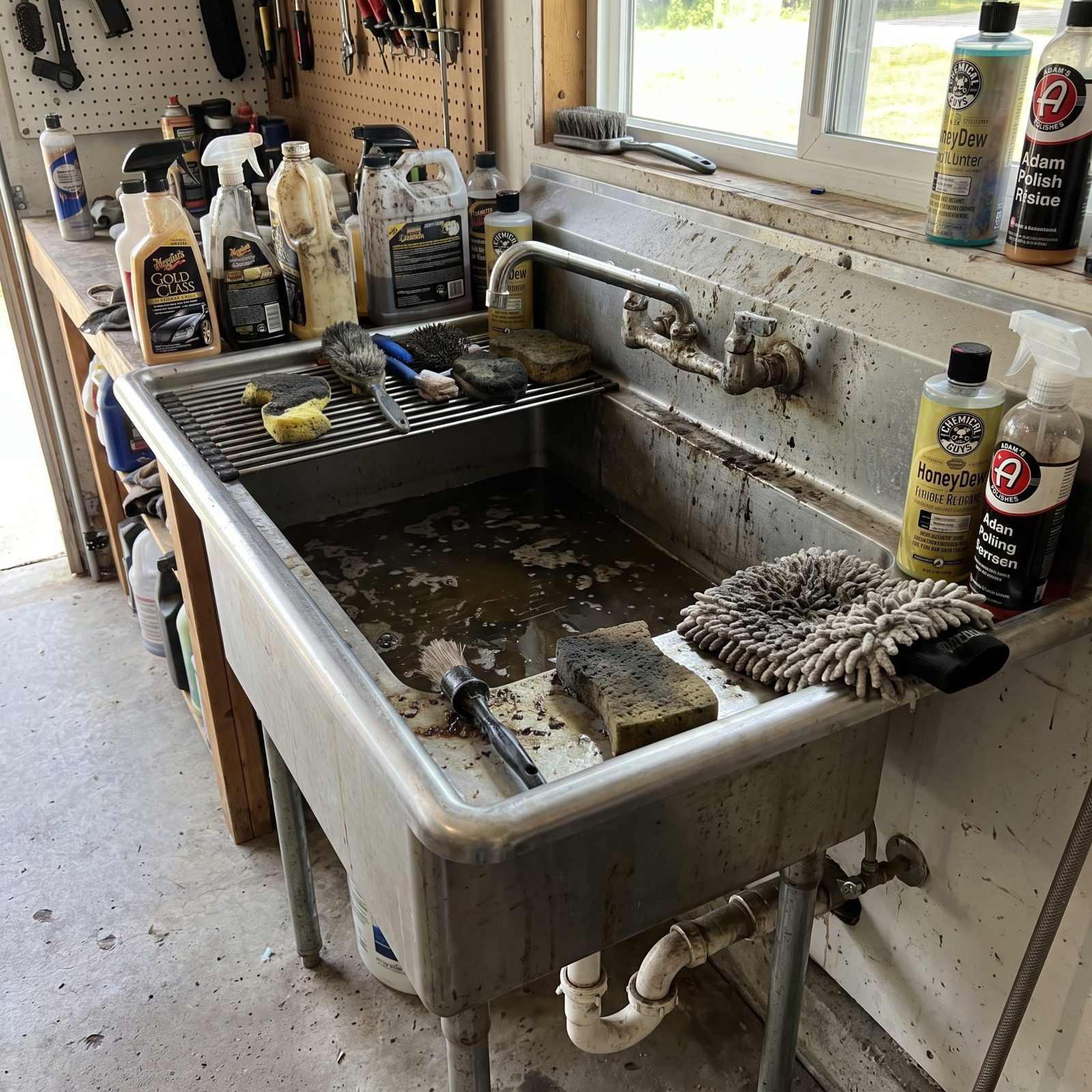
Detailing supplies hate your kitchen sink. Tire dressing, wheel acid, degreaser rinse — none of it belongs anywhere near where you wash dishes, and the rest of the household knows it too.
A deep utility sink in the garage gives all that mess its own address. Wide enough to soak a whole batch of sponges and mitts at once, deep enough to rinse a filthy brush without painting the backsplash, and plumbed so grimy water goes where grimy water should.
Spring for the deepest basin you can fit. The shallow ones splash everything right back at you, and you’ll resent that choice every single wash.
Spot-Free Deionized Rinse System

Water spots are minerals, not dirt. Which is why you can wash a black car dead perfect and still end up with a hood full of little white rings the moment it dries in the sun.
A deionized rinse strips the dissolved minerals out before the water ever touches the paint. Run your final rinse through the canisters and the car air-dries with no spots at all. No chamois marathon. No chasing drips around the badges.
Wall-Mounted Vehicle Drying Blower

Towels put the scratches in your paint, not the dirt. Every drag of cotton across a panel is grit quietly sanding your clear coat, which is why even well-kept cars pick up swirl marks over the years.
A pressure rinse like this one blasts the grit off without a towel touching the paint, and the wall-mounted blower behind you then dries the car without contact too. Once the spray stops, aim its filtered air into the mirror backs, door handles, grille, and badge gaps — all the places water hides and then dribbles out onto a clean panel an hour after you’ve put the towels away. Infuriating, that last part.
Mount it on the wall near the wash bay so it’s a thirty-second reach, not a thing you have to haul out of a cabinet. Make the no-touch dry the easy option and you’ll actually do it every time.
Hard-Piped Compressed-Air Outlets Around the Walls
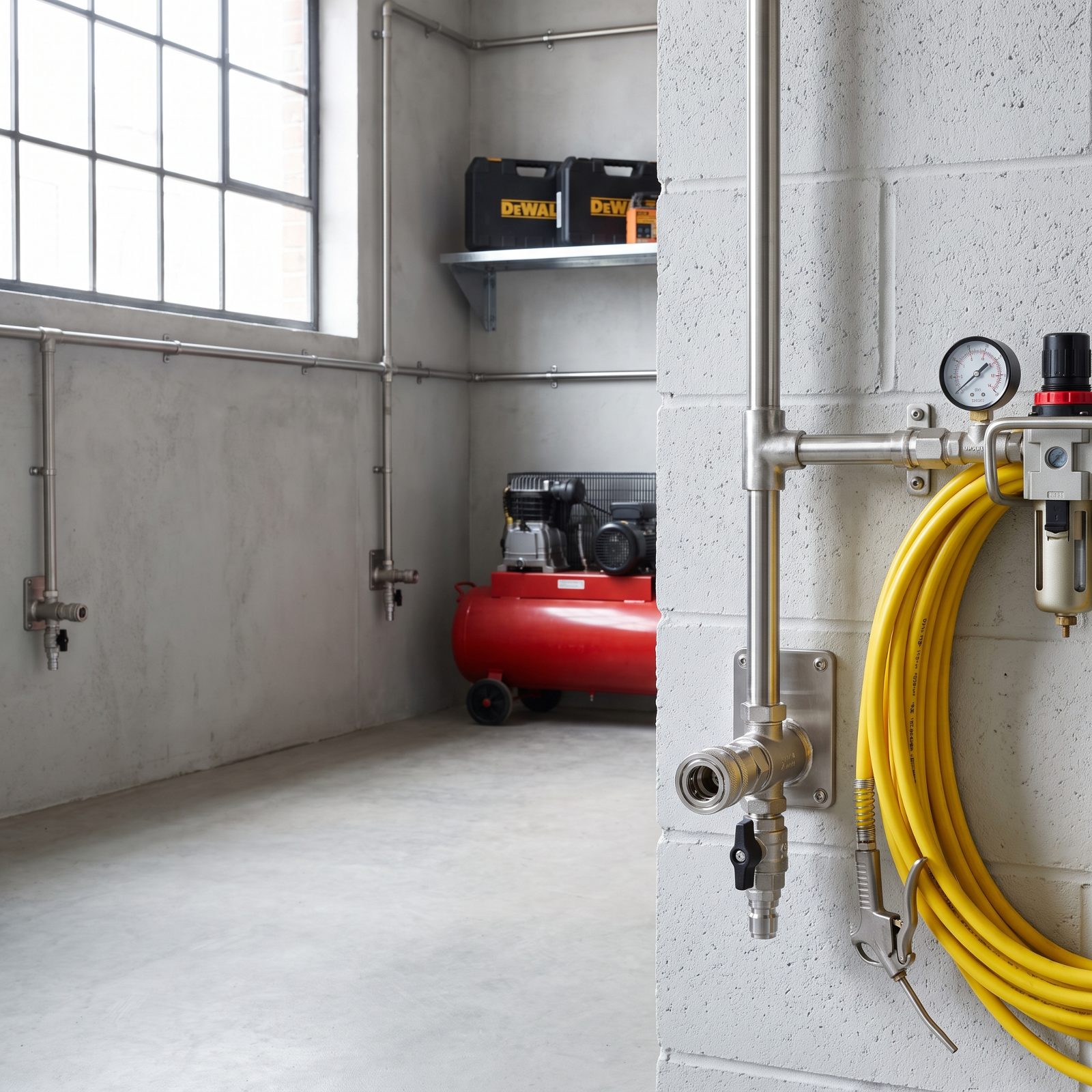
Dragging a hose and compressor across the garage every time you need to seat a tire bead or blow out a brake caliper gets old fast. Hard-piped air fixes that. You run rigid line around the perimeter, drop a few quick-connects at the spots you actually work, and the compressor lives in a corner where its racket bothers nobody.
The detail folks skip: a water separator and a slight downhill slope on the runs so condensation drains instead of spitting rust into your tools. Aluminum pipe costs more than black iron but assembles like plumbing and won’t corrode. Add an outlet outside the door too, and you’ll air up trailer tires without ever opening the garage.
A Two-Post Service Lift You’ll Actually Use

Lying on a creeper under two tons of car held up by jack stands is the kind of thing you do when you’re young and figure you’ll be careful. A two-post lift changes the whole math. Oil changes, brake jobs, exhaust work — all of it happens standing up, with full access underneath.
Here’s what people get wrong. They buy the lift before they check the slab. A proper two-post needs four to six inches of good concrete, and your builder-grade floor might not be it. Get that verified first. The lift is the easy part.
A Ceiling-Mounted Laser Parking Guide

A spot on the dash, a crack in the floor, a tennis ball dangling from the rearview mirror — everybody’s got some trick to stop the bumper from kissing the shelf. A ceiling laser does the same job with less drama. It throws a dot you line up with a mark on your dash, and you stop in exactly the right place every time.
Cheap ones run twenty bucks and bolt to a joist. The real value shows up in a tight bay where six inches decides whether you can open the driver’s door.
A Lift-Ready High Garage Ceiling
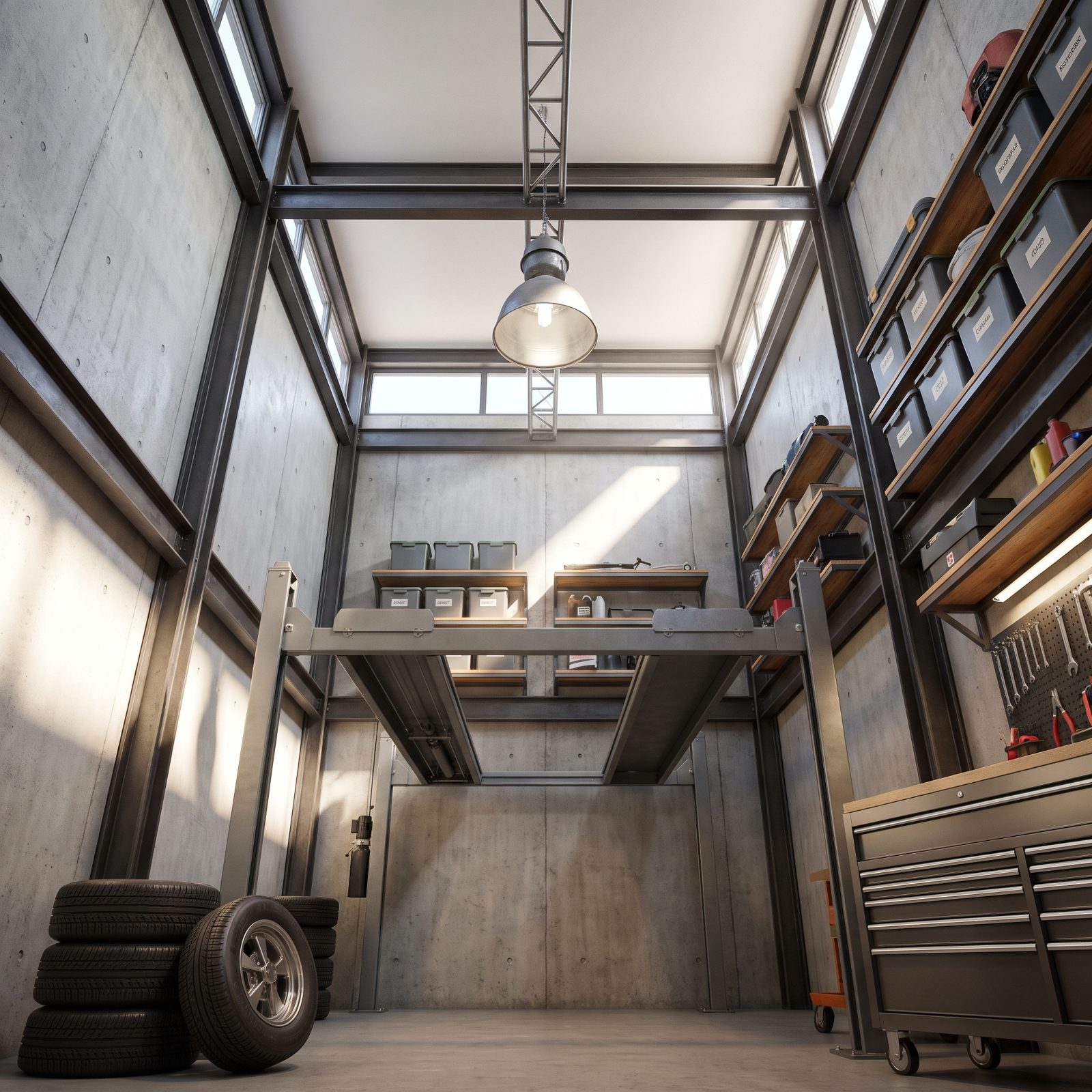
Ceiling height is the upgrade you can’t retrofit without a sawzall and regret. Standard garages run about eight feet to the opener track, which is enough to park and nothing more. It won’t let you lift a truck over a car, stand a tall RV ladder, or run a four-post storage lift that doubles your floor space.
Twelve feet is the sweet spot for most home lifts. If you’re building or adding on, this one decision quietly determines everything else you’ll ever be able to do in that room. Route the ducts and lighting around the lift zone while the ceiling is still open — you won’t get a second shot at it.
Extra-Deep Parking Bays With Room to Work

The dirty secret of most garages is that they’re built to the minimum. Twenty feet deep fits a sedan and a closed door, and not much else. Push the depth to twenty-four or twenty-six feet and the whole space changes character. Now there’s a workbench in front of the hood instead of a wall in your face.
Extra depth also saves your tailgate. Ever opened a liftgate into a shelf of paint cans? Then you know the problem. A few extra feet means you can load gear, pop the hood, and still walk around the front without turning sideways.
An Oversize Garage Door Opening

A standard seven-foot door is fine until the day you buy a truck with a roof rack, or a van with a vent fan, or a lifted rig that scrapes the header on the way in. Then it’s a daily annoyance you can’t fix cheaply.
Going to eight, nine, or ten feet of clearance future-proofs the opening for the vehicles you don’t own yet. Width matters just as much. A wider door means less white-knuckle alignment pulling in and far less chance of folding a mirror.
A Drive-Through Rear Garage Door
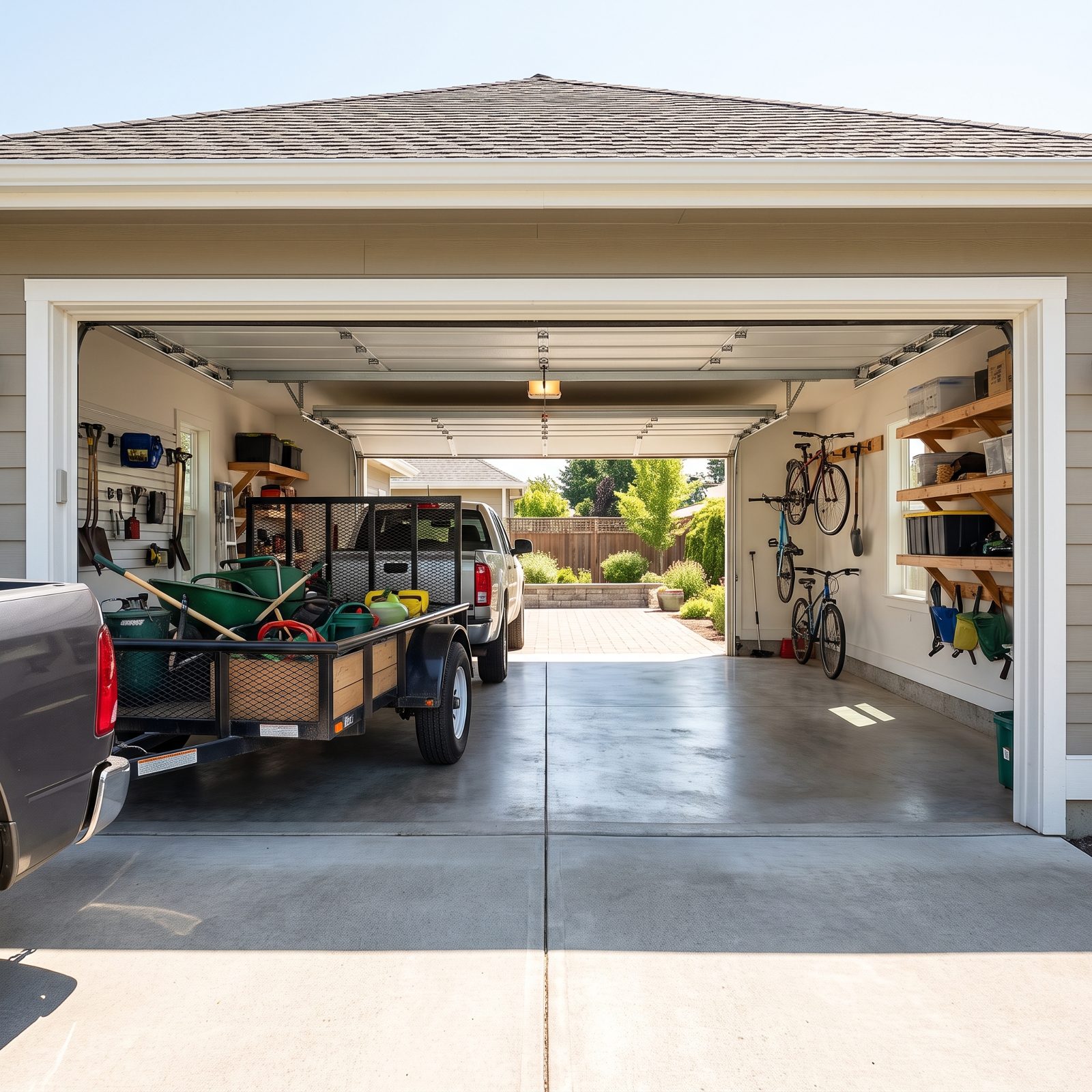
Backing a trailer out of a one-way garage is a special kind of misery, usually performed with a spouse yelling helpful directions. A rear door turns the whole bay into a pull-through. You come in through the back, you leave out the front, no reverse required.
It’s a gift for anyone towing, hauling a boat, or wrenching on a project car they’d rather roll out into the backyard. The tradeoff is wall space and cost, since a second door means a second opener and less cabinetry room. For a lot of hobbyists, worth every inch.
A Fire-Rated Garage-to-House Separation

This is the least glamorous item on the list and the one most likely to matter on the worst night of your life. The wall between your garage and your house is supposed to buy time if a fire starts where all the gasoline, oil, and batteries live. In an older home, that barrier may be cut corners you’ve never once looked at.
A proper setup means fire-rated drywall, a self-closing rated door, and no pet flap or gap underneath feeding air to the flames. Codes vary by state, so check local requirements. And if your door into the house is a hollow builder slab that’s been propped open for years? Fix that first.
An Automatic Garage Fire-Suppression System

EV batteries, lithium power tools, stored fuel, a project car that leaks a little. The modern garage holds more fire risk than it used to, and a lot of that risk sits unattended for hours at a stretch. An automatic suppression system is the backstop for when nobody’s home to grab an extinguisher.
Your options run wide. Heat-activated ceiling nozzles that dump clean agent, residential sprinkler heads tied into the water supply, small self-contained units that mount over a single hazard like a charging station. Cost and complexity swing hard depending on which route you take.
Overlapping Security-Camera Coverage

One camera over the door is theater. It catches the back of a hoodie and nothing useful. Overlapping coverage actually protects what’s parked inside: a camera on the opening, one on the vehicles, one covering the walk door, each seeing what the others can’t.
Redundancy is the whole point. Thieves know to spot the obvious lens and work the angle it misses. When two fields of view overlap, there’s no clean blind spot left to stand in.
Run the important ones on local storage or wired power so a cut internet line doesn’t erase your footage. And put one camera low, pointed at license-plate height. Wide overhead shots look impressive and identify nobody.
Automatic Water-Leak Shutoff Valve

Water finds the car first. A slab leak or a burst washing-machine line two rooms over will run downhill into the garage and pool under whatever you love most. The fix worth having now is a valve that sits on your main water line and slams shut the second the flow does something it shouldn’t.
These plumb into an existing copper line and learn your normal usage, so if you leave a hose bib dripping overnight, it notices. Figure a few hundred to around a grand installed. Most tie into an app, which means you can kill the water from the driveway.
Dedicated Garage Wi-Fi Access Point
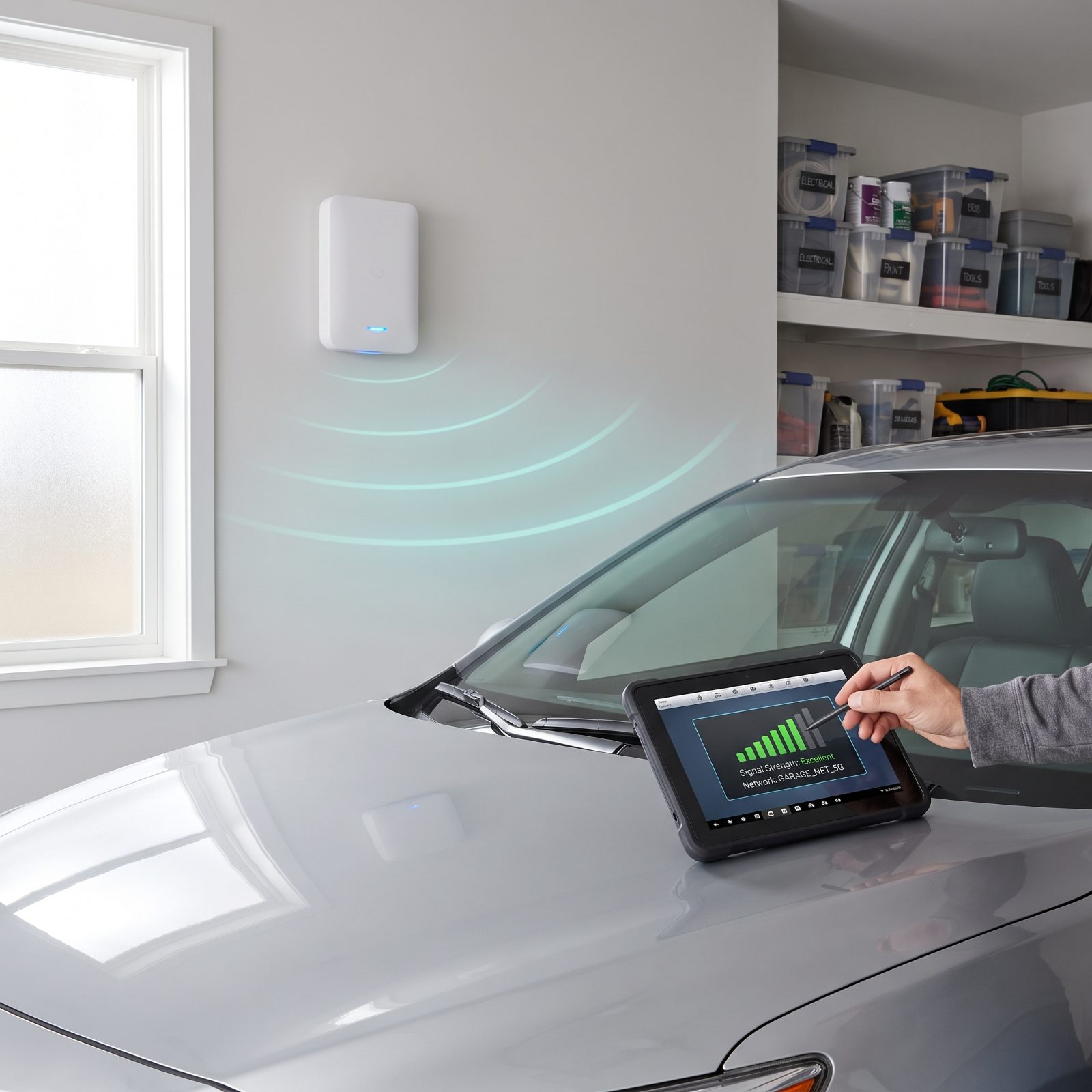
Your home router sits in the living room, three walls and a steel garage door away, which is exactly why the diagnostic app stalls the moment you need it. A dedicated access point mounted on the garage wall fixes the dead zone nobody talks about.
And it matters more every year. EV chargers, tire-pressure monitors, battery tenders, security cameras, over-the-air car updates — they all want a solid signal out there. A mesh node or hardwired unit runs maybe eighty to a couple hundred bucks, and it earns that back the first time a big software update finishes overnight instead of dying in the nineties.
The garage is the one room in the house we fill with computers on wheels, then starve for bandwidth.
Sound-Absorbing Acoustic Wall Panels

Run an impact wrench in a bare concrete box and the noise doesn’t leave — it ricochets. Hard floor, hard walls, hard ceiling, every clang comes back at you twice. Felt-wrapped acoustic panels soak up that reflection so you can wrench past nine without the whole house turning on you.
I ignored this for years and just got louder. Then I lined one wall, and the difference hit me the same afternoon. Phone calls out there stopped sounding like they were coming from inside a parking structure.
Panels run a few bucks a square foot. Cover the wall you work against and the ceiling above the bench first — that’s where your ears live.
Bidirectional Vehicle-to-Home Charging

Most EV owners think of the car as something to fill. The smarter move is treating it as something to draw from. Bidirectional charging lets the battery under your floor send power back into the house when the grid goes dark, or when evening rates spike right as you’re cooking dinner.
A midsize EV holds enough to run a typical home for a day or more, depending on what’s plugged in. Here’s the catch nobody mentions. The car, the charger, and your panel all have to support it, and plenty of models still don’t. Confirm compatibility before you spend a dime.