
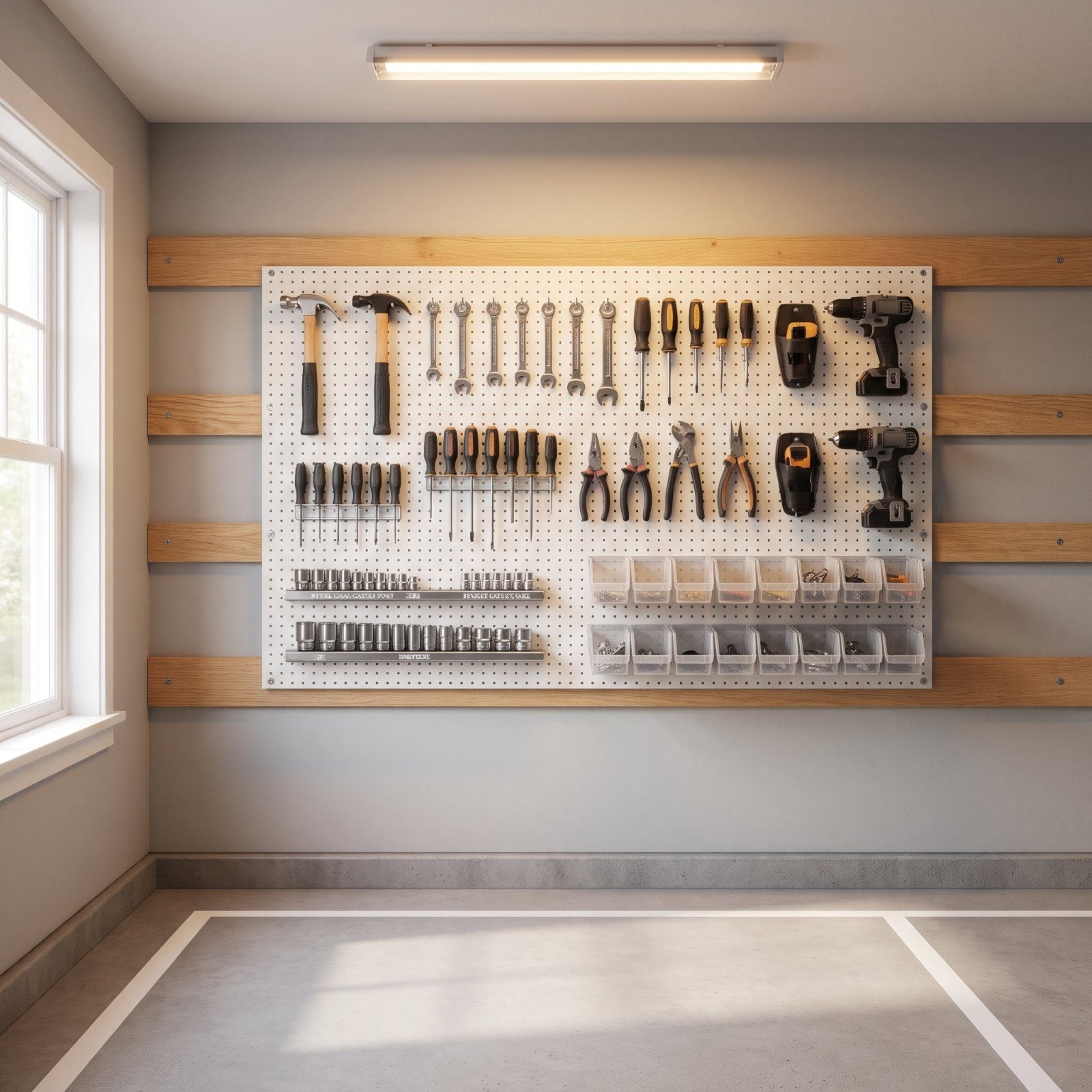
A one-car garage holds one car. That math never changes, no matter how many plastic bins you cram against the wall. The car still has to fit, and the door still has to clear the fender when it swings open. That’s the whole problem.
Please note that some of the images in this article were created with the assistance of AI.
Pegboard solves it by going up instead of out. Every tool you hang is floor space you keep. The trick is doing it so the wall carries real weight, the car still slides in clean, and you can grab a drill without walking around a bumper to do it. Here’s how that actually gets built — sheet by sheet, hook by hook.
44. Framed Hand-Tool Pegboard Above the Workbench
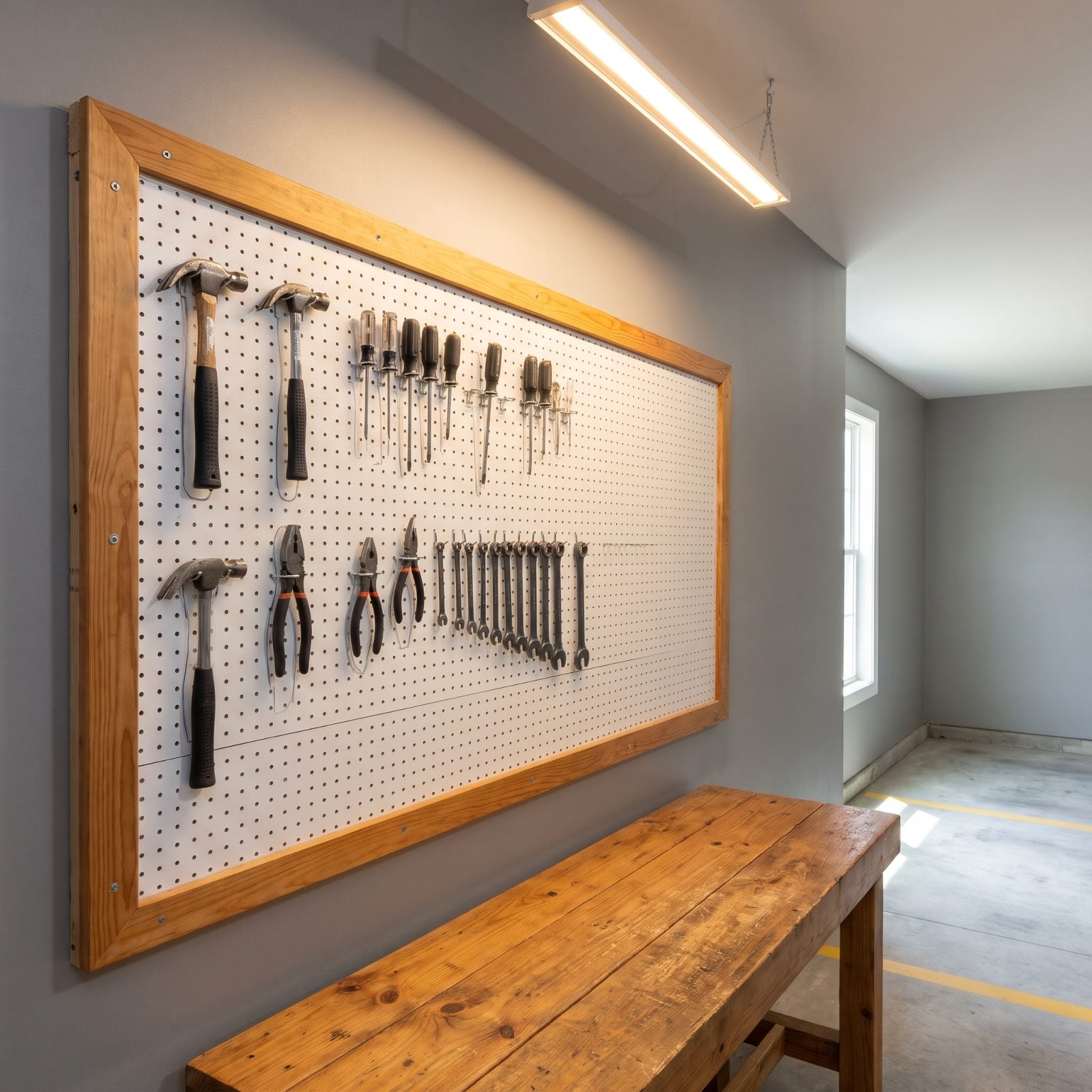
The frame is not decoration. A trim surround hides the cut edges, and it gives you something rigid to screw through into studs. Pegboard alone flexes under a loaded wrench rack. Frame it, furr it out a half-inch, and the hooks stop pulling loose.
Mount it above the bench and the whole wall goes vertical, which keeps the full depth of floor in front of it — exactly where your front bumper wants to live. Trace each tool with a pencil before you hang it. You’ll put things back without thinking, and one glance tells you what wandered off into the yard.
43. Pegboard Holsters for Cordless Drills
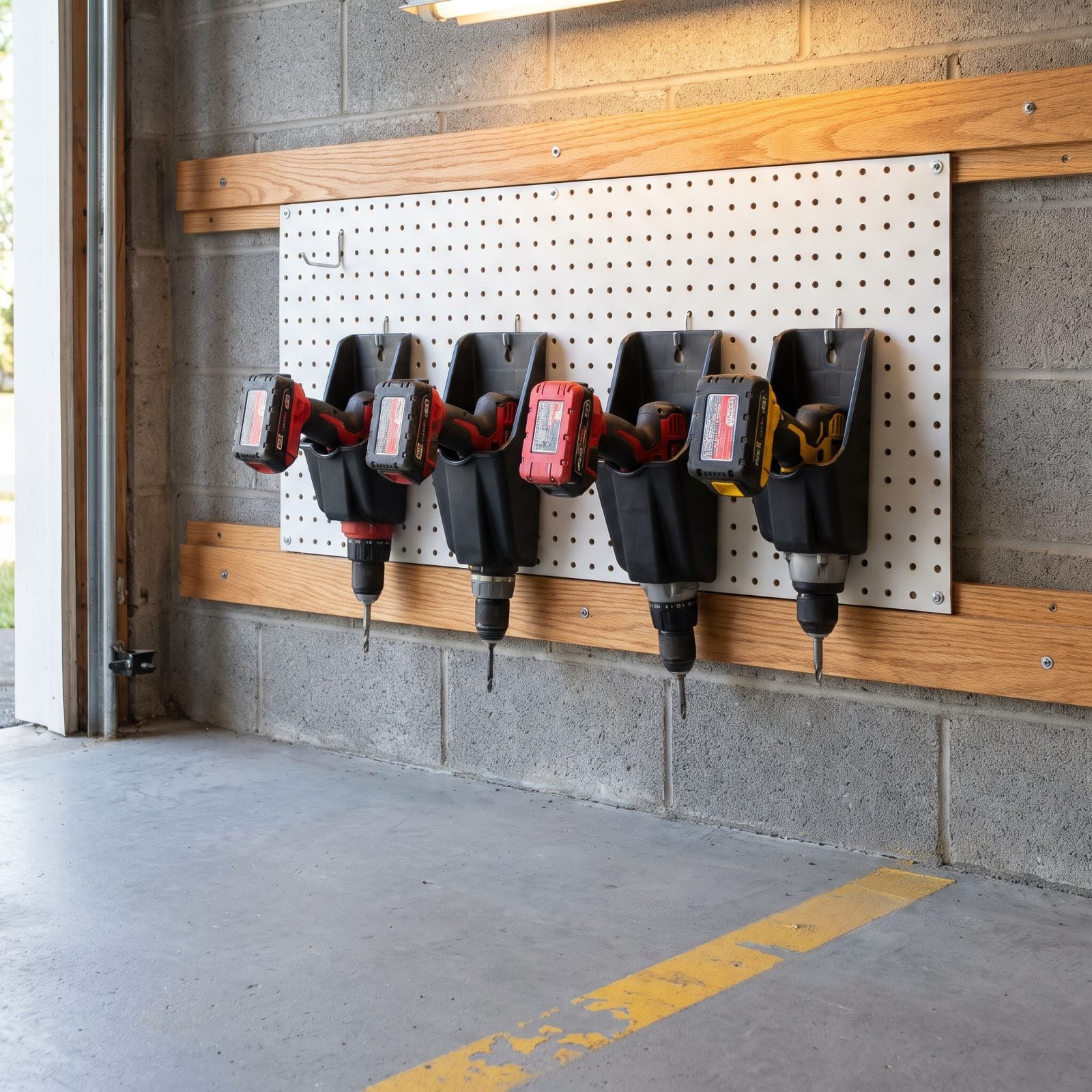
Drills are the worst offenders. They live in a pile on the bench, battery half in, trigger snagging on everything. Hang them nose-down in dedicated holsters and the clutter disappears in about thirty seconds.
The holster cradles the body so the weight pulls straight down instead of levering off a single hook — and that matters with a four-pound hammer drill. Grab-and-go, drop-and-done, and you never have four drills when you can only find one. Keep the row low, around knee-to-waist height, so you can grab one without reaching over the hood.
42. Pegboard Charging Shelf for Tool Batteries
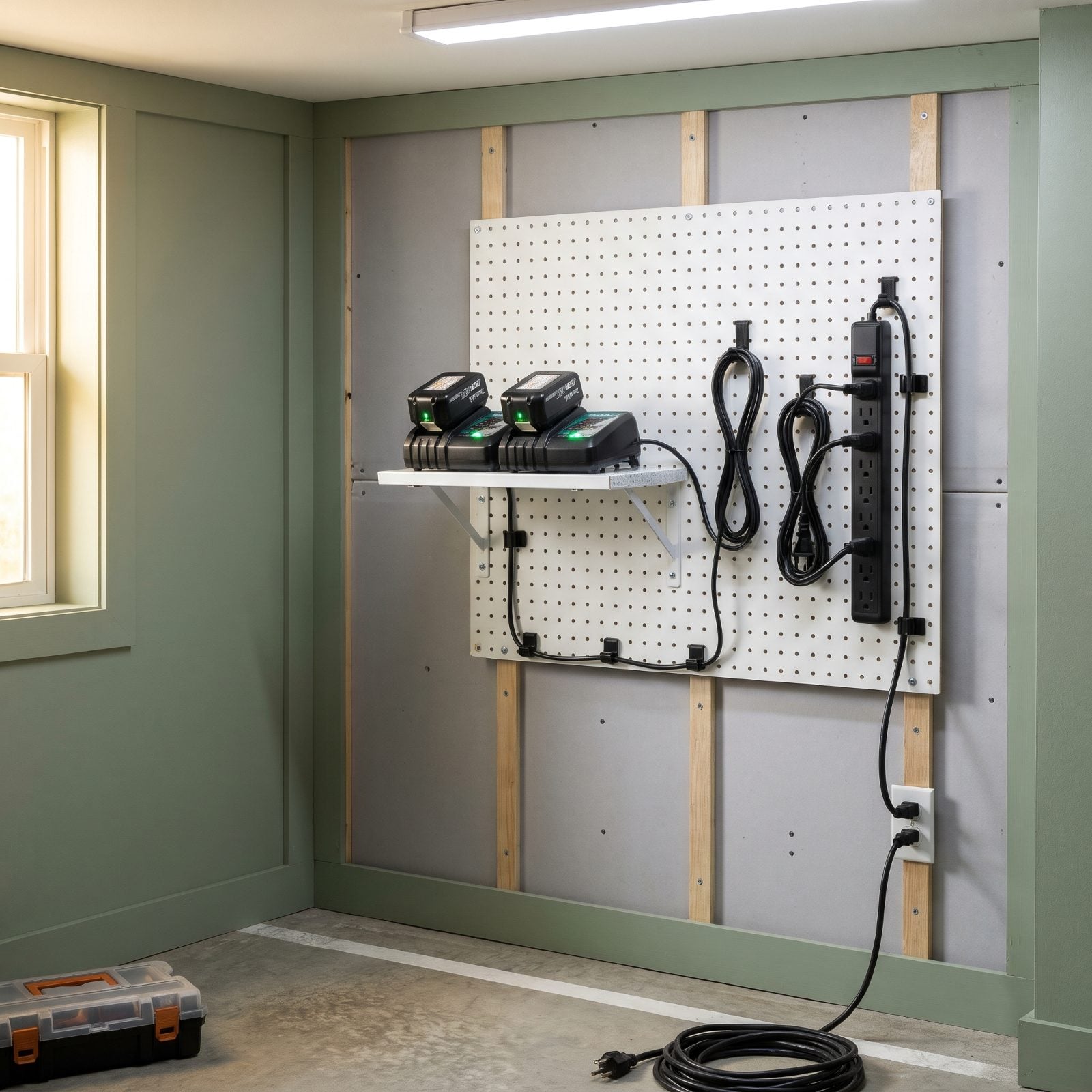
Batteries charge flat on a bench, trailing cords across your work surface, usually right where you want to set down a part. Lift the whole operation onto a pegboard shelf and the bench comes back to you.
Bracket a narrow shelf, run the charger cords through a few clips, and mount a power strip off to the side to feed the coiled cords hanging on hooks. Chargers sit up and out of the way, indicator lights visible from across the garage so you know what’s topped off.
41. Pegboard Socket Rails With Labeled Sizes
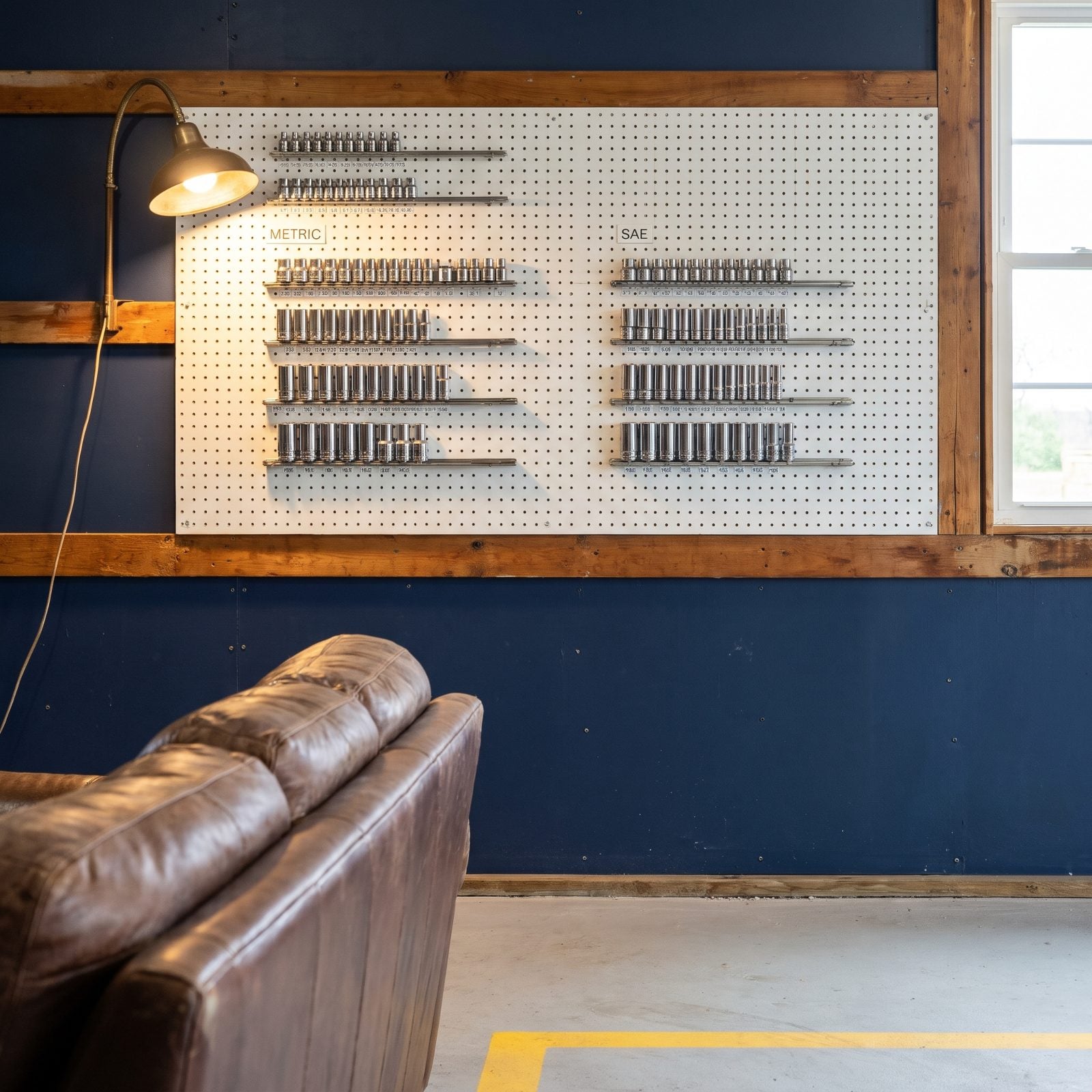
Loose sockets are chaos in a drawer — rolling around, rolling off the bench, rolling under the car where they live forever. Clip them onto labeled rails and every size gets an address.
Run metric on one side, SAE on the other, drive sizes grouped. The labeled gap shouts at you when a socket’s missing, which is usually the exact one you need. You’ll see it’s gone before you start the job, not halfway through with a knuckle already bleeding.
40. Pegboard-Mounted Tip-Out Fastener Bins
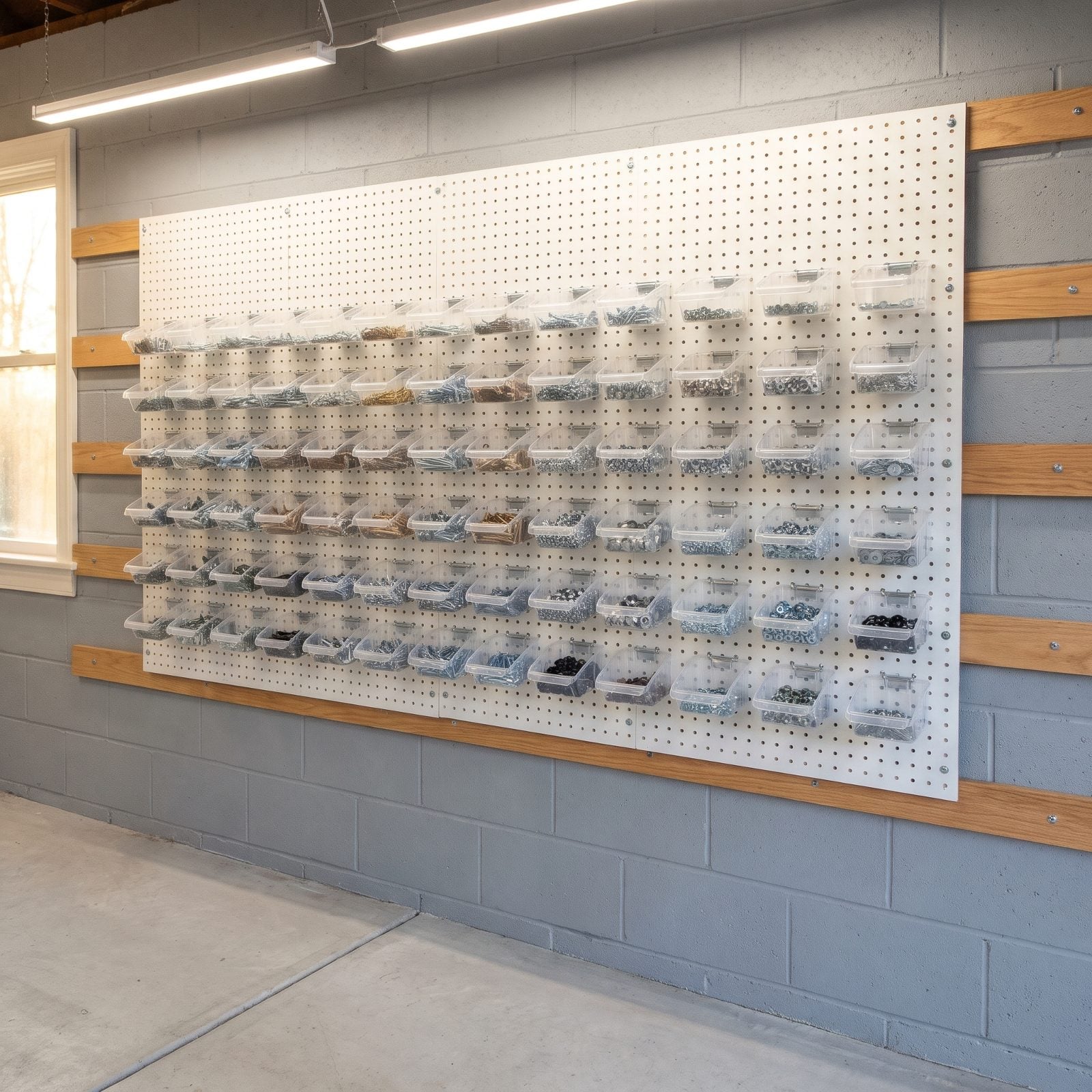
Tip-out bins are the move for small hardware. One hand tilts the bin open, you grab what you need, it swings shut when you let go. No lids to lose, no coffee cans full of mystery fasteners.
Spread across a full wall of pegboard, a whole hardware store fits into about thirty square feet of vertical space that was holding nothing before. Here’s the part people get wrong: sort by type, not size. You reach for “wood screw” faster than you reach for “one and a quarter inch.”
39. Vertical Pegboard Sandpaper Sorter
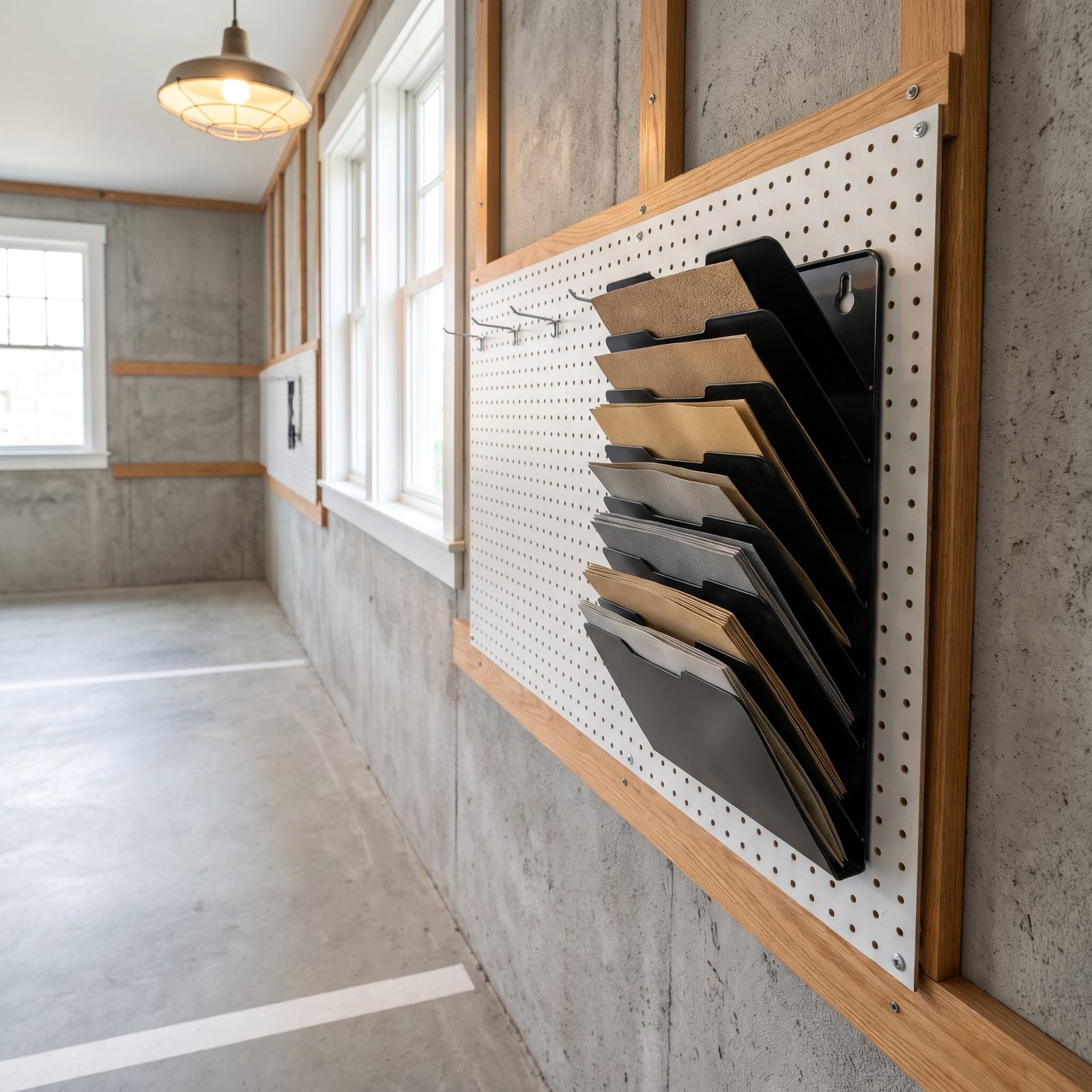
Sandpaper curls, creases, and migrates to the bottom of a drawer where it gets crushed into useless confetti. A vertical sorter keeps sheets flat and filed by grit — coarse at one end, fine at the other.
Slide out 120, slide out 220, keep moving. Stand the sheets on edge and they take up almost no wall and zero floor. Nothing on the ground means nothing in the way of your door swing.
38. Pegboard Dowels for Tape Rolls
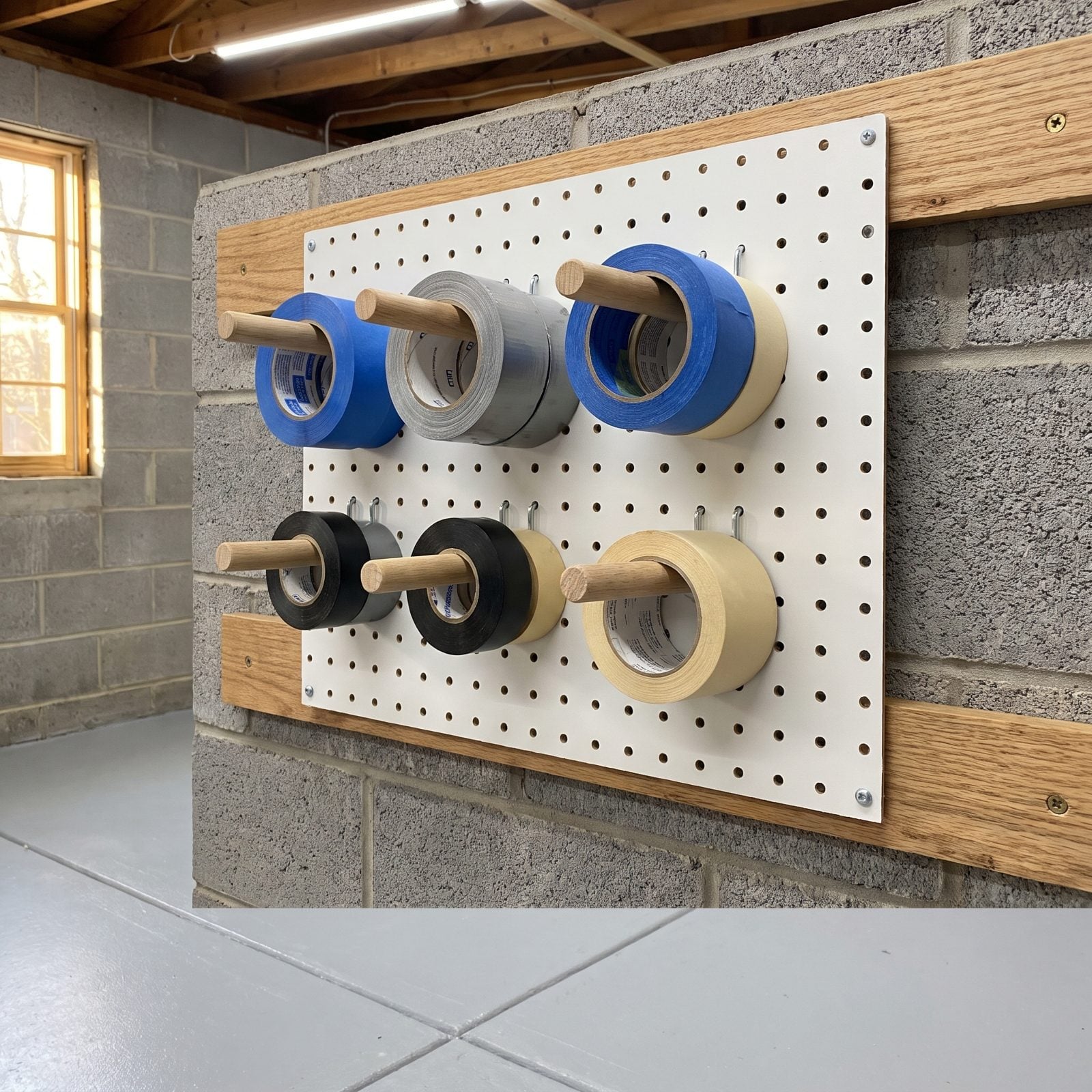
Tape is the thing you always own six rolls of and can never find one. Stick a dowel peg out from the board and thread the rolls on like a napkin holder. Painters tape, duct, electrical, masking — each on its own stub.
Pull one off, tear what you need, drop it back. Dumb-simple, and it works. That’s really all you want from it.
37. Pegboard Cubbies for Spray Cans
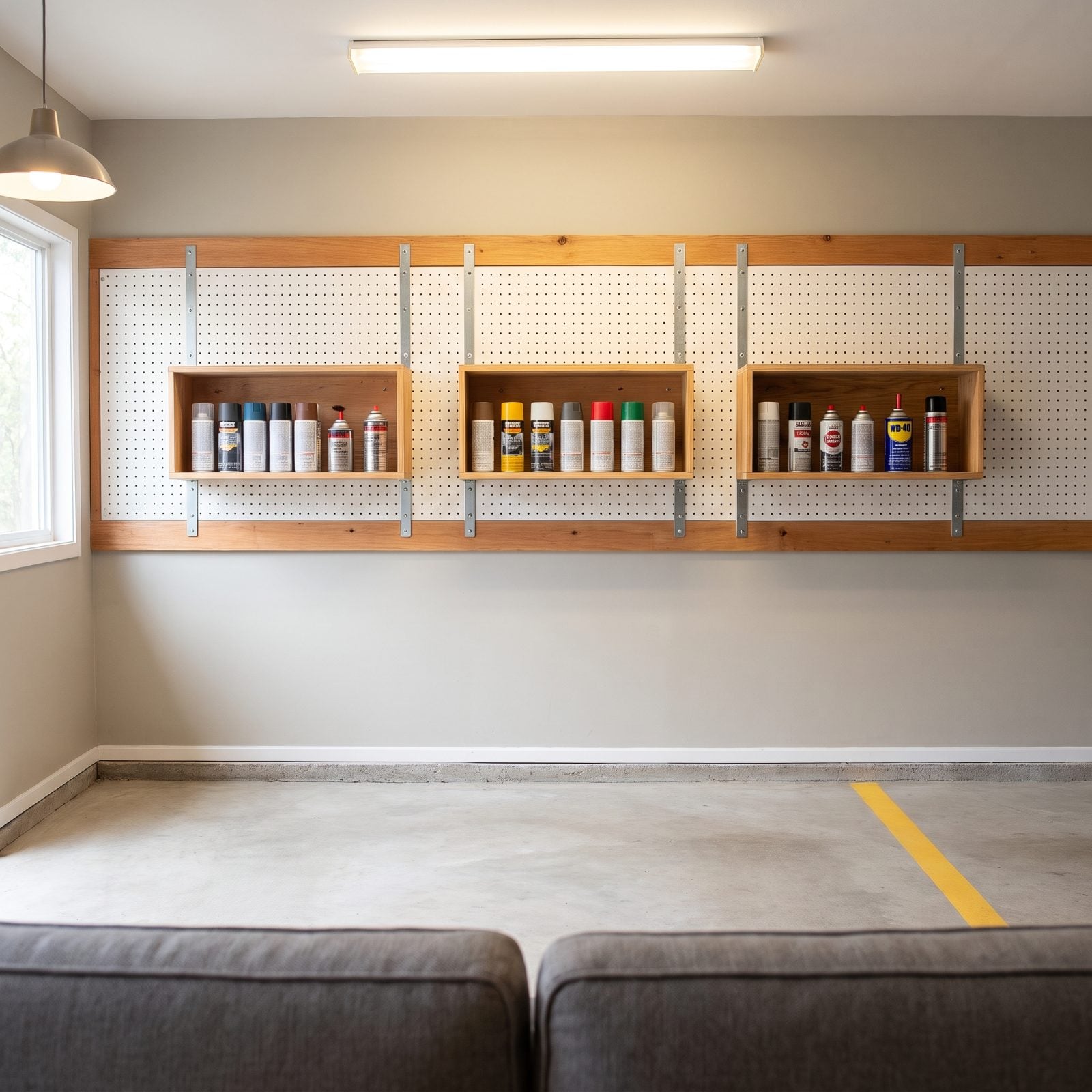
Spray cans crammed in a drawer or box get buried, knocked over, and leave a ring of overspray on everything. Line them up in a single row on an open wooden shelf with a pegboard back, nozzle-up, and they stay put, labels facing out so you grab primer instead of clear coat.
Up on the wall they’re also off the floor and out of the way of tires and boots.
36. Pegboard Rack for Caulk Tubes
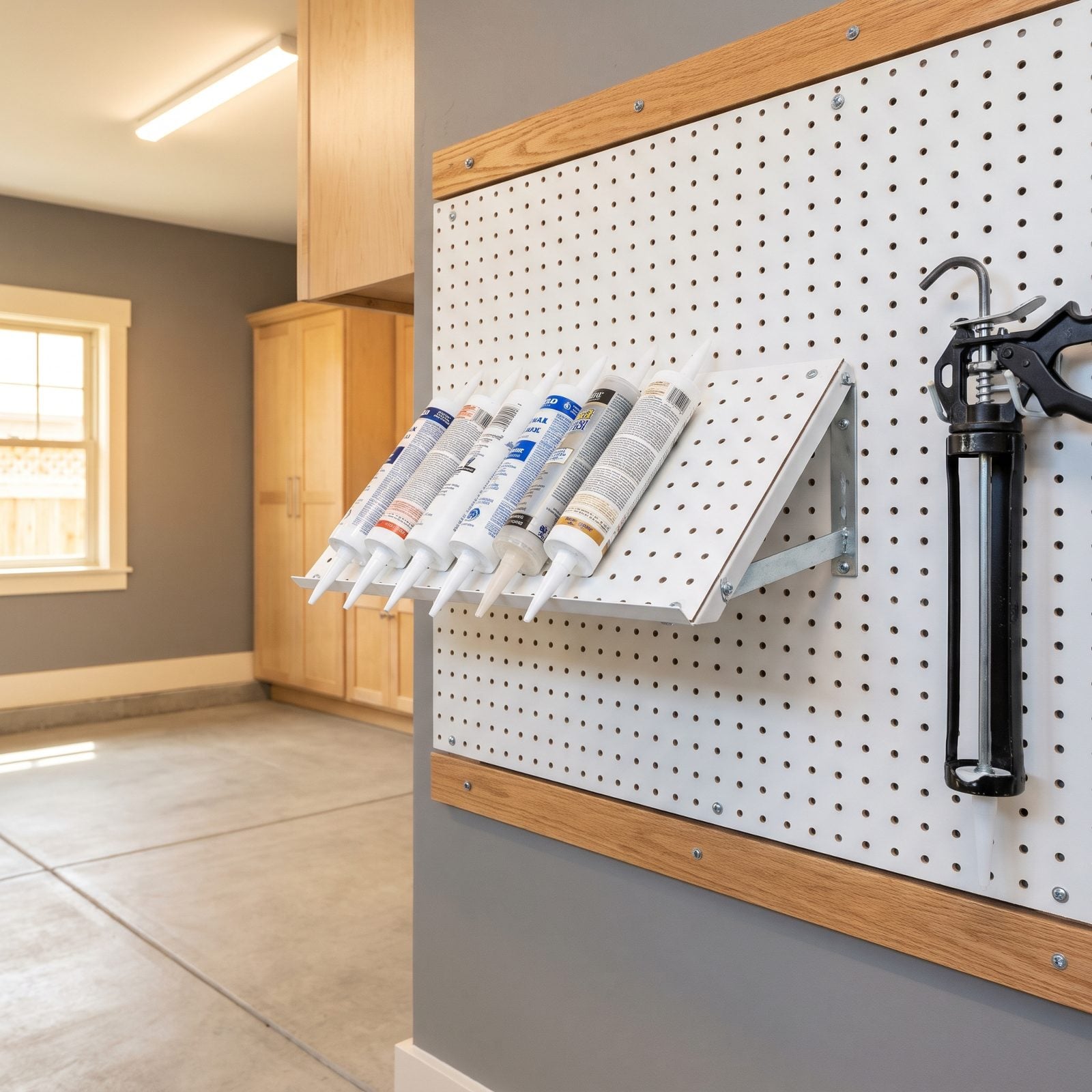
Caulk tubes are awkward — too long for a drawer, too round to stack, and the opened ones always dry out before you remember you had them. An angled rack holds them in a tidy row with the caulk gun hanging right beside it.
Keeping them all in one visible row means a half-used tube gets used next time instead of forgotten until it’s plugged solid. Small thing. Saves you a trip to the store.
35. Pegboard Bar for Woodworking Clamps
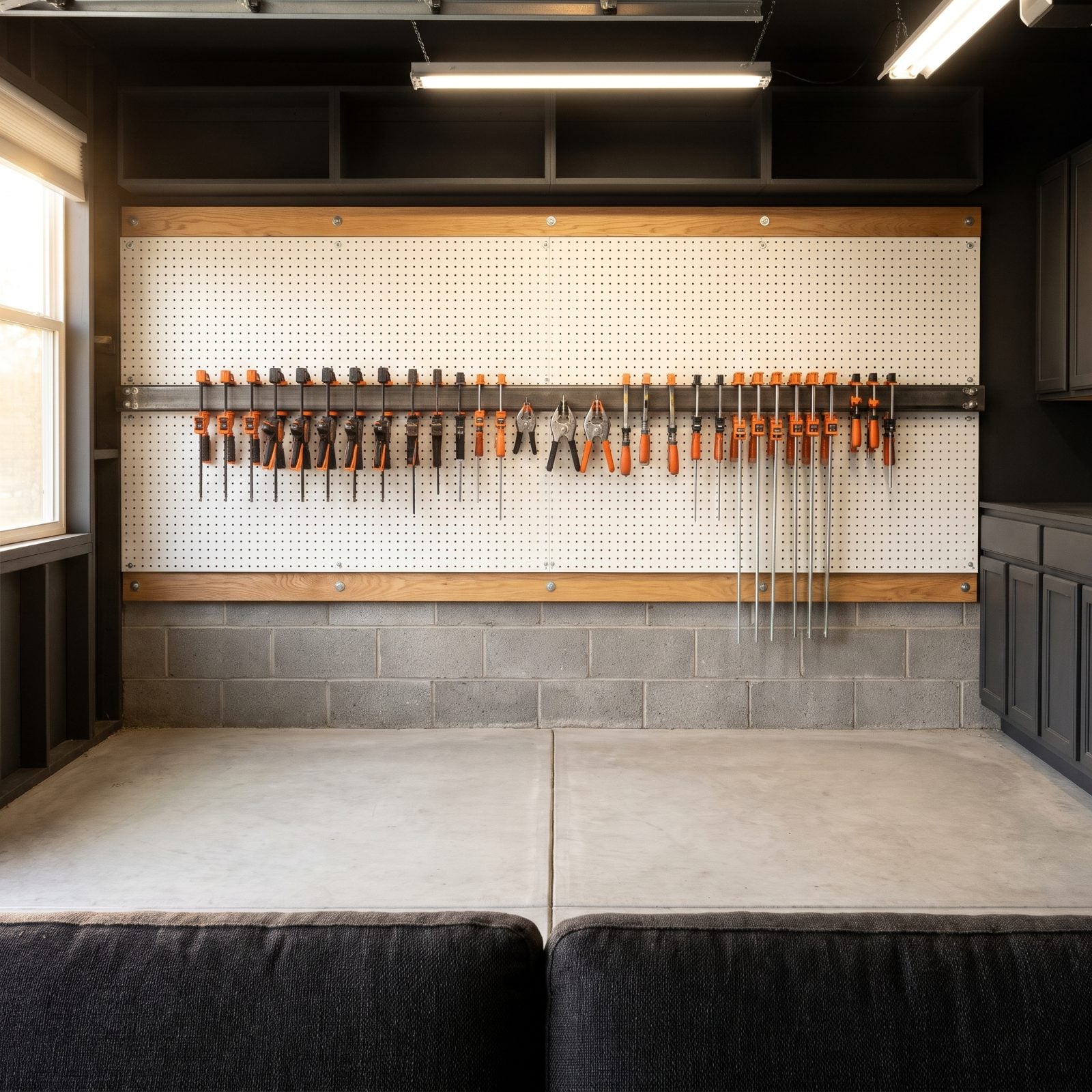
Clamps are heavy, and here’s where the wall has to earn it. A rack of bar clamps can run twenty, thirty pounds. Standard pegboard hooks pop right out under that load.
Hang a steel bar across the board and anchor it straight into studs, not just the pegboard. Clamps clip over the bar and the weight transfers into framing. You get a whole wall of clamps hanging ready instead of tangled in a bucket, and the floor underneath stays clear for the car.
34. Pegboard Safety Station for Goggles and Ear Protection
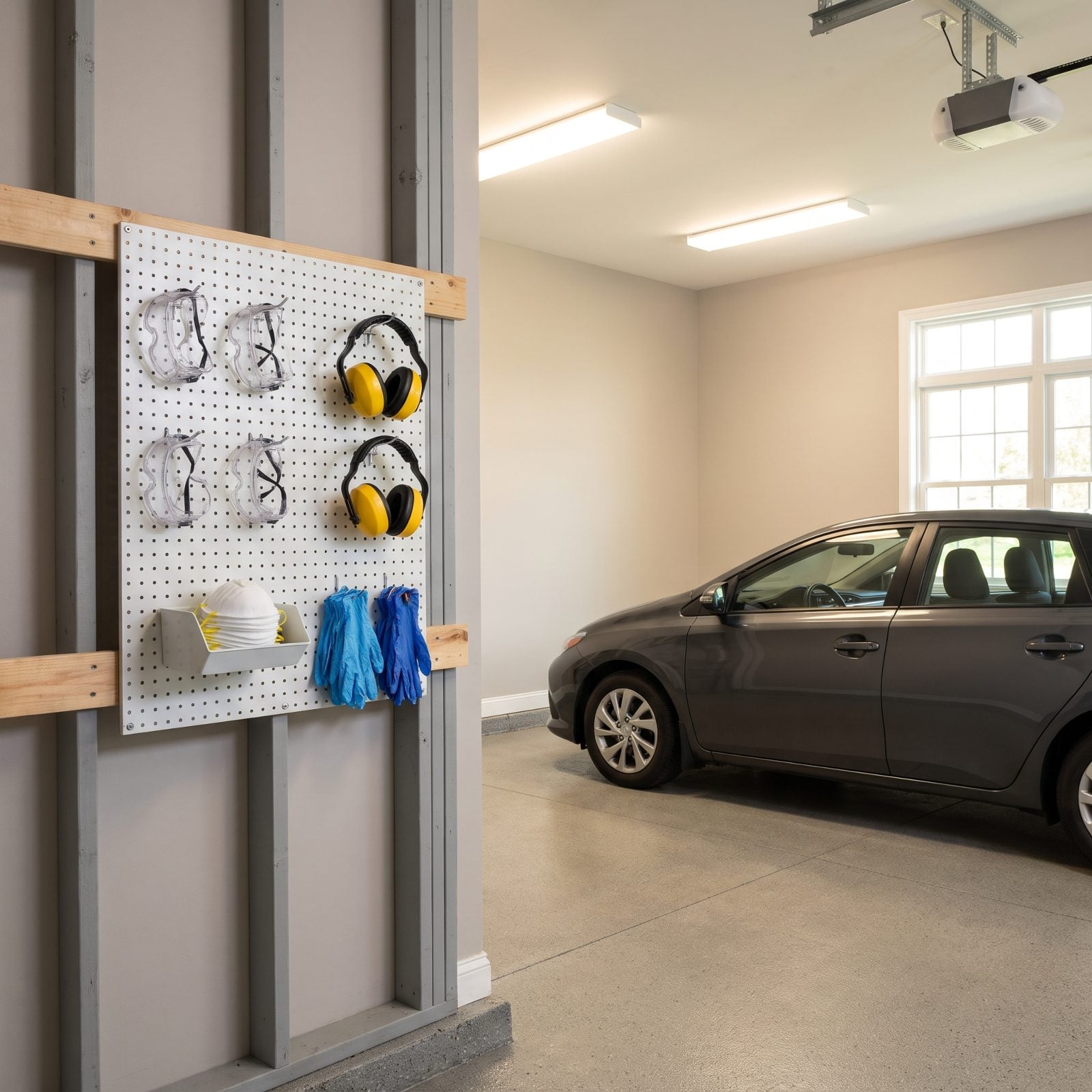
Safety gear you can’t find is safety gear you don’t wear. Toss your goggles in a drawer and here’s what happens: by the time you dig them out, you’ve already fired up the grinder bare-eyed.
So mount a small pegboard panel right by the bench, goggles on one hook and muffs on the next, respirators in a shallow bin underneath. Costs almost nothing. Eats maybe two square feet of wall, and the car never knows it’s there.
33. Pegboard Spindles for Grinding and Cutting Discs
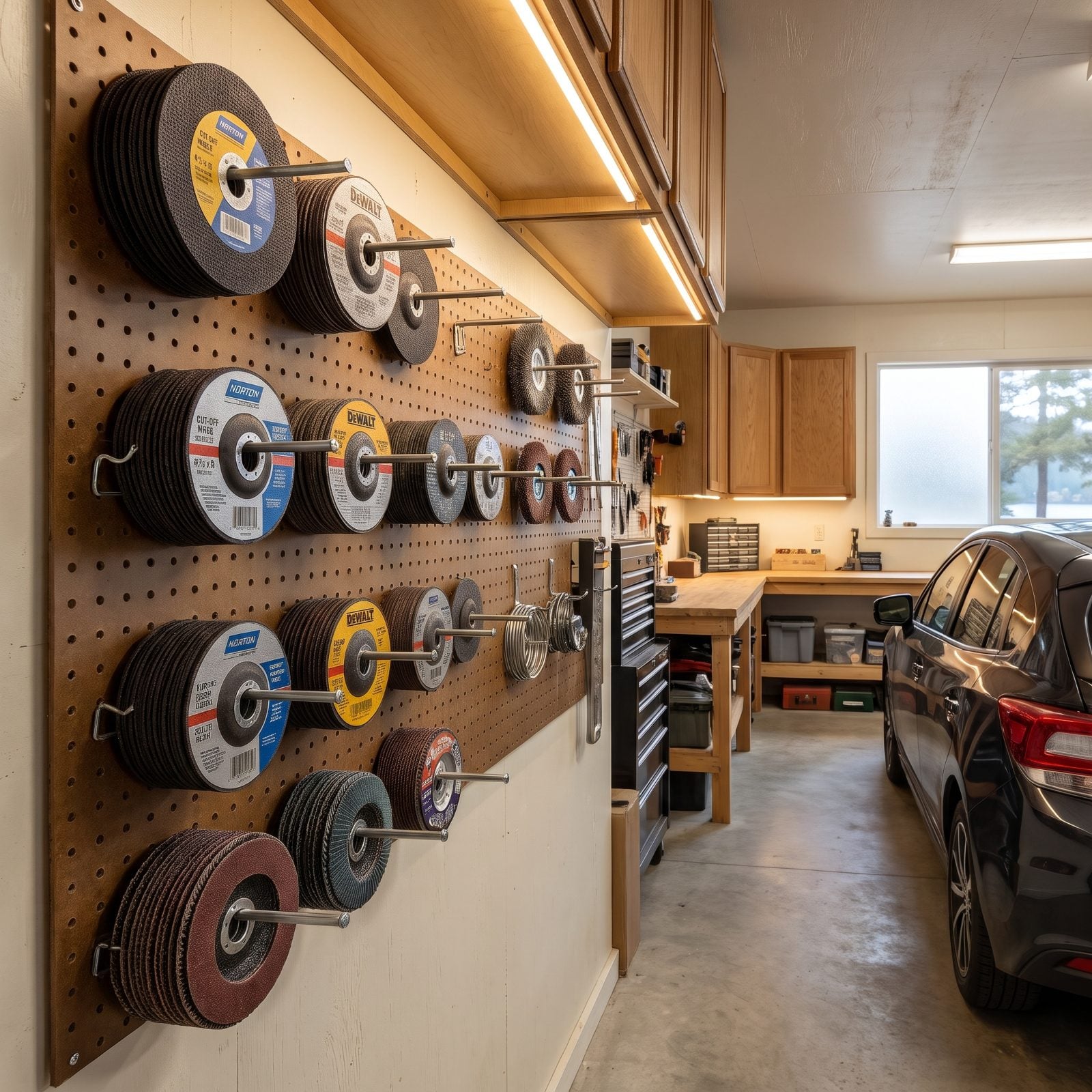
Consumable discs are the junk drawer of any garage. They slide around and crack, and you end up buying duplicates because you never know what you already own.
Spindle pegs fix that cold. A metal rod spears the center hole, discs stack flat by grit and size, and you read your whole inventory in one glance — no clamshell packaging, no bent flap discs rotting at the bottom of a bin. Vertical storage, close to the grinder, zero floor footprint. The parked car doesn’t lose an inch.
32. French-Cleat Wall With Removable Project Boxes
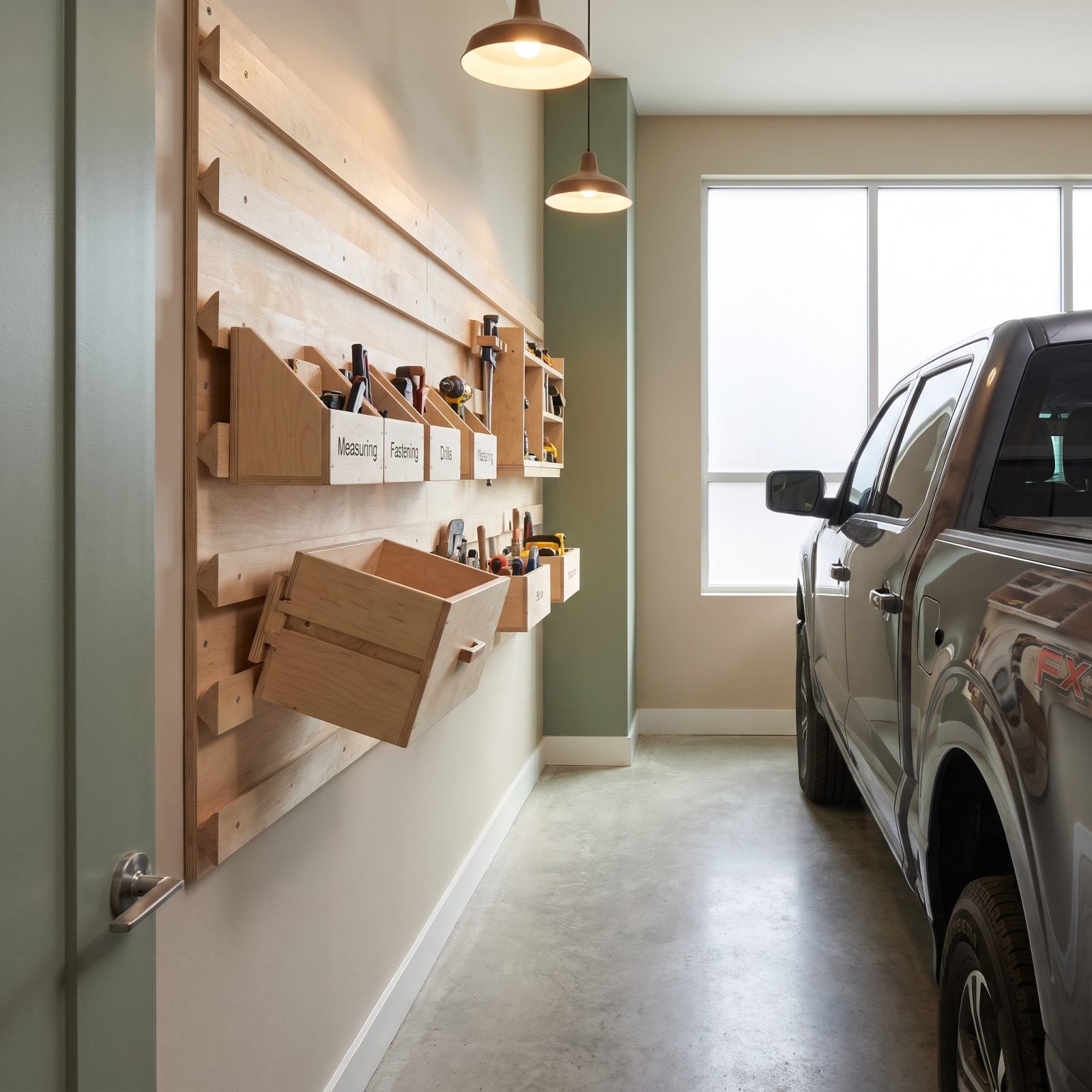
French cleats are the closest thing to Lego for grown adults who own drills. A row of 45-degree strips screwed into the studs, and everything you hang locks in by gravity. Move a box in two seconds. No remounting, no new holes.
The genius part is the flexibility. Cleats sit nearly flat against the wall, but deep boxes can project well out into the room, so leave enough clearance between the wall and where you park.
31. Slatwall Hooks for Strollers and Kids’ Ride-On Toys
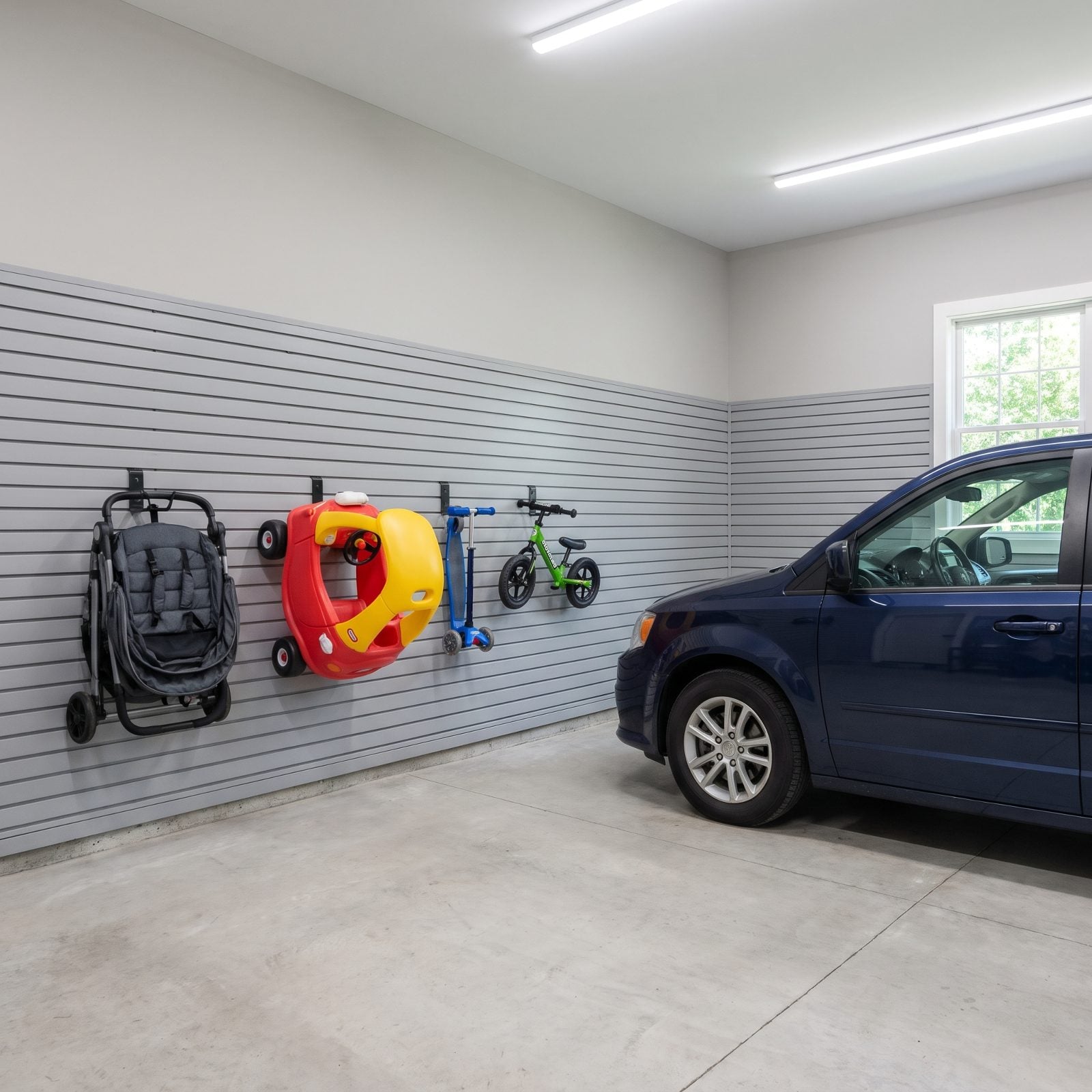
Kid stuff breeds on the garage floor. A stroller, two scooters, a plastic jeep, and suddenly you’re parking on the driveway because the bay belongs to a toddler now.
Slatwall changes the math. Big molded hooks take a folded stroller flat against the wall, ride-ons hang by their frames, and the floor comes back to you. Pull-down height means the kids can grab their own gear.
The slats run the whole wall, so as the toys change, the hooks just slide along. No wall ever becomes obsolete.
30. Track-Rail System for Long-Handled Yard Tools
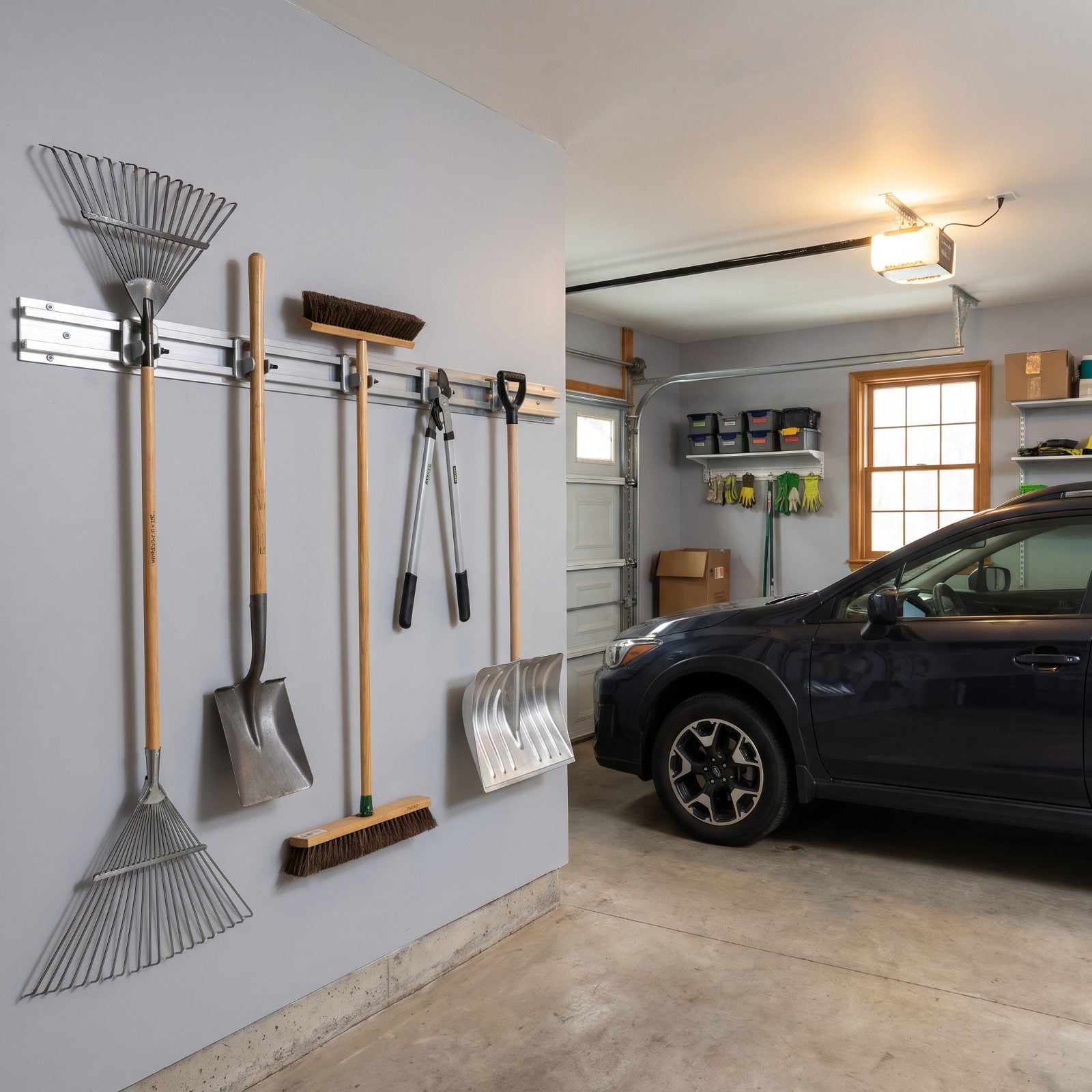
Long-handled tools are the worst offenders in a tight garage. Leaned in a corner, they slide, tangle, and clock you in the head the second you open a cabinet.
A track rail turns that corner into a wall of order. Adjustable clips grip each handle, tools hang straight up and down in a tidy line, and you can slide them left or right without unscrewing a single thing.
29. Corner Shelves for Bulk Household Supplies
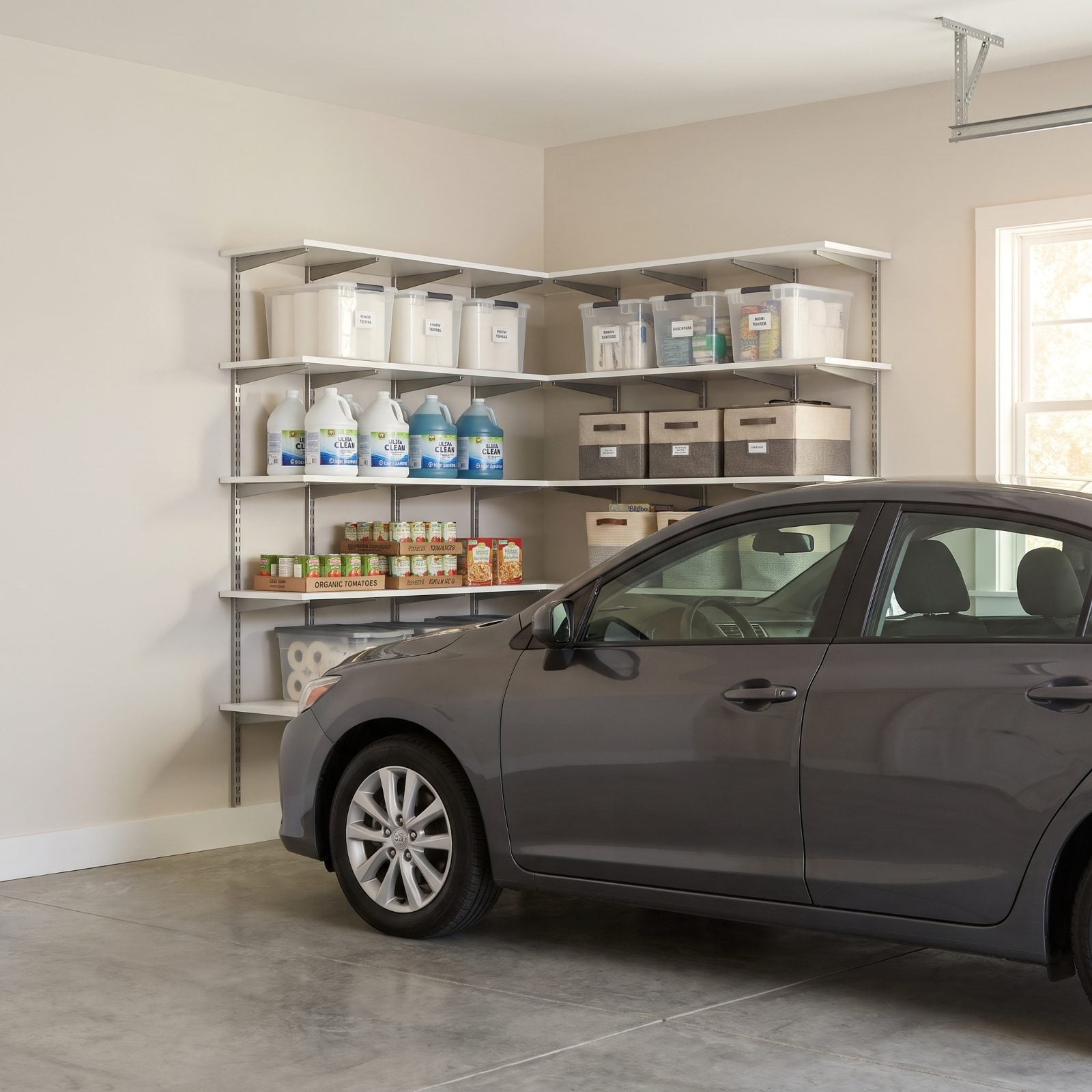
Every garage has a corner nobody uses. It’s awkward, the car’s nose pulls right up to it, and it collects cobwebs and a dead weed sprayer.
Corner shelves claim that useless triangle for bulk goods — the warehouse-club stuff that has no home indoors. Paper towels, detergent, canned overflow, all stacked vertically in the corner the car noses into. With the car parked, it blocks the lower shelves and the right-hand run, so keep the stuff you grab often up high where you can still reach it. You gain a small pantry, though you’ll be squeezing past the bumper to reach the rest.
28. High Perimeter Shelves for Pantry Overflow
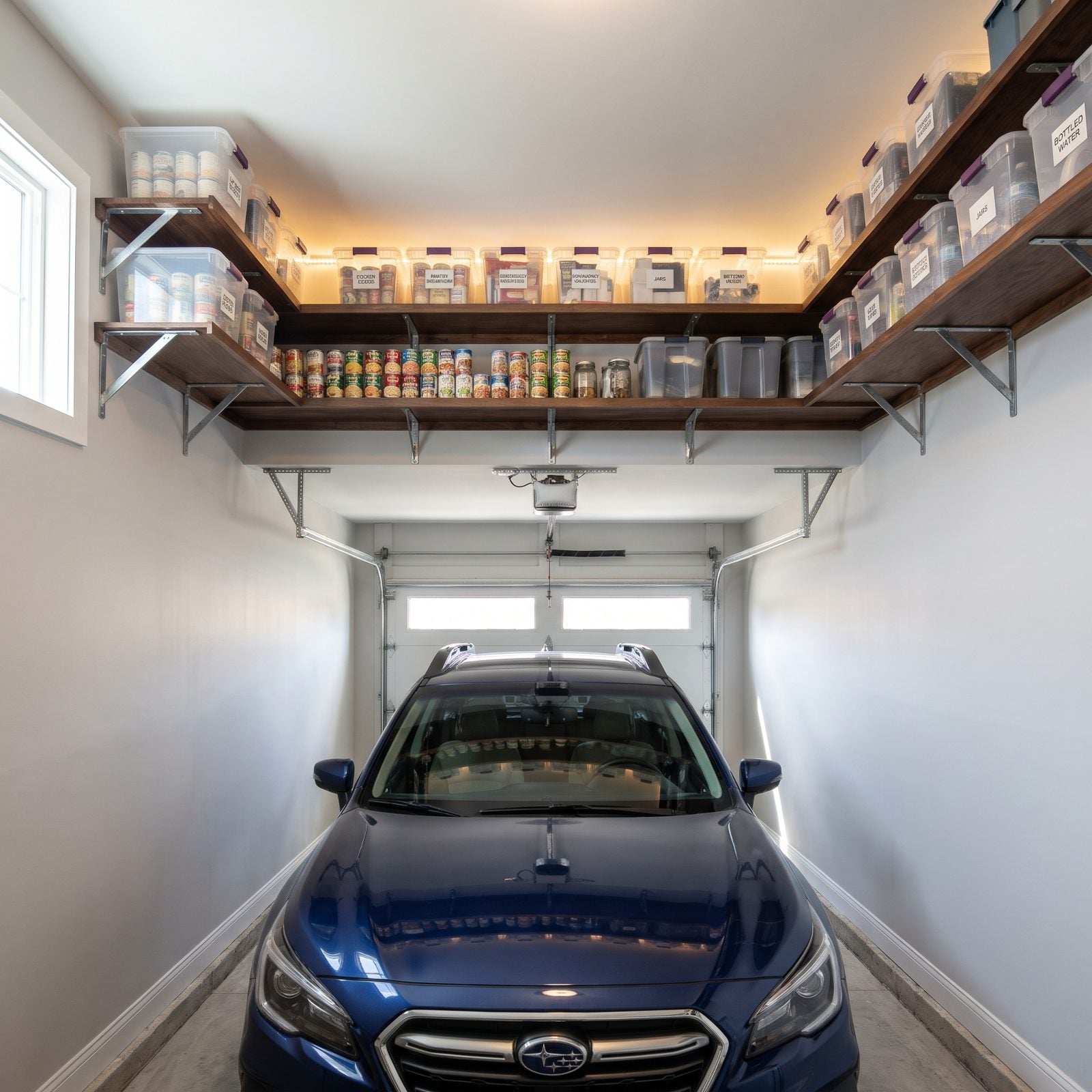
The top foot of your garage walls is empty air doing nothing. Run a shelf up there — even across the back on a dropped bulkhead — and the whole garage turns into a stockroom nobody trips over.
Pantry overflow lives up high beautifully — canned goods, bulk staples, sealed totes you touch maybe twice a year. Above the car roof, high over the parking path, out of the walking zone entirely.
27. Lockable Wall Cabinet for Chemicals and Pesticides
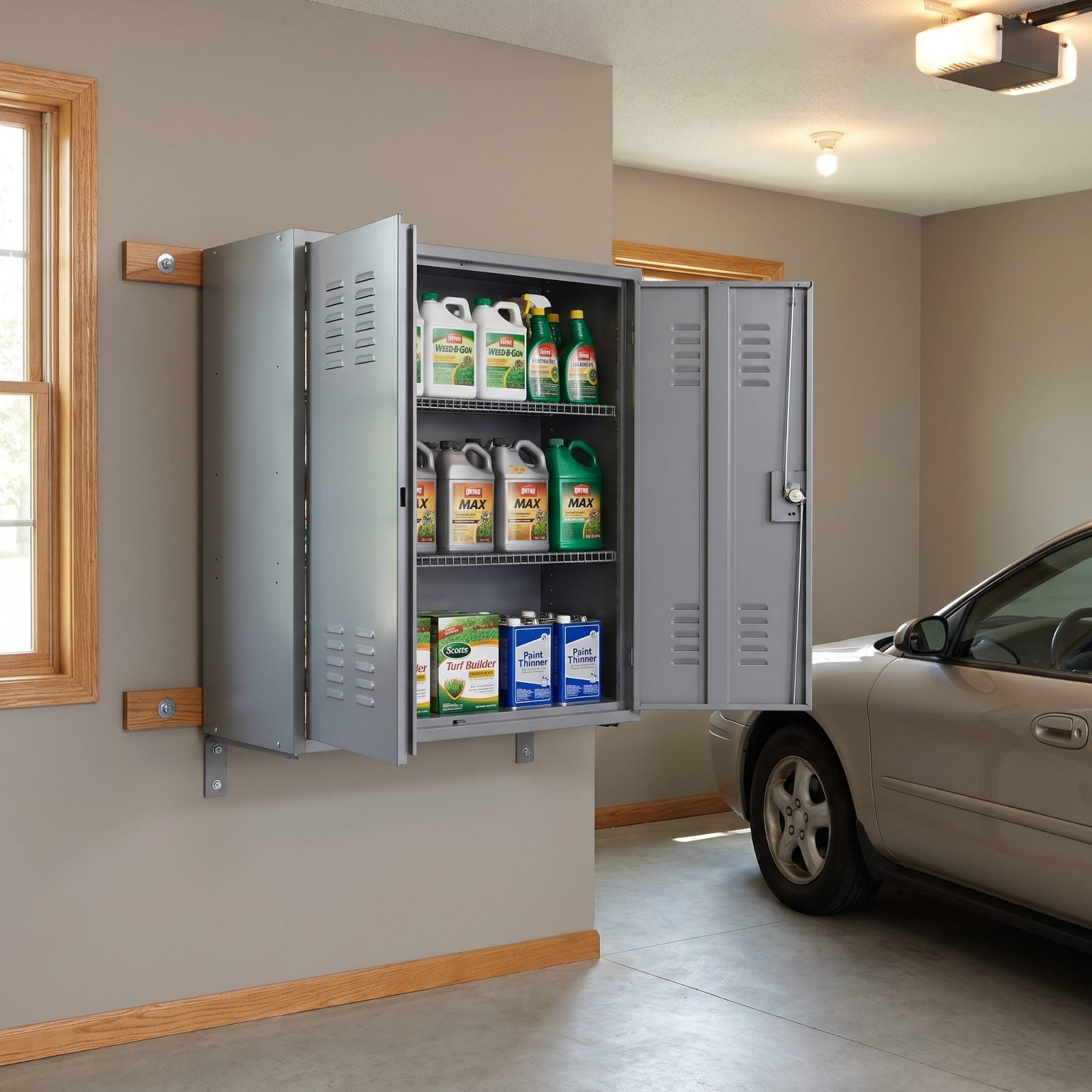
Pesticides and solvents on an open shelf are an accident waiting for a curious kid or a knocked-over jug. A locking cabinet is the one upgrade here that’s about safety first, tidiness second.
Wall-mounted keeps it off the floor and out of flood range. Ventilation slots let fumes escape instead of pooling, and the lock keeps the dangerous stuff separate from the everyday stuff.
26. Fold-Up Wall Rack for Spare Wheels and Tires
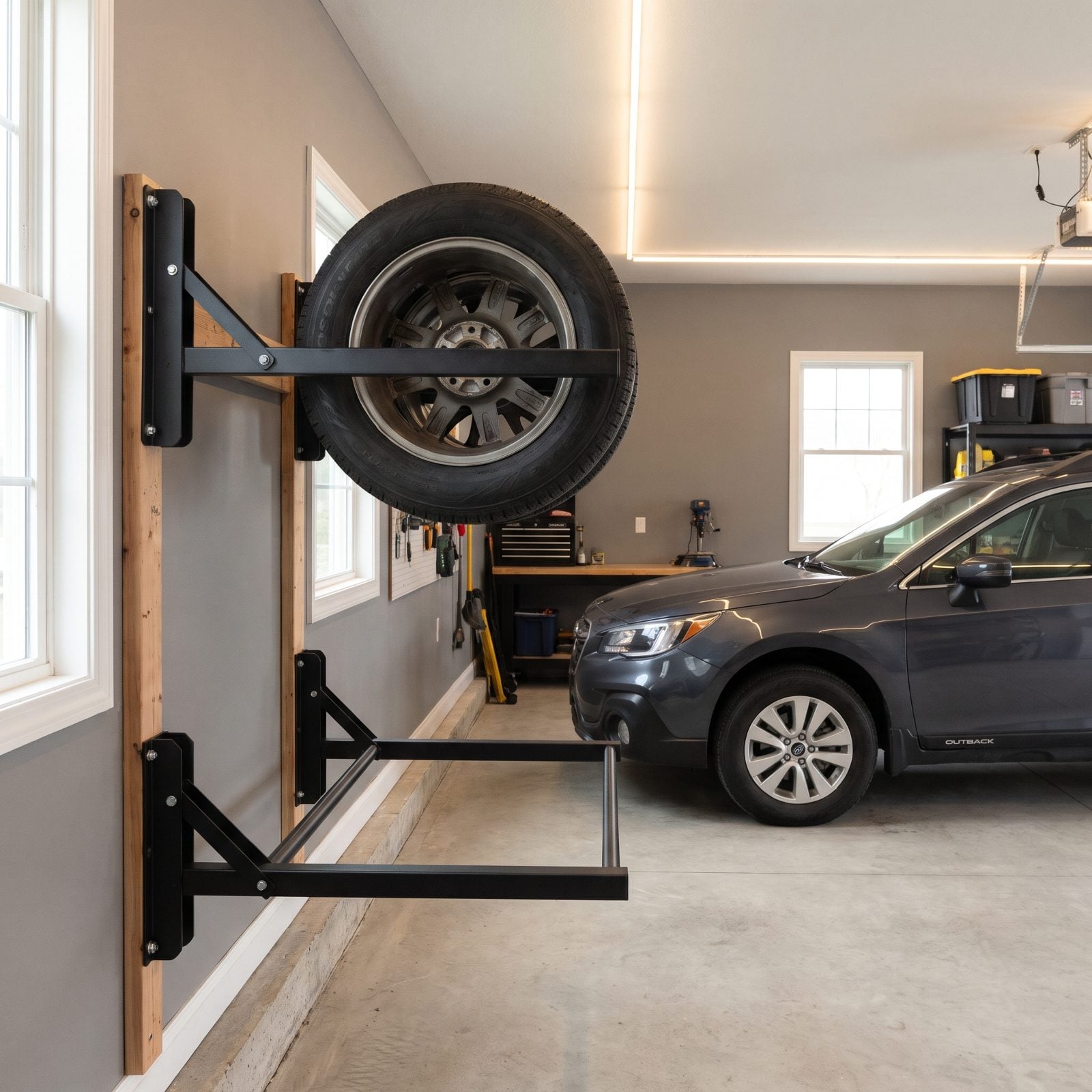
Seasonal tires are dead weight on the floor — four heavy donuts that claim a corner of the bay and roll around every time you nudge them.
A sturdy wall-mounted rack lifts them up off the floor and onto the wall, so they aren’t hogging floor space all year long. Rotate your winters off, set them on the rack arms, lift your summers down, mount them. Done.
Just respect the load rating and lag into real studs. A set of wheels and tires is heavy, and this is one bracket you really don’t want pulling loose over the hood.
25. Swiveling Vertical Wall Rack for a Bicycle
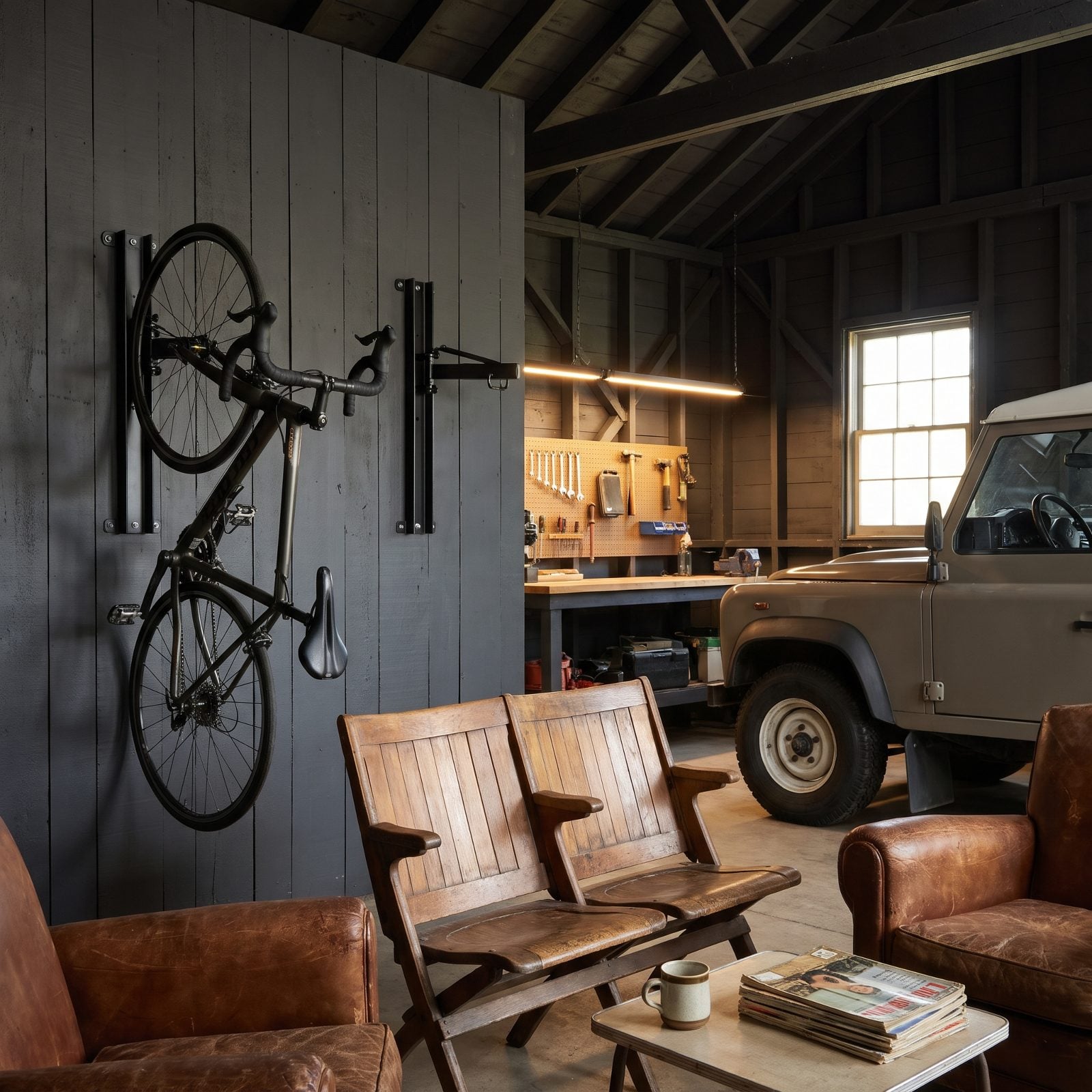
A bike hung straight out from the wall eats the exact space your car door needs to swing. That’s why most wall hooks fail in a tight garage — the back wheel lives right where your elbow wants to be.
A swiveling rack solves the geometry. Load the bike pointing out, then rotate it flat and parallel to the wall. It tucks into a few inches of depth and clears the car door completely.
24. Heavy-Duty Wall Brackets That Hang a Ladder Flat Against the Studs
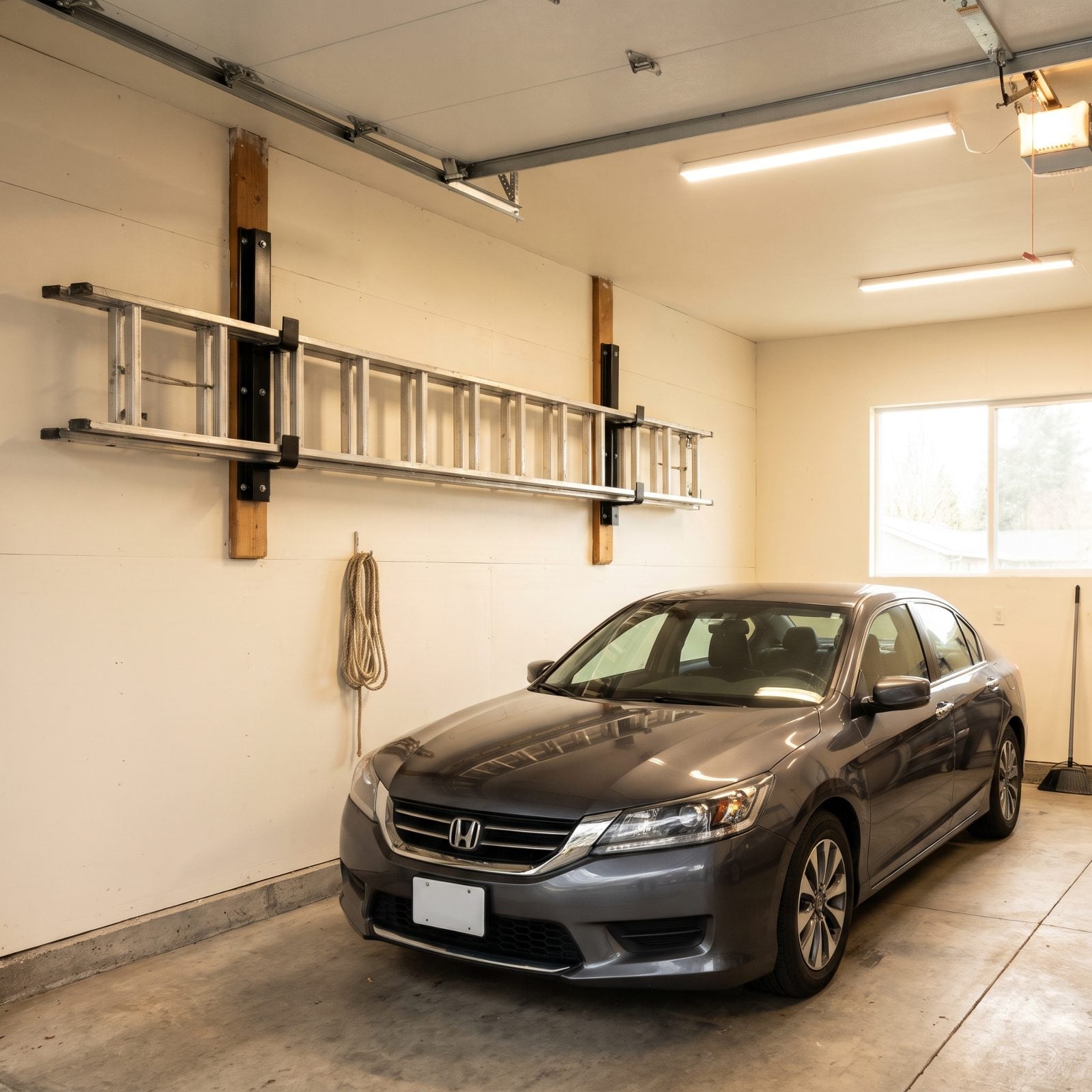
A ladder leaned in the corner is a tripping hazard waiting to happen, and it eats a corner you could actually use. Get it up on the wall, flat and horizontal, and that whole slice of floor comes back to you.
Bolt the brackets into actual studs — drywall anchors won’t cut it. A 20-foot extension ladder weighs a good chunk, and you want that load going into wood. Hang it high enough to clear the garage door track when it rolls up, but low enough that you can still lift it down without balancing on your tiptoes on a stool. We got that height wrong the first time and had to re-drill the whole thing, cursing the entire way. Measure your door’s fully open position before you commit.
23. Multi-Tier Wall Rack That Sorts Your Dimensional Lumber by Length
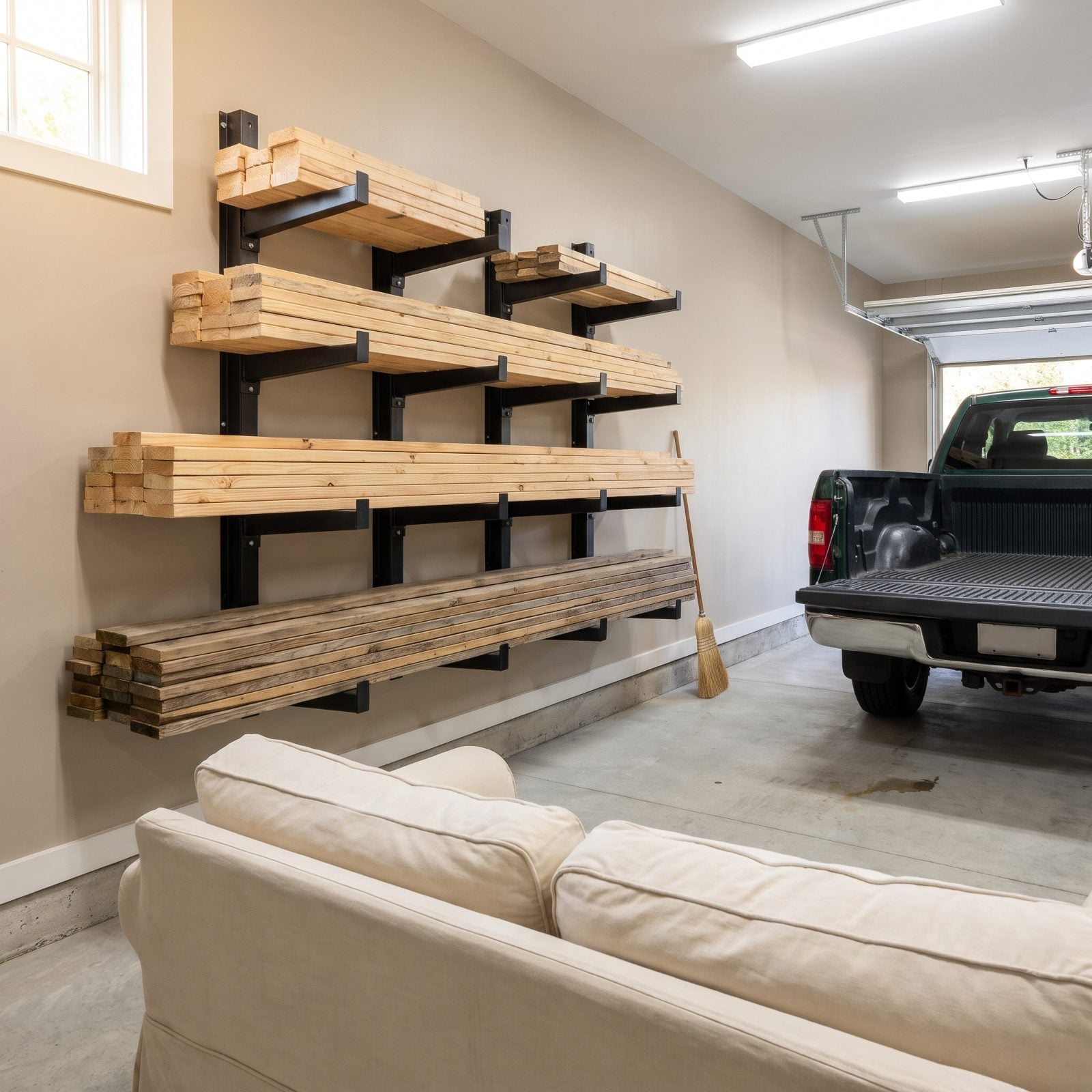
Lumber migrates. A few 2x4s left over from one project, some trim from another, and suddenly there’s a pile against the wall you’ve been stepping over for a year.
A multi-tier wall rack gives every length its own shelf. Shorter offcuts up top, long stock on the lower tiers where it’s easy to slide in and out. Now you can see what you’ve got, which stops you buying a third sheet of the same thing you already own twice. Space the arms so a warped board can’t sag and twist between them. And keep the whole rack off the floor so nothing wicks moisture up from the concrete.
22. Upright Wall Slot That Stands Plywood and Sheet Goods on Edge
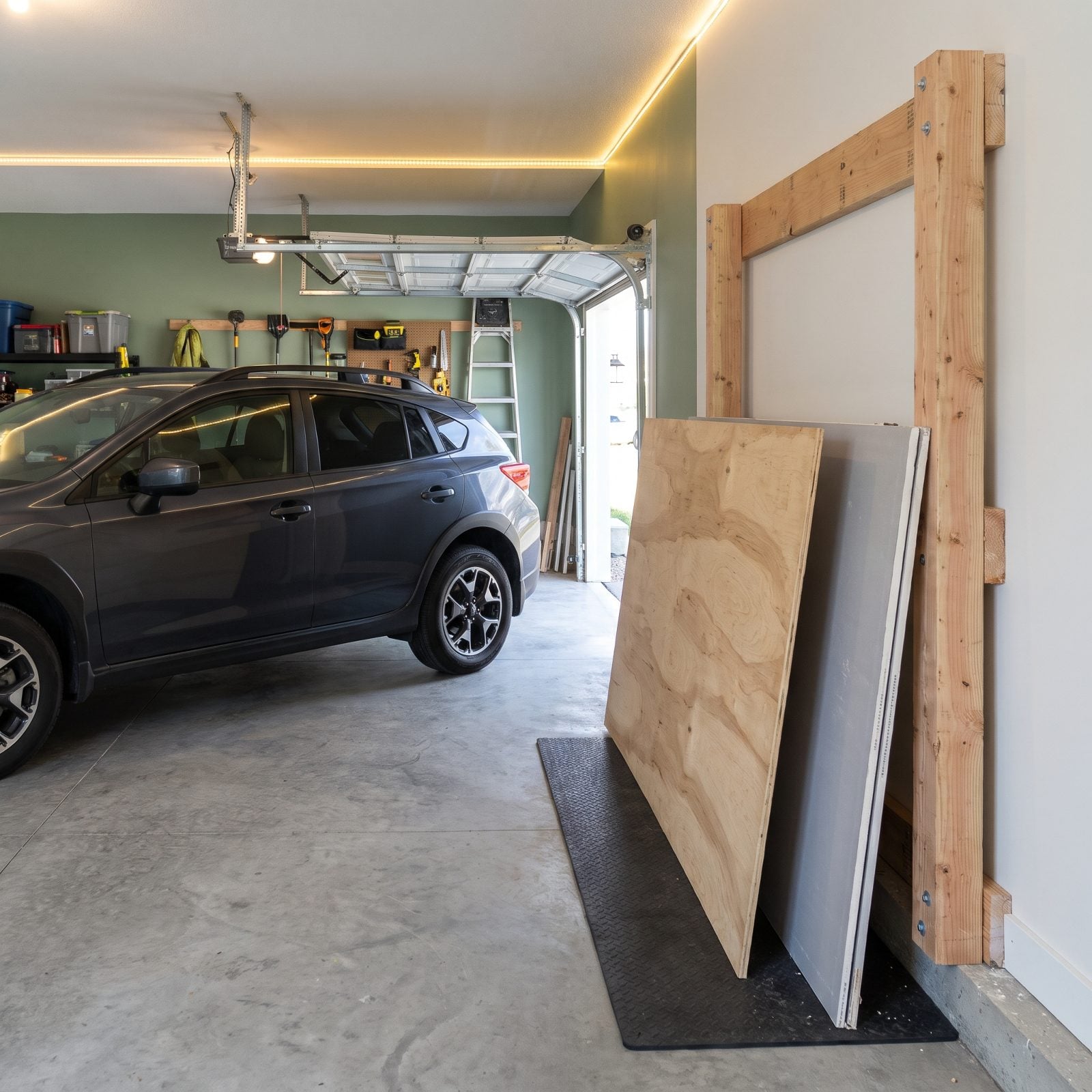
Plywood laid flat takes a huge bite out of your garage. Stood on edge and leaned against a wall frame, it takes up only a strip of floor along the wall.
The build is simple. A couple of uprights anchored top and bottom, a crosspiece and spacer blocks to hold the frame off the wall, and a lean back against the uprights so gravity does the holding. Full 4×8 sheets are heavy and awkward, and with nothing stopping the bottoms they’ll splay out at the base, so leave them room clear of the walking path. Lay a rubber mat on the floor under them so the bottom edges stay dry. And nobody ever mentions how fast a plywood edge rots when it sits on bare concrete overnight.
21. Twin Wall Hooks That Hold a Wheelbarrow Flat and Off the Floor
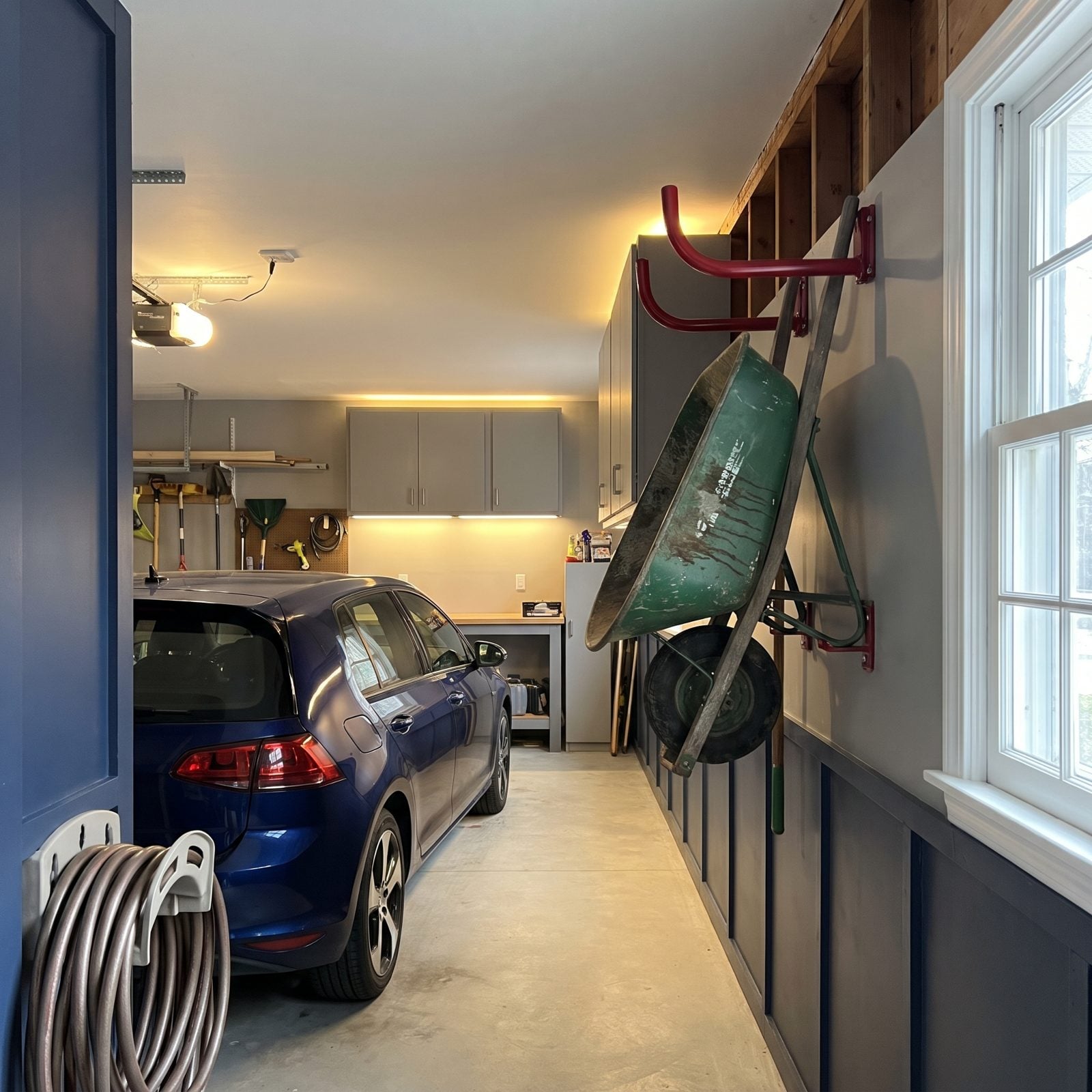
A wheelbarrow parked on its wheel is a floor hog. It rolls, it collects spiders, and it blocks the path to your workbench every single time you need to get past it.
Hung at a tilt on the wall with two sturdy hooks mounted just beside the handle grips, it gets off the floor. Position it so the wheel sits low and the handle grips end right next to the hooks. Lift it, hang it, done. Just hang it high enough that nobody walks face-first into the point of the tub.
20. Wall-Mounted Retractable Hose Reel That Rewinds Itself
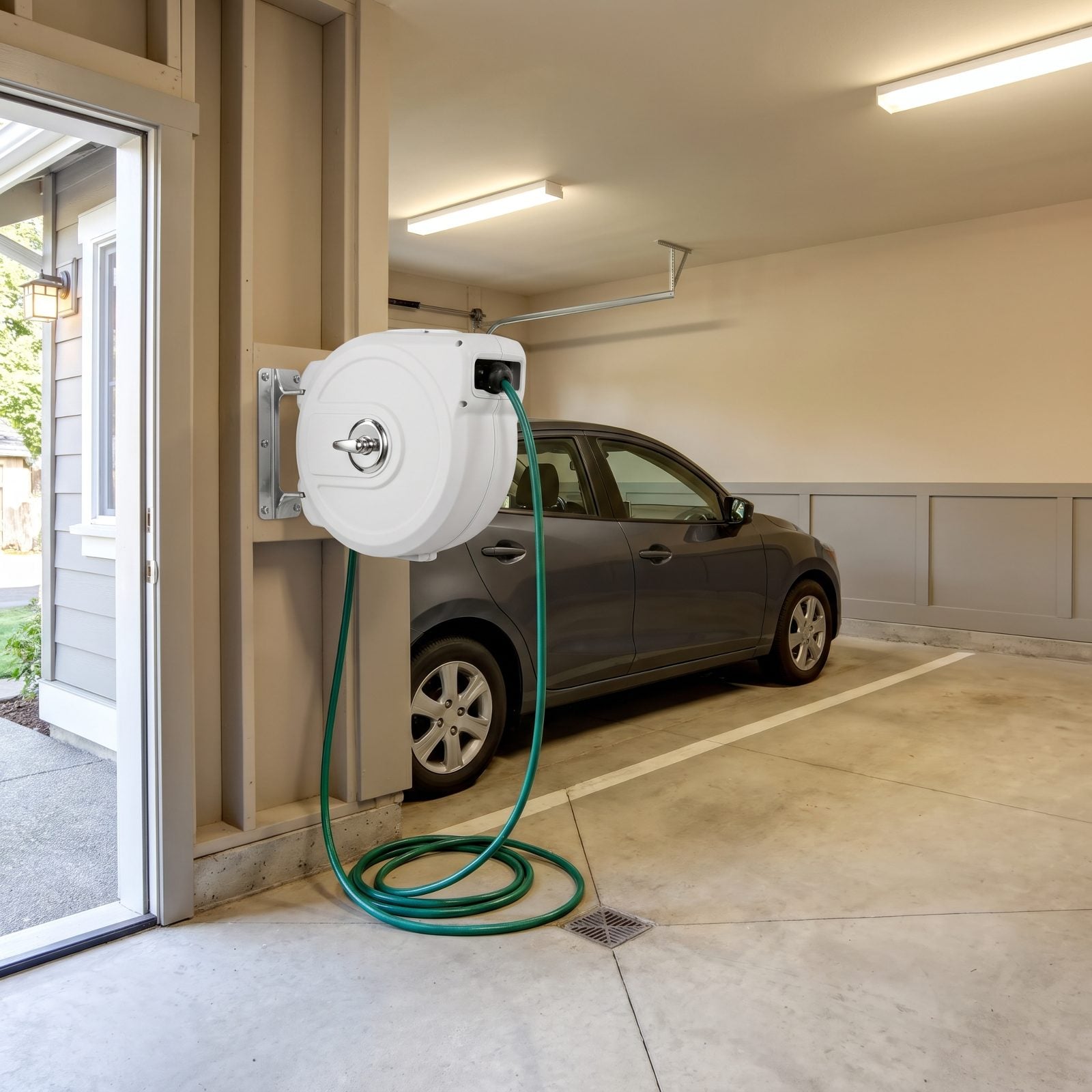
A coiled hose living in a tangled heap by the door is one of those small daily annoyances that adds up. You kick it, it kinks, and watering the plants starts with five minutes of untangling.
A retractable reel on the wall pulls out to length and rewinds with a tug. It keeps the hose out of the parking bay. Mount it near your spigot and your most-used door. The retract mechanism puts real pull on the bracket over time, so anchor it into a stud — not the siding, not the drywall. We’ve watched a cheap screw-in mount tear right out of the wall by season two. Ugly.
19. Wall Rack That Keeps Coiled Extension Cords Untangled and Ready
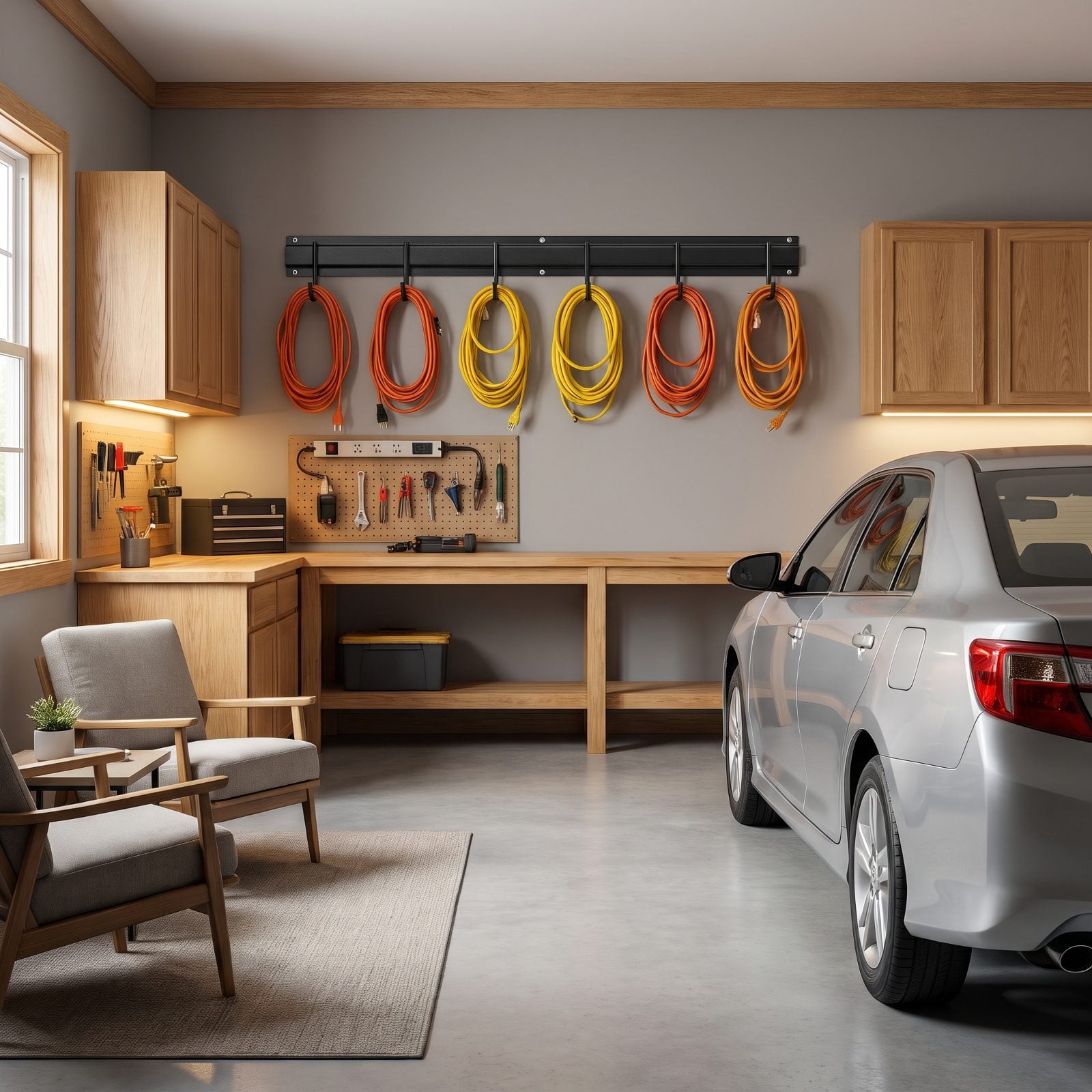
Extension cords are the sock drawer of the garage. They knot themselves overnight even when you’d swear you coiled them right.
A simple wall rack with spaced hooks keeps each cord coiled over-under on its own peg. You grab the one you need without dragging three others onto the floor behind it. Space the hooks far enough apart that a 100-foot coil doesn’t crowd its neighbor. Hang the heaviest-gauge cords lowest so you’re not wrestling the biggest loop over your head.
18. A Dedicated Wall Dock for the Pressure Washer and Its Lances
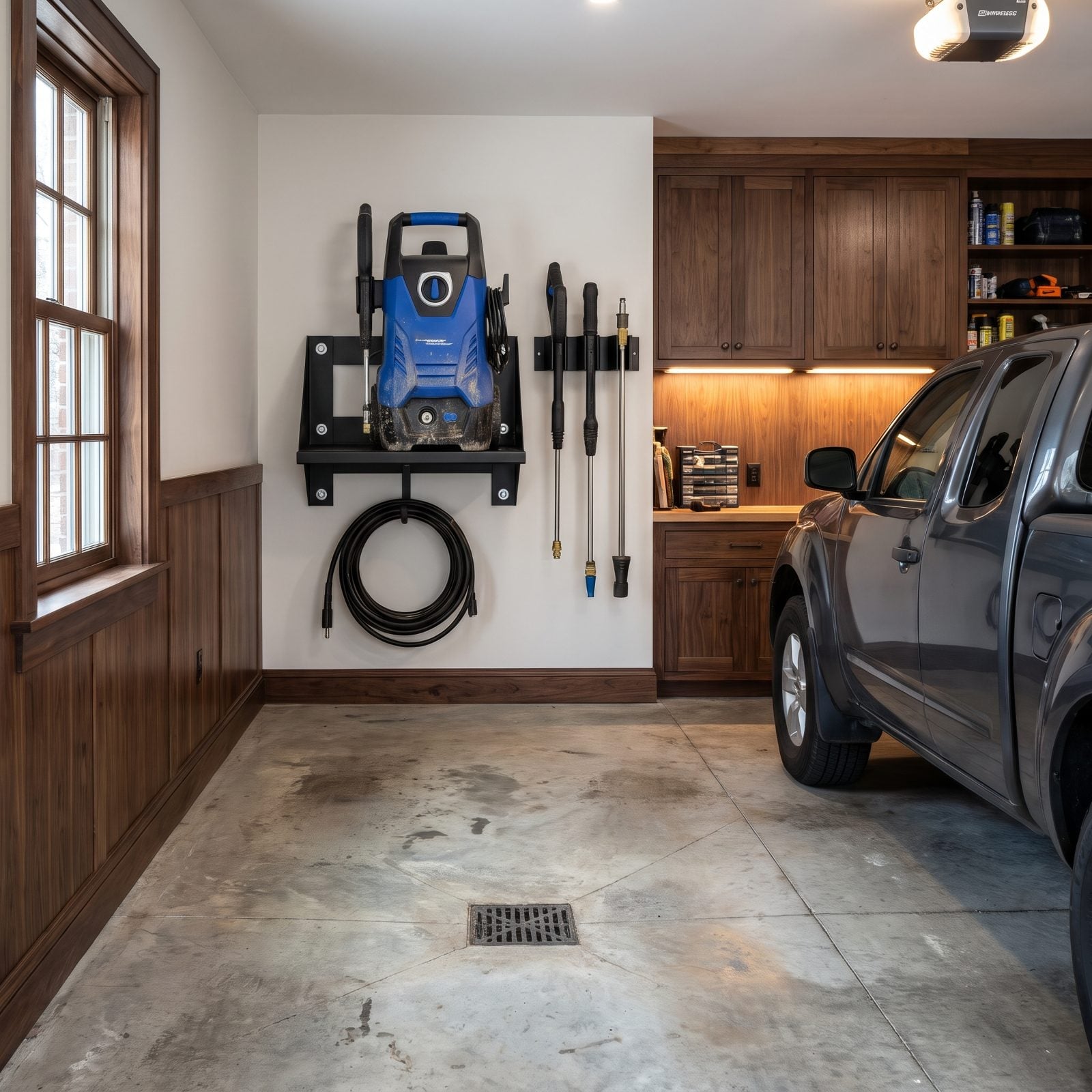
A pressure washer is bulky, awkward, and always damp after a job. Leave it on the floor and it becomes a thing you shove from spot to spot forever.
Build it a wall dock instead: a cradle shelf for the unit, vertical holders for the lances and nozzles, a hook underneath for the coiled high-pressure hose. Everything in one zone, up off the concrete, drying out instead of rusting. Keep it near an outlet and your water source so setup takes two minutes.
17. A Compact Wall Station That Hangs the Shop Vac Off the Floor
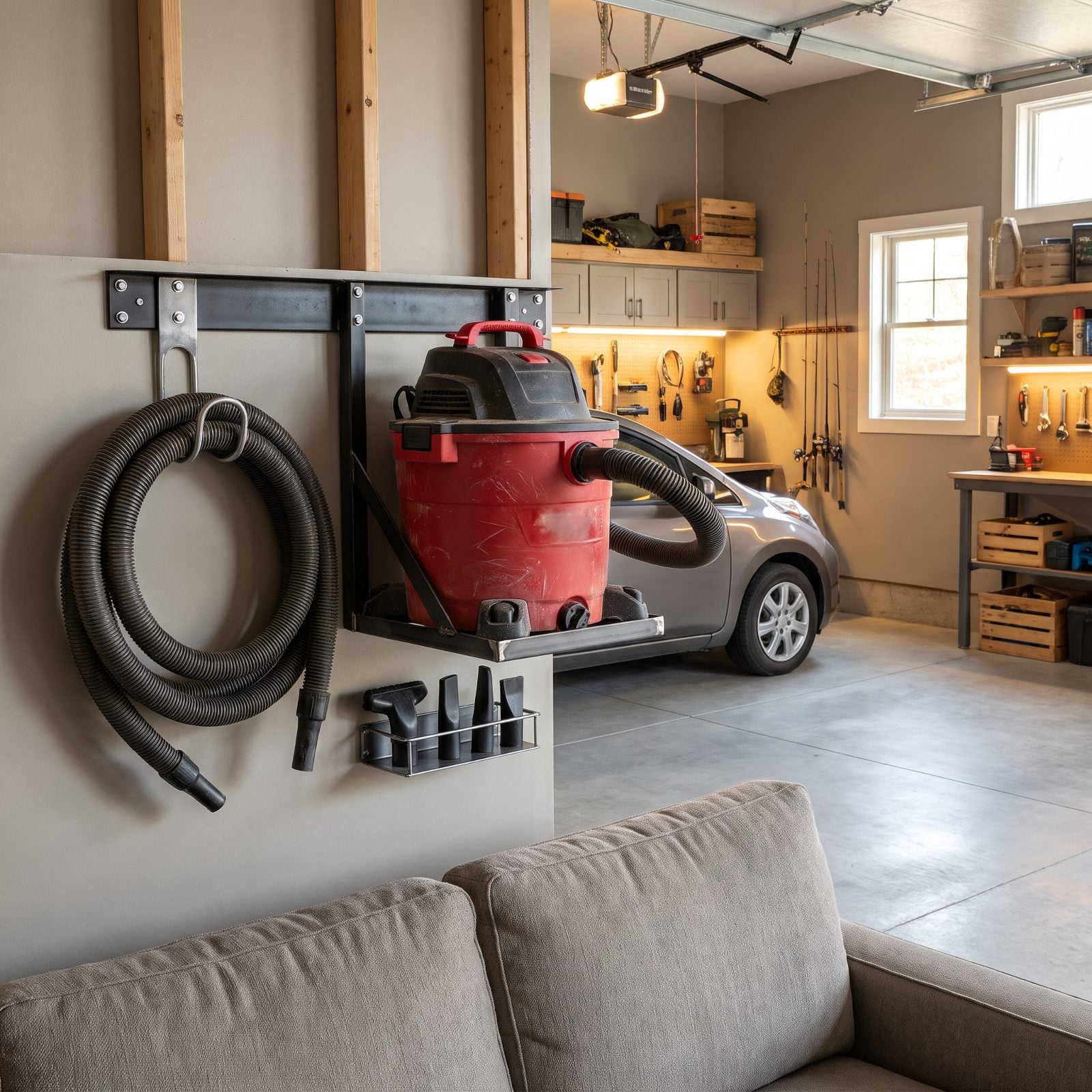
The shop vac rolls around like a stray cat — always underfoot, never where you left it. Put it on the wall and it stays put while the floor opens up.
A compact station holds the canister in a cradle, loops the hose on a hook, and slots the nozzles in a holder below. Hang it near an outlet so you’re not dragging a cord across the bay every time you need to clean up. The hose coiled up top drains any leftover moisture down and out, which keeps the filter from going musty on you.
16. A Wall Rack That Stacks Folding Chairs in a Few Square Feet
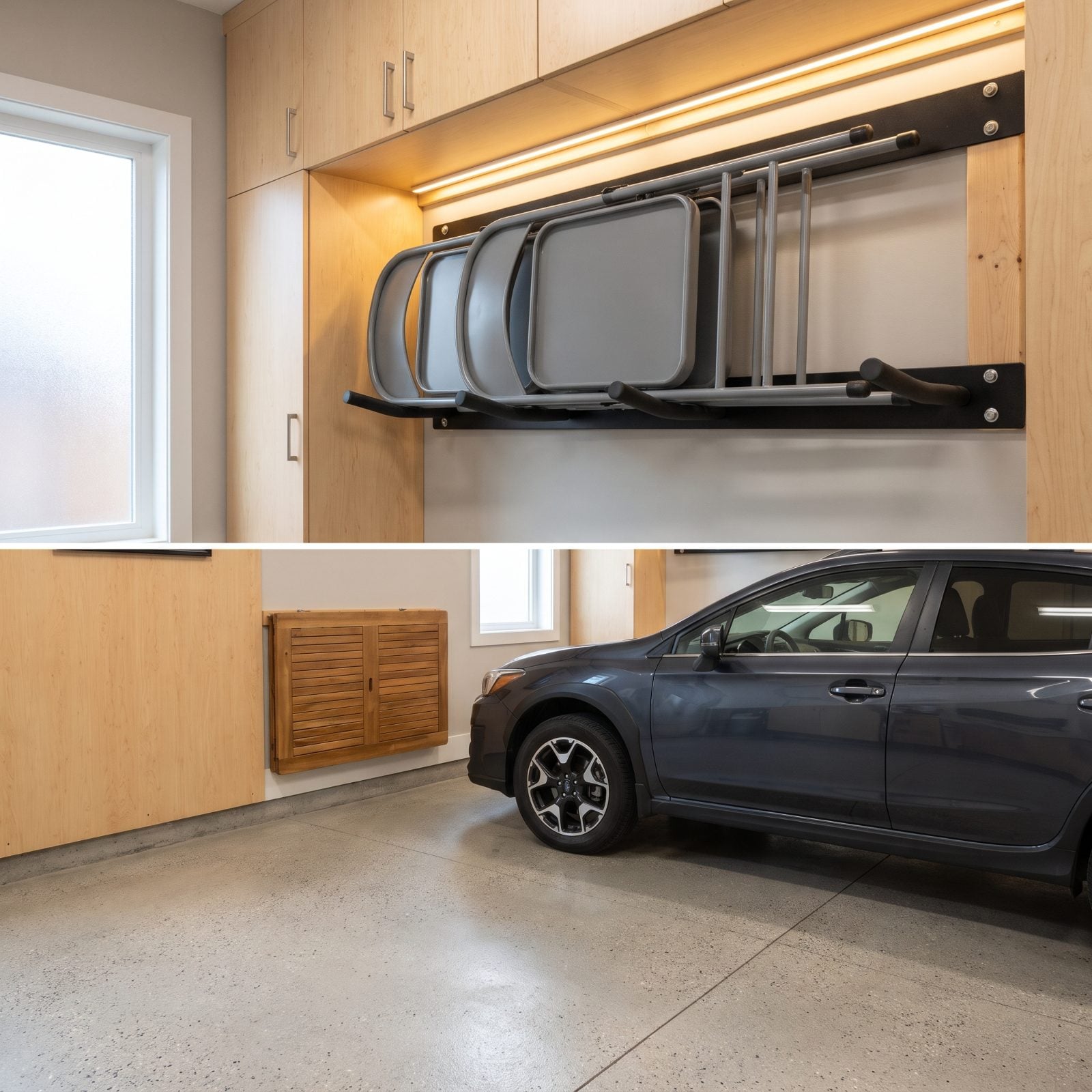
Folding chairs only earn their keep a few times a year. The rest of the time they sulk in a corner, falling over one at a time whenever you brush past. Get them up on a wall rack and that corner comes back for good.
Horizontal padded arms let you slide the folded chairs on flat and stacked tight. Mount the rack above a workbench or in dead space near the door where nothing else lives. Pad the arms or wrap them in foam so the chairs don’t get scratched up. Then one tug and they’re down when the family shows up unannounced.
15. A Bracket Pair That Hangs Collapsible Sawhorses Flat Against the Wall
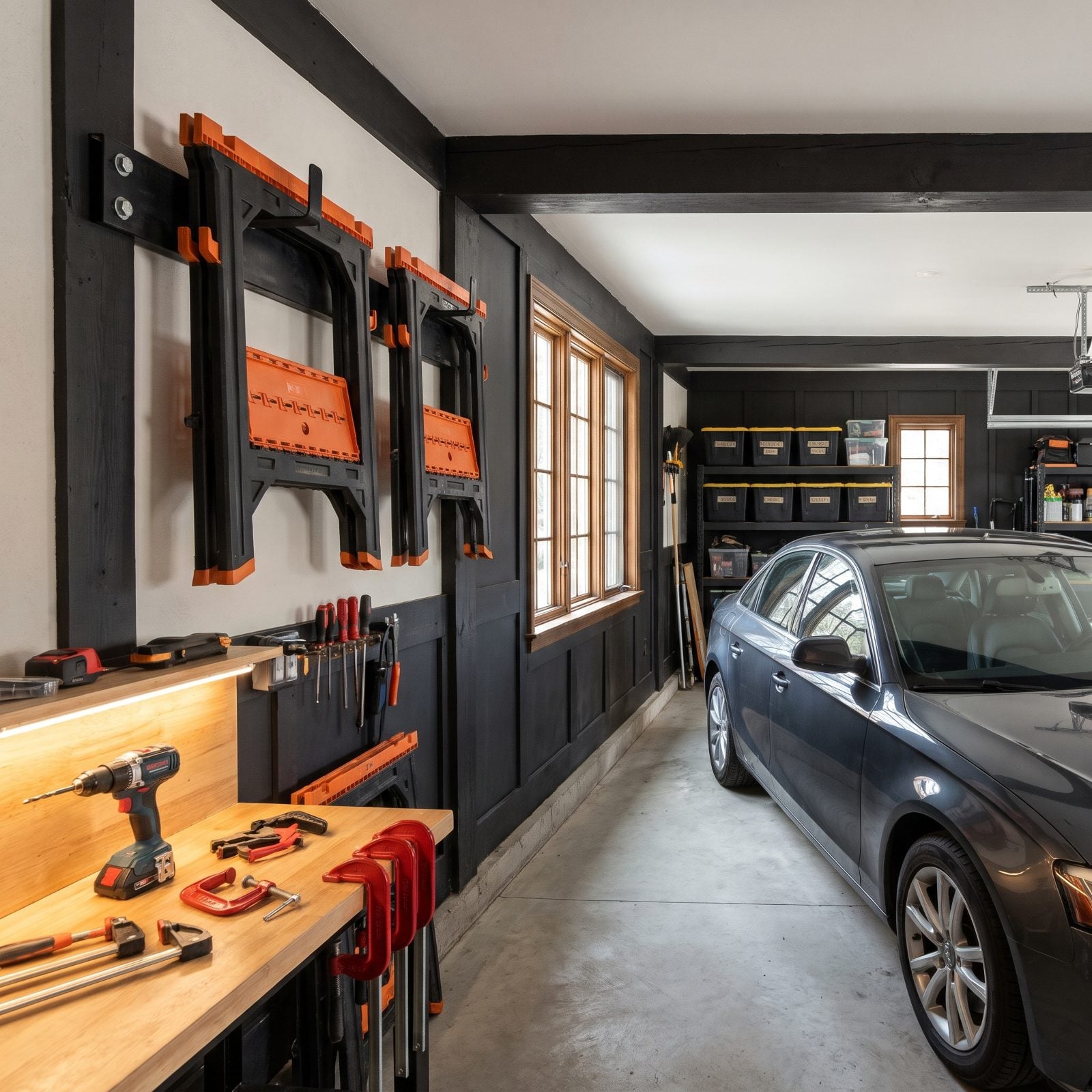
Collapsible sawhorses fold flat for a reason. So don’t leave them standing open in the middle of the bay collecting your shins.
A simple pair of hooks or brackets holds them folded against the wall, flat and out of the way. Mount them above the workbench where you actually use them, and you can set them up and stow them in seconds. Two pairs of brackets hold four horses in the footprint of a towel bar, and your parking bay stays a parking bay.
14. Bungee-Front Wall Cage for Sports Balls
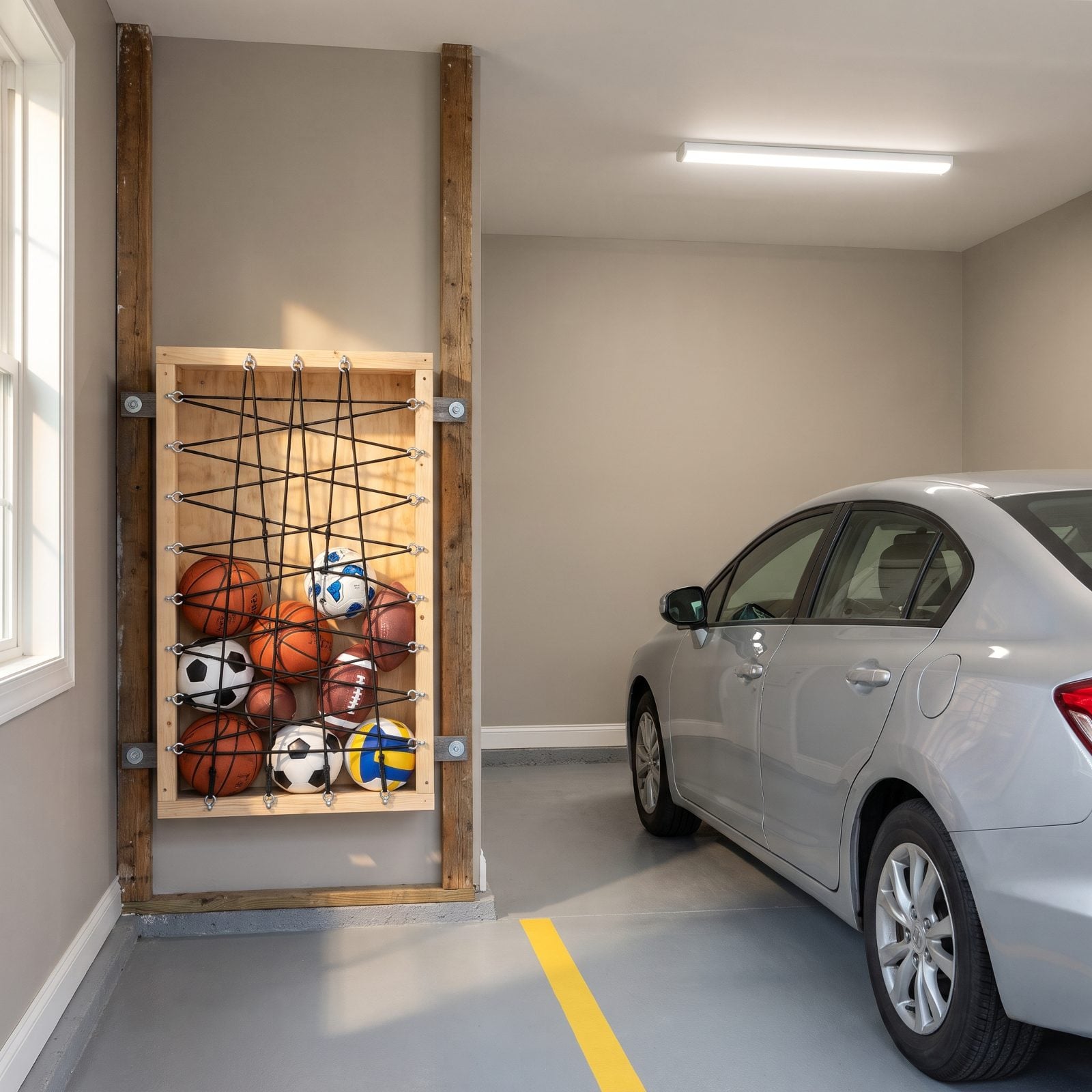
Loose balls are the raccoons of the garage. They roll under the car, wedge behind the mower, and turn up right when you’re backing out in a hurry.
A bungee-front cage fixes that for almost nothing. You build a shallow frame against the studs, screw in a few eye-bolts, and lace elastic cords across the front. Balls drop in from the top, the cords flex to let them out, and the whole rig sticks out from the wall only a few inches, with the balls bulging past the front. Mount it where your bumper won’t find it.
13. Wall Organizer for Golf Bags and Clubs
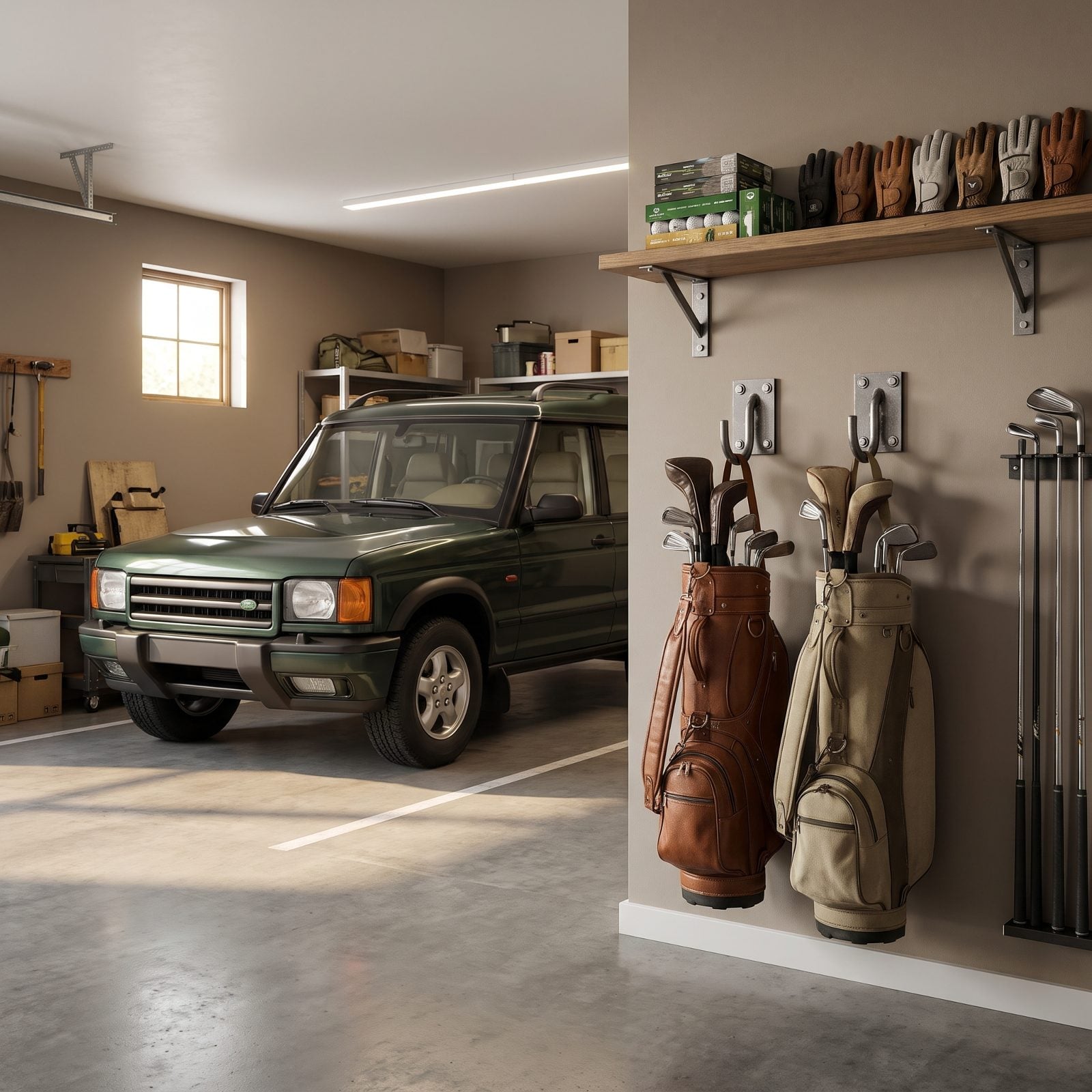
A golf bag standing on the floor is a tripod waiting to fall. Lean it in a corner and it slides, dumps your irons, and scratches your door panel on the way down.
Hang it instead. Two heavy hooks set at the right height let a full bag rest upright and flat against the wall, clubs pointing up, zippers all reachable. Add a short shelf above for balls, gloves, and tees and you’ve built yourself a little pro shop that eats zero floor. The car parks right up against it. And you can load the bag straight into the trunk without ever setting it on the ground — that alone sells the whole idea.
12. Padded Wall Rack for Skis and Snowboards
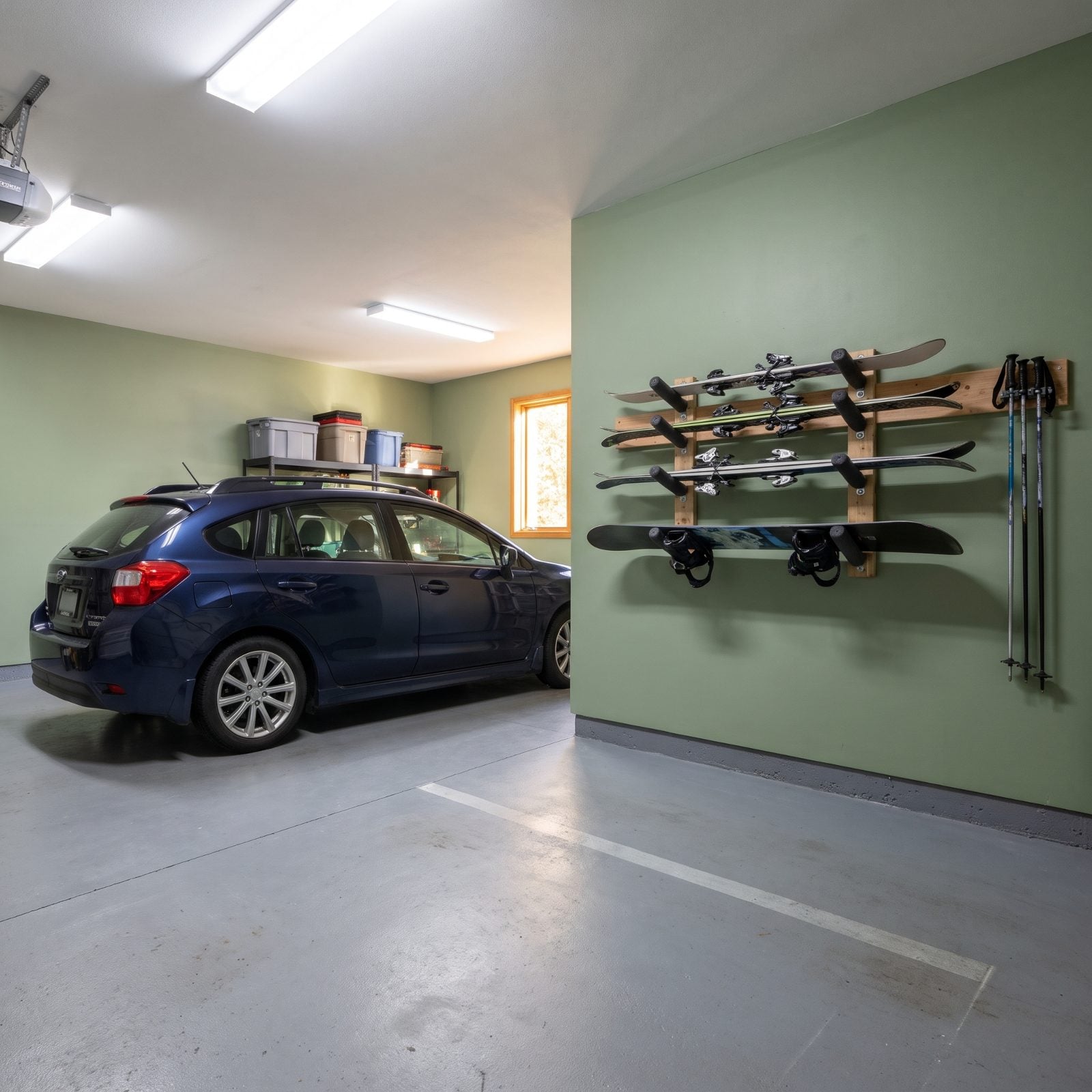
Bare steel will chew the topsheet off a ski in one season. That’s the mistake people make with cheap hooks. Foam padding isn’t a luxury here — it’s edge protection, plain and simple.
A padded horizontal rack holds skis and boards stacked flat against the wall, high enough to clear the hood of whatever’s parked below. Edges stay keen, bases stay unscratched, and everything hangs right in your line of sight so you actually grab the correct pair instead of fumbling. Eight inches of wall depth handles a family’s worth of gear.
11. Padded Wall Cradles for a Kayak
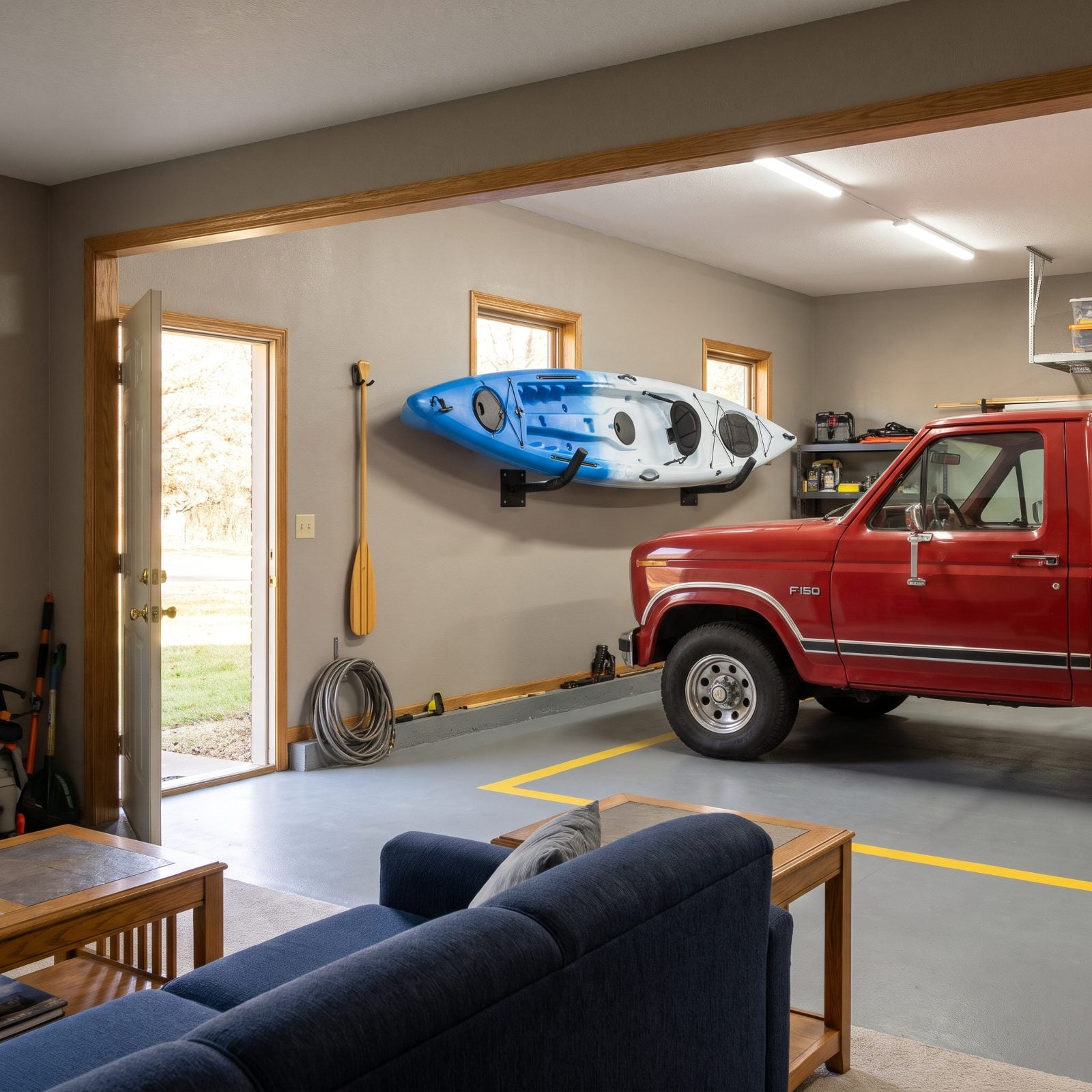
A kayak on the floor eats a kayak’s worth of space. Which, in a one-car garage, is basically the entire negotiation.
Padded J-cradles bolt into two studs and hold the boat on its side, up high, deck facing the room. The foam spreads the load so the hull doesn’t deform where it rests — and that slow deforming quietly ruins boats left on a single hard point for months. Mount the cradles above bumper height and the car slides right underneath.
10. Ceiling Tote Grid for Off-Season Clothing
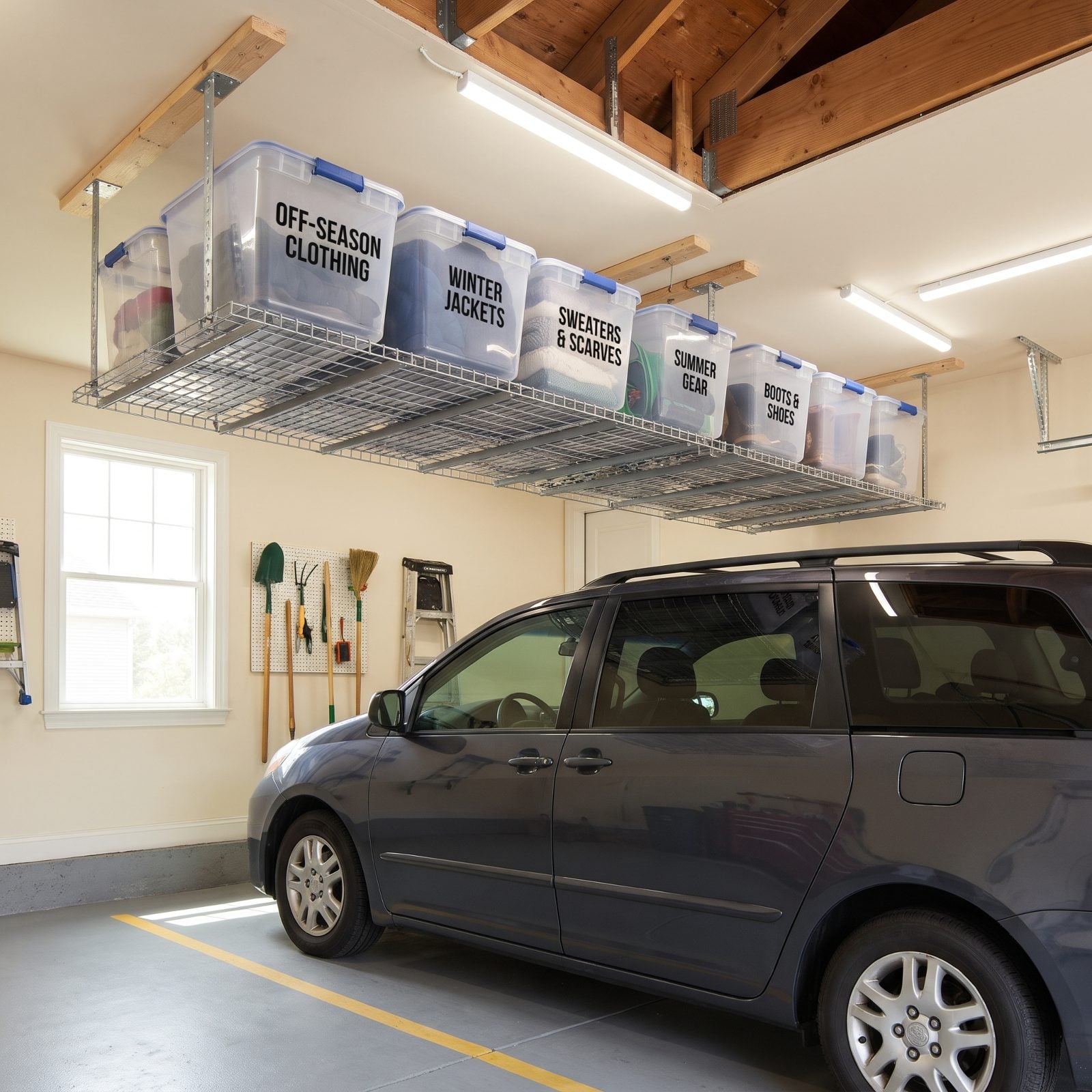
Winter coats in July are dead weight in the closet. Meanwhile the garage ceiling is empty air doing nothing.
An overhead wire grid turns that dead air into a season’s worth of storage. Matched totes slide onto the racks lid-up, labeled on the ends you can read from below. The whole row floats above the van’s roofline with room to spare. When October comes, you pull the coats down and send the shorts up in the same bins. Keep the lightest stuff up top and the loaded totes nearer the walls, where the joists carry the most. Clothes weigh almost nothing, which makes this one of the easiest overhead loads you’ll ever trust.
9. Ceiling Cargo Net for Sleeping Bags and Camping Gear
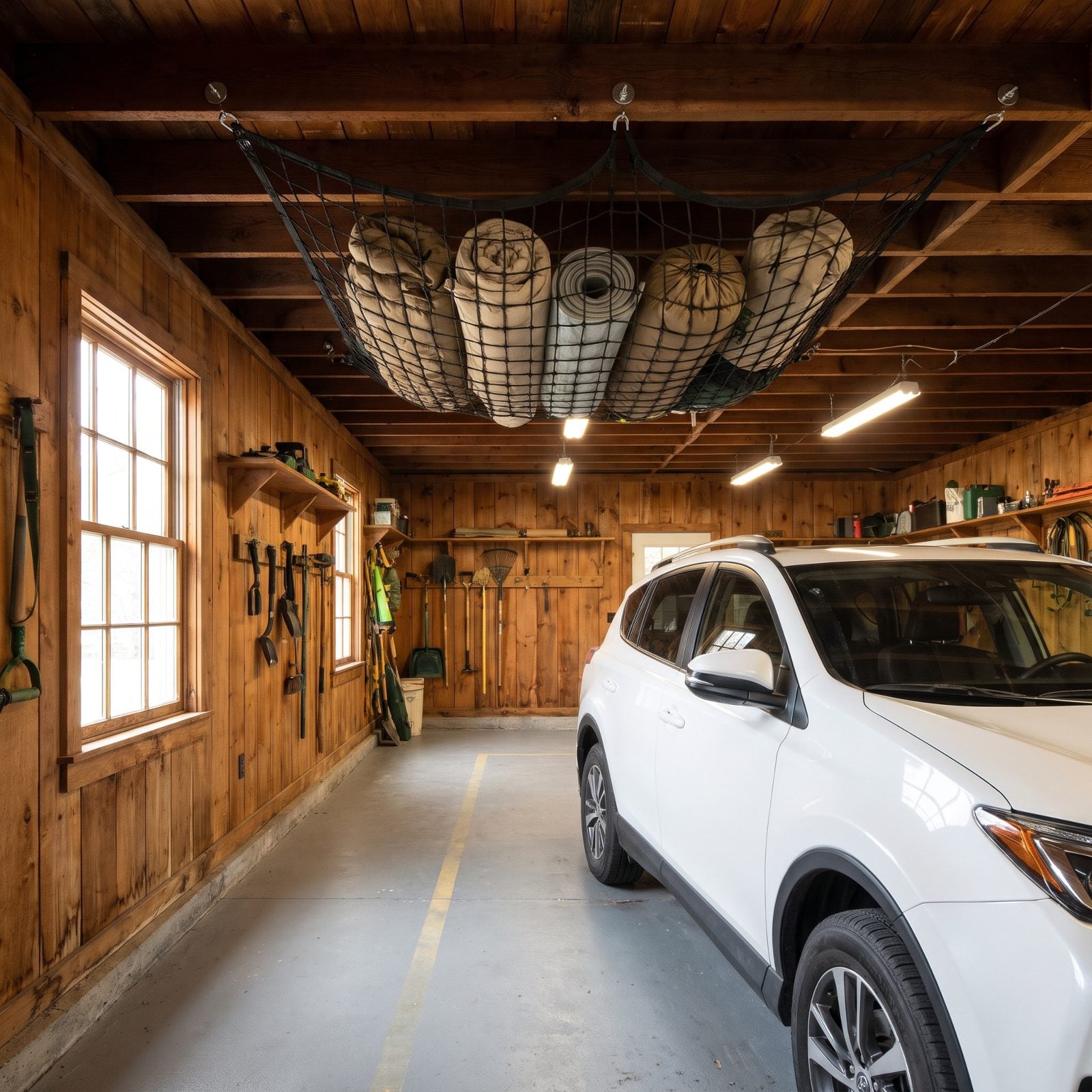
Sleeping bags are bulky, light, and squishable — basically the ideal thing to toss into a net slung from the ceiling.
Four eye-bolts in the joists, one cargo net, and all your soft camping gear suddenly lives overhead in a loose hammock. No shelf to build. No rigid frame. The net gives, so you can cram foam pads and stuff sacks in without careful stacking, and it all rides above the car. Keep it to light gear only, though. This is for puffy things, not tool chests.
8. Overhead Rack for Folding Banquet Tables
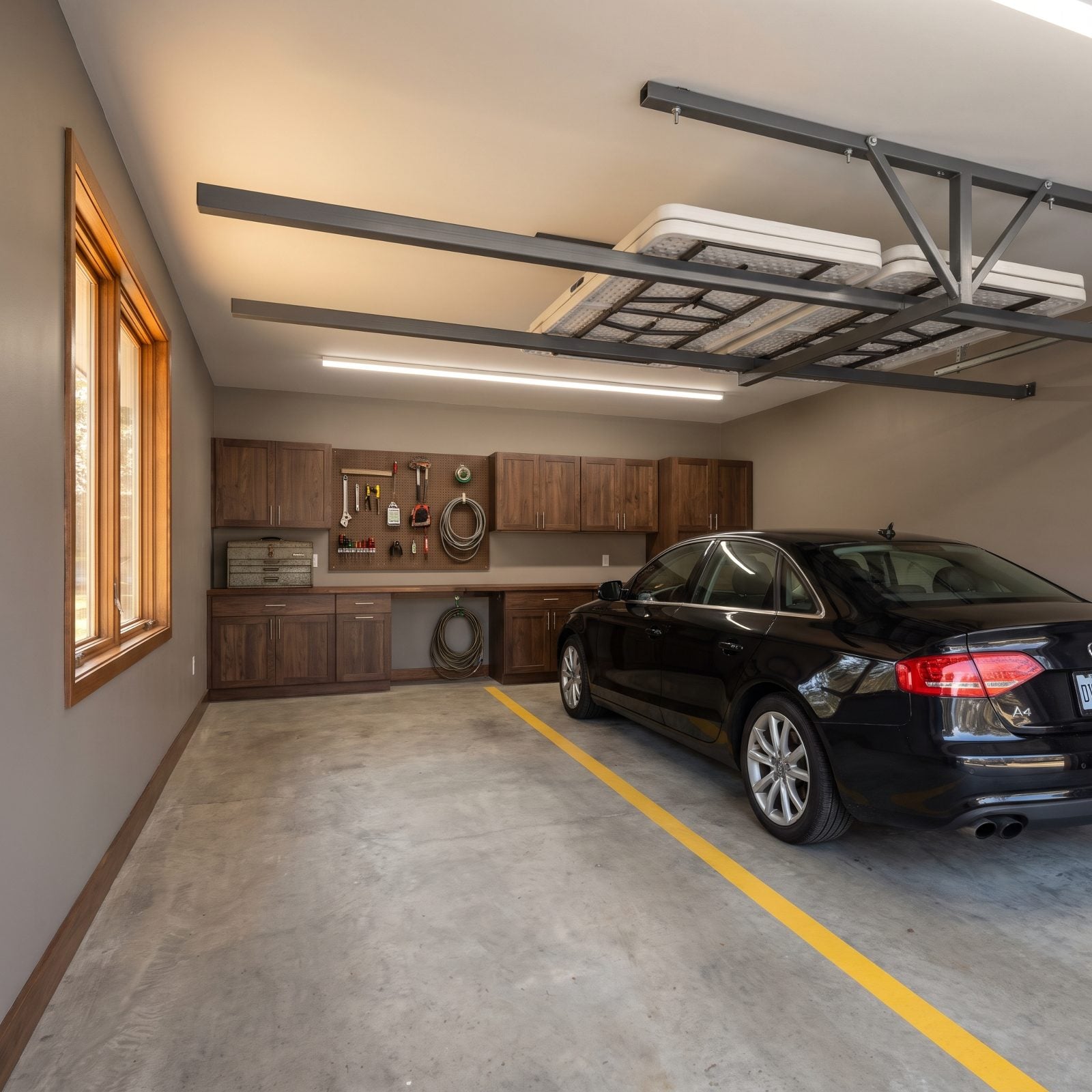
Folding banquet tables are the furniture equivalent of a houseguest who never leaves. Flat, awkward, and in the way of everything.
An overhead rack grabs them by the only dimension that matters: thinness. Two or three tables slide flat onto steel arms bolted to the joists, hung from the middle of the ceiling right above the parking bay, high enough for the car to pull in underneath. They come out twice a year for the family cookout and spend the other 363 days pretending they don’t exist.
7. Ceiling Shelf for Bulky Coolers
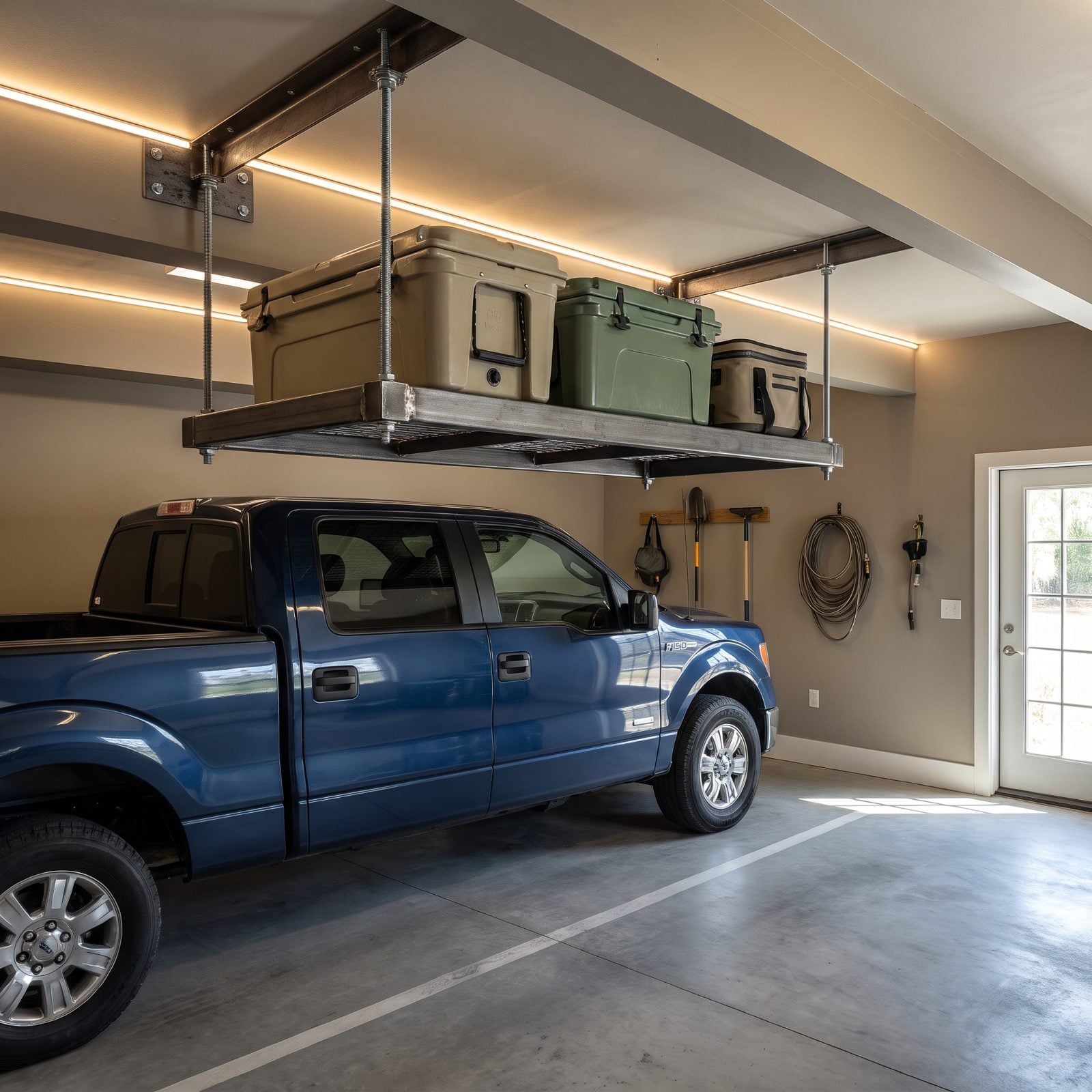
Coolers are bulky, but they’re boxy, so a single overhead shelf fits three in a row. Big tan hard-sided chest on one end, the green one beside it, soft bag at the far end.
Up on a ceiling shelf they’re out of the splash zone and off the floor where they collect dust and spider webs. Empty coolers weigh almost nothing, so the load stays modest. Anchor the shelf into real joists anyway. A shelf full of coolers is easy today and heavier the day you crowd the camping bins in next to them.
6. Ceiling Sling for an Artificial Christmas Tree
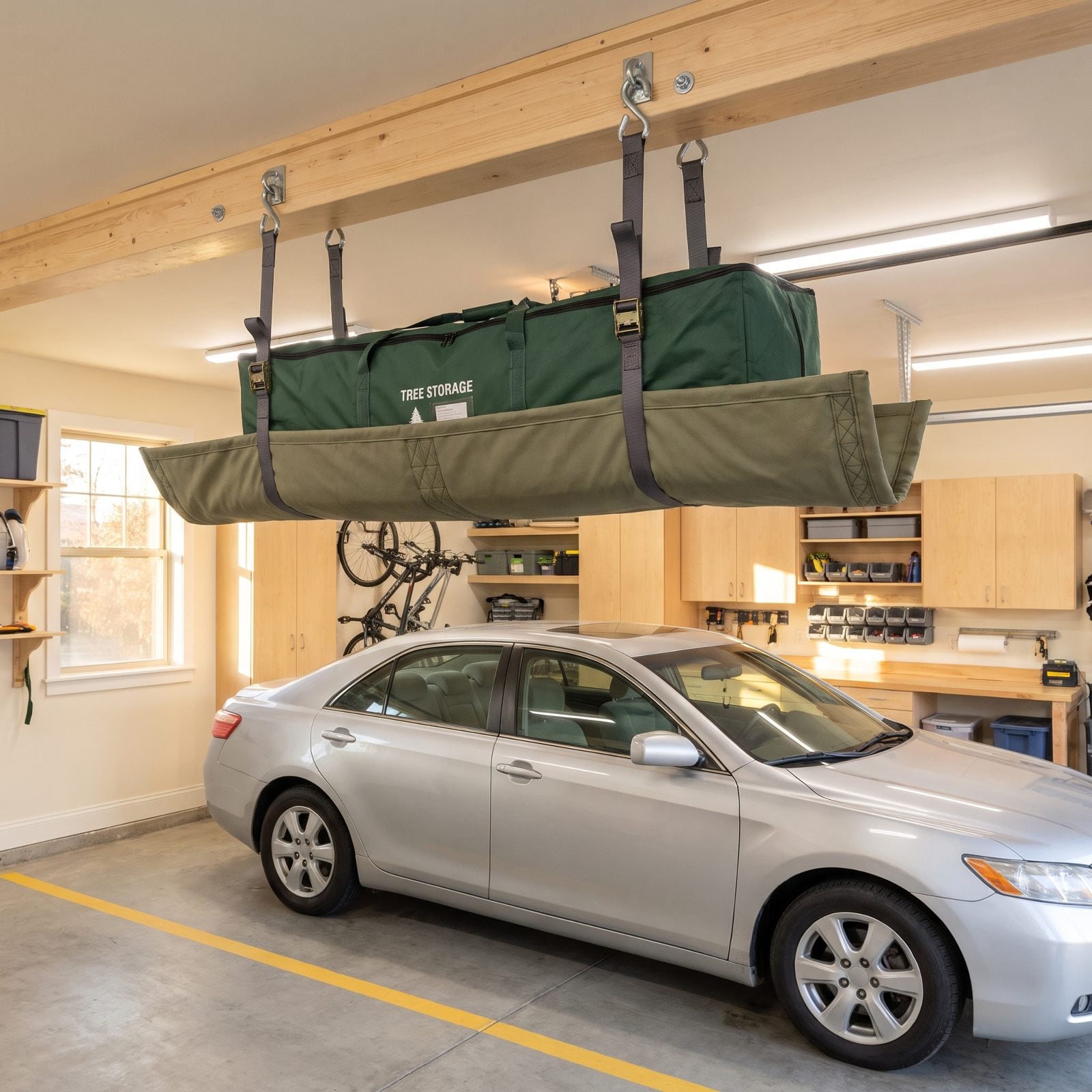
A boxed fake tree is long, heavy on one end, and impossible to stack anything on. Honestly the single most annoying thing to store in a normal house.
So get it off the ground entirely. A padded sling cradles the bagged tree horizontally, two straps looped over joist hooks, hanging up near the ceiling eleven months of the year. The branches stay compressed, the box stays off the damp floor, and the whole thing drops right into your arms when December rolls around.
5. Mesh Overhead Cage for Patio Cushions
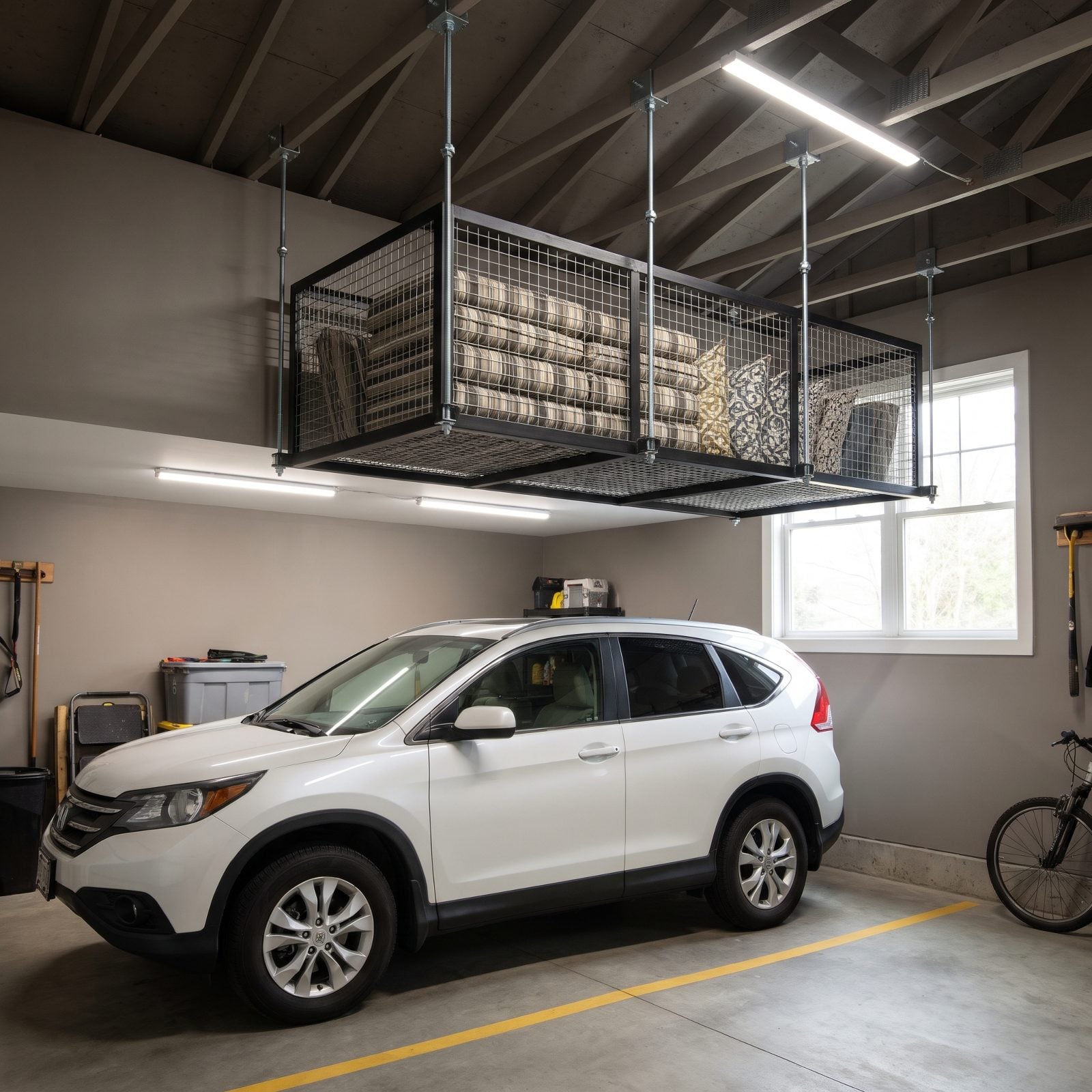
Patio cushions are the definition of bulky-but-light, and they rot if you seal them in plastic. Trapped moisture plus a dark bin equals a mildew smell you never fully kill.
A mesh overhead cage handles both problems at once. The cushions stack inside, the open weave lets air move through, and the box lives up by the ceiling until spring. Nothing’s crushed, nothing’s damp, and your floor stays a floor. When the weather turns you reach up, pull the stack down, and the patio’s ready in one trip.
4. Protected Ceiling Slots for Window Screens
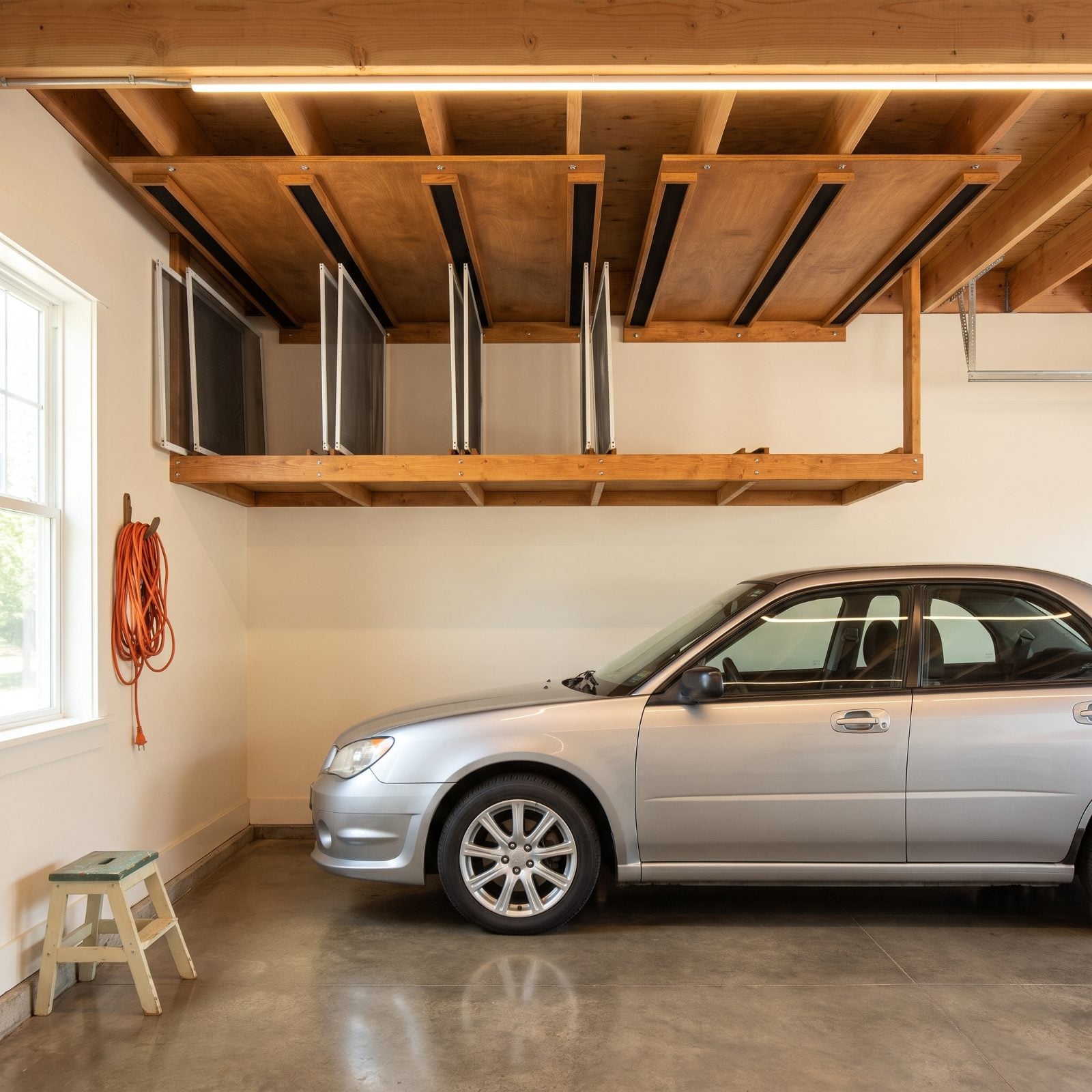
Window screens are the worst thing to store. Too big for a shelf, too flimsy to lean against a wall, and the second you stack them the bottom one bends under the pile. Then spring rolls around and you burn an afternoon prying a dent out of aluminum that will never sit square again.
The fix lives overhead, in that dead space above your hood. Hang a plywood platform from the ceiling joists, suspend an open shelf beneath it, and stand each screen upright on edge between small wooden stops — mesh protected, frames dead straight, everything up high and clear of the traffic path. Nothing scrapes the car when you swing the door open.
3. Ceiling-Mounted Tubes for Trim and Molding
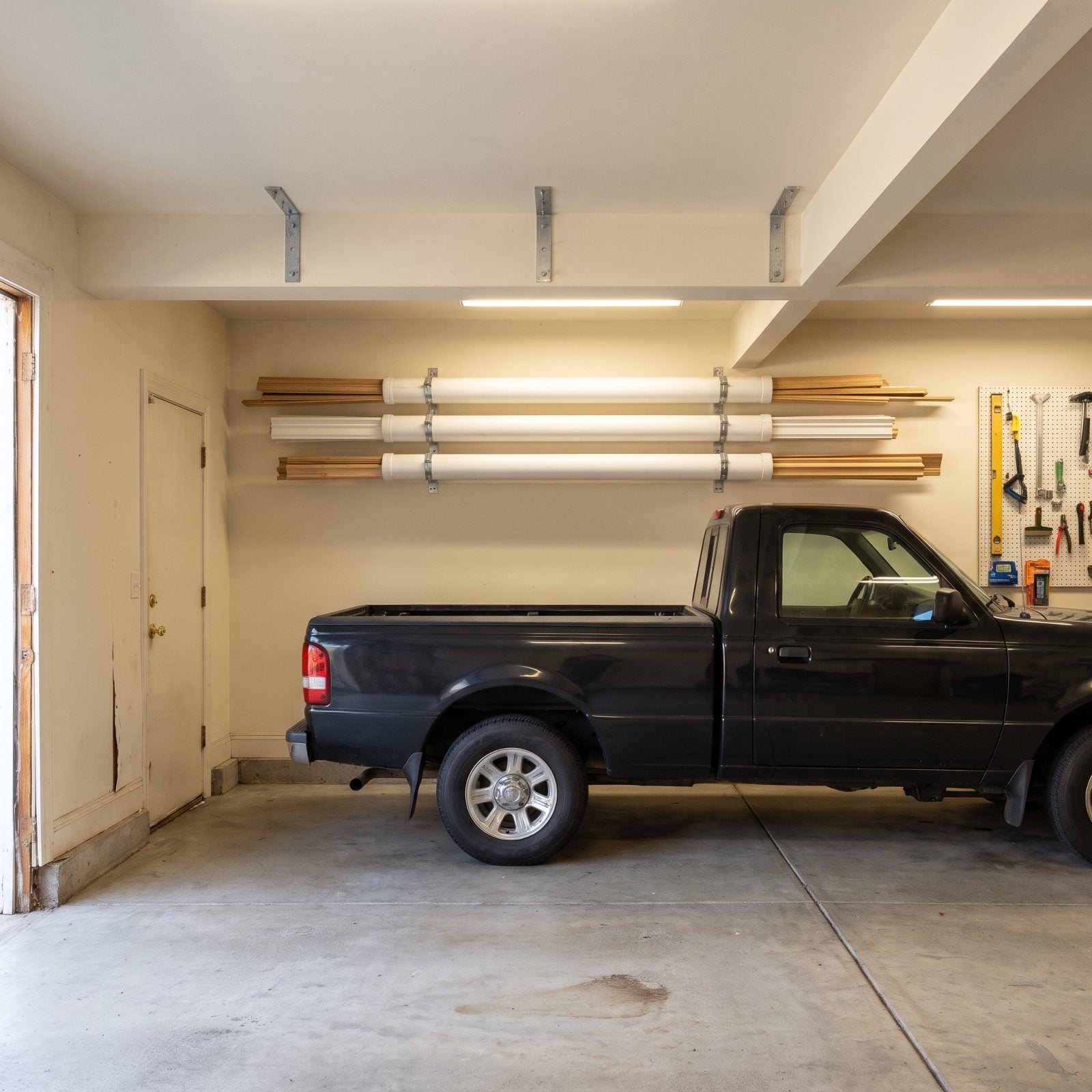
Long trim warps if you lay it flat and splits if you stand it up. It needs to be dead straight and dead horizontal — exactly what a wall won’t give you in a cramped garage.
Run a few capped PVC tubes along the ceiling instead. Slide your leftover crown, baseboard and quarter-round inside each tube. The tube supports its full length and keeps a ten-foot stick from tripping you every time you walk to the bench. We let a bundle of molding lean in a corner for two years and warped every single piece. Would not recommend.
2. Long Ceiling Cradle for a Portable Pop-Up Canopy
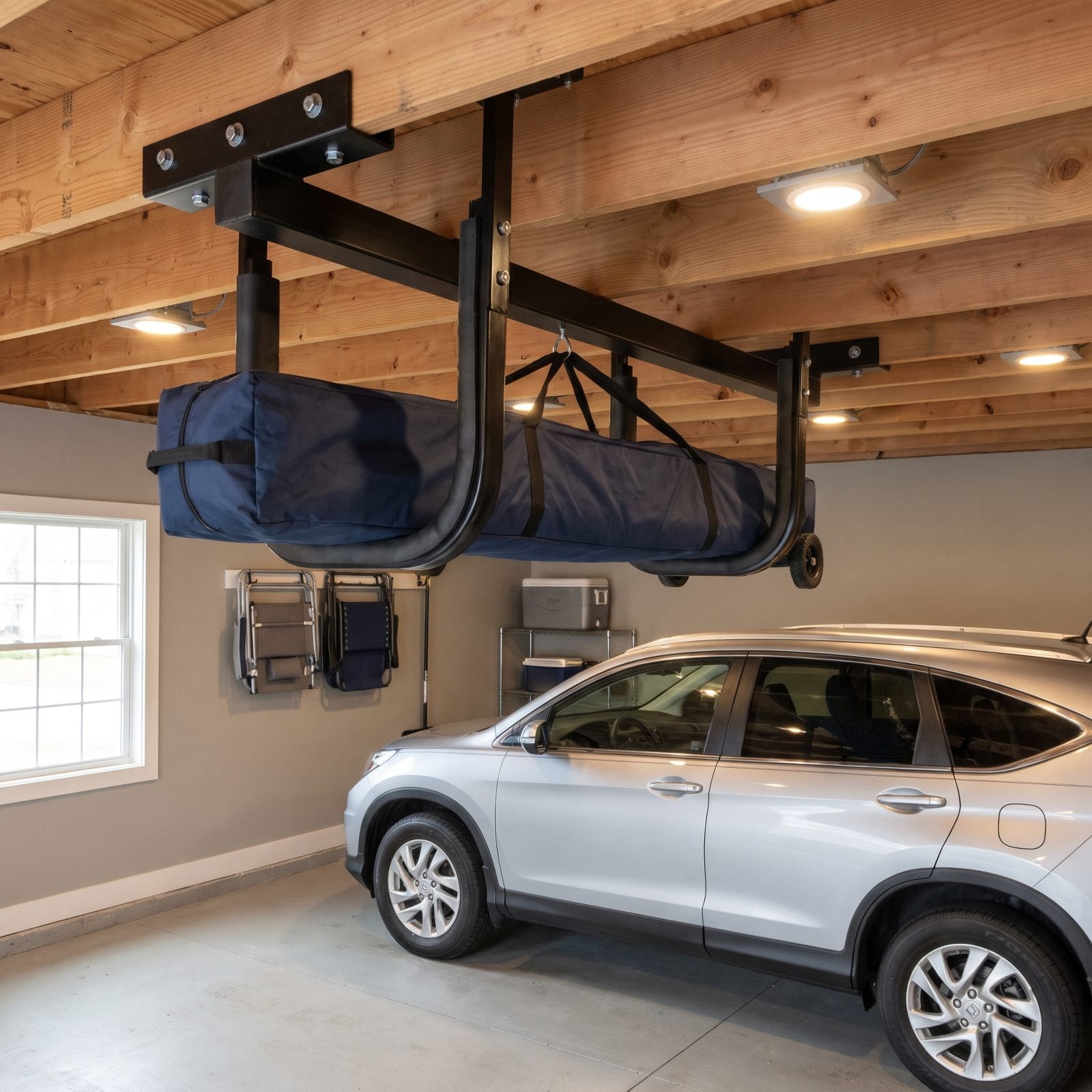
A folded pop-up canopy is six feet of awkward. It won’t stand in a corner without toppling, it eats a whole shelf, and the carry bag always ends up on the floor collecting sawdust and cobwebs.
So hang it. Two rubber-lined J-arms bolted into the joists hold the whole bag lengthwise above the bay, out of the way until the next tailgate or yard sale. The bag already rides on wheels, so you pull it down, roll it to the car, and you’re loaded before the coffee goes cold.
1. Heavy-Duty Ceiling Hoist for a Rooftop Tent
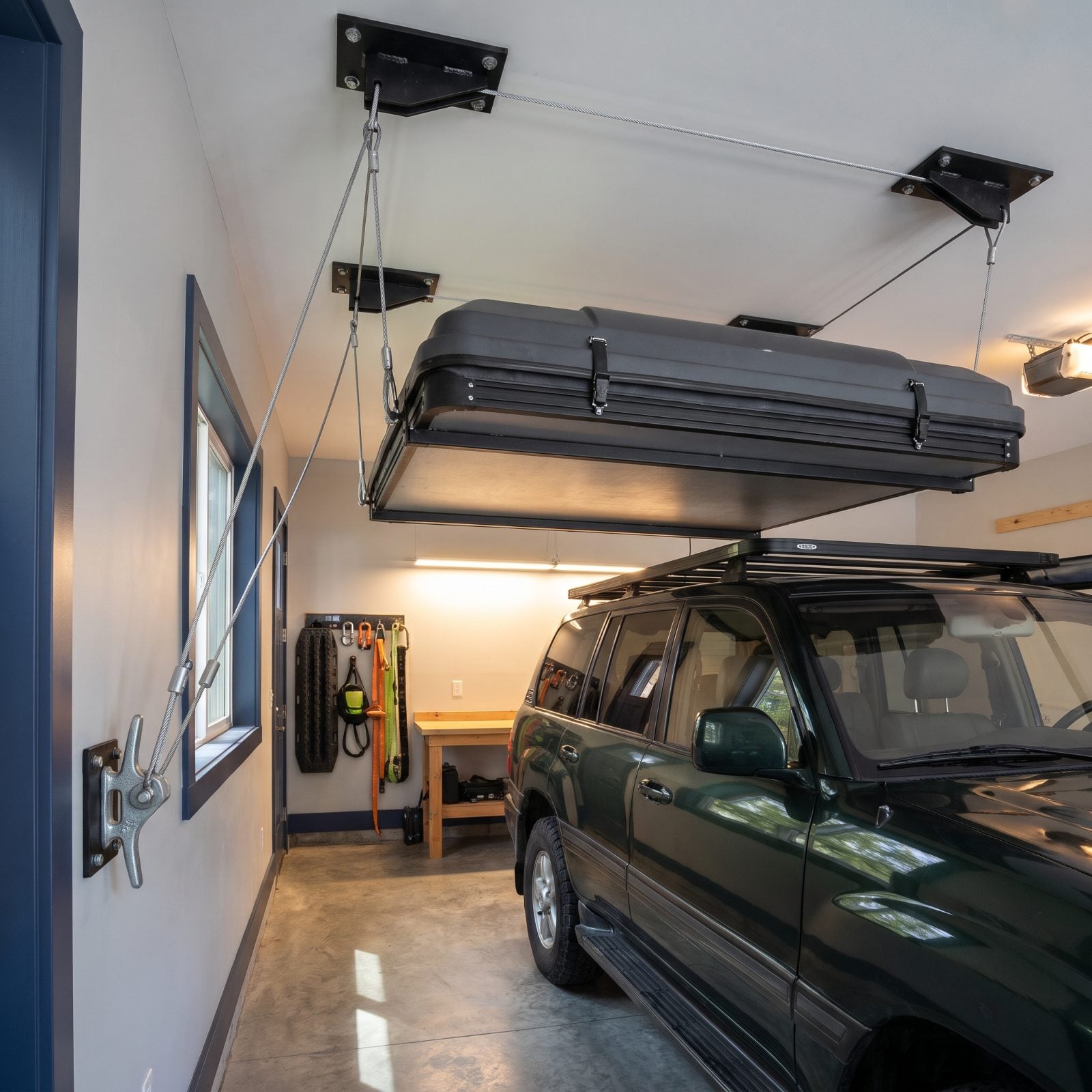
A rooftop tent is the one piece of overland gear you don’t want on the floor and can’t haul up a ladder solo. Most hard-shell models are heavy — dead weight, up high, over your head and your hood.
A four-point hoist handles it. The tent lifts flat off the roof rack, parks against the ceiling, and drops back onto the vehicle in minutes when you’re ready to roll. This is the one spot on the list where the hardware carries everything: use a rated garage hoist bolted into real framing, and if your joists aren’t up to it, add blocking or sister them first. A tent letting go is not a mistake you walk away from.