The cordless everything in your garage will be landfill before long. Meanwhile the wall-mounted vise your grandfather bolted down in 1963 is still clamping just fine. Somewhere we traded steel and hardwood for plastic clamshells and battery packs that die the week the warranty does. Those old suburban garages got a lot right, and not by accident — they built for decades, not seasons. Here are the features worth stealing back, the ones that outlast trends, outlast tools, and sometimes outlast the people who installed them.
Please note that some of the images in this article were created with the assistance of AI.
39. A Hardwood Workbench Built to Take a Beating
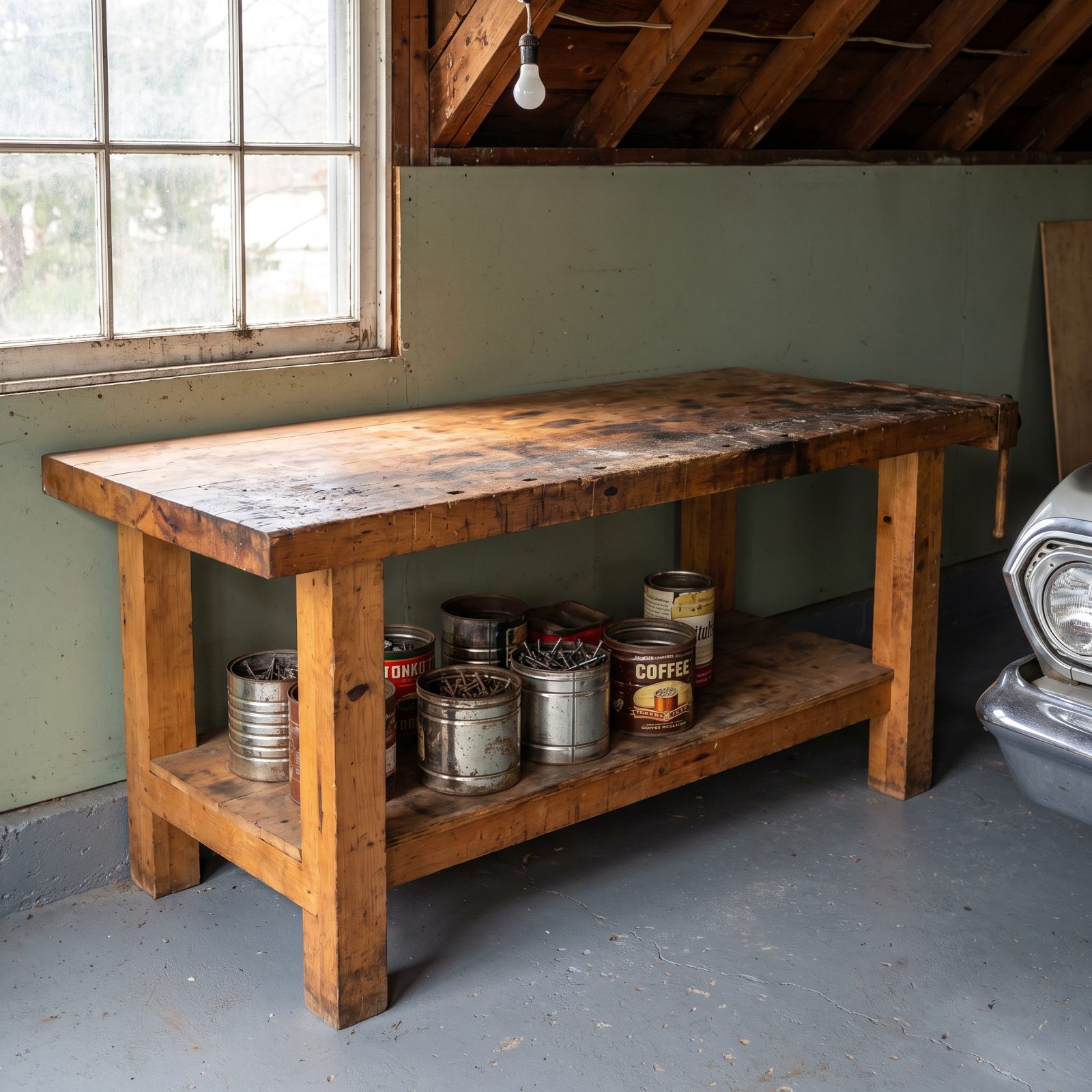
Most benches sold today are a steel frame topped with particleboard that swells the first time you spill brake fluid on it. The 1960s version was a slab of maple two inches thick, bolted to legs you could park a car on.
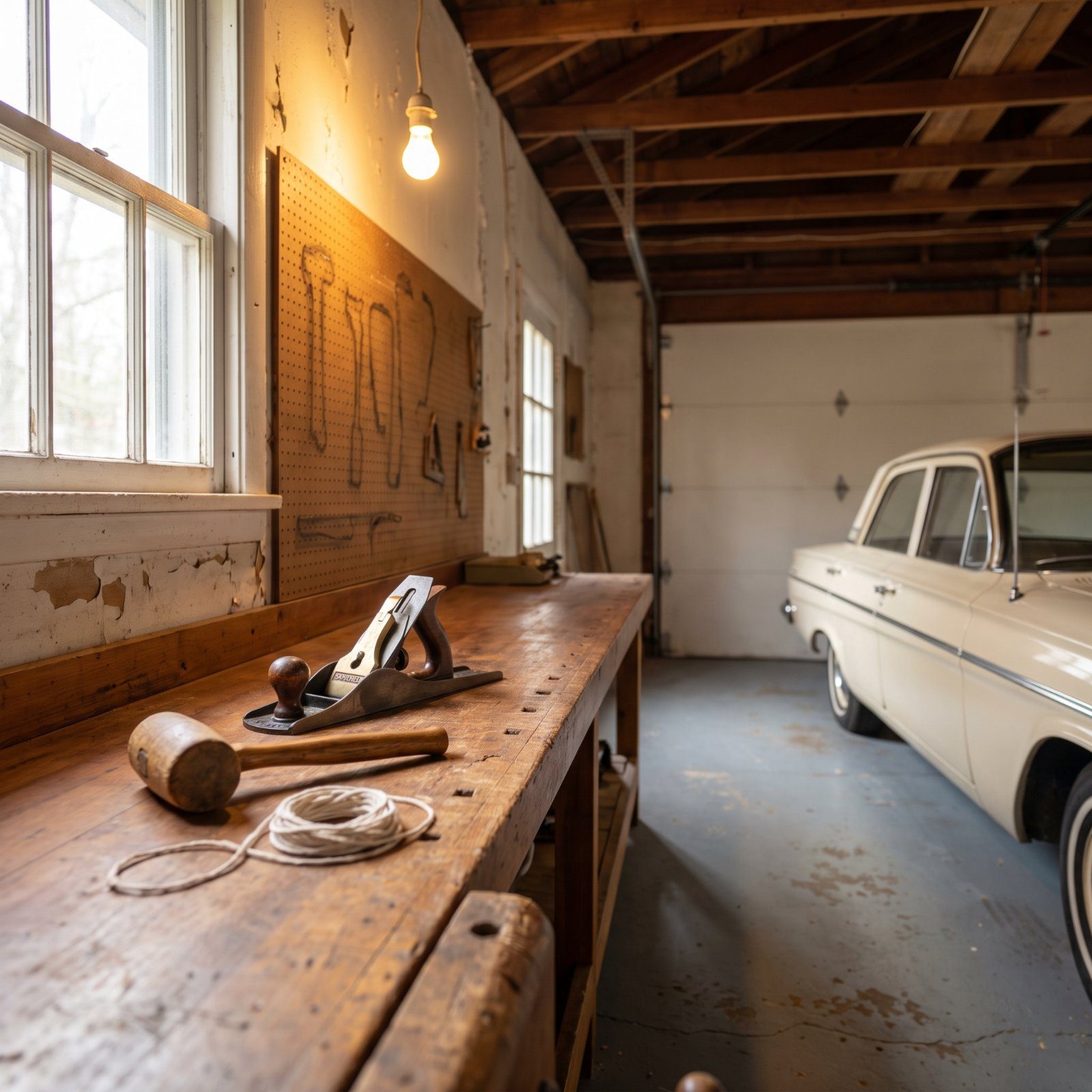
You can hammer on it, clamp to the edge, drag an engine head across it, and it just takes it. The wood dents instead of cracks, and a quick pass with a hand plane plus a coat of oil brings it back. We’ve seen one outlast three owners and a house fire.
38. A Pegboard With Outlined Tool Positions
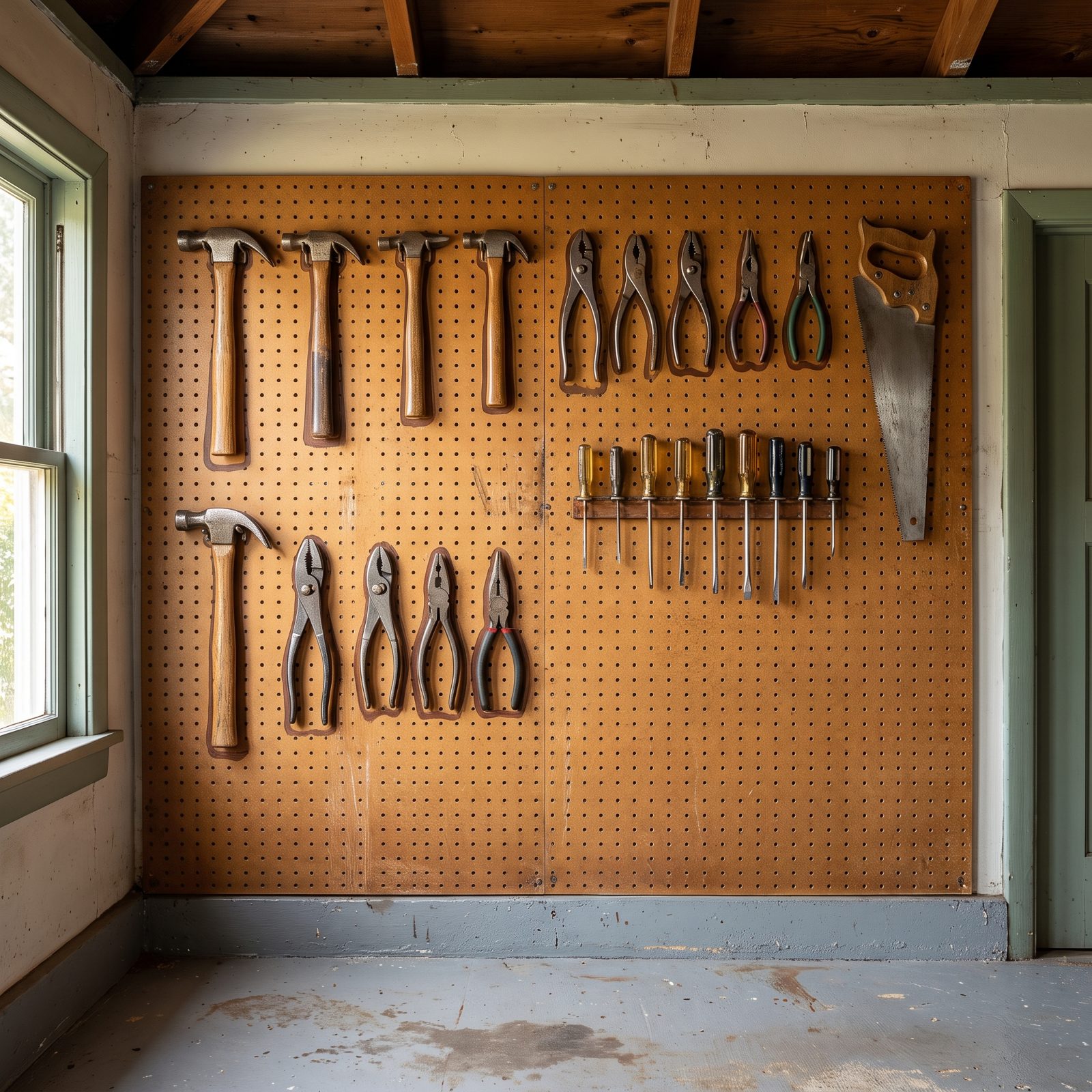
The genius wasn’t the pegboard. It was the painted silhouette behind every tool.
Hang the pliers, and you see the pliers. Take them, and you see a pliers-shaped hole that nags at you until the tool goes back. No labels to read, no drawer to open — just instant inventory you take in with a glance.
37. A Wall-Mounted Bench Vise
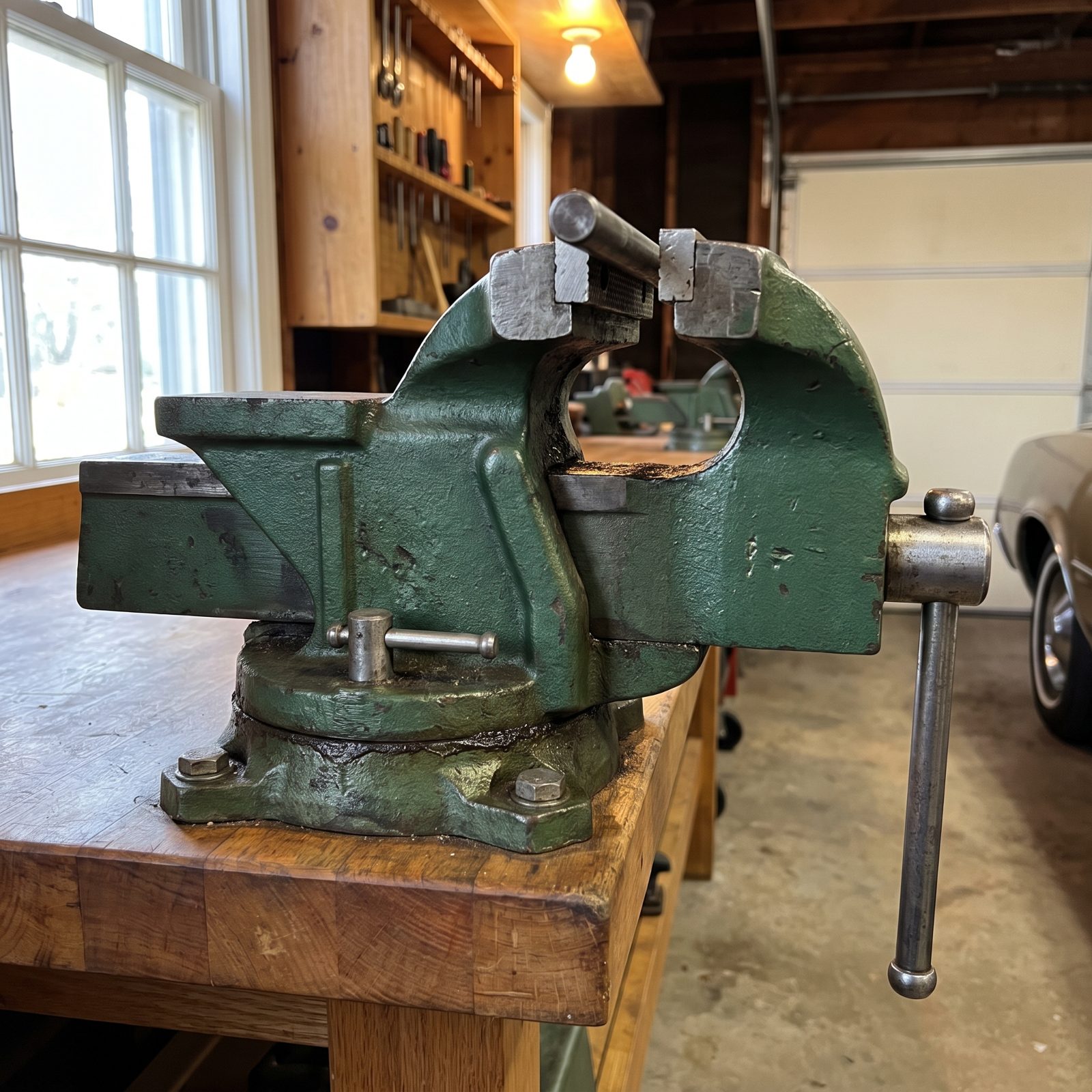
A good vise is the quietest workhorse in any garage. Bolt a four-inch cast-iron one to the bench corner and it becomes a third hand that never gets tired or second-guesses you.
The 1960s models were forged iron with a pipe jaw built into the throat, so you could hold round stock without crushing it. People hunt for these at estate sales now and pay more than new ones cost. There’s a reason. New castings crack; the old ones you could drop off the roof.
36. A Steel Cabinet With Labeled Parts Drawers
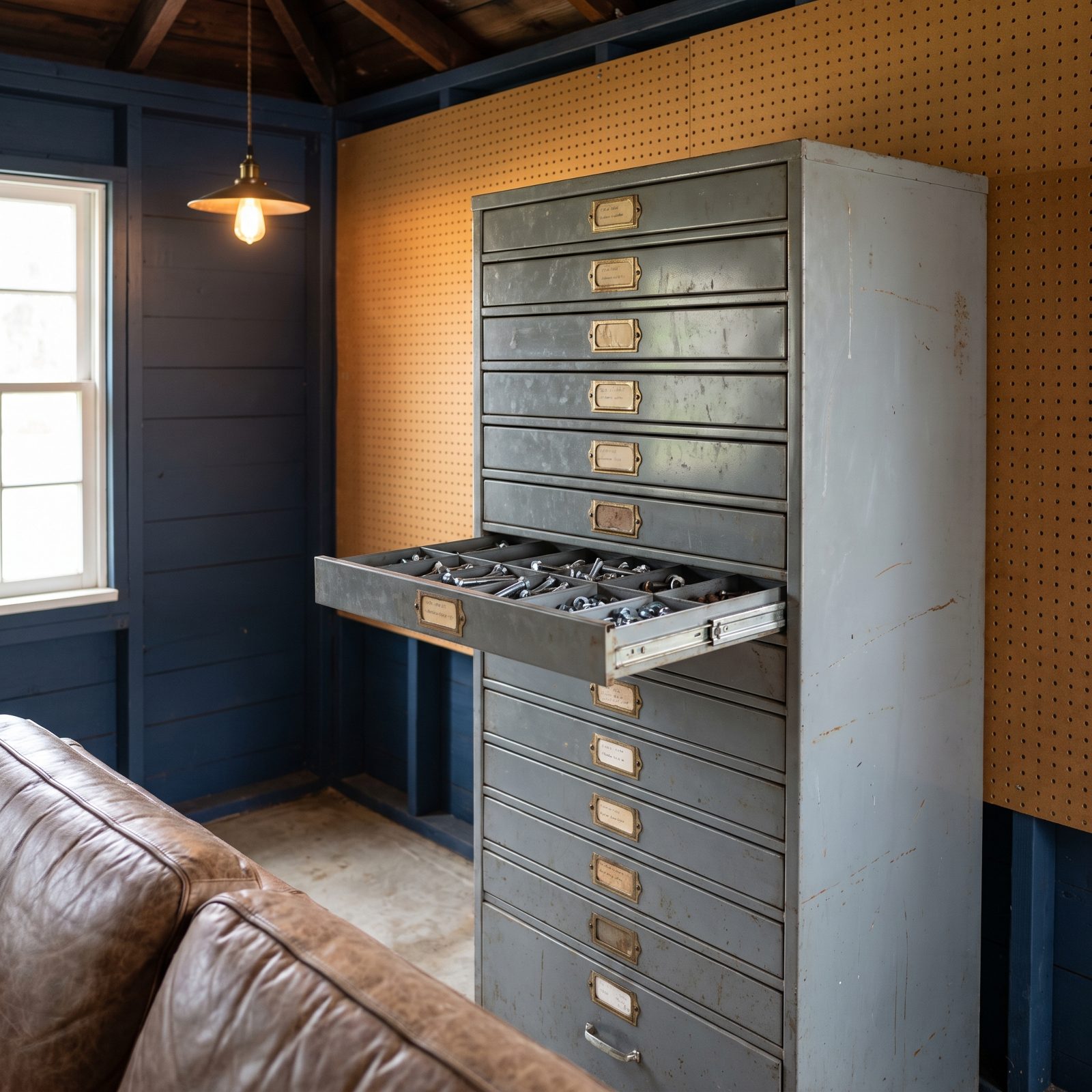
Nuts, bolts, cotter pins, washers — the hardware that vanishes into the void of your garage floor used to live in a wall of shallow steel drawers, each one labeled by hand.
Fastener size on the card, drawer slides out, you take what you need. No dumping a plastic tub onto the hood and picking through it. The whole thing is fire-resistant and rodent-proof, which the cardboard boxes you’re currently using are decidedly not.
35. A Cantilever Steel Toolbox
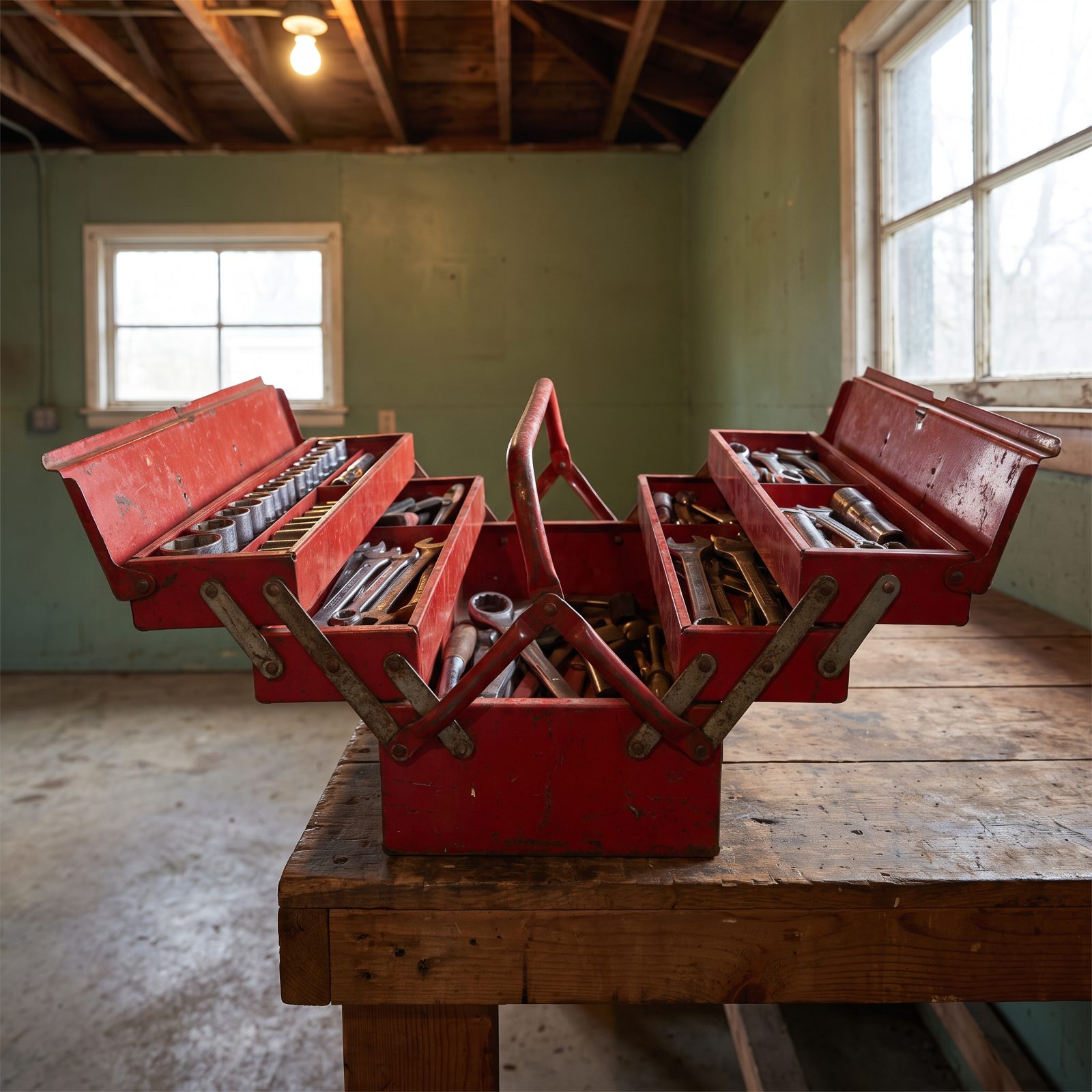
Pop the latch and the trays fan out and up, every tool rising to meet you. No digging through a pile at the bottom of a plastic box.
The cantilever design put your most-used tools in the top trays and the heavy stuff down in the base. All steel, so it handled the weight and survived being kicked across the floor. You can still find them — dinged and faded, doing exactly what they did sixty years ago. Try that with the stamped-plastic box on the shelf at the big-box store.
34. A Wall-Mounted Clamp Rack
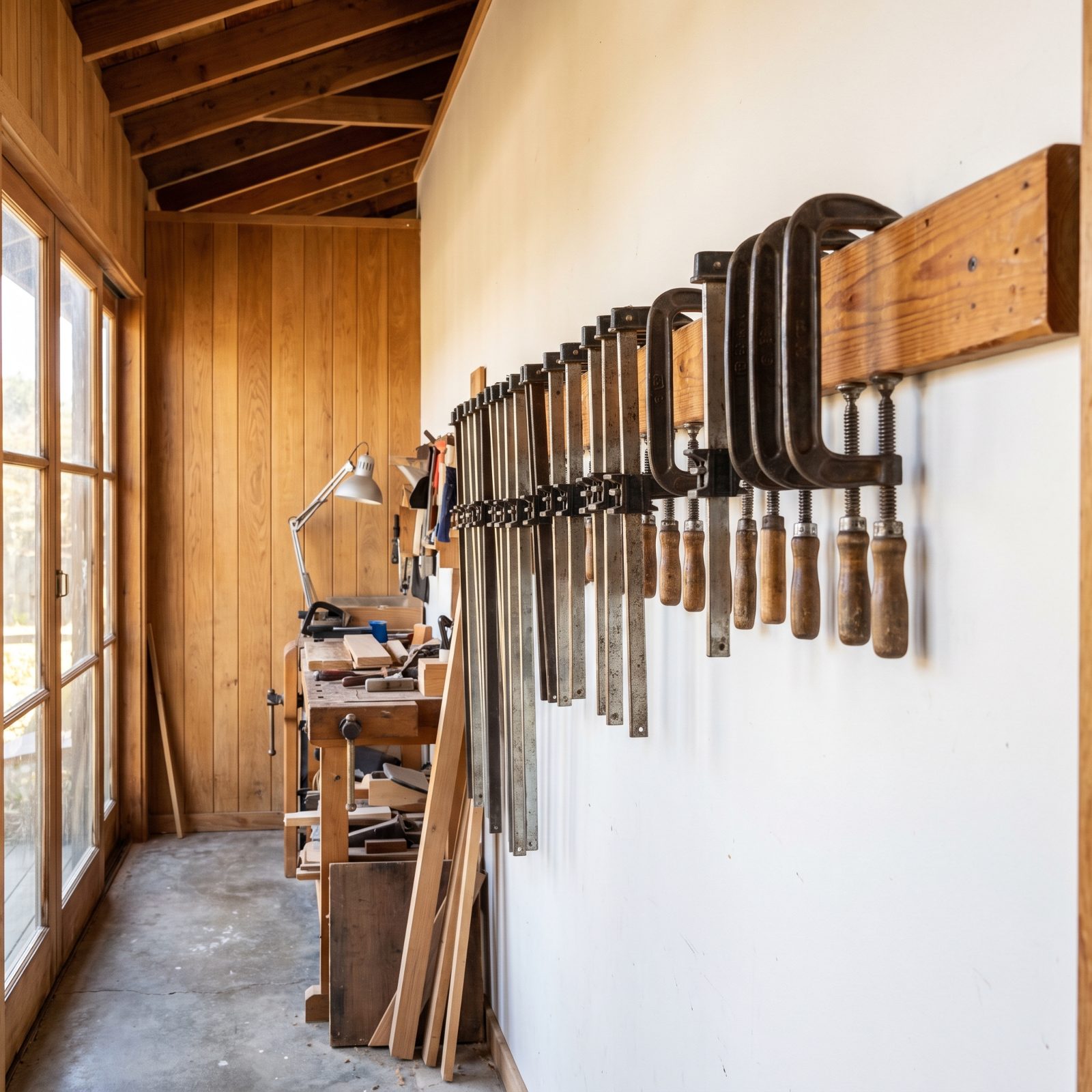
Clamps are useless the moment you can’t find them, and they’re always the thing you can’t find. A wood rail on the wall, clamps hung by size, fixes that for good.
You see every clamp you own at once, grab the right one mid-glue-up before the squeeze-out sets, and hang it back one-handed. It also keeps the heavy bar clamps off your bench, where they always seem to slide onto your foot at the worst possible moment.
33. An Overhead Rack for Scrap Lumber
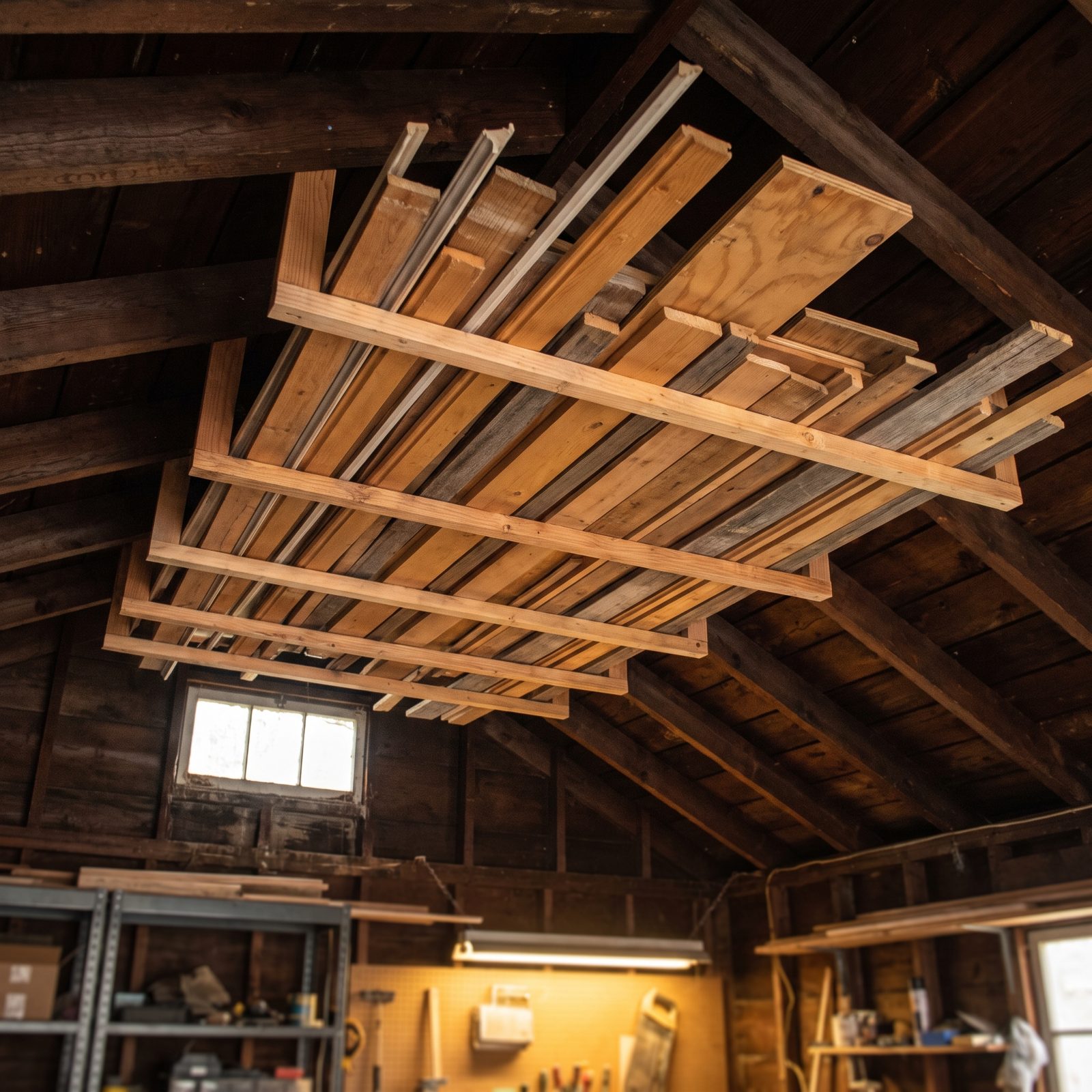
Every garage accumulates offcuts. The leftover boards and lengths of moulding you swear you’ll use — and will, the day after you throw them out.
Instead of a pile in the corner collecting spiders, the old builds ran a simple rack across the rafters and laid the long boards flat overhead, stacked across the crosspieces like a shelf. Dead space becomes storage. The wood stays dry and straight instead of warping on the damp floor, and your actual floor stays clear for the car.
32. Ceiling Hooks That Kept Bicycles Off the Floor
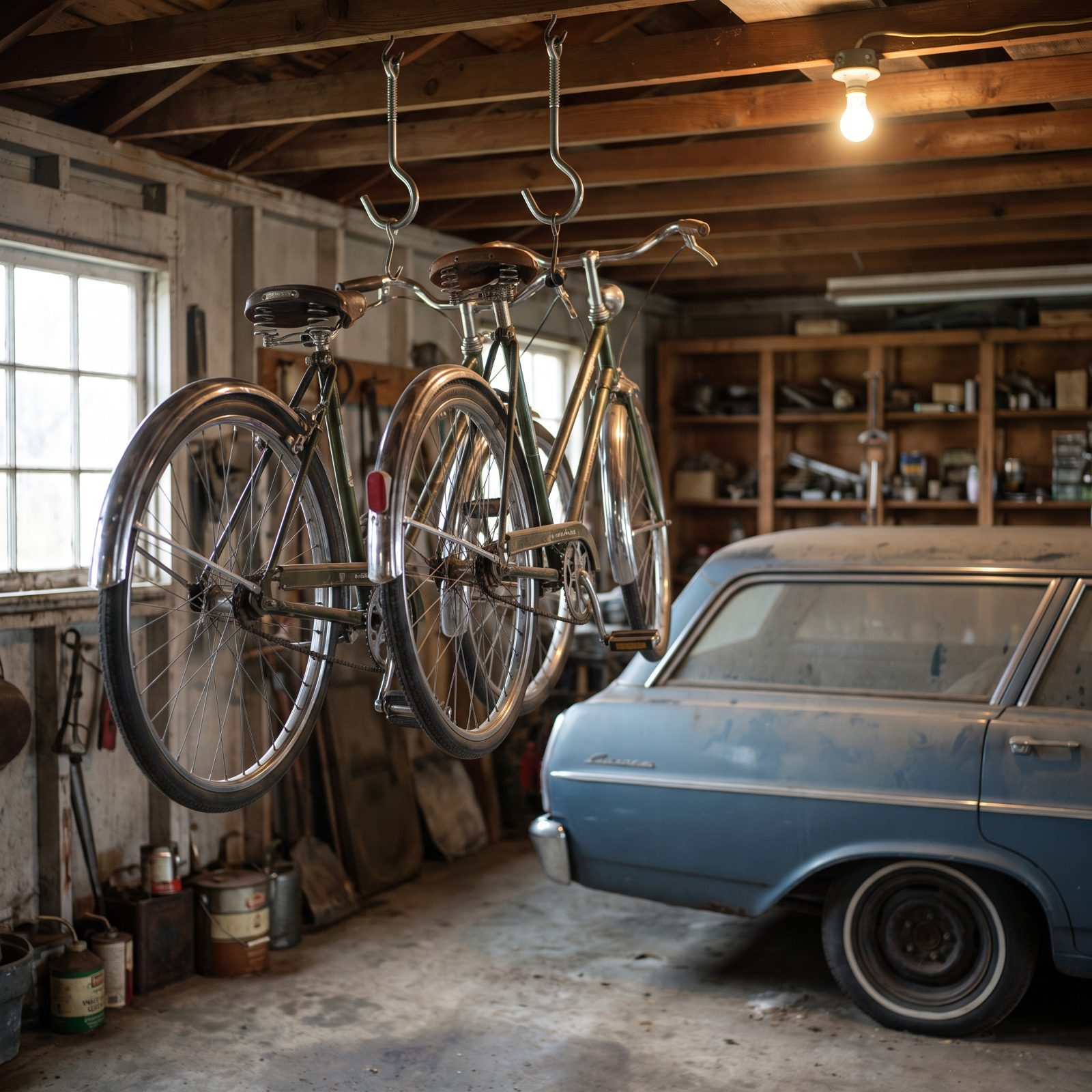
Long screw-in hooks catching the saddle and handlebars. That was the whole system, and it still beats most of what’s sold today.
Hang the bikes upright and level from the rafters, wheels down, and you reclaim a chunk of floor, keep the tires off cold concrete, and stop tripping over pedals in the dark. Two of these have held a kid’s bike for a generation. The fancy pulley hoist you’re eyeing online does the same job with more parts to break.
31. A Wall Rack for Long-Handled Yard Tools
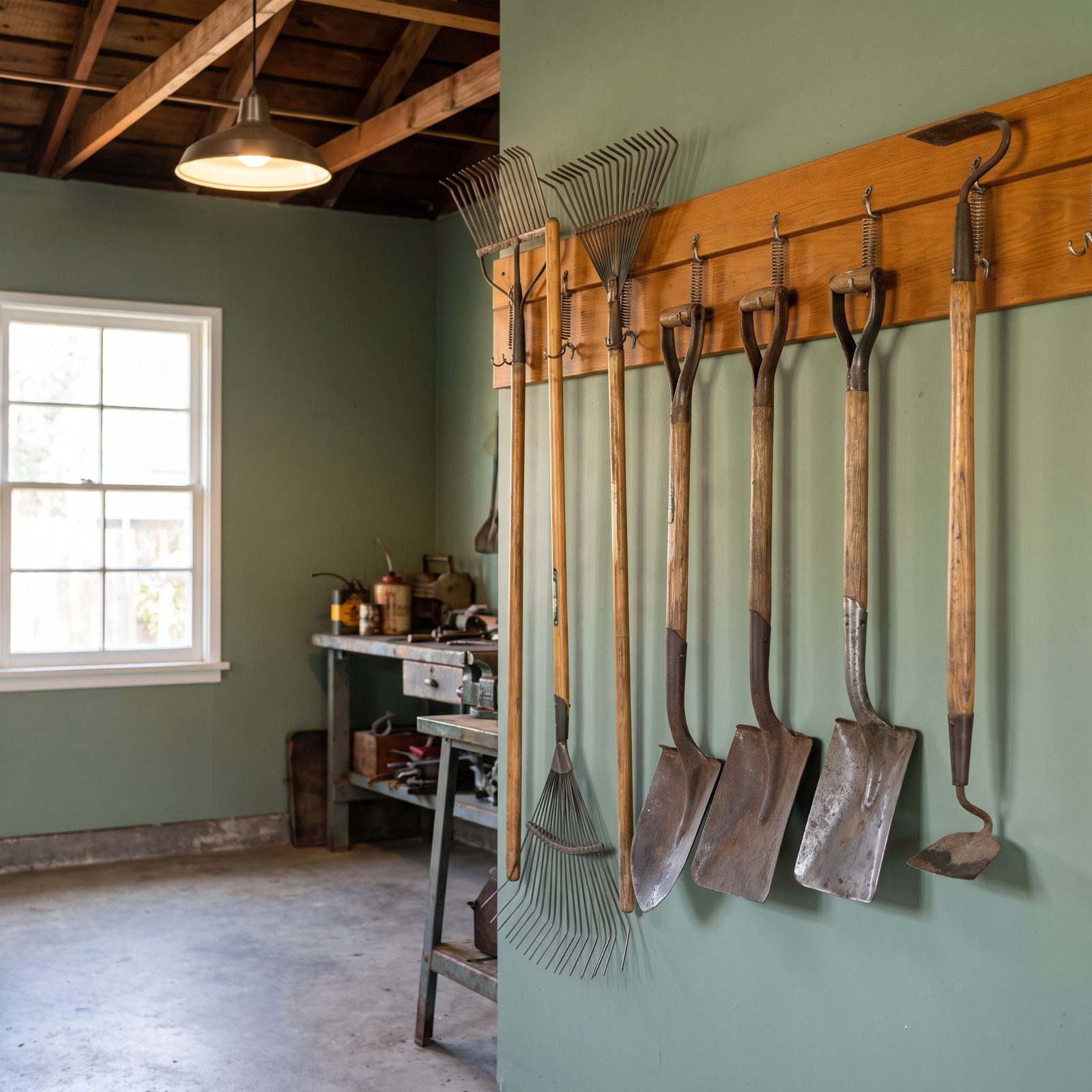
You know the corner where the rake, the shovel, and the broom all lean together and all fall over the second you reach for one. The 1960s answer was a row of spring clips or a notched rail on the wall.
Each long-handled tool gets its own slot, hung off the floor so the steel heads stay dry and the handles don’t rot at the base. Takes up a strip of wall nobody was using and clears the whole corner. Simple to the point of being obvious — which is exactly why it works.
30. A Lockable Cabinet for Paints and Chemicals
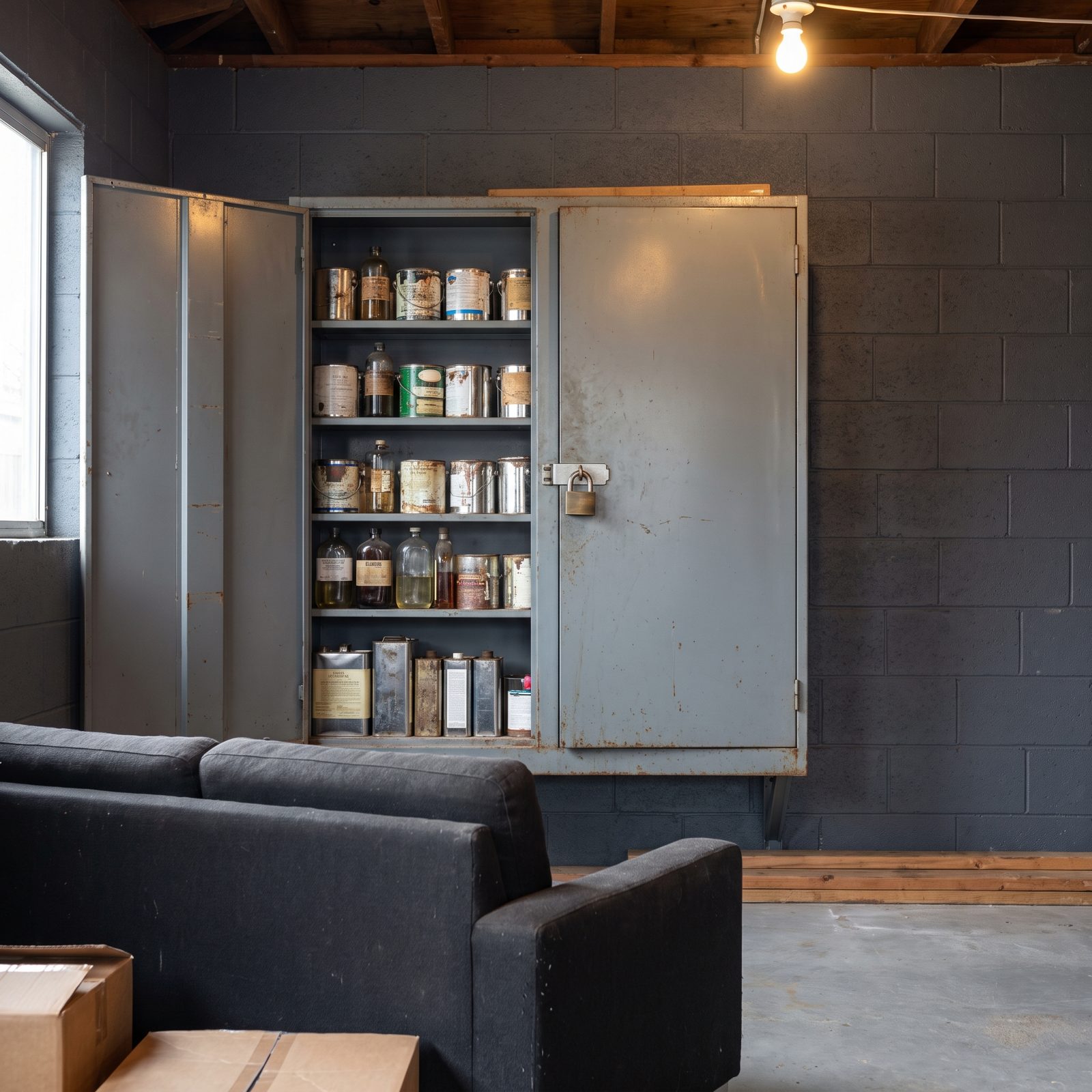
Paint thinner, motor oil, gas-can spouts, and whatever that half-full tin of something is. All of it flammable, some of it toxic, and most of it currently sitting on an open shelf at kid height in a lot of garages.
The old move was a steel cabinet with a hasp and a padlock, tucked away from the water heater’s pilot light. Keeps curious hands out, contains a spill, slows a fire down instead of feeding it. Not glamorous. Possibly the smartest cheap upgrade in the whole garage.
29. A Dedicated Shelf for Repair Manuals
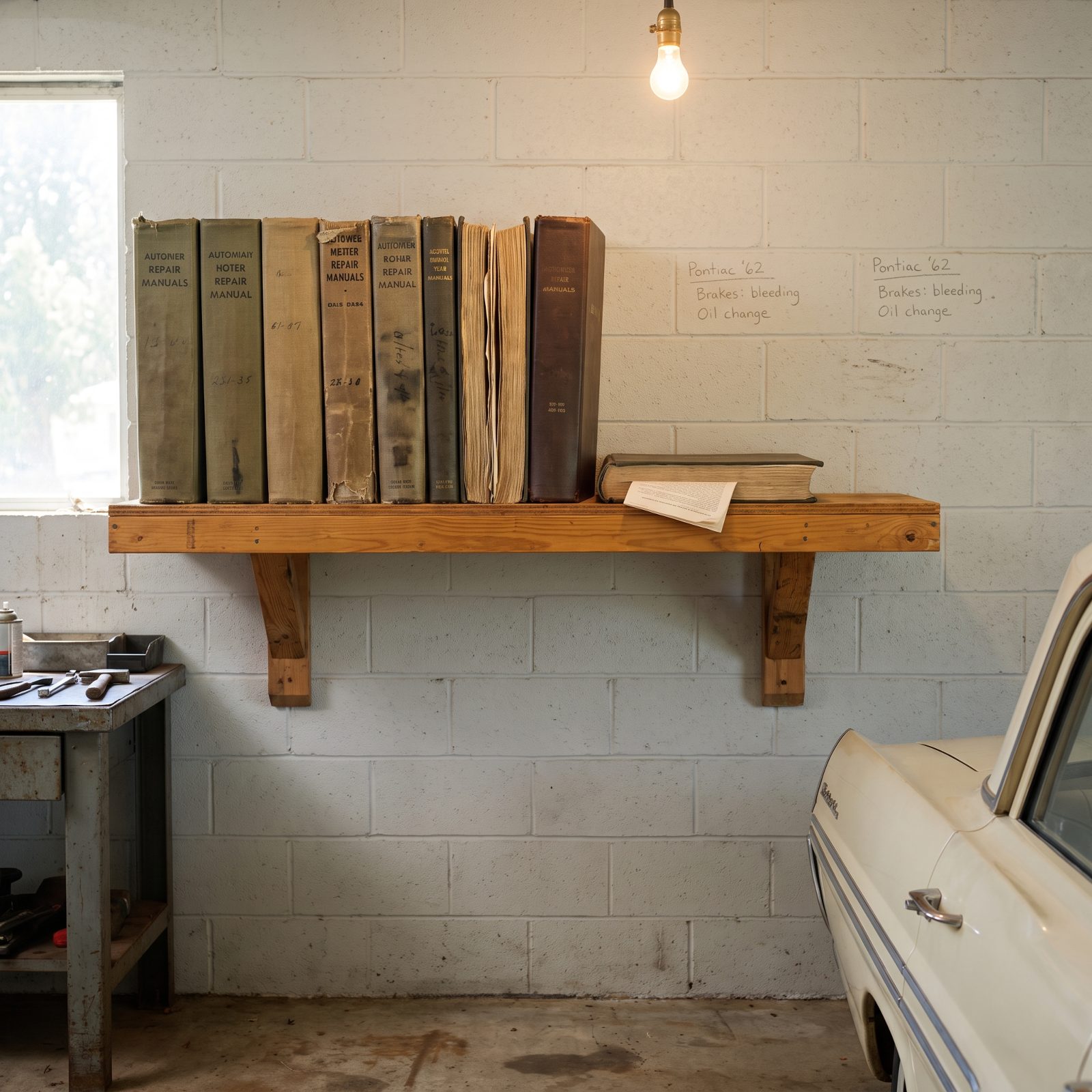
Before the glove box PDF and the YouTube rabbit hole, there was a shelf. One spot, eye level, where the factory service manual lived next to the Chilton guide for whatever you actually drove. You didn’t search. You reached.
The modern version holds up because paper doesn’t buffer, doesn’t die mid-job when your hands are greasy, and doesn’t bury the torque spec under three ads. Keep the real manual for your vehicle within arm’s reach of the bench. We fought this for years, squinting at a cracked phone propped against a battery. The shelf won.
28. A Chalkboard for Maintenance Notes
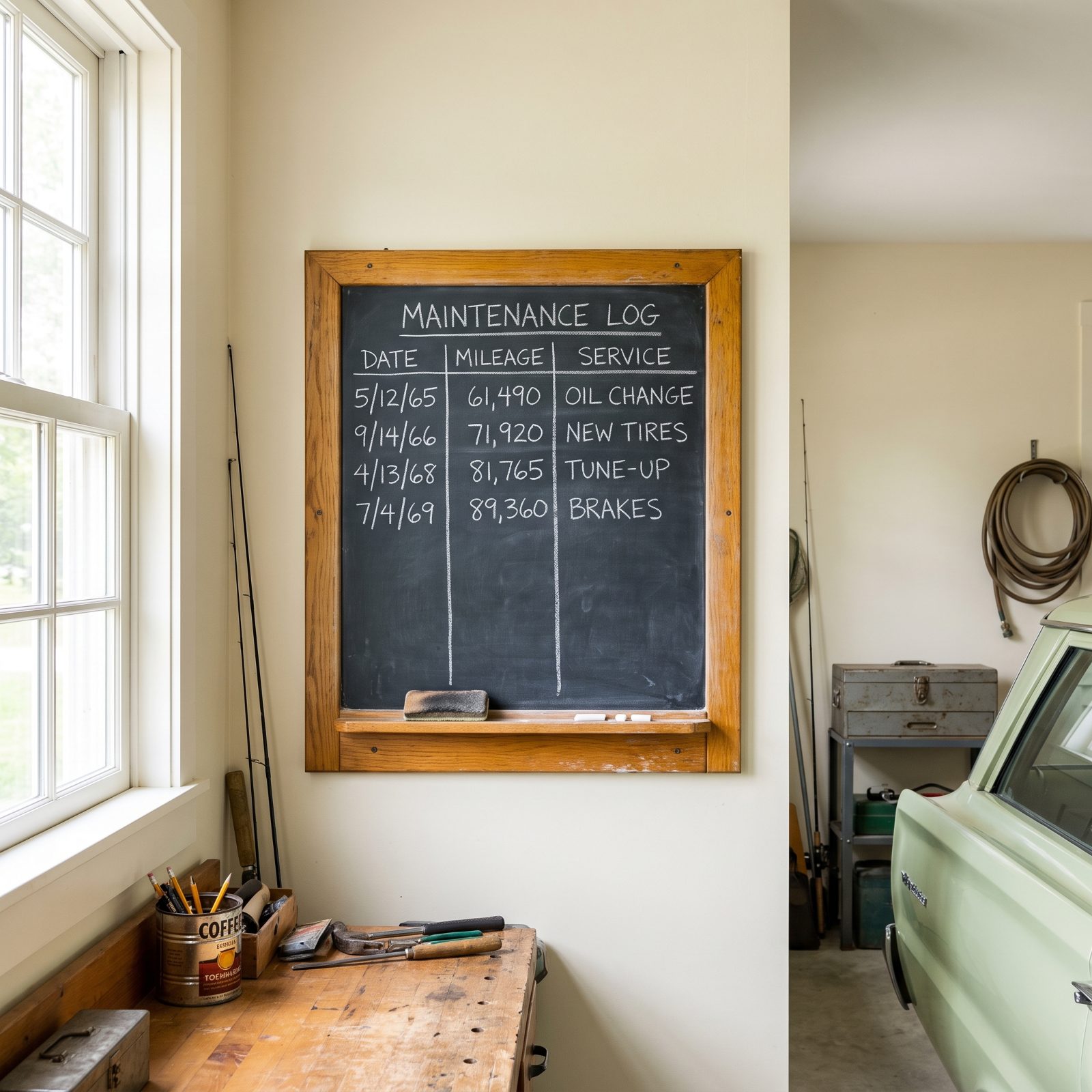
A chalkboard is the oldest maintenance tracker there is, and it still embarrasses the subscription apps. Oil changed at 47,200. Rotated the tires. Belt looking cracked — watch it. Write it where you’ll see it every time you walk in.
The magic is the glance. Your eye catches the board without being asked, so the job you’ve been dodging nags you quietly until you deal with it. Run two columns if you want, one for done and one for next. Costs a few bucks. Never needs charging.
27. A Labeled Board for Every Set of Keys
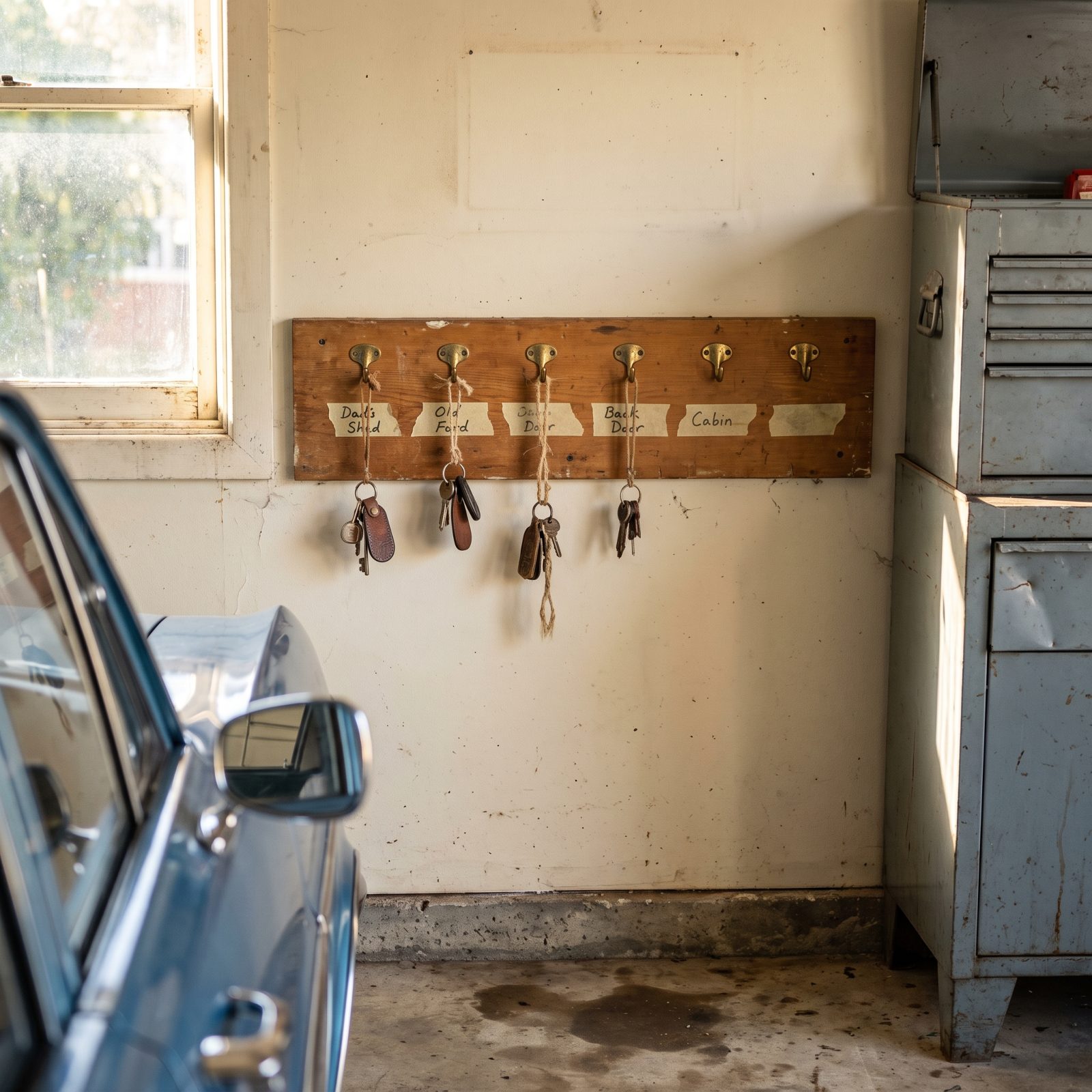
Everybody’s got a junk drawer with four unidentified keys and a family argument waiting inside it. The old fix was a board of brass hooks on the wall, each one labeled, each key home when the engine’s cold.
Spare to the truck, the shed padlock, the hitch lock, the neighbor’s place for when they travel. An empty hook tells you instantly that something’s out in the world. No hunting required.
26. An Embossed Label Maker for Drawers and Shelves
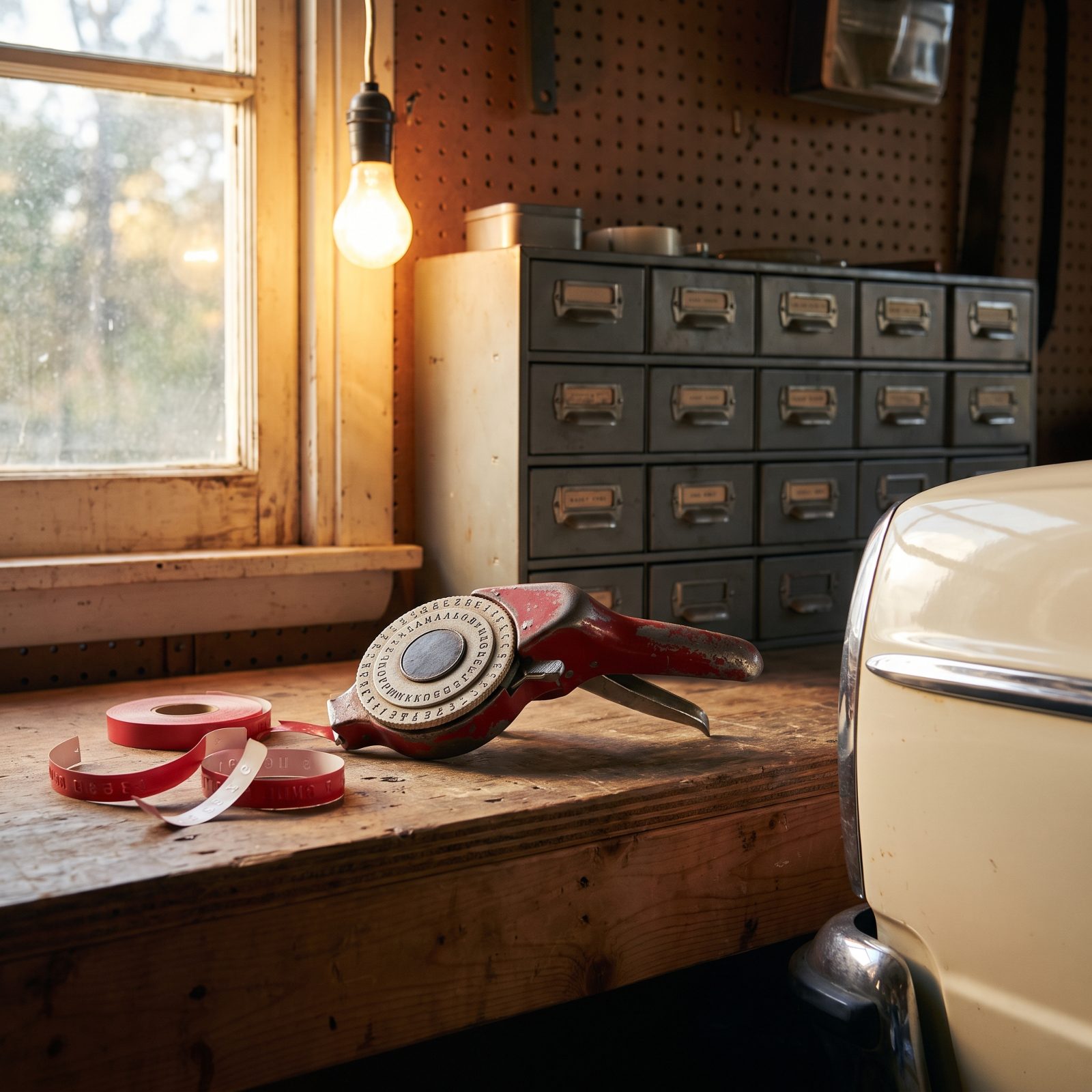
The click of that dial wheel, the squeeze that punched a raised white character into red tape — that sound is pure garage memory. But the embossed label earns its keep now for one dull, unbeatable reason. It survives.
Printed labels fade and peel the minute solvent or oil touches them. Embossed plastic takes a thumb of grease and shrugs it off. Stick one on every small-parts drawer — washers, cotter pins, fuses — and you stop pawing through six bins looking for the one with the thing you need.
25. An Adjustable Gooseneck Work Light
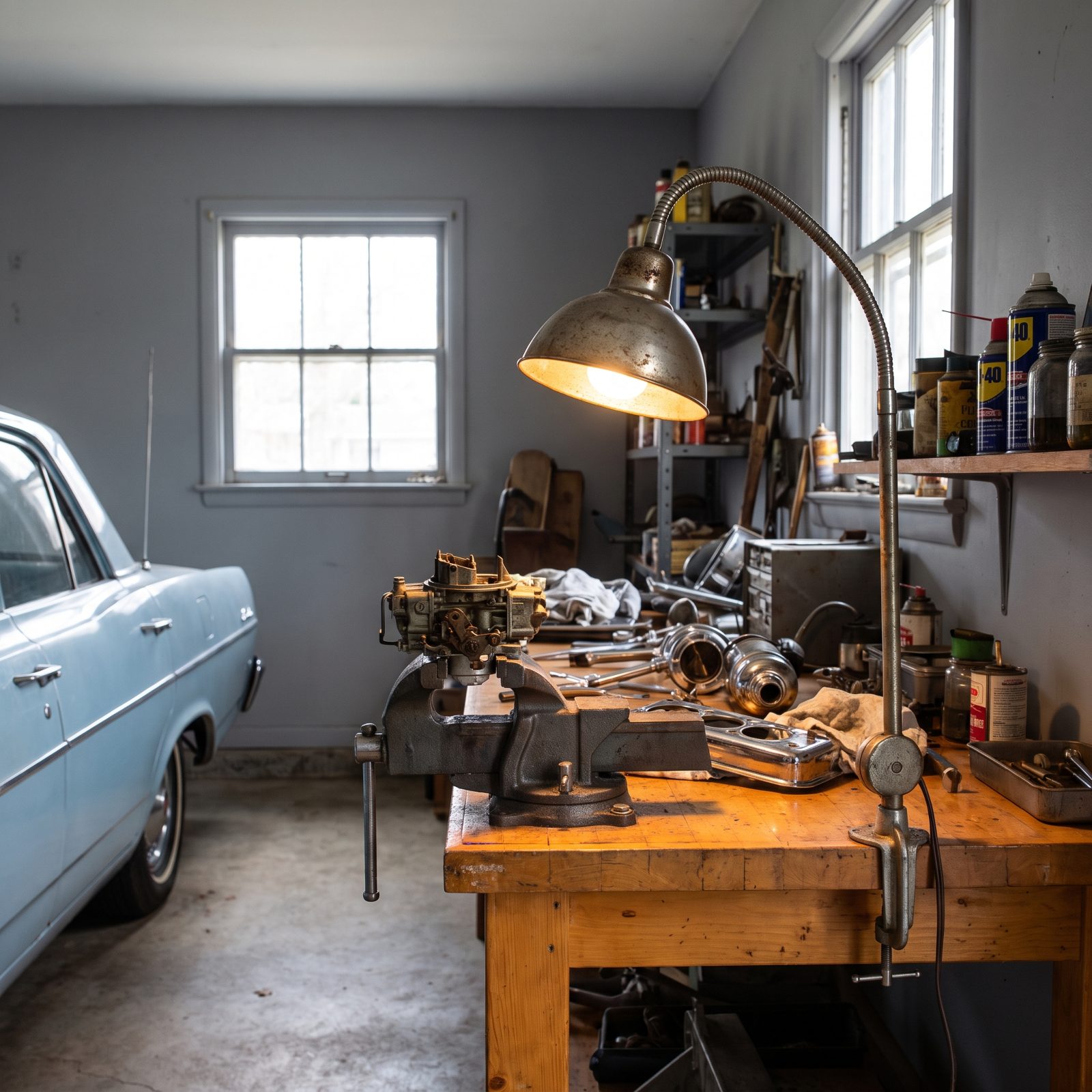
Overhead lighting lies to you. It throws your own shadow right onto the exact bolt you’re trying to see. A gooseneck light fixed that sixty years ago by letting you aim the beam where your hands actually are.
Clamp it to the bench, bend the neck, and the thread pitch you’ve been guessing at goes obvious. Move the light and you move the shadows — which means they fall away from the work instead of landing on it.
24. A Deep Porcelain Utility Sink
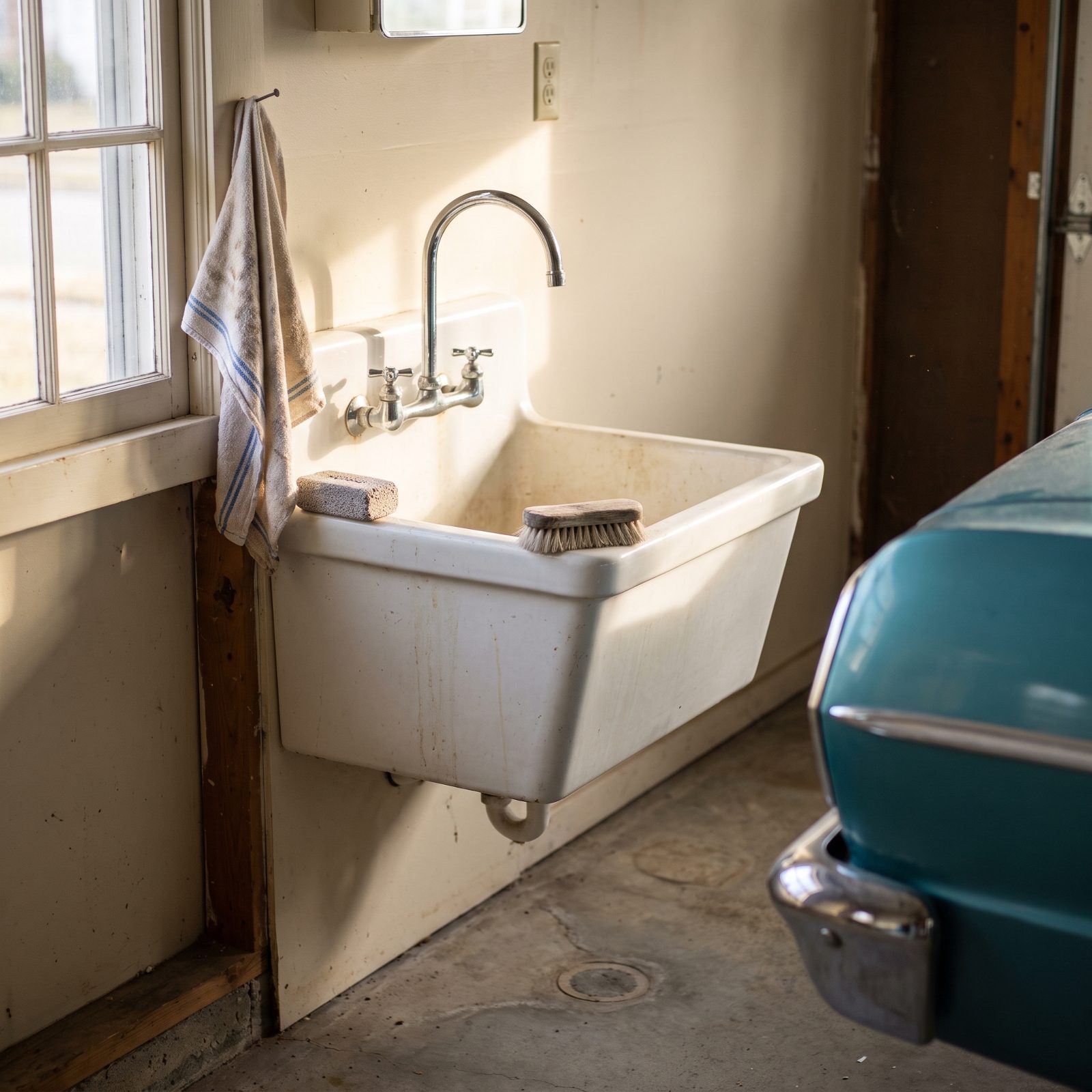
You come inside with brake dust up to your wrists, track it across the kitchen tile, and somebody is not happy about it. The old garages solved this with a deep porcelain basin out where the mess belonged.
Porcelain is the unsung hero. It won’t stain the way plastic does, it won’t crack when you drop a wrench in it, and a deep basin lets you rinse a greasy part or a filthy pair of hands without flinging water across the room. Wash up before you go in. Everyone’s happier.
23. A Thick Rubber Mat at the Workbench
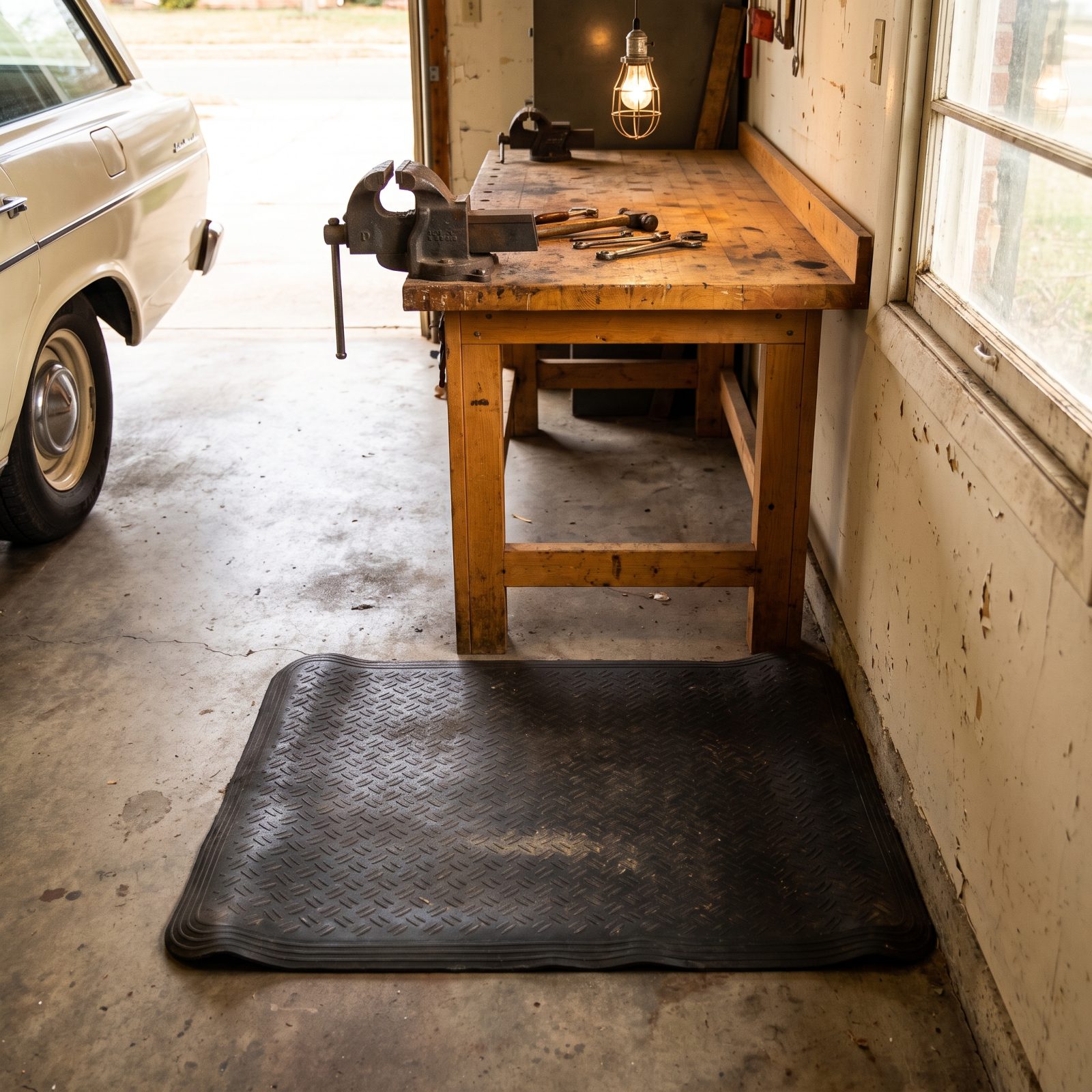
Concrete is hard on a body, and it gets harder the older you get. A slab of thick rubber at the bench is the cheapest comfort upgrade a garage ever invented.
Your knees and lower back will notice after an hour of standing. There’s a bonus the old timers knew too — drop a nut on rubber and it stays put. Drop it on bare concrete and it rolls under the car to hide from you forever.
22. A Swiveling Metal Shop Stool
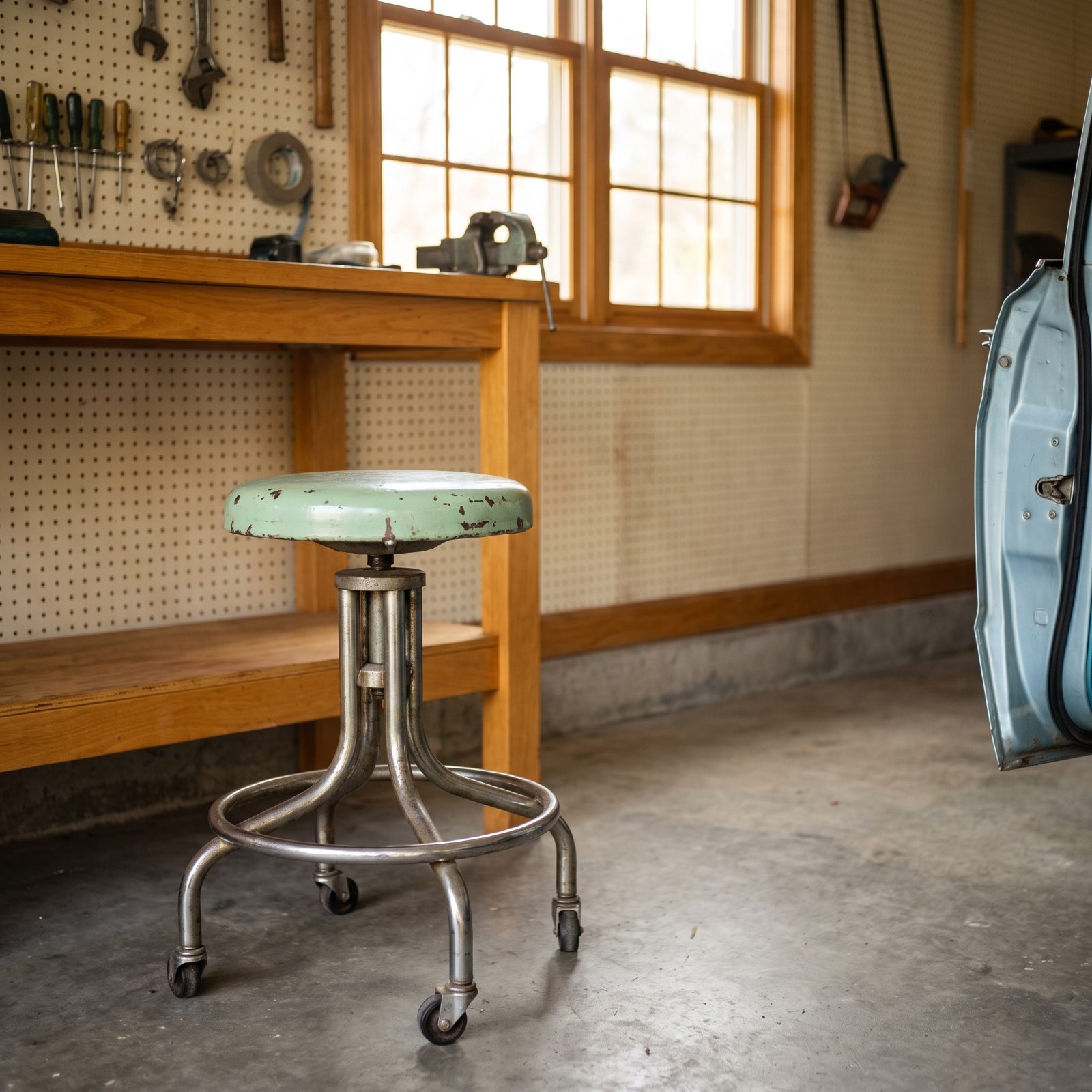
A good shop stool is low, round, heavy, and it spins. That’s the whole spec. No arms to snag on things, no back to get in your way, just a seat you can roll between the bench and the fender without ever standing up.
Casters that actually lock matter more than people expect. The swivel means you reach the tool behind you with a twist of the hips instead of a full get-up-and-walk. Small thing. Saves a thousand little trips over the length of a project.
21. A Bank of Windows for Honest Natural Light
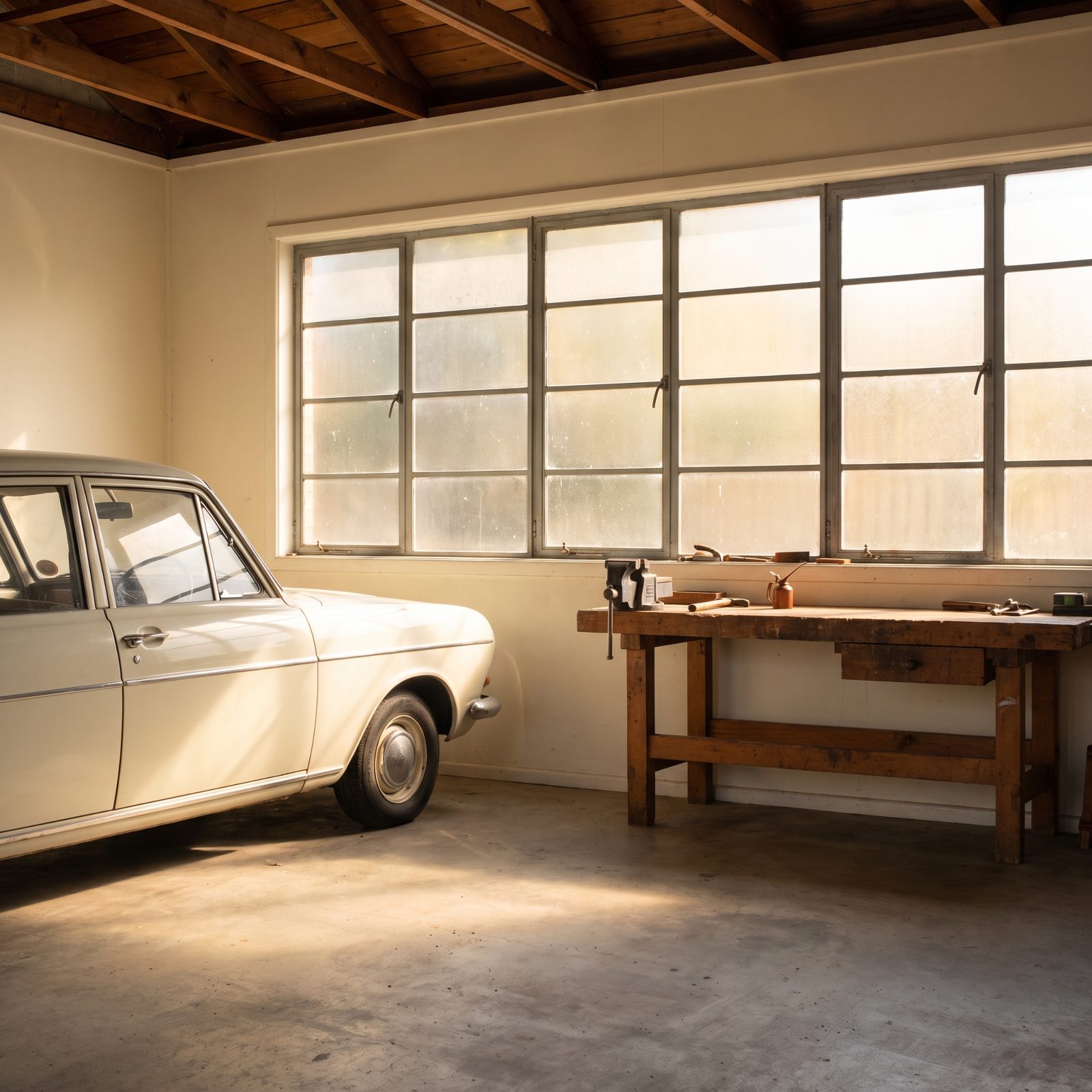
Modern garages treat daylight like a liability. Seal it up, bolt in fluorescent tubes, call it done. The old builders ran windows along the work wall because nothing shows true color like the sun does.
Matching paint, reading a fluid level, telling oil from coolant on the floor — all of it goes easier under honest light. And you just feel better in a room the sun reaches. A string of fixed panes along the bench wall costs little and quietly changes how long you want to stay out there.
20. A Hanging Tennis Ball Parking Guide
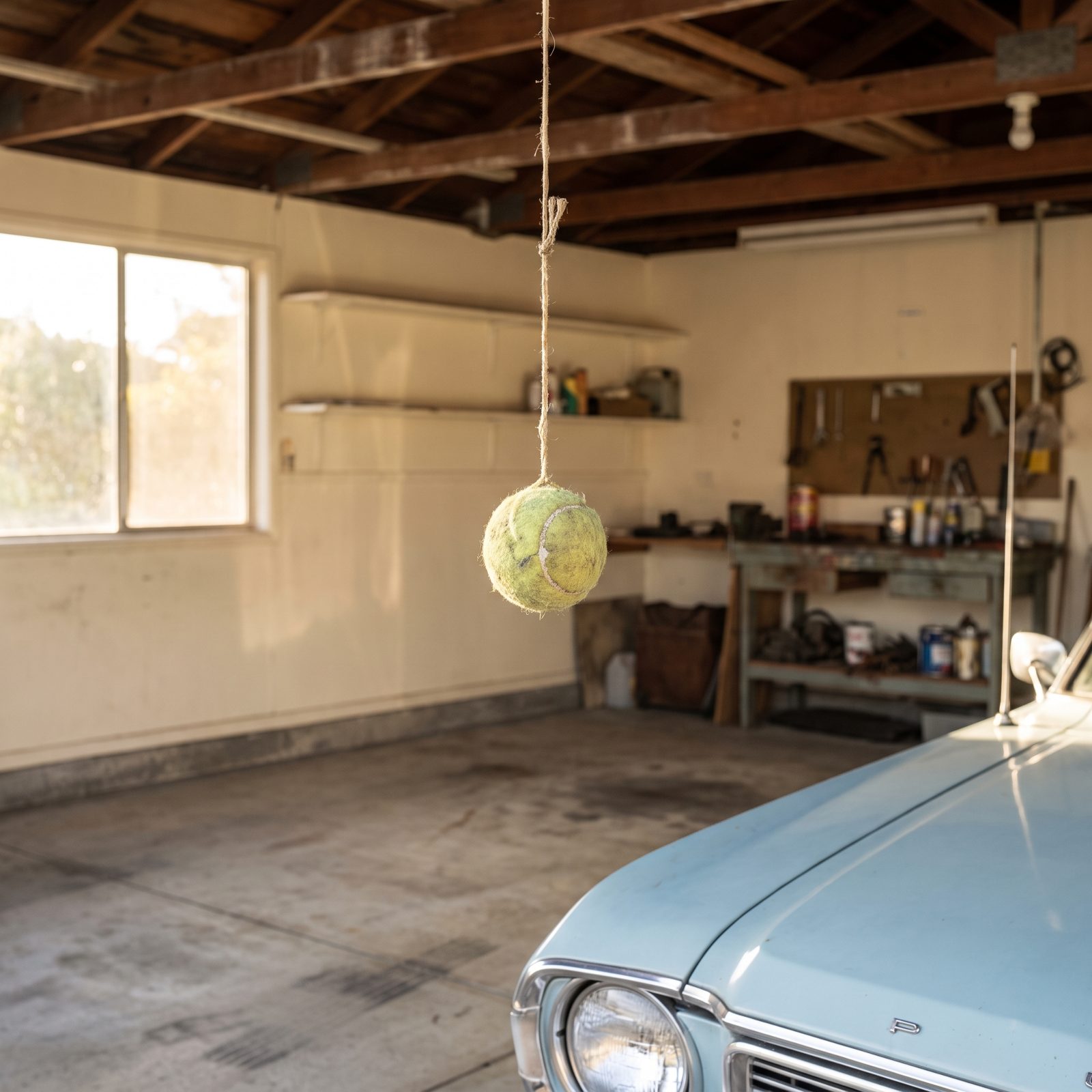
The dumbest-looking fix on this list is also the one that’s never once failed us. A tennis ball on a string, hung so it just taps the windshield when the car’s in the right spot.
Pull in, watch the ball, stop when it kisses the glass. No sensors, no beeping, no backup camera squinting at distance for you. Your bumper lands in the same place every single time, keeping the front off the bench and the rear clear of the door. Tie one up this weekend. You’ll feel quietly smug about it for years.
19. A Low Rolling Mechanic’s Creeper
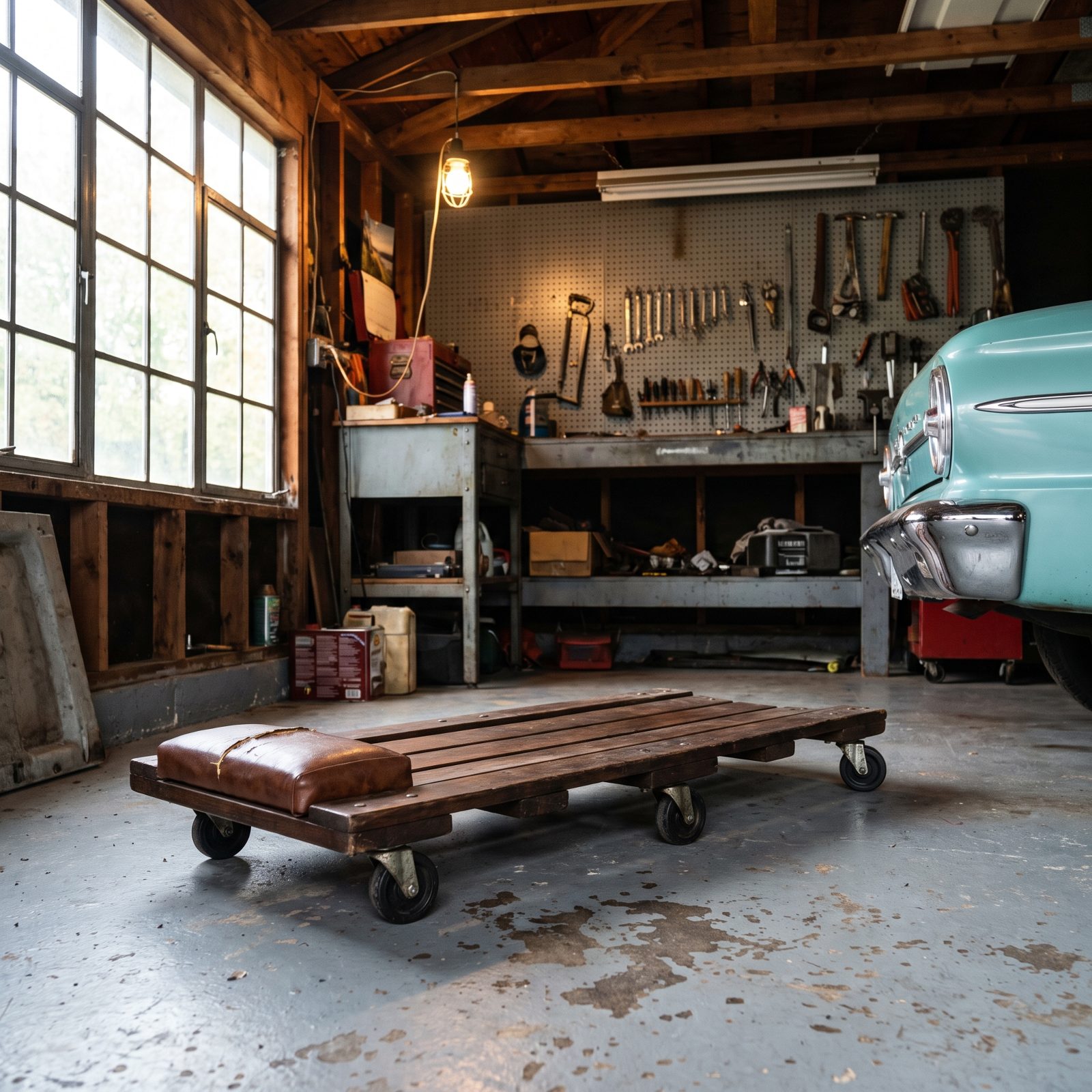
The creeper that mattered rolled low. Three inches off the concrete, maybe four, so you slid under a car without doing a sit-up the entire time you were down there.
Most modern plastic creepers sit too high, and the casters jam on every pebble you roll over. The old wooden ones had bigger wheels and a cutout for your shoulder blades, so you could lie there an hour without your neck screaming by the end.
Find a solid-wood one at an estate sale for under thirty bucks. Oil the bearings, check the wheels, done. It’ll outlast anything hanging on a big-box rack.
18. A Heavy Hydraulic Floor Jack
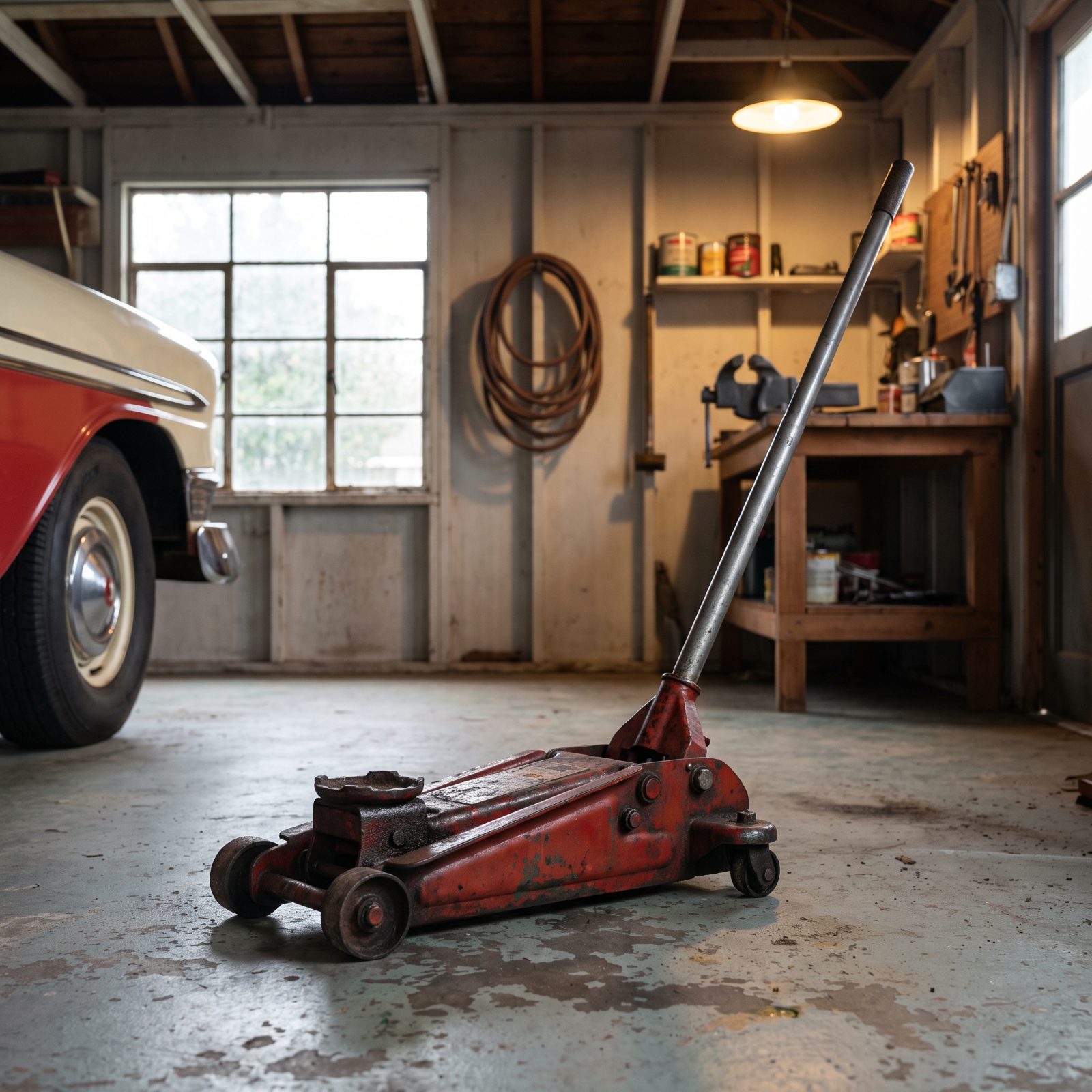
Weight was a feature, not a flaw. Those old floor jacks were cast steel and they felt like it. Sixty pounds of jack that didn’t skitter sideways when you leaned into the handle.
Today’s aluminum racing jacks are light and quick, which is great right up until you’re lifting something heavy and the whole thing wants to walk out from under the load. A heavy jack stays planted. The mass does half the work of keeping it right where you park it.
They leak eventually. Seals dry out and fluid weeps past the ram, sure, but a rebuild kit runs twenty dollars and the castings never wear out. You’re not replacing this tool. You’re keeping it alive, and that’s the deal you want.
17. A Proper Pair of Steel Jack Stands
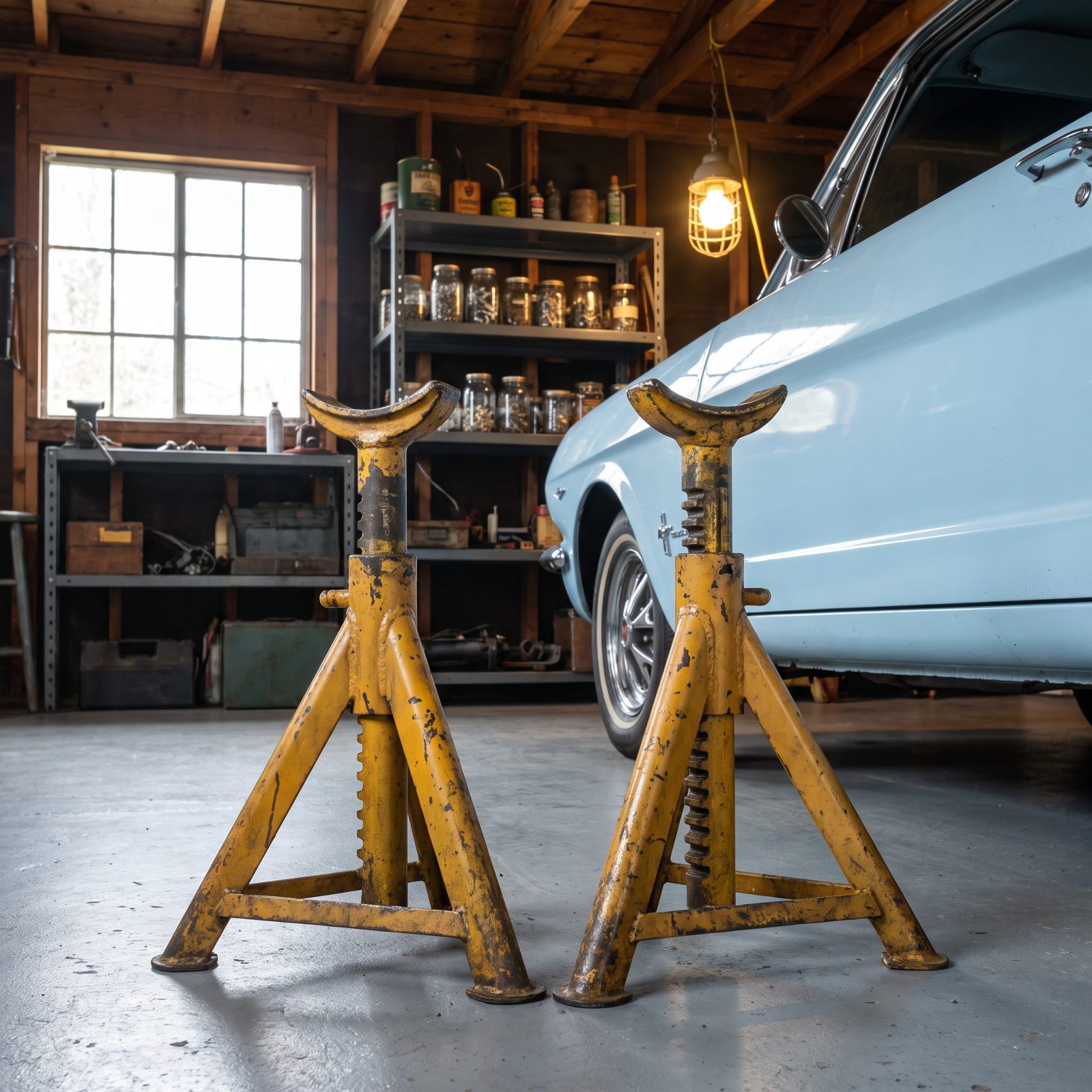
Nobody says this part out loud, so we will: a floor jack is a lifting tool, not a holding tool. The old-timers knew it in their bones. The car never stayed up on the jack. It came up on the jack, then came down onto steel stands, every single time, no exceptions.
Those welded tripod stands had a wide base and a ratchet you could actually trust. No stamped sheet metal. No sketchy pins. You set the height, dropped the car, heard it settle with that solid clunk, and only then did you crawl under it.
If you only copy one habit from a 1960s garage, make it this one.
We’ve watched people skip this. We won’t repeat what happened afterward. Get the stands, use them in pairs, rated above what you’re lifting. Not negotiable.
16. A Foot-Operated Tire Pump
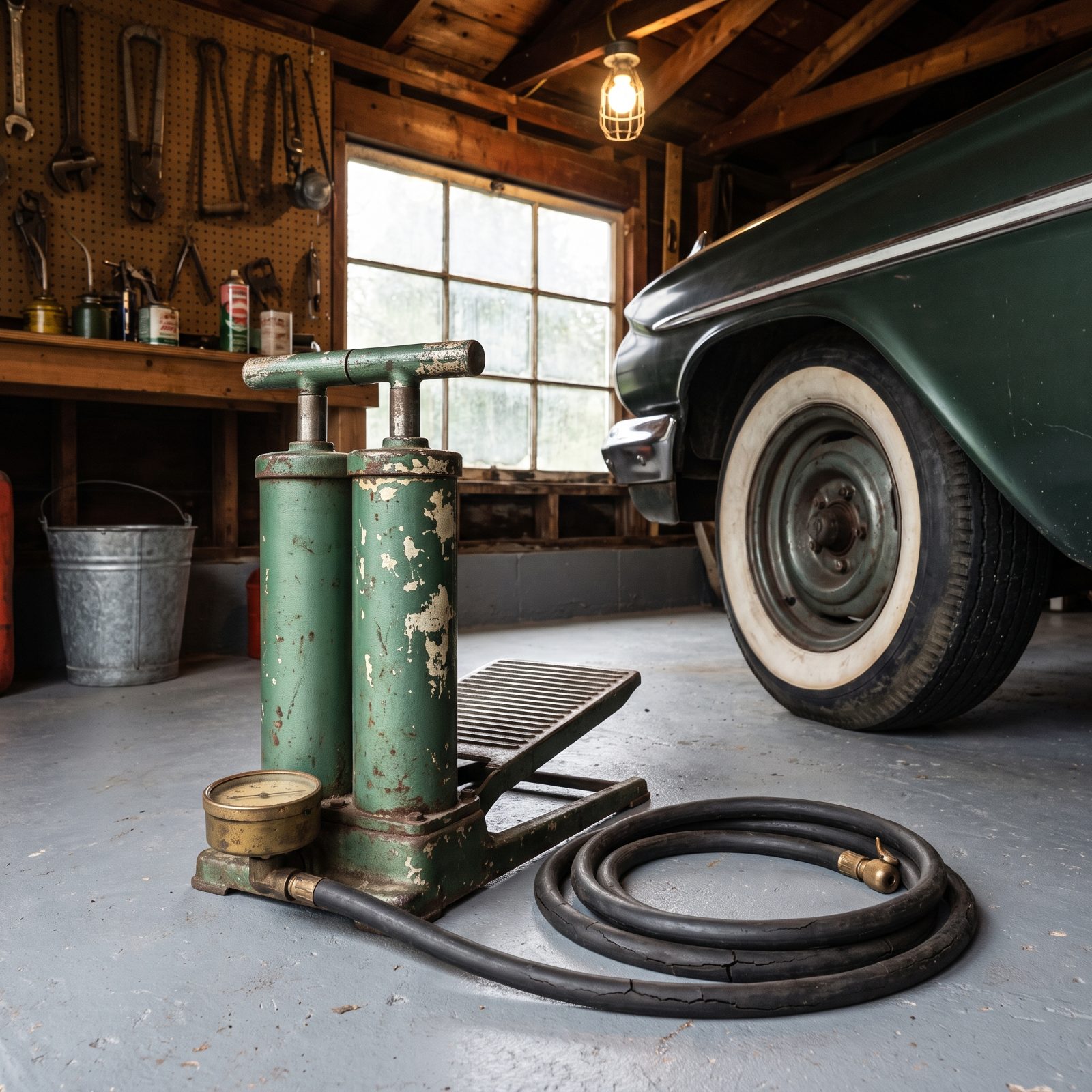
Before every garage had a compressor humming in the corner, you aired up tires with your own leg. The double-barrel foot pump moved real volume, and the gauge down at your foot told you exactly when to quit pumping.
Sounds quaint. It isn’t. No electricity, no fittings, no 110 volts live near a gas smell. When the power’s out, or you’re stuck in a shed with a single tired outlet, the thing still works.
Keep one even if you own a compressor. It’s the backup that never picks the worst possible moment to quit on you.
15. A Pencil-Style Tire Pressure Gauge
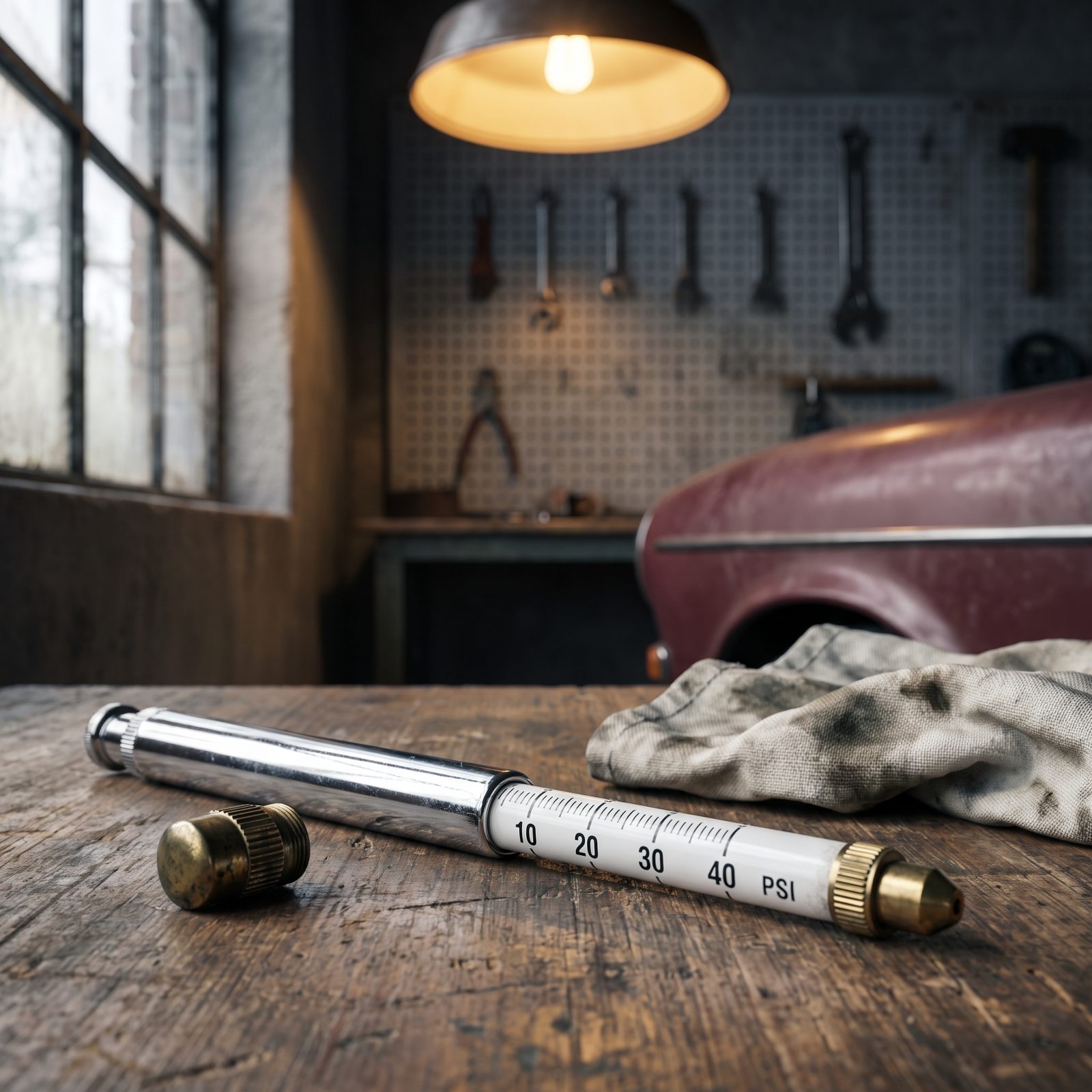
Small, cheap, and more accurate than the digital stick you paid four times as much for. The pencil gauge is a little miracle of doing one thing well.
No battery to die in the glovebox. No screen that fogs up or freezes solid in January. You press it to the valve, the white bar shoots out, you read the number. Done.
Buy two. One in each vehicle. They cost about what a coffee does.
14. A Bench-Top Battery Charger
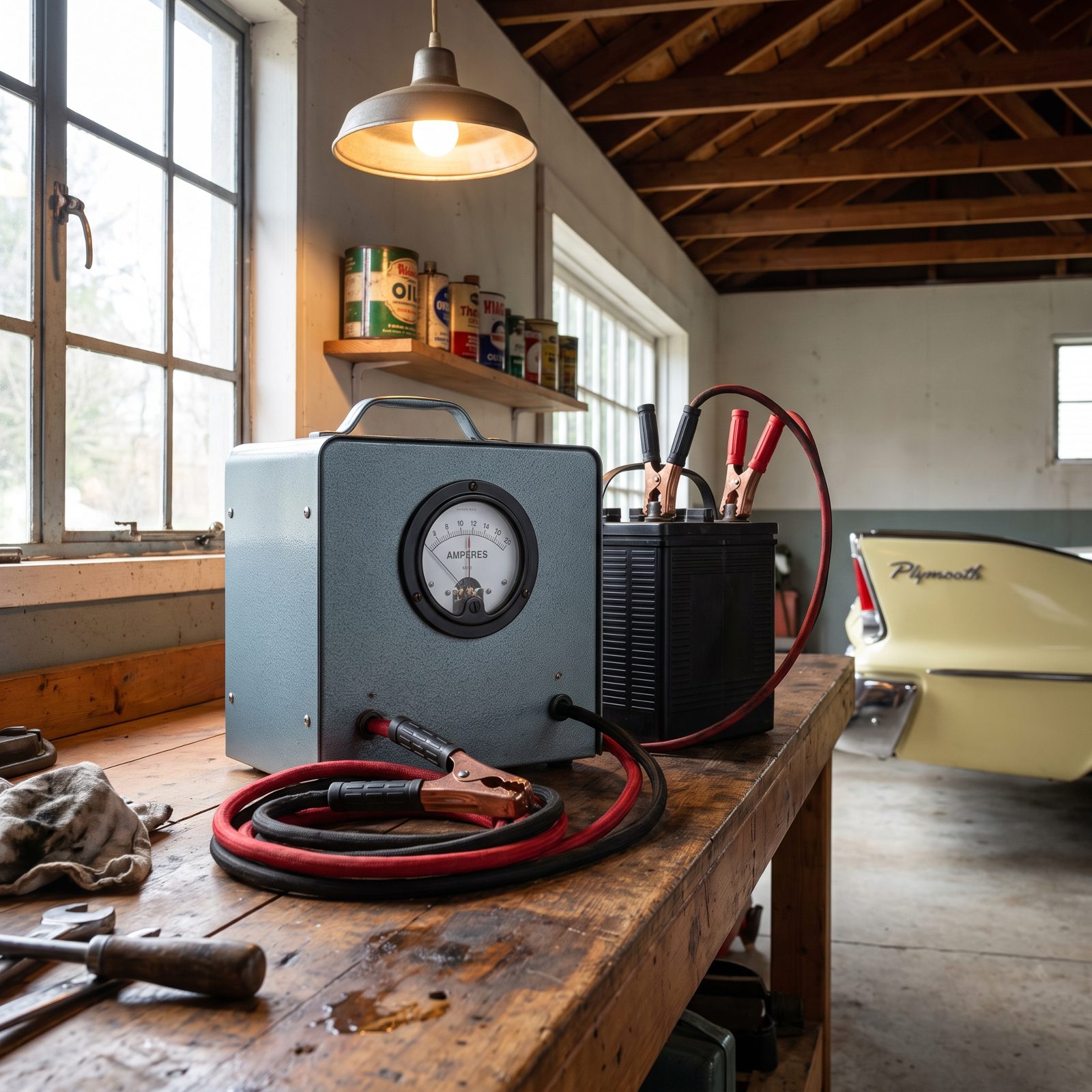
The old steel box told you the truth. Those old bench chargers were plain steel boxes with heavy copper clamps, and you learned to read a battery by how it behaved on the charge. High draw at first, tapering as the cells filled. You knew the job was finished without a single beep or blinking light.
Modern smart chargers are genuinely better at not cooking a battery, and I won’t pretend otherwise. But the old steel-case units had a manual mode that let you push a tired battery hard when it needed the shove, and they went on doing it for decades.
Got a lawn tractor, a boat, a motorcycle, and a winter car? One real bench charger on a shelf beats four little maintainers you keep misplacing.
13. A Strobe Timing Light in Its Original Case
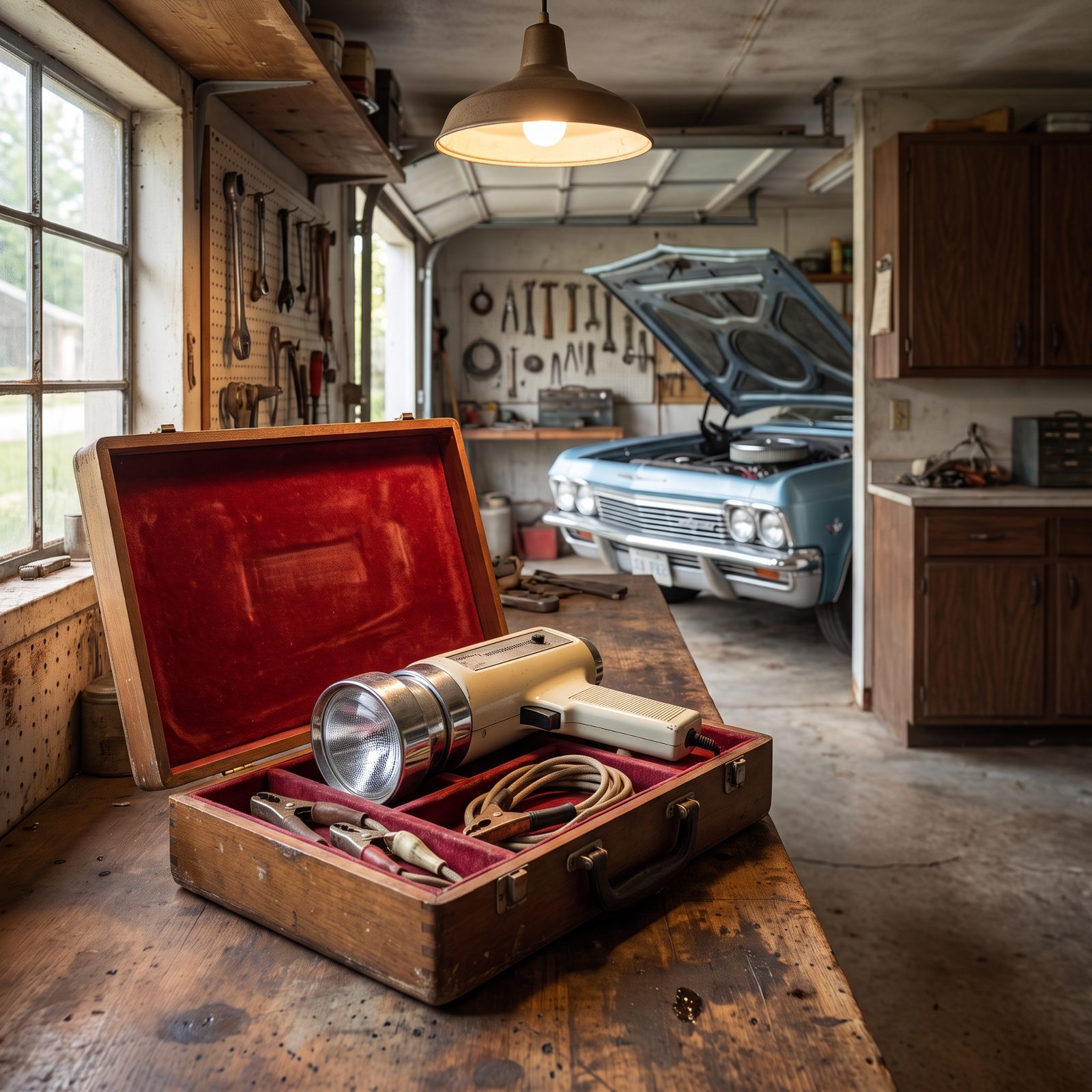
Open the case and it smells like the sixties. Fitted foam, a scrap of red velvet, the tool sitting in its own molded cradle. Somebody cared where this thing lived.
A timing light flashes in sync with the spark so you can watch the timing marks freeze under the strobe. Points-and-distributor engines needed it badly. Modern cars don’t, and most folks under fifty have never once held one.
Keep anything carbureted, though, and it earns its shelf space in a hurry. A classic cruiser, an old bike, a vintage boat motor, they all still want one. And the habit worth stealing isn’t the light itself. It’s keeping precision tools in a case that protects them instead of rattling loose in a drawer.
12. A Lever-Action Grease Gun
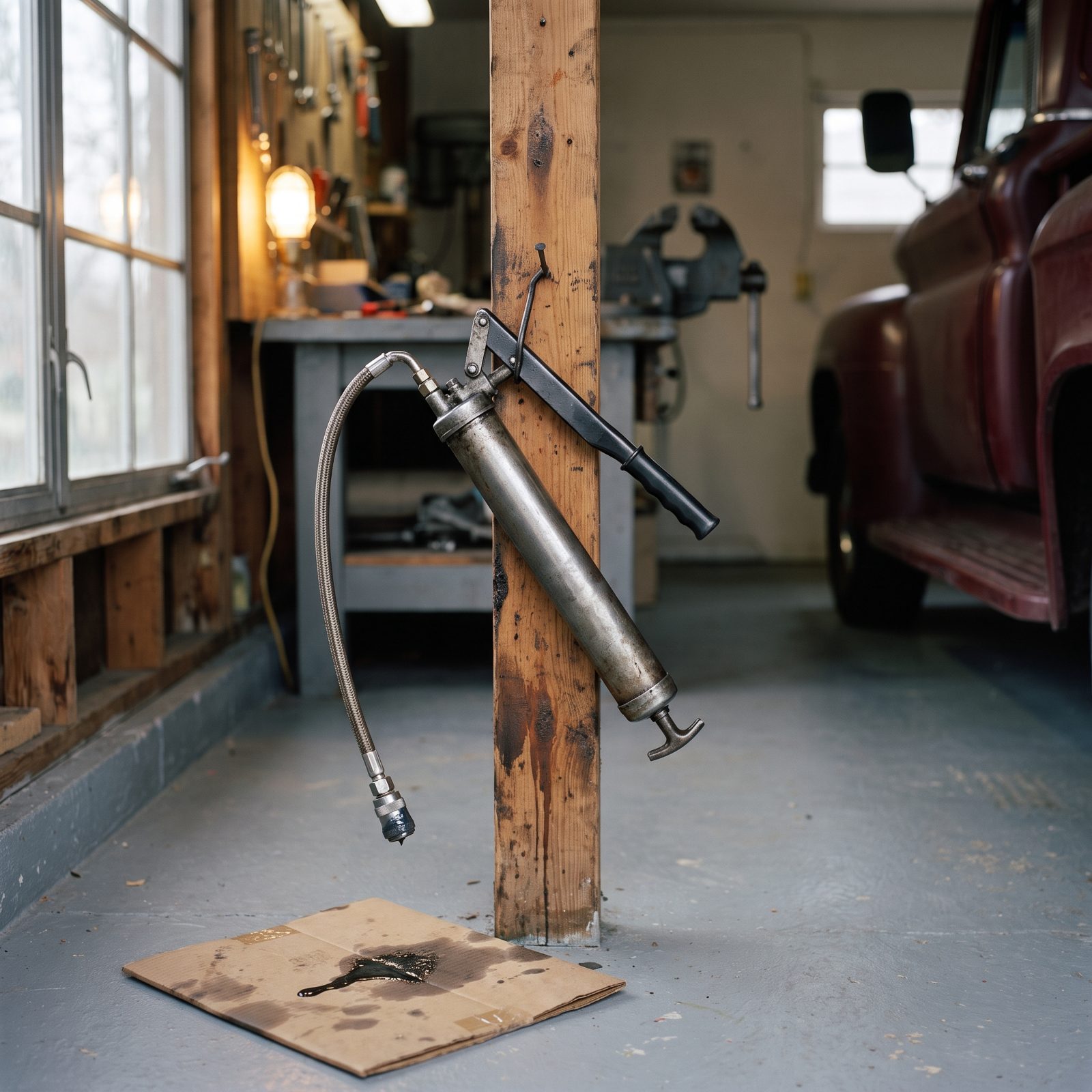
Cars stopped having grease fittings and a whole generation forgot this tool existed. Their loss.
Your trailer still has them. So do your tractor, your boat trailer bearings, your mower spindles, half the old iron in your life runs on a shot of grease pushed through a zerk fitting, and the lever-action gun delivers it one-handed.
Cheap guns leak and the couplers won’t seat right. Spend a little more on one with a solid steel barrel and a coupler that genuinely locks on. Load it once, hang it on the wall, and it’ll be ready whenever you reach for it over the next few years.
11. A Pump Oil Can With a Flexible Spout

A thumb pump and a long flexible spout. That’s the whole design, and nobody has managed to improve on it.
Fill it with light machine oil and you can reach a hinge, a linkage, a sticky latch, a sewing machine, a door that’s squeaked at you for a year straight. One pump, one precise drop, exactly where you aimed it. No aerosol fog coating everything within three feet.
The brass ones take on a patina that honestly looks better the older they get. Grab one at a flea market, wipe out the inside, fill it with 3-in-1 or a light hydraulic oil, and it becomes the tool your hand finds twice a week without you even thinking about it.
10. A Wide Galvanized Oil-Drain Pan
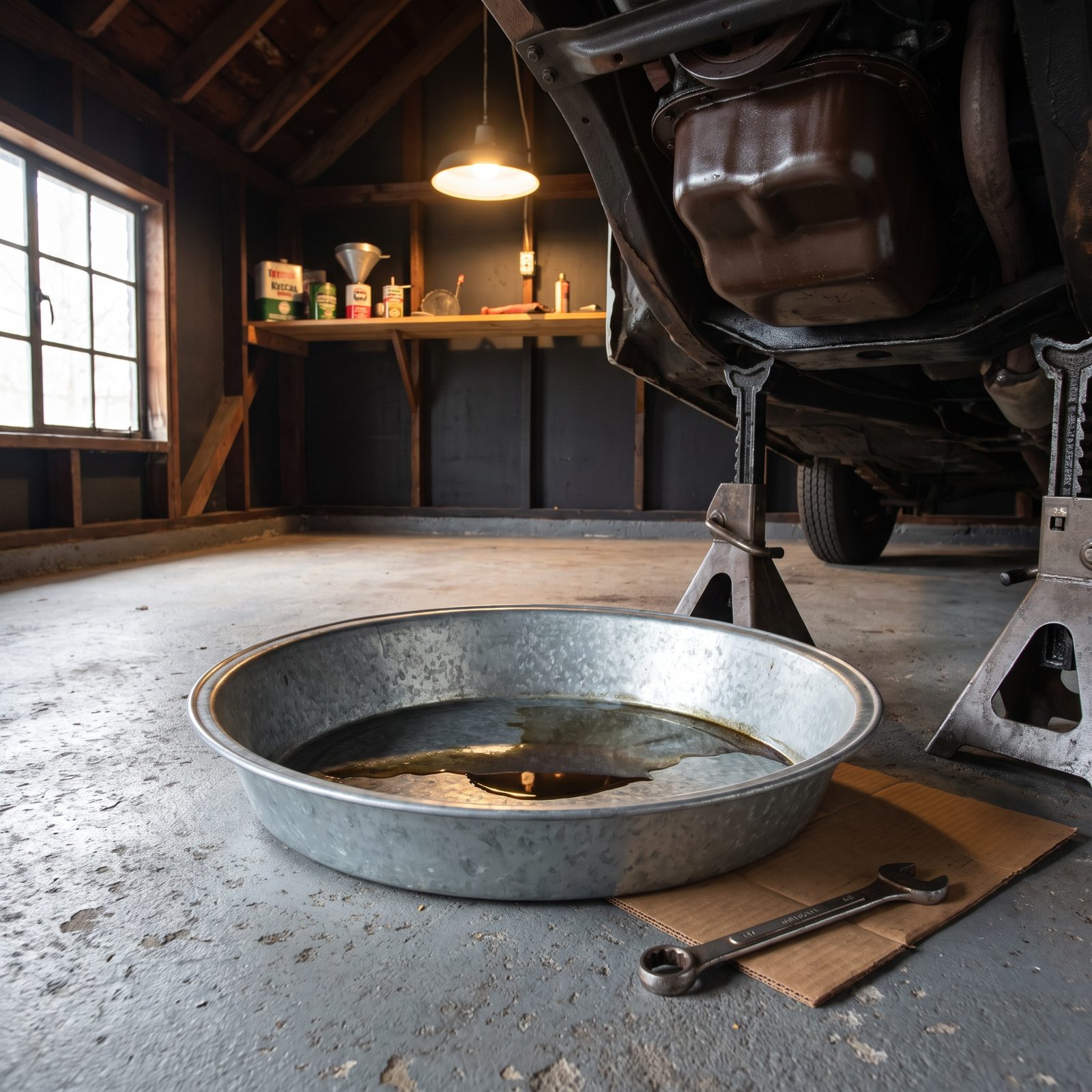
Wide beats deep, every time. The old galvanized pans understood this. With that big low footprint slid under the drain plug it will catch the stream wherever it decides to run, because the oil never pours straight down the center the way the catalog photo pretends it does.
Those modern enclosed plastic containers with the screw cap look clever on the shelf. Then you watch the first glug of hot oil miss the little hole and sheet across your floor. The open galvanized pan forgives a bad aim.
Zinc won’t rust out from the bottom. Plastic can’t rust either, I know, but it will crack and warp anywhere near heat.
9. A Bench Grinder Bolted to the Workbench for Sharpening and Cleanup
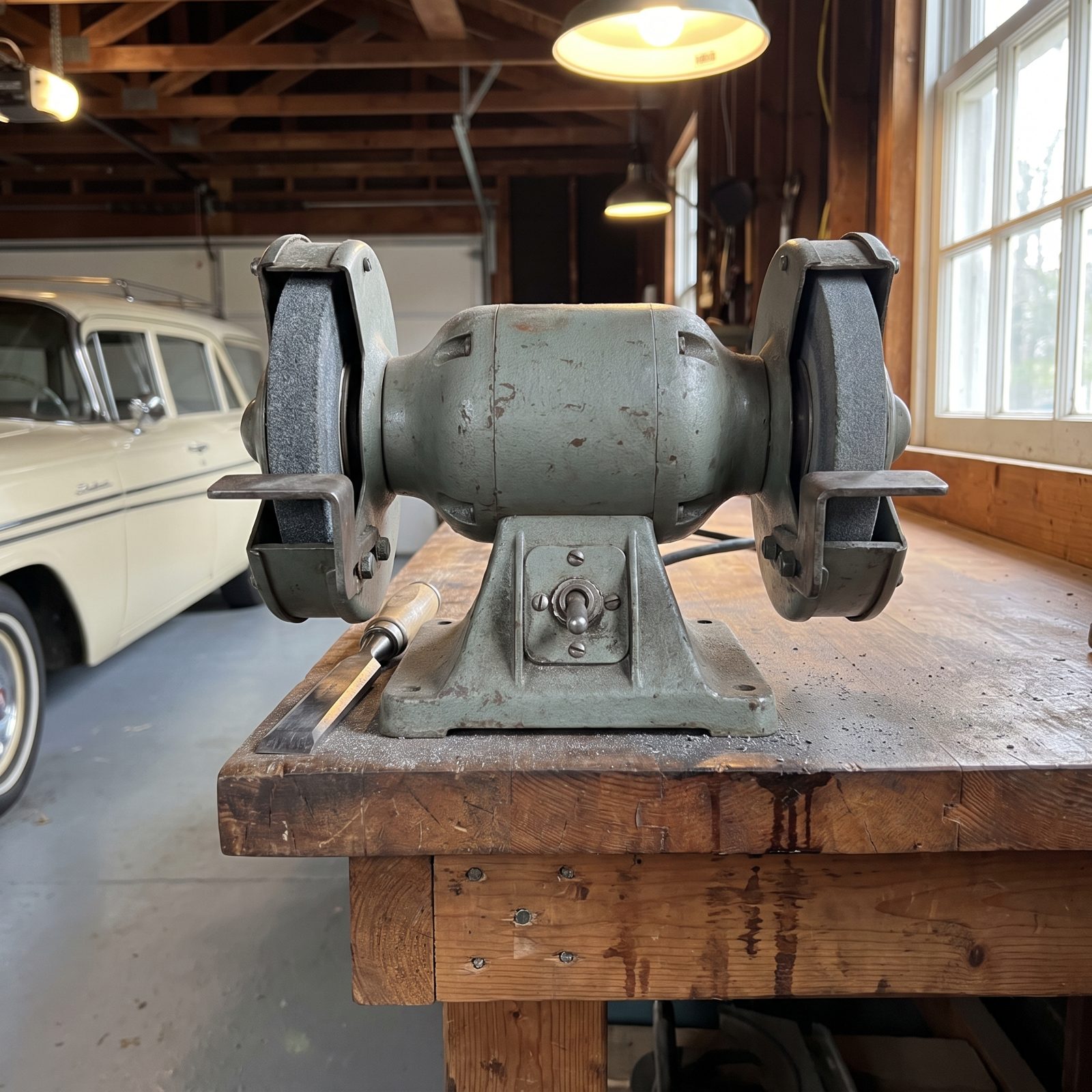
You never missed a bench grinder until you owned one, then you wondered how you managed without it. Bolt it down once and it’ll sharpen chisels, clean rust off bolts, knock the mushroom head off an old punch, and put an edge on a mower blade in about a minute. The old cast-iron units weigh a ton, and that heft is the reason they work — mass kills vibration, so the wheel stays dead true.
Modern garages lean on throwaway grinding discs and a cordless angle grinder that quits halfway through the job. A fixed grinder asks nothing but a wall outlet and runs for decades. I’ve seen fifty-year-old Craftsman units still humming on their original bearings.
8. A Hand-Crank Drill for Quiet, Controlled Precision Work
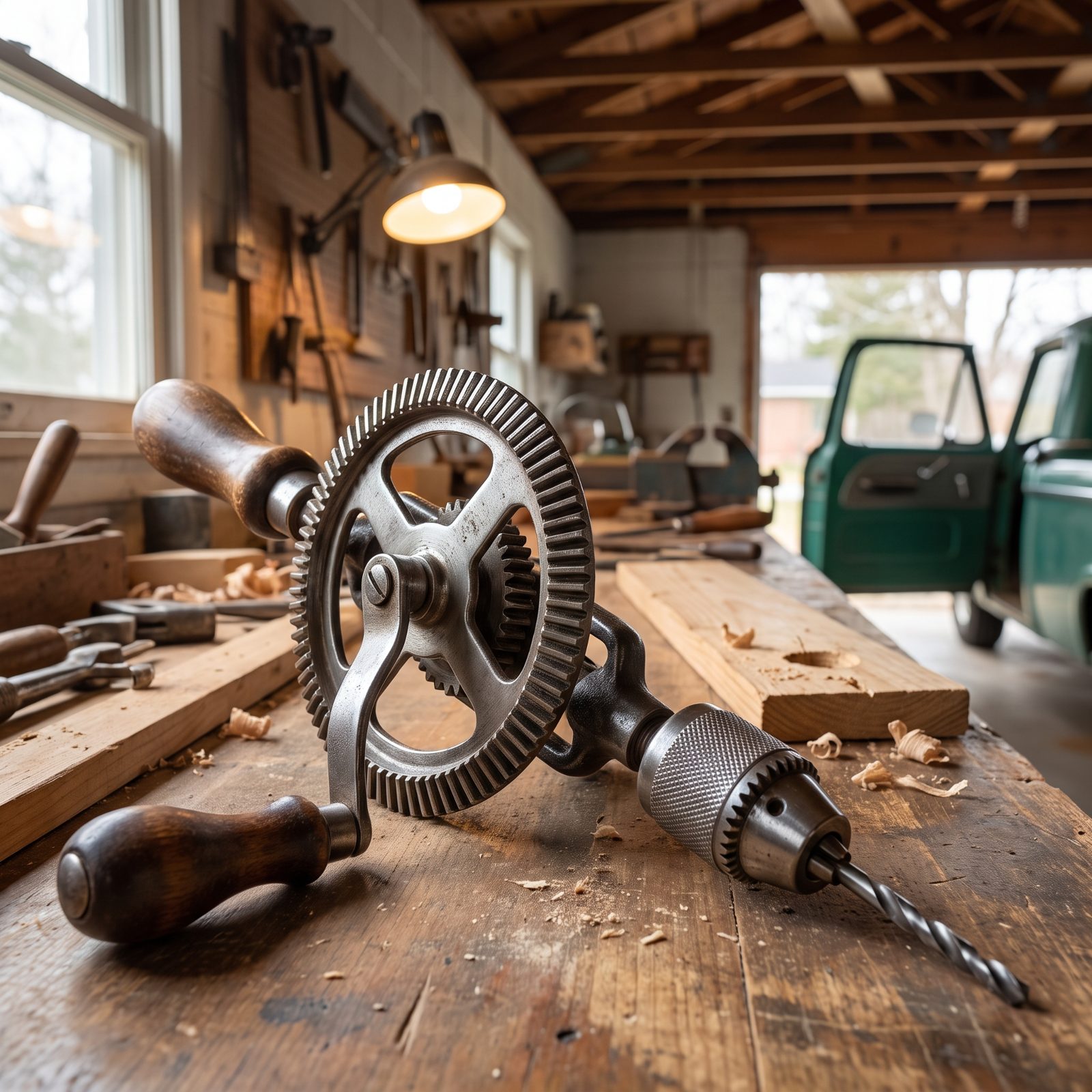
Not every hole needs 1,800 RPM and a lithium battery. A hand-crank drill gives you what a power drill can’t: total control over speed and pressure, right down to the final turn. Starting a pilot hole in brass, drilling thin sheet without blowing through, any job where a screaming motor would wreck delicate work — the eggbeater wins.
It’s silent. Never needs charging. You can run it at ten at night without waking the house, and it’ll outlive you and your grandkids. And there’s something honest about feeling the bit bite through the material right there in the handle, so you know the exact moment you break through.
7. A Simple Soldering Station Set Up and Ready to Go
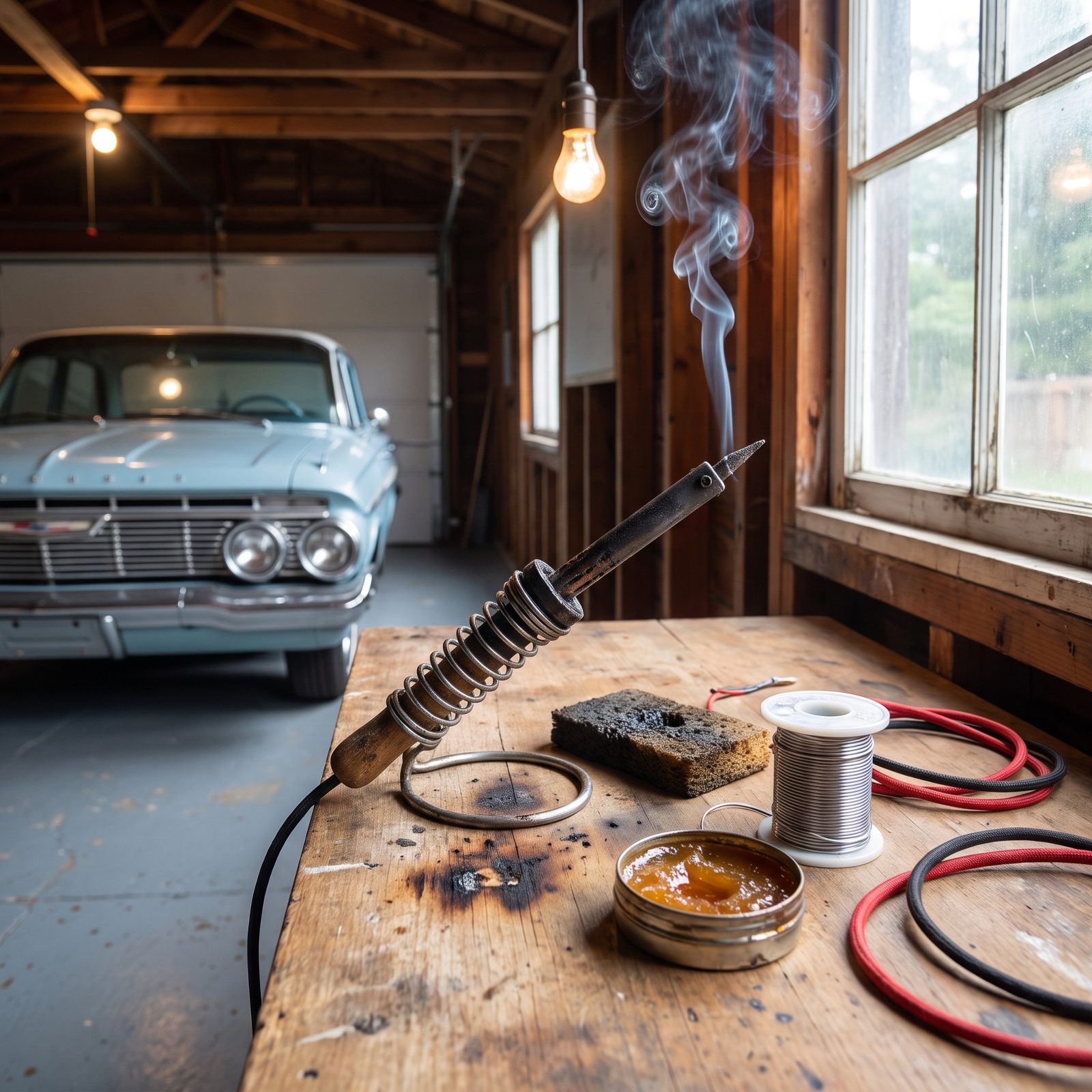
A soldering station is the quietest workhorse in any garage, and most modern setups skip it entirely.
Every car and bike on your property runs on wiring, and sooner or later a connector corrodes or a ground goes bad. A twist-and-tape repair fails the first damp winter. A soldered joint, sealed and heat-shrunk, holds for the life of the vehicle.
The old irons were about as simple as a tool gets — a heating element, a copper tip, a handle. No digital readout, no base station that costs more than the iron itself. You learned to read the heat by how fast the solder flowed. Keep the tip tinned and clean and one of these serves you thirty years.
6. A Pair of Sturdy Wooden Sawhorses Stacked in the Corner
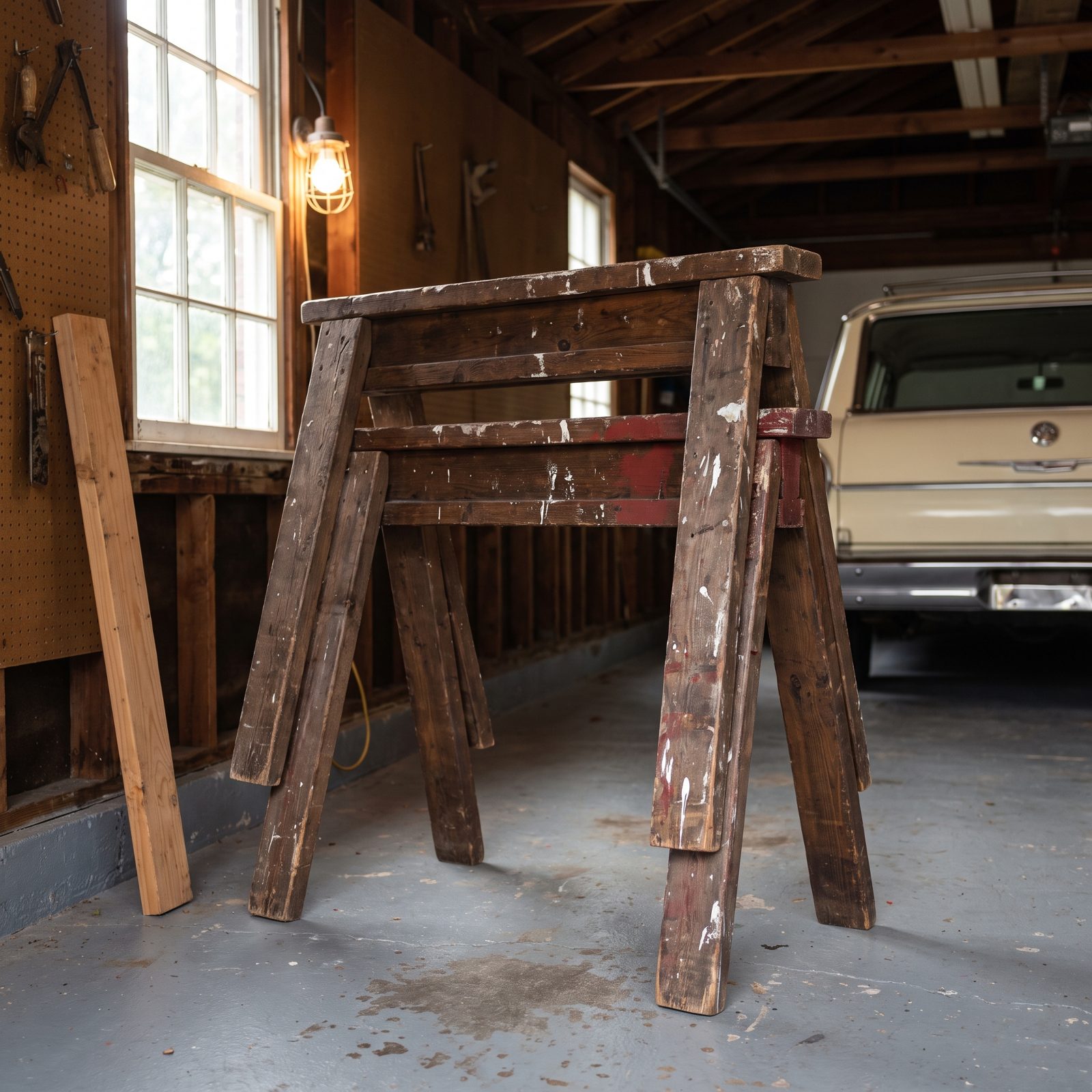
Two sawhorses and a sheet of plywood make a workbench anywhere you need one. Prop up a door you’re painting. Hold a differential while you wrestle it. Lay a motorcycle fairing across them for sanding. They fold flat, stack in a corner, and cost almost nothing to build in an afternoon.
The plastic folding ones from the big-box store crack the first cold morning you drop something heavy on them. A pair built from two-by-fours will shrug off five hundred pounds and get better looking with every coat of overspray. We’ve got a set that’s decades old, and they don’t wobble a hair.
5. A Bright Red Fire Extinguisher Mounted Right by the Door
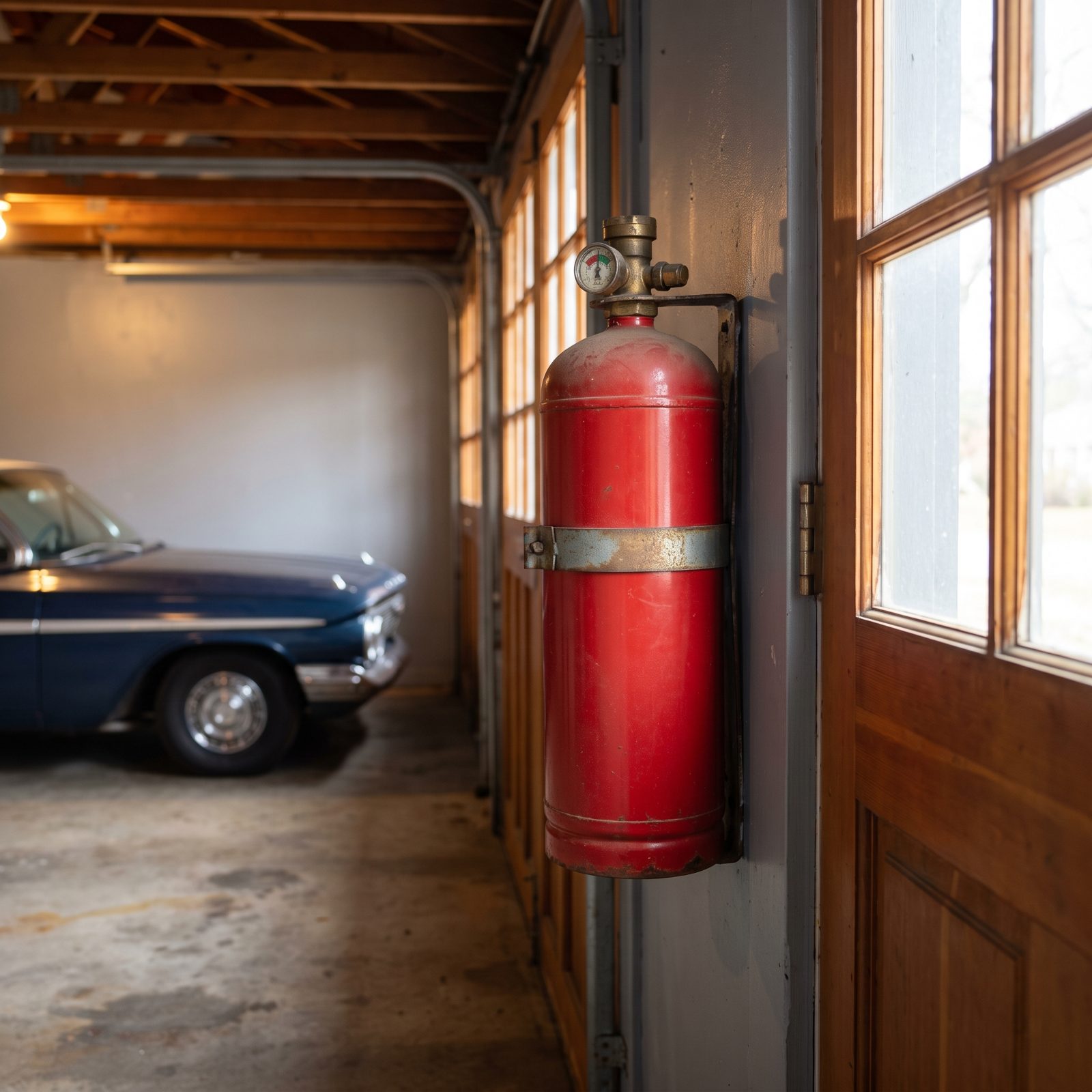
Mounted by the door, not buried under the bench. That one placement decision is the whole lesson. A garage fire goes from spark to serious in under a minute, and you won’t have time to dig through a cabinet. The extinguisher has to sit between you and the exit, where your hand finds it on the way out.
Gasoline, solvents, oily rags, a battery charger left on overnight — a garage is full of things that burn. Keep an extinguisher where you can see it, check the gauge twice a year, and remember that an extinguisher wants servicing or replacing after about a decade whether you’ve used it or not.
4. A Clearly Marked Metal First-Aid Kit Within Arm’s Reach
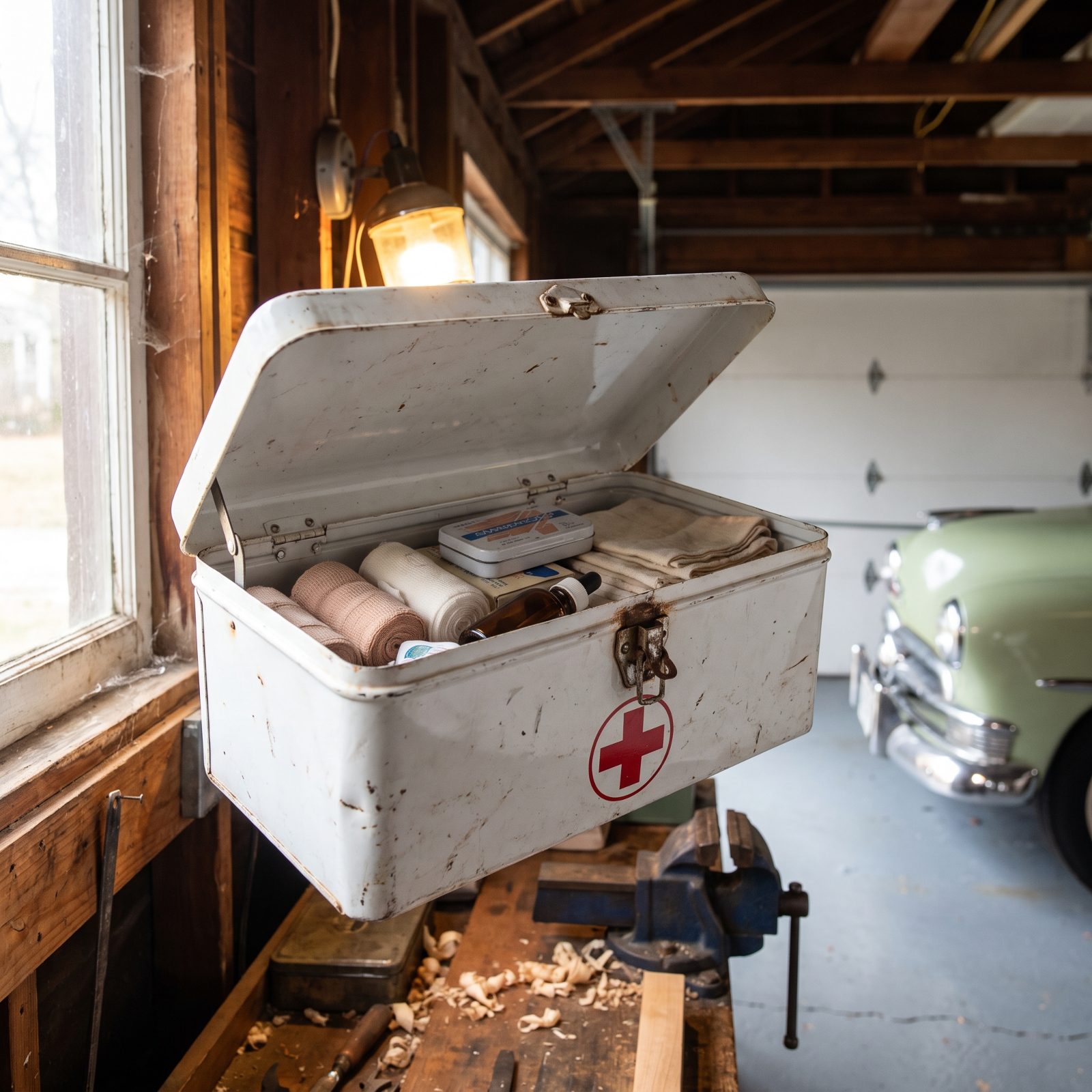
Knuckles meet metal. That’s the job. Anyone who’s spun a wrench knows the slip, the busted knuckle, the sliver of steel in the thumb. Old garages kept a metal first-aid box right by the workbench — a lid you could flip open with a greasy hand, everything inside grabbed one-handed.
Modern kits come in soft nylon pouches that slide off a shelf and scatter their contents across the floor. A sturdy steel box stays put, keeps the dust and grease off the gauze, and tells you at a glance it’s right where you left it. Stock it with the real stuff: butterfly closures, tweezers, eyewash, burn gel. Honestly, the garage is one of the likeliest places in the whole house to get hurt.
3. A Lidded Metal Can for Oily Rags That Won’t Catch Fire
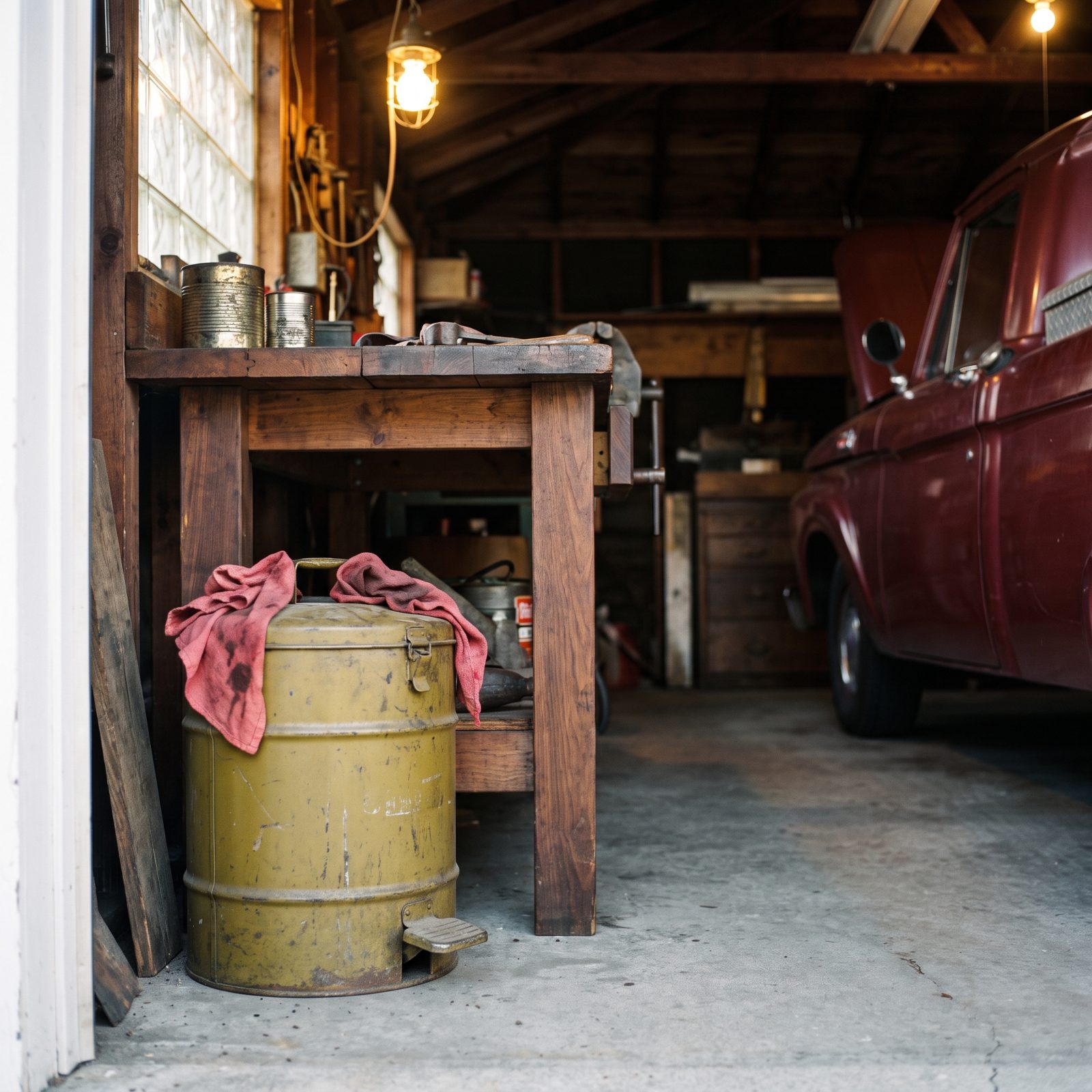
A pile of oily rags in the corner can start a fire with nobody around to light the match.
Spontaneous combustion. It’s real, and it’s not a campfire story. Rags soaked in linseed oil, some stains, and certain solvents generate heat as they oxidize, and when you bunch them up with no airflow that heat has nowhere to go. Enough of it and they’ll ignite on their own in a closed garage.
The old foot-pedal metal rag cans solved this cold, but only with the lid shut. A closed lid chokes off the oxygen and the steel contains any flare-up. Leave rags sitting on top of a latched lid and that protection does nothing for them. Rags go all the way inside, and the lid comes down. A trash bag does neither. If you do any staining, oiling, or finishing work, this one cheap can is insurance against waking up to a very bad night.
2. A Portable AM Radio Earning Its Spot on the Shelf
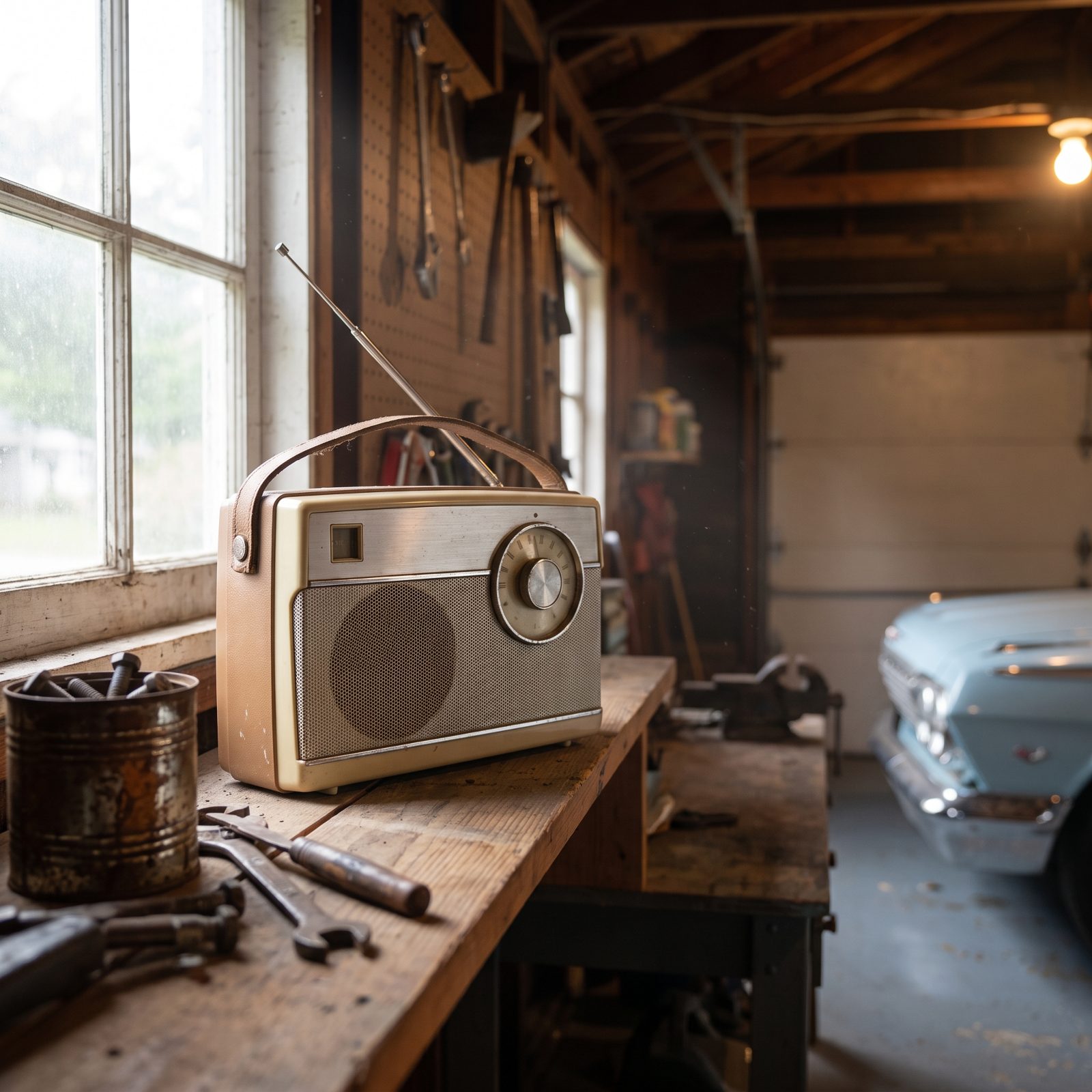
A ballgame crackling through static while you change the oil — that sound belongs in a garage. The old transistor radio ran for weeks on a nine-volt, survived being knocked off the shelf, and never once asked for a password or a subscription.
Nobody’s telling you to toss the Bluetooth speaker. But there’s a case for a simple radio that just works, pulls in the local AM stations, and keeps you company without a phone in the mix. It catches weather and emergency broadcasts when the power’s out and the Wi-Fi’s dead too, which is exactly when you want to know what’s going on.
1. A Small Project Corner Where Kids Could Learn the Tools
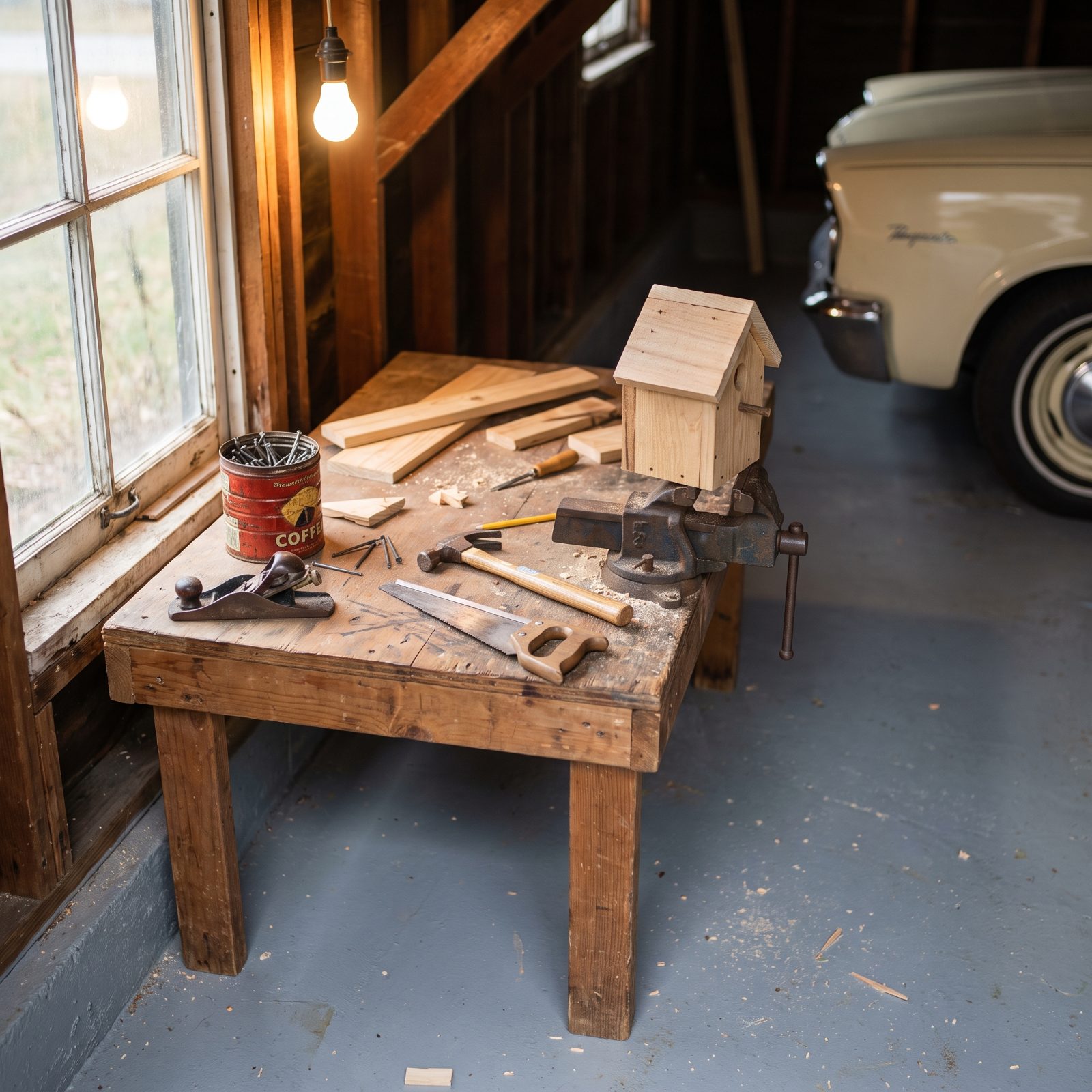
The best thing in a lot of old garages wasn’t a tool at all. It was the low corner of the bench set aside for a kid, with a few real tools scaled down and a scrap pile to ruin. That’s where a whole generation learned to hold a hammer, cut a straight line, and figure out that things get made by somebody with their hands.
You don’t need much — a small vise bolted low, a hand saw, a block of pine, and the patience to let the first birdhouse come out crooked. Kids who grow up around real tools grow up unafraid to fix things. In a world where everything’s sealed shut and shipped off for repair, that’s a gift worth building a corner for.